This image is from: artie.com
The Castle:
The king lived in a castle which had a main section located in the center of the acreage surrounded by walls and towers. This fortification would be known as "the keep". It had an upper and lower hall, a prison (dungeon) located in the upper portion of the building. The lowest parts were for storage.
There were two sections inside the castle wall called wards or baileys. The soldier's barracks, stables, smithy, carpenter's shop, etc. were in one bailey and the apartments and offices were in the other.
The king had a big, canopied bed, tapestries on the walls and the best of all possessions. There were many servants in the castle. Among them were the queen's lady's maid and the king's valet; their duties were to tend to the royal couple's clothing, dressing and toiletries.
When Duke William of Normandy became King of England he was surrounded by a lot of very angry Anglo-Saxons. He slaughtered their king, earls and soldiers and ruled over all those who survived. To ensure his safety he constructed enclosures called "motte-and-bailey". The stockades in which he resided were made of wood and were situated upon a hill. This was the "motte". The "bailey" was the courtyard, or the land around the motte that was enclosed by wooden walls. While this kept William and his men safe, the climate eventually caused the wood to rot. This meant that these motte-and-bailey structures would have to be replaced. William built his Windsor stockade in 1070.
Here are a few important medieval castles:
Windsor Castle:
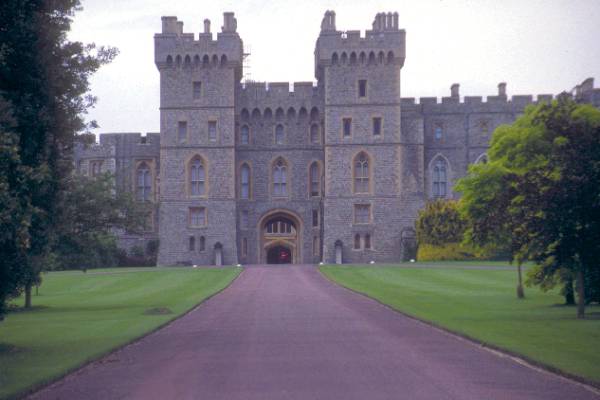
Built on the Thames River, 20 miles west of London with 13 acres of grounds. There was an Anglo-Saxon hunting lodge used by their kings, two miles from the present castle. The Chiltern Hills, a royal forest, was situated north of Windsor on the other side of the Thames. The construction of Windsor Castle began in 1170, by King Henry II. He used stone to build the Round Tower and surrounding walls.
The west ward contains the stables, storehouses, kitchen, chapel and lodging for the garrison. The west ward has the king's private lodgings and offices.
There were two sieges of Windsor Castle: One in 1193 and the other in 1216 when King John repudiated the Magna Charter. The barons and King Philip Augustus of France laid siege for three months, damaging the west ward.
King Henry III spent much time and money making repairs. He rebuilt the king's and queen's apartments, built chapels and fortified the outer walls with towers.
11-20-1992: A fire does extensive damage to Windsor Castle during the 45th wedding anniversary of the Queen and the Duke of Edinburgh. The fire blazed for 15 hours and 1 and 1/2 million gallons of water was needed to stop it. The restoration cost the Queen $59.2 million. The cause of the fire was said to have been the heat of a spotlight which ignited a curtain, but the Scribe told me otherwise. The Scribe, who resides at Windsor Castle, said something about Prince Charles, a hot plate and a bag of marshmallows.
Poisonous Spiders Found Near Windsor Castle
Found on the web: 6-27-2001
This (condensed) article was taken from: thisislondon.com
by Peter Gruner and John Gubba
World renowned entomologist Graham Smith was contacted after British Telecom engineers discovered swarms of giant venomous spiders on underground cables at Windsor Great Park, meters from the Queen Mother's weekend residence Royal Lodge.
Mr. Smith, a member of the Project-ARK conservation team (saving endangered species), said the creatures can attack and will not be repelled by conventional means. They are either a new species or a species thought to be extinct. There could be multiple thousands of them, possibly living underneath Windsor Castle.
The spiders are venomous with jaws strong enough to penetrate human skin. They should not be handled by humans (they should not be kissed, either). They also have large fangs, hairy legs, an aggressive nature and a predominantly rusty red and black coloring.
To locate the spiders in the underground labyrinth of tunnels, the Project-ARK team will use sophisticated electronic mole cameras. When the spiders are found they can then be enticed, captured and removed, a procedure that may take as long as two years.
Tower of London:
Royal Palace on the Thames. A concentric castle with 84 acres
of grounds. First built by William the Conqueror in 1078, the donjon or White Tower (circa 1100) is the castle's military and residential centerpiece. Stone walls were built, then the walls and towers.
Henry III enlarged the royal apartments. Included were a great hall, king's and queen's great chambers and he also enlarged the perimeters. Two fortified curtain walls marked boundaries for inner and outer wards, and the entire structure is surrounded by a deep moat. The walls were built between 1189 and 1306; most of this was Henry III's work. Used as royal palace, armory, mint, treasury, wardrobe, record office, library, council chamber munitions factory, menagerie and prison. Henry III kept a menagerie in cages at the Tower of London: elephant, lion, leopards, herd of buffalo and a white bear.
Palace of Westminster:
This walled and moated palace of 12 1/2 acres and Westminster Abbey was built by Edwards the Confessor, The Anglo-Saxon king in 1065, a year before the Normans invaded. Built on Thorney Island in the Thames River, the palace became the center of government under Henry II (1150's) who moved the treasury from Winchester. By the mid 12th century, it included the Treasury and the Exchequer.
Henry III added apartments (1230's) and built the great chamber as the "painted chamber", decorated with Biblical murals.
He also demolished the original abbey and built a new one. The palace was damaged by fire and dispensed by Henry VIII, the only part of the present Westminster remaining from the original is the great hall.
Some words pertaining to castles:
battlements��a low wall with alternating rising and lowering stonework for the archers.
barbican��a fort at a gate or bridge leading to a city or castle.
bastion��a fortification that extends from the castle where archers are positioned.
crenellation��atop the walls surrounding the castle and its grounds was the alternating rising and lowering of stonework. The crenellations allowed the archers space to fire from and protected them at the same time.
curtain wall��the huge walls that surround the castle and castle grounds.
dungeon��where prisoners were confined. It was in the upper region of the castle, the lower part of the castle was for storage.
drawbridge��the bridge lowered over the moat for entry into the castle.
embrasure��same as the crenellation. An open space with raised stonework on either side to fire projectiles from.
esplanade��level or sloping open space around the castle which left the attackers open to fire.
guardrobe��this was the toilet seat, placed inside a recess in the castle walls. It emptied out into the moat or a stream if there was no moat.
garrison��the soldiers who lived on castle grounds.
great hall��the large hall on either levels of the castle which led to the other rooms.
keep��the innermost and safest part of a castle, also another word for castle.
loops��the slits in the tower walls from which the archers would shoot from.
machicolation--same as a murder hole, an opening in castle ceilings for soldiers to strike at intruders.
merlons��the name for the rising stonework on either end of the embrasure.
moat��a deep trench filled with water that encircled many castles. The filth from the guardrobe found its way there, which helped keep the intruders away, sort of like crossing the Rio Grande (but more effective). Some castles did not have moats.
motte--castles without a moat would be built on a motte, a defensive mound that sloped away from the wall. This made it difficult for invaders to get close to the wall and possibly tunnel under it or break into and through it.
murder holes--if invaders got through the gate, there were openings in the ceilings above from which defending soldiers would shoot arrows, throw spears and rocks or pour boiling water.
portcullis��the gate of timber or iron latticework suspended by chains over the gateway to a castle, lowered when under attack.
parapet��the wall which the archers stood behind.
solar room��another name for bedroom.
tower--there were towers placed throughout the curtain walls.
Archers would shoot their arrows from the slits in the tower's walls.
turret��a small tower projecting from the castle.
wall-walk��the area atop the curtain wall on which the archers walked.
Here are some of titles held by important men:
chief justiciar��the chief political and judicial officer
chamberlain��manager of the king's household
chancellor��had judicial powers
constable (also castellan or castle commander)�� Watched over the garrison, weapons and soldiers food. Govern district and in charge of castle repair.
marshal��was in charge of military affairs and ceremonies
steward (also reeve or bailiff)��the king's chief officer of a town or district.
sheriff��chief law-enforcement officer of a county. Keeps the peace, executed court orders, collects taxes. Presided over the "Shire Moot", a court held periodically in his shire.
wardrober��In charge of clothing, food, jewelry, etc. Also kept the king's private seal. His office became one of great power.
