
On the death of the ageless king
An esoteric vision of the postmodern crisis
By Fady Bahig
In 1916 and around the time of his break with Freud, The Swiss psychiatrist Carl Jung was passing a gloomy phase of depression. He felt suffocated with dead souls in his house and found himself writing down a cryptic text out of instinct. He called the text the seven sermons to the dead and illustrated his philosophy of psychology in it with Gnostic symbols. I found myself writing down the eighth sermon to the dead to illustrate my feelings about the postmodern crisis. I first wrote a cryptic myth and then followed with the interpretation. Since writing this text some months ago, I still hold to most of the ideas that I have discussed in it. My current thoughts on epiphenomenalism are, however, not quite clear. Since learning about William James� refutation of epiphenomenalism I started to doubt it. My current thoughts about the philosophy of the mind as a whole now are unclear and uncertain.
To read Jung�s original Seven Sermons to The Dead you can go here
The dead approached me and asked, tell us blessed one of the death of the ageless king.
I can still remember the day the old one died. He has ruled forever, his grip never weakening by the passage of time. Nobody dared imagine him vanish. But on one day everything changed. At the morning a group of bright young men came to see him. Their parents have always received his letters and taught their children his name. But now the youth were driven by curiosity to get more of him and they set off for their journey to his palace.
As they walked they examined the road to his palace that he made just as he had become king. By noon they approached his palace but were already forgetful of his holy name. They couldn�t have forgotten his name as long as they were reading his letters, but the road that they examined was made of bricks, and can bricks be signed?
Suddenly they found out that they had already reached the palace. Can it be that the palace had always been that close? As children they were taught that the palace was far away, but they reached it in a single day. As they walked in the royal garden they found everything cut into two with a sharp knife, the trees, the fountains, the lovely birds and the shady seats. Inside the palace things were no better; the throne was sharply cut into two and the old king was lying on the floor in tremendous pain, in his chest was the knife deeply buried.
The young gentlemen cried in horror and asked the king who or what ruined him in that awful manner. It was you, nobody else, cried the dying king. How can it be us, your majesty, cried one of the men passionately, we didn�t wish to hurt you, we always wanted to see you, we wanted to find more about you through your craft.
Oh, let leave! Cried another man in pleasure. This man was not but a despot. He brought us no good during his endless days. Now we don�t have to pay any taxes, or obey useless laws.
Having heard those words, the old king was infuriated, he wished that he could live forever, but he realized that he was to live no more. Being an expert in the dark arts, he gathered all what remained of his powers and prepared to cast a last spell.
Hearken! He cried with immense pain, it is not yet time to laugh and dance, for you have killed me, but out of my corpse there will arise three demons who will bring along sourness and disdain.
The first devil is the lord of the chains. He will cast his chains all over you, but fear not! For the chains will not paralyze you. You will move as you wish, but you will wish what the chains want you to wish!
The second devil is a thousand dwarfs. They will fool around aimlessly as young schoolboys do. But watch the shadows that come out of their feet! Those are nothing but the most precious that you have. You still don�t understand the games? Their moves are the will of the chains!
Slowly the third demon was summoned as well. He was the lord of the seas who has always deluded men through his tempests. He was blind and held the forbidden vessel that smelled with forgetfulness. He was expressionless, for had he laughed in irony or frowned with hatred, all his dark power would have gone away.
He is the hardest demon to be summoned ever, cried the king with blood dripping out of his mouth, for this demon is the strongest demon of all. The demon of chain kills the free, the demon of shadows marginalizes the nonmaterial but this demon is the infernal gorge that strips the vivacious maiden of her royal garment.
The men, having seen the horrible demons cried in horror and begged the king to have mercy on their souls, but it was too late; the king was dead.
The men fell on earth. Realizing how powerful the devils were, they surrendered and prepared themselves to die. But one of them quickly pointed and cried: Look!
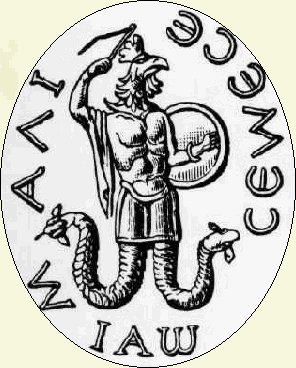
Out of nowhere came a holy angel and stood calmly, holding two serpents in his hands, one was raised above his head and the other lowered till it reached the ground. Rejoice! He said with tranquility, for now the road is prepared for the pneumatics. To become of the wind, you must first be defeated.
The serpent of the earth sees glory in victory; it sees a gem where a gem is. False is this gem. For it is only seen where it is, just like wood and straw. The serpent of the wind sees the gem in the abandoned. It emerged victorious from its fight with the three demons, and bit its tail. It sought the gem where it was not, and found it!
The gem that can be seen where it is cannot put off thirst. It would be real but unsatisfying. The gem that can be seen only where it is can answer questions but cannot grant satisfaction. All men would add it to the book of law, but it will not answer their drive, for the nature of the drive is not satisfied with gems. It can only rest in the fullness of light. And only those who posses the fullness of light can see gems where gems are not.
Believe it or not gentlemen, added the holy angel, as long as the king was alive he was but another page in the book of the law. He could never be light then, for he was ink that really existed on the pages of the book. But now that the ink has been erased, you will see him again. You will not see him as another fact in the book of the law, you will not see him as a major despot, but you will see him as an inner sublime light.

You may have noticed that the king made the road (the world) just as he had become king. This is an implicit tribute to Meister Eckhart, who had a similar quote being the first heretical phrase mentioned in the papal bull that condemned him briefly after his death. 'God created the world as soon as God was.' In his sermon of the poors, Eckhart stated that �before creatures were, God was not yet �God�; rather he was what he was. But when creatures came to be and when they received their created being, then god was no longer �God� in himself; rather, he was God in the creatures.�
The men were surprised as they reached the palace so quickly. Indeed, free thought quickly brought about atheism. They were horrified as they saw everything in the palace and the garden cut sharply with a knife. This knife is, as you may have already guessed, nothing but Occam�s razor. They found the king dying, not that they didn�t find a king at all. Actually, I don�t think that science has ever proved the king nonexistent. Yet it has proved his hypothesis to be a useless complication, a burden that was cold-bloodedly eliminated with Occam�s razor.
Now we come to the three demons who were summoned just as the king was about to depart. The first is the lord of the chains. Yes, scientific determinism. I believe that the whole efforts of Immanuel Kant were solely intended to fight this demon, not atheism per se. The greatest humiliation that this demon inflicts upon his victims is that they are unaware of being entrapped in chains. They do what they will but will what the chains want them to will. Free will can�t be but a subjectivistic illusion in a postmodern world.
Schopenhauer had that right when he said that �A man does what he wills, but he cannot will what he wills�. Yet he was not talking about scientific determinism then. He was talking about his peculiar theory of will as being the thing in itself.
The second devil is a thousand dwarfs (neurotransmitters in the brain) that fool around aimlessly. We (our consciousnesses) are but shadows of their movement. The second devil�s name is epiphenomenalism, the position that some or all of the mental states are byproducts of the physical states of the world. This demon marginalizes the nonmaterial (consciousness) belittling it into a useless side effect of material interaction. We also notice how scientific determinism and epiphenomenalism are related, both being natural consequences to the materialistic theory of the origin of mind. Their moves are the will of the chains. Now you understand the two nasty games.
Some people would argue that epiphenomenalism is still a debatable issue, but I have a deep conviction that as long as scientific materialism is reigning (and it should) we will end up with epiphenomenalism or with one of its close variants.
The third demon is nihilism in person. He is the lord of the seas. You can watch the sea as a tempest approaches and you will feel as if it is the apocalypse, and you will get ready and fill your heart with the emotions of �the end is near� but then the tempest will come and eventually pass forgotten. This devil strips the vivacious maiden (life) of her royal garment (meaning). The world of nihilism is a world where there is no prophetic end, no final meaning and no goal. Shakespeare�s lines in Macbeth are the classic superstars when it comes to nihilism �Life's but a walking shadow, a poor player that struts and frets his hour upon the stage and then is heard no more. It is a tale told by an idiot, full of sound and fury, signifying nothing.�
The third devil also holds the forbidden vessel that smells with forgetfulness. The third devil is entropy as well, the primordial chaos that will eventually suck all information into itself and cast its scrabbles over the written wisdom of humans. Bertrand Russell was troubled with this and he wrote that �all the labors of the ages, all the devotion, all the inspiration, all the noonday brightness of human genius, are destined to extinction in the vast death of the solar system, and that the whole temple of Man's achievement must inevitably be buried beneath the debris of a universe in ruins.� Imagine that you want to know a very important thing, like who killed your friend, and you find someone who is ready to tell you, but you know that just after hearing the name, you will forget it. Will listening to the name make any difference?
Just as the king dies a holy angel lifts the broken morals of the men. He informs them that the king has just summoned the devils, but the devils have always existed when the king was alive.
To become of the wind (spiritual) you must first be defeated, so that you can see the devils and fight them. If life was not just an accident, if our consciousnesses were indeed products of sublime unearthly souls, if death were just a passage to the other side of existence, there would still be no answer to the old koan, �Why is there anything instead of nothing?� All what modern science striped us of was, when we deeply contemplate, irrelevant to the question of meaning!
Spirituality is not about seeing a gem (meaning) where a gem is, for the gem would then be just ink on the book of law (just a fact that holds no internal mystical meaning). A deeply religious man is no more spiritual than an atheist. For to him God would just be �an object� that exists like a book or a car. This is why Meister Eckhart prays to God to rid him of God. As long as God is seen as an entity that exists objectively, he will fail to achieve the mystical �meaning�. Eckhart emphasized the idea one more time on another occasion, �Man�s last and highest parting occurs when, for God�s sake, he takes leave of God.�
Seen in this light, it would be quite expected to realize why romanticism and existentialism didn�t rise when the king was �really� there, their magic is derived from the paradox of tasting the tasteless, for tasting the tasteful is not �magical� anymore; it fails to put off the spiritual thirst.
I believe that the mystical experience is the ultimate answer to the old question of meaning. I was deeply touched when I read a certain paragraph from Walter Stace�s �Mysticism and philosophy� for it represented exactly my ideas. The paragraph was the testimony of an anonymous American intellectual about his mystical experience. He says:
�I think I said to you that once my life was meaningless and that now it had meaning. That was misleading if it suggested that human life has a purpose and that I now know what that purpose is. . . . On the contrary I do not believe that it has any purpose at all. As Blake put it "all life is holy" and that is enough; even the desire for more seems to me mere spiritual greed. It is enough that things are; a man who is not content with what is simply does not know what is. That is all that pantheism really means when it is not tricked out as a philosophical theory. It would be best not to talk of meaning at all, but to say that there is a feeling of emptiness, and then one sees, and then there is fullness.�
Things get bizarre when we talk about the final meaning of life. If we are mortal, then all our experiences and feelings are doomed to dust, if we are immortal then we are likely to riot with our memories in a dark corner of heaven for an infinite time without expecting an �end� to come and make sense of it all.
Many people believe that the question of meaning is a question that has no logical answer. I will go further to say that this question can�t be satisfied with one. David Hume believed that we cannot derive an �ought� from an �is� and I believe that we cannot derive a �meaning� from an �is�. Whether the world was created for a reason or not is irrelevant to our search for a meaning.
The ancients believed that man can know about the laws of the universe by looking inside himself and they were wrong. Empiricism defeated rationalism and the ancient magical world models were replaced by modern cosmology. But when it comes to meaning, I think that the ancients were right after all, because unlike the universal laws, meaning is something that belongs to man, not to the universe. Meaning is by definition an internal value, the holy grail of every path and the deepest depth beneath every mystery.
The question of meaning was further explored in my novel �The journey of the fool� where the protagonist suddenly was enlightened to see meaning in the meaningless.