
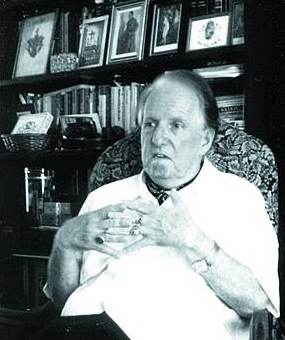
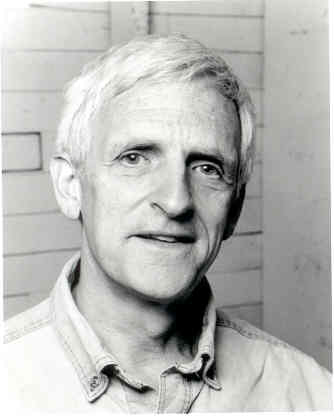
Stephan Hoeller and Matthew Fox
Ecclesia Gnostica and Creation Spiriutality
Through my wanderings in the realms of quasi-Christian traditions, I came to know many heretic Christian sects. While I do disdain a big majority of these groups, I find some of them really interesting and promising. I would like to dedicate this article to a brief discussion of two of those groups, namely the Ecclesia Gnostica, founded and maintained by the Gnostic bishop Stephan Hoeller and Creation Spirituality that was formulated by Father Matthew Fox. Before proceeding I desire to make it clear that I belong to neither of the two groups, although I hold both in a high regard.
Father Matthew Fox
Father Matthew Fox is a formal catholic priest. He was silenced by Cardinal Ratzinger (now Pope Benedict XVI) in 1988 and in 1992 was dismissed from the Dominican order(1). Fox has become an important figure in Creation Spirituality, a movement deeply influenced by the beautiful mystical writings of Meister Eckhart and other prominent mystics. Fox regards nature as an original blessing and sharply disagrees with the orthodox doctrine of original sin (2), dismissing it as a neo-platonist concept adopted by Saint Augustine from the works of Plotinus(3).
He invites native Americans to his mass and promotes the idea of the Techno-cosmic Mass(4). Fox writes extensively on Meister Eckhart and on the idea of a sacred nature. He calls constantly for a reformation in the catholic church(5).
Bishop Stephan A. Hoeller
Stephan A. Hoeller was born in Budapest, the only child of an Austrian baron and a Hungarian countess, he didn�t have a nice childhood though, seeing his father shot point-blank by Joseph Stalin�s goons and left lying in a pool of his own blood(6). He immigrated to the USA where he founded the Ecclesia Gnostica.
Hoeller made an extensive effort to revive the Gnostic tradition, unlike some other notorious self-dubbed Gnostic organizations, He tries to stick as much as he can to the true legacy of the ancient Gnostics, yet he never loses his spiritual creativity, a value that he constantly stresses. He subscribes to the Gnostic mythos, namely that humans are divine sparks that fell into an inferior material realm to be eventually entrapped by bodies created by an inferior deity. Jesus, according to Gnostics, is a divine being who descended to earth to spread gnosis, divine knowledge, so that we can escape this world and return to our heavenly origin.
The Parallels
Fox and Hoeller are both similar in many ways, they are both quasi-Christian revolutionaries who encourage spiritual creativity. They are both proud of their Christian heritage, they are both regarded as heretics by mainstream Christianity and they are both on the �pagan� side of Christianity as contrasted to �Jewish� Christians like Jehovah�s witnesses.
Both men promote feminine spirituality, a beautiful trend that stresses the caring, loving and maternal aspects of the divine. With Hoeller referring constantly to Sophia the queen of heaven, the female emanation of the godhead who is the guide for her orphaned human children(7), and Fox stressing the feminine aspect of divinity with his words �God as Mother, not just Father. God as Birther, not just Begetter�(8). Since both men aspire to spiritual freedom they equally stress the personal nature of enlightenment and salvation. Fox states that �Everyone is a mystic , born full of wonder and capable of recovering it at any age.�(9) And Hoeller believes that salvation doesn�t come through dogmatic belief or virtuous deeds, but through an inner transformative divine knowledge, gnosis.
Both men stress the divine status of humans. They see humans as divine beings rather than creatures inferior to the divine. Fox declares clearly that �We are all sons and daughters of God; therefore, we have divine blood in our vein, the divine breath in our lungs.�(10) Hoeller believes that humans possess a divine spark of the ultimate divine but are ignorant of its presence, he writes that �humans are generally ignorant of the divine spark resident within them.�(11)
Another surprising parallel between the two is their rejection of the orthodox doctrine of original sin, though for different reasons. Fox, as previously mentioned, denounced the idea as non-Christian and believes salvation to be �preserving the good.�(12) While Hoeller believes in the �fall� yet he doesn�t believe it to be the fault of Adam or Eve, but rather the fault of the aeon Sophia. So, after all, man is not guilty of an original sin.
The opposite poles
From what is mentioned above, one can come to the conclusion that both men are in perfect accordance. But if we are to look deeper in their systems serious differences will soon emerge. Actually, sometimes the two theologians are on radically opposite poles. In an oversimplification we can say that both men are not adherents of orthodox Christianity and favor a �pagan� mysticism and spiritual freedom. But while Fox is more oriented to monist optimism, Hoeller is more into dualist �pessimism�.
Those differences become quite evident when we are to speak about nature, for instance. Fox promotes a very optimistic version of Christianity where nature is an original blessing of an angelical benevolence. Hoeller is more conservative and has more skeptic views of nature. Believing it to be the flawed creation of a flawed demiurge, Hoeller is not very enthusiastic about nature and often refers to environmentalists as �eco-fascists� in his sermons. He doesn�t consider himself a pessimist, though, since he believes that there is a �way out� of this world. There are some Gnostic quotes that are often used as an argument for pantheistic Gnosticism. In the gospel of Thomas, Jesus is depicted as saying �Split a piece of wood; I am there. Lift up the stone, and you will find me there.�(13) But Hoeller argues that one first has to �split� the wood and �lift� the stone, indicating that one must transcend nature to reach the divine. (14) With such teachings Hoeller is more prone to otherworldliness.
Fox is a faithful monist. All is Sacred, all is divine. He takes Christian panentheism to new heights. Hoeller, on the other hand is a strict dualist, dismissing monism as na�ve and weak, especially when confronted by the problem of evil. He stresses a source of evil, a flawed creator who was called Yaltabaoth by the ancient Gnostics. (15) The strong dualistic nature of Gnosticism expresses itself in the classical themes of spirit vs. body and thought vs. matter.
Fox is more into abstract mysticism. A big fan of the pure oneness, he feels comfortable with eastern mysticism, especially Buddhism and Taoism where he claims that he finds Creation Spirituality. (16) Hoeller, on the other hand feels more at home with western mysticism. With a deep knowledge of the occult and alchemy,(17) he is a member of the lecturing faculty of the Philosophical Research Society and a national speaker for the Theosophical Society of America. (18)
Conclusion
I found the comparison between Fox and Hoeller irresistible. The reason for that is the striking amount of similarities and dissimilarities that exist between the two. Though being liberal and mystical they are quite often on opposite poles. Who do I like the most? It depends. When I am feeling fine I am more into Fox, I feel like celebrating my improbable existence in the world and the beauty of the cosmos. But when I am troubled I tend to sympathize with Hoeller, and share him his longing for a better and higher place, where there is a sun that doesn�t burn and fruits that don�t rot. I don�t know what Fox thinks of Hoeller, but Hoeller doesn�t seem to think highly of Fox, referring to Creation Spirituality enthusiasts as �flapdoodles� in one of his sermons. (19)
If we are to meditate on the differences between those two men we are to find some of the most important dichotomies in religious traditions. Optimism on one hand and pessimism on the other, life affirmation and life negation, worldly concern and other worldliness, mystical dissolution in the divine and Jung�s principle of individuation.
References
1- http://en.wikipedia.org/wiki/Matthew_Fox_(priest)
2- http://www.creationspirituality.info/Principles.html
3- http://www.freewebs.com/greentheology/creationspirituality.htm
4- http://www.matthewfox.org/sys-tmpl/htmlpage20/
5- http://www.encyclopedia.com/doc/1G1-145836581.html
6- http://www.gnosis.org/LAWeekly.htm
7- http://www.gnosis.org/ecclesia/ecclesia.htm
8- http://www.matthewfox.org/sys-tmpl/theblackmadonna/
9- http://www.creationspirituality.info/Principles.html
10- Ibid
11- http://www.christianinformation.org/article.asp?artID=105
12- https://www.wisdomuniversity.org/faq.html
13- http://www.gnosis.org/naghamm/gosthom.html
14- http://www.gnosis.org/930112.ram minute 14:40
15- http://www.gnosis.org/iniquity.htm
16- http://www.randypeyser.com/fox.htm
17- http://www.gnosis.org/jung_alchemy.htm
18- http://en.wikipedia.org/wiki/Stephan_A._Hoeller
19- http://www.gnosis.org/930112.ram minute 12:50