The Danger of
Food Additives
I have been doing a lot of research on food
additives and what they do to our bodies.
I’ve had a lot of
bad experiences with certain foods, specifically ones with refined flour or
sugar, and additives such as glutamate.
I have compiled what I have learned and created this website to answer the main questions about additives (mainly MSG,
Aspartame, and Neotame). Since I have been watching what I eat and
looking at the ingredients before buying, I have noticed that as long as I don’t eat anything
with refined flour or sugar, or additives, then I am fine. Plus, the food tastes better! Organic food tastes so much better than “fake” food. And it fills me up faster, so I don’t have to eat
as much.

You have to watch what is in medicine,
too--especially children’s medicine and vitamins.
There are certain chemicals in them that are worse for your child than
the symptoms that you are trying to get rid of.
For example, when I was pregnant I took some children’s cold medicine
because I thought that it would be safe.
Instantly after taking it, I felt very strange--fast heart-beat, dizzy.
. . . I was very scared. I prayed to God
for the medicine to not hurt my baby.
Later I found out that it had aspartame in it, which pregnant women are
not supposed to have because it could cause harm to the baby.
Some things are not labeled. For instance, my daughter, age 8, ate some
Del Monte microwavable stew. It was not canned or frozen. She
threw up after eating it and I thought she was sick. She didn’t have any other symptoms and she felt
fine after that. About a week later, she
ate the same kind of stew and threw up again after eating it. I read the ingredients and all it listed was
meat and vegetables. It did not list any
additives which were obviously in it.
Excitotoxin Introduction
How were excitotoxins
discovered?
In 1957,
two ophthalmology residents, Lucas and Newhouse, were
conducting an experiment on mice to study a particular eye disorder. During the
course of this experiment they fed newborn mice MSG and discovered that all
demonstrated widespread destruction of the inner nerve layer of the retina.
Similar destruction was also seen in adult mice but not as severe as the
newborns. The results of their experiment was published in the Archives of
Ophthalmology and soon forgotten. For ten years prior to this report, large
amounts of MSG were being added not only to adult foods but also to baby foods
in doses equal to those of the experimental animals.
Then
in 1969, Dr. John Olney, a neuroscientist and neuropathologist
working out of the Department of Psychiatry at
What
is an excitotoxin?
These are
substances, usually acidic amino acids, that react with specialized receptors
in the brain in such a way as to lead to destruction of certain types of neurons.
In other words, they can cause brain damage and other cell damage. Glutamate is one of the more commonly known excitotoxins.
What
is MSG?
MSG is the sodium
salt of glutamate. This amino acid is a normal neurotransmitter in the brain.
http://www.rense.com/politics6/excito.htm
What is the difference between bound and free MSG?
It
is the glutamate molecule that is toxic in MSG (monosodium glutamate).
Glutamate is a naturally occurring amino acid found in varying concentrations
in many foods. But, it is free glutamate that is the culprit. Bound glutamate,
found naturally in foods, is less dangerous because it is slowly broken down
and absorbed by the gut, so that it can be utilized by the tissues, especially
muscle, before toxic concentrations can build up. http://www.rense.com/politics6/excito.htm
What
does MSG do?
Glutamate, as a
neurotransmitter, exists in the extracellular fluid
only in very, very small concentrations - no more than 8 to 12uM. When the
concentration of this transmitter rises above this level the neurons begin to
fire abnormally. At higher concentrations, the cells undergo a specialized
process of delayed cell death known as excitotoxicity,
that is, they are excited to death.
http://www.rense.com/politics6/excito.htm
What is Aspartame?
Aspartame is an
artificial sweetener that breaks down within 20 minutes at room temperature
into several primary toxic and dangerous ingredients:
1. DKP (diketopiperazine) (When ingested, converts to a near
duplicate of a powerful brain tumor causing agent)
2. Formic Acid
(ant venom)
3. Formaldehyde
(embalming fluid)
4. Methanol (causes
blindness...extremely dangerous substance)
http://www.rense.com/general35/hidd.htm
What does Aspartame do?
Aspartame/Nutrasweet
is a brain drug that stimulates
your brain so you think that the food you're eating tastes sweet.
Aspartame/Nutrasweet
(aspartylphenylalanine-methyl-ester) breaks down to
its poison constituents at 86 degrees (Aspartic Acid
40%, Phenylalanine 50%, and Methanol 10%)
"Burning Mouth Syndrome"
experienced by the Desert Storm troops was actually Methanol poisoning from the Diet Coke they drank
lots of, after being exposed to desert temperatures.
Aspartame/Nutrasweet's
40% Aspartic Acid is an "excitotoxin" in
the brain and excites neurons to death, i.e. it kills brain cells and causes
other nerve damage.
Aspartame/Nutrasweet
triggers Migraine Headaches\
Aspartame/Nutrasweet's
breakdown products attack the bodies tissues and
create Formaldehyde
which builds up in the tissues forever. Formaldehyde is thought to cause cancer.
Aspartame/Nutrasweet
also breaks down to diketopiperazine (DKP) which is
proven to cause Brain Tumors
http://www.lovethetruth.com/truth_about_aspartame.htm
What is Neotame?
Neotame contains all the dangerous elements
found in aspartame and more: the amino acids L-aspartic acid and
L-phenylalanine, plus two organic functional groups, one known as a methyl
ester group and the other as a neohexyl group.
Neotame does not have to carry the PKU warning,
as aspartame is required by law to do, so its addition to all products can go
without warning.
Ingredients of Neotame:
Phenylalanine: An amino acid necessary for neurotransmitter
production. Pregnant women, those with anxiety attacks, individuals with high
blood pressure, people with phenylketonuria and
pre-existing pigmented melanoma should avoid its supplementation.
Aspartic acid: Too much of this substance is suspected
to cause brain damage in fetuses, and high doses have been found to destroy
brain cells in experimental animals
Methanol (methyl alcohol, wood
alcohol): This substance
is converted to formaldehyde and formic acid, which have a toxic effect on the
thymus gland. Formaldehyde is a known carcinogen, producing cancer of the
throat, pharynx and lung
The Effects of Excitotoxins
How
much are people affected?
The effects of excitotoxin food additives generally are not dramatic. Some
individuals may be especially sensitive and develop severe symptoms and even
sudden death from cardiac irritability, but in
most instances the effects are subtle and develop over a long period of time
. http://www.rense.com/politics6/excito.htm
What
are some reactions to MSG?
Reported MSG
reactions, which can occur as a result of consuming even small amounts (much
less than the 1/2 gram the FDA considers to be low), include migraines; hives;
mouth eruptions; numbness; tingling; swelling of mucous membranes in the oral,
gastrointestinal or reproductive tract; asthma; runny nose; insomnia; seizures;
mood swings; panic attacks; diarrhea; and cardiac irregularities.
http://www.rense.com/health3/msgsources.htm
What
are the symptoms of excitotoxicity?
Migraines,
seizures, infections, abnormal neural development, certain endocrine disorders,
neuropsychiatric disorders, learning disorders in children,
AIDS dementia, episodic violence, lyme borreliosis, hepatic encephalopathy, specific types of
obesity, and especially the neurodegenerative diseases, such as
Other
MSG symptoms:
·
Headaches/migraines
·
Lethargy
·
Sleepiness
·
Anxiety
·
Panic
attacks
·
Mental
confusion/disorientation
·
Insomnia
·
Nausea/vomiting
·
Diarrhea
·
Stomach
cramps
·
Irritable
bowel syndrome
·
Bloating
·
Asthma
attacks (even death)
·
Shortness
of breath
·
Chest
pain or tightness
·
Runny
nose/sneezing
·
Extreme
dryness of the mouth
·
Hives
or rash
·
Palpitations
·
·
Mouth
lesions
.
MSG has been shown
to cause lesions on the brain, especially in children. These lesions cause
cognitive, endocrinological and emotional
abnormalities. In children excess glutamate affects the growth cones on
neurons. Growth cones are vital in laying down chemical pathways in the brain
to enable the brain to operate effectively. Studies show that rats who had been
fed MSG from birth could not escape mazes or discriminate between stimuli as
well as non MSG fed rats. The implications for human children are that MSG
could seriously affect their cognitive skills and cause learning difficulties.
Scientists have
proven that everyone does react to MSG – it all depends on the dose of MSG
given. People who do not suffer an immediate or acute reaction to the substance
will, scientists believe, suffer brain cell damage which can lead to long-term
health problems as detailed above
http://www.healthdangers.com/drugs/MSG/msg-health-effects.htm
What are the symptoms of Aspartame?
Headaches, memory loss, seizures, vision loss, coma,
cancer, fibromyalgia, MS, lupus, ADD, diabetes,
Alzheimer’s, chronic fatigue, and depression.
How
does Aspartame cause so many different symptoms?
It goes to many different types of cells, but has a particular
liking for the cells of the central and peripheral nervous systems. The damage
from aspartame can show up anywhere the nerves are—which is anywhere in the
body. And because it attacks your body at the cellular level, it can cause any
number of diseases.
Another
danger . . .
It interacts with other chemical substances,
including antidepressants, Coumadin, cardiac
medications, hormones, insulin, vaccines, other artificial sweeteners and many
others.
How
does Aspartame, a zero calorie ingredient, make people gain weight?
Some recent research conducted at Purdue University
shows that a group of test subjects fed artificial sweeteners subsequently
consumed THREE TIMES THE CALORIES of those given ordinary sugar.
What
diseases does Neotame aggravate?
Diabetes and its
complications, multiple sclerosis, brain cancer, and the acceleration of
Alzheimer's disease.
Why
doesn’t the FDA take MSG off the market?
The FDA uses the
term "monosodium glutamate" for ingredients that are a 99 percent
pure combination of glutamic acid and sodium.
However, most of the MSG-containing foods that cause MSG syndrome are not 99
percent pure and are allowed to be labeled obscurely: "monopotassium
glutamate," "autolyzed yeast,"
"hydrolyzed soy protein" and "sodium caseinate"
are examples of ingredients that always contain MSG. http://www.rense.com/health3/msgsources.htm
Food that has Excitotoxins
What are some other names of
ingredients to watch out for?
Hydrolyzed
vegetable protein, vegetable protein, textured protein, hydrolyzed plant
protein, soy protein extract, caseinate, yeast extract,
and natural flavoring. We know experimentally that when these excitotoxin taste enhancers are added together they become
much more toxic than is seen individually. In fact, excitotoxins
in subtoxic concentrations can be fully toxic to
specialized brain cells when used in combination. http://www.rense.com/politics6/excito.htm
Bouillon, stock,
broth, malt flavoring, barley malt, seasonings, carrageenan,
soy sauce, soy protein, whey protein and anything enzyme-modified always
contain MSG. http://www.rense.com/health3/msgsources.htm
Other names: "umami", MSG, glutamate, free glutamic
acid
http://www.msgtruth.org/avoid.htm
What
are some MSG foods?
Hot chocolate
contains sodium caseinate, carrageenan,
and partially hydrogenated vegetable oil (all forms of MSG). Microwaveable
pizza has hyrdolyzed soy protein. Potato chips have
monosodium glutamate. Fried chicken has beef stock and hydrolyzed vegetable
protein. Ice cream has carrageenan.
http://www.rense.com/politics6/msgbaby.htm
Is
MSG in baby food?
It has been found
in baby food and infant formula. Dr. Olney was shocked to learn that the
concentrations of this substance added to commercial baby foods was equal to
that which created brain lesions in the experimental models. After the Food and
Drug Administration refused to take action, Dr. Olney testified before a
Congressional committee and finally succeeded in getting food manufacturers to
remove MSG from their infant product lines. Ironically, they simply substituted
a more dangerous ingredient in its place: hydrolyzed vegetable protein (HVP),
which contains three known excitotoxins.
What
is Hydrolyzed Vegetable Protein?
HVP, though
advertised as a safe, natural, plant-based protein, is actually a mixture made
from "junk" vegetables unfit for sale. The extraction process involves
boiling them in a vat of acid, then neutralization with caustic soda. The
resulting brown sludge, extremely high in glutamates, is scraped off the top,
dried, and sold. (It is added to peanut
butter to keep the natural peanut oil from separating. Which, by the way, I found that natural
peanut butter tastes so much better!)
http://www.rense.com/health3/msg.htm
Aspartame
is commonly found in . . .
Diet soft drinks,
sugar free gums, sugar free Kool Aid, Crystal Light, childrens' medications, and thousands of other products
claiming to be 'low calorie', 'diet', or 'sugar free'.
http://www.rense.com/general35/hidd.htm
Watch
out for these ingredients! (Even in soaps, shampoos, hair conditioners, and
cosmetics)
Disodium guanylate
disodium inosinate
hydrolyzed
amino acids
protein
Low fat and no fat
glutamic acid (not always named on labels but
are often in protein powders)
Aspartic acid
neotame
aspartame (often hidden in medicine [particularly children’s] drinks,
candy, and chewing gum)
Binders and fillers for medications, nutrients, and supplements, both
prescription and non-prescription, enteral feeding
materials, and some fluids administered intravenously in hospitals, may contain
MSG.
According to the manufacturer, Varivax–Merck
chicken pox vaccine (Varicella Virus Live), contains
L-monosodium glutamate and hydrolyzed gelatin both of which contain processed
free glutamic acid (MSG) which causes brain lesions
in young laboratory animals, and causes endocrine disturbances like obesity and
reproductive disorders later in life. It would appear that most, if not
all, live virus vaccines contain MSG.
http://www.truthinlabeling.org/hiddensources.html
Why
are some additives not listed on the label?
If a chemical is considered
“mandatory” or “permissible” by the FDA food standards, its presence on the
label is optional. Examples include brominated vegetable oils in ice cream, caffeine in cola
drinks, and MSG in salad dressings or mayonnaise. http://www.pacifichealthcenter.com/blog/67-food-additives/
Detrimental Effects of Additives During
Pregnancy
What
are some effects of taking Aspartame and Neotame
while pregnant?
It can cause brain damage to an unborn fetus. This brain damage can
be manifest as mental retardation, Cerebral Palsy, autism, ADD, ADHD, brain
tumors, and a multitude of other brain related disorders!
It disrupts fetal development by
aborting it or inducing defects. And if a live child is born, aspartame may
have heinously damaged the
During pregancy or during nursing, it is
a major cause of brain cancer among many children younger than 1 year old.
What
are some effects of taking MSG, HVP, Cysteine while
pregnant?
MSG (monosodium glutamate) can also cause the same conditions as aspartame because
it has the same chemical properties (excitotoxins) as
one of the chemicals in aspartame. It is particularly damaging when aspartame
and MSG are consumed together!!
Hydrolyzed vegetable protein (HVP) and cysteine can also cause these same conditions because they are also excitotoxins.
What
about using Cosmetics and Toiletries during pregnancy?
Numerous cosmetics and toiletries, such as perfumes, deodorants,
hair spray, hair shampoo, toothpaste, etc. contain chemicals that are dangerous
to a fetus and nursing infant.
Phthalates are metabolized in humans once
ingested or absorbed through the skin. In pregnant women, phthalates pass
through the placenta to be absorbed by the fetus. In nursing women, phthalates
are found in breast milk, which means infants
are ingesting these chemicals as they develop. In male fetuses --
and infants especially -- the phthalates have been shown to cause testicular
atrophy and a reduced sperm count, among other serious health problems.(http://www.healthy-communications.com/6-are_your_beauty_products_killingyou.html)
“Ever since 1938, when the Food and Drug Administration (FDA) granted
self-regulation to the cosmetic industry, such products can be marketed without
government approval of ingredients, regardless of what tests show. Most of the
25,000 chemicals used in our everyday skin products have not been tested for
long-term effects. In a typical day, you might be exposed to more than 200
different chemicals--many of which are suspected of causing cancer or
disrupting hormones."
http://www.cancertutor.com/Pregnant.html
Other
Facts about Chemicals In Soap
99.6 percent of
the products contain one or more ingredients that have never been safety tested
by the
One of every 120
products contains ingredients classified as known or probable human carcinogens
(cancer-causing) by the government.
One-third of all
products contain one or more ingredients classified as possible human
carcinogens.
55 percent of all
products contain "penetration enhancers," (including some that
contain known or probable human carcinogens) which increase the product's ability
to penetrate the skin and get into the bloodstream.
The FDA has banned
or restricted only nine personal care product ingredients. For comparison, the
European Union has banned 450.
http://shop.sixwise.com/index.asp?PageAction=Custom&ID=181
Excitotoxicity Reduction
What
can I do to reduce excitotoxicity?
Other than avoiding processed food and only
eating organic, natural food, there is also evidence that several nutrients can
significantly reduce excitotoxicity. For example,
combinations of coenzyme Q10 and niacinamide have
been shown to protect against striatal excitotoxic lesions. Methylcobolamine,
phosphotidylserine, picnogenol
and acetyl-L-carnitine all protect against excitotoxicity as well.
http://www.rense.com/politics6/excito.htm
Eat
lots of . . .
organic fresh fruits and vegetables NOT
sprayed with Auxigro
Juicing organic fruits like carrot and
apple and green vegetables is highly recommended
organic frozen vegetables that do not contain
added ingredients
Naturally raised meats - unprocessed - in
small amounts
homemade rice milk, homemade almond milk, or
homemade hazelnut milk
Italian/French bread made with only wheat
flour or semolina flour (NO malted barley), yeast, salt, and water (this
freezes well)
Wheat flour WITHOUT malted barley in it
olive oil and fresh squeezed lemon juice as a
salad dressing
quickly cooked homemade pasta sauces made from
fresh vegetables
whole organic milk
organic butter with only cream and salt in it
only fresh homemade mozzarella - not aged
Italian pasta
black olives (read labels)
almonds - with nothing added
fresh eggs
cooking oil - hazelnut, grapeseed,
sunflower, almond, avocado, sesame etc. with nothing added
Brown rice - with nothing added
http://www.msgtruth.org/eatwhat.htm
You will avoid most
food additive problems simply by avoiding
junk food! If you’re not drinking
regular soft drinks, chips, hot dogs, lunch meats, caffeine drinks, gelatin,
and sugared foods, you’ll have minimal exposure to food additives.
Then how do you get the toxicity from years of food
additive ingestion out of the body?
Ceasing the intake of junk food will help a lot. Fasting will probably also help, since many
toxins are stored in fatty tissue that’s broken down in fasting. Specific homeopathic formulas can target food
additives as well. Lots of distilled
water and buffered vitamin C can also cleanse a whole range of toxins from the
body.
http://www.pacifichealthcenter.com/blog/67-food-additives/
How Does MSG Cause So Many Symptoms?
How
does MSG cause Autism?
The latest autism research links two genetic areas
to the disorder. These genes code for proteins for glutamate receptors and
synapses. Glutamate induces epileptic seizures. 20% of autistic children also
have epilepsy. Glutamate increases histamine response. Autistic children often have
food allergies.
Some autistic
children improve on a gluten-free, casein-free diet. Glutamate is found in
large amounts in gluten, and casein (wheat and milk proteins). Glutamate
reduces levels of taurine - essential to proper
digestion. Autistic children often suffer digestive symptoms. Glutamate targets
the amygdala of the brain. An overstimulated
amygdala results in the most classic behaviour of autism:
avoiding gazes perceived as threatening.
How
does MSG cause Obesity and Diabetes?
There are
glutamate receptors in the pancreas.. Excess Insulin release triggers
hunger and can lead to obesity and insulin resistance in lab animals.
Laboratory researchers inject animals with MSG to induce obesity. Ingested MSG
has been shown in human subjects to increase blood levels of free glutamic acid and in turn, insulin. Glutamate-induced obese
animals become resistant to leptin - the substance
released by fat cells that scientists hope will cure obesity. Obesity and
Type
II Diabetes have increased to epidemic levels in the
Type II
Diabetes has actually doubled in the past 30 years in the
WebMD article. Obesity among young people in
(CNN Story.) Over
85% of people studied with Type I Diabetes have tested positive for
antibodies to glutamic acid decarboxylase
(GAD) which is the enzyme responsible for turning excess glutamate into GABA.
How
does MSG cause high blood pressure?
The glutamate in
MSG has a vasoconstrictive effect. MSG is added
mainly to salty, processed American foods. Teens in
How
does MSG cause Stroke?
High blood
pressure is a risk factor for stroke. Asians have been using MSG in large
amounts since 1908 when it was discovered. Young adults in Asian countries are
now experiencing stroke in record numbers. Stroke victims are now given
glutamate blocking drugs. MSG contains glutamate.
How
does MSG cause Migraines?
A dentist recently
discovered that anti-inflammatory topical medicine can alleviate migraine
headaches.
He believes inflammation in the mouth above the upper rear
molars presses against nerves - causing migraine. MSG induces histamine
response. Histamine induces inflammation. MSG is a migraine
trigger.
Does
MSG cause Seizures?
The latest drugs
to treat Fibromyalgia are anti-epileptic drugs which
reduce glutamate levels. Hospitals warn patients taking anti-seizure
medications to avoid MSG. GlaxoSmithKline's Lamictal (lamotrigine),
a glutamate blocker, has been approved in the US for treating "Grand
Mal" or primary generalized tonic-clonic (PGTC)
seizures. The anesthetic Ketamine is a glutamate
blocker.
Does
MSG cause Alzheimer’s and MS?
Late stage Alzheimer's
patients are now showing improvement on the glutamate blocker, memantine
A.L.S. victims are
now being treated with glutamate blocking drugs
MS
victims may soon be treated with glutamate blocking drugs
Many of the
elderly in nursing homes are suffering the effects of stroke, Alzheimer's
disease, and A.L.S.
MSG producers are
now advocating the use of MSG in nursing homes.
Does
MSG cause Depression?
The glutamate
blocker Lamictal is used to treat bipolar disorder
(manic depression).
MSG was only added
to the American food supply after World War II and has steadily increased.
Suicide among
adolescents and young adults has nearly tripled since 1952.
Chinese processed
foods are high in MSG.
Ketamine - a glutamate blocker - relieved
depression in 71% of study patients within one day of treatment.
How
does MSG cause Hypothyroid and Heat Stroke?
The blood brain
barrier protects most of the human brain. The hypothalamus of the brain is not
protected by the blood brain barrier. The hypothalamus of lab animals was
damaged by MSG ingestion. The hypothalamus directs the action of the pituitary
gland and entire endocrine system. Many MSG-sensitive individuals have been
diagnosed hypothyroid.
The hypothalamus
regulates body temperature. Many young athletes are exhorted to use
body-building products which contain free glutamate (MSG). There has been an
increase in heat
stroke deaths in young athletes.
http://www.msgtruth.org/foodfor.htm
The Connections Between Vaccinations and Autism
The first connection with autism and vaccinations comes through a
preservative called thimerosal. Thimerosal
is a preservative found in many vaccinations. Thimerosal
contains 46.9% ethyl mercury. Mercury is the second most harmful natural
substance to humans, next to uranium. Mercury has been proven to cause
neurological damage, among other ailments, and pregnant women are warned
against the ingestion of mercury, even warning expectant mothers of eating fish.
Autism and autistic spectrum disorders are neurological disorders. Although the
CDC claims that vaccinations no longer contain thimerosal,
it must be noted that pharmaceutical companies were not prohibited from using
this preservative, but strongly encouraged to or reduce the amount found in
certain vaccinations. Seventeen vaccinations contain thimerosal,
including the flu shot. Although new vaccinations are being created without thimerosal, vaccinations containing the preservative are
still being administered throughout the country.
Another suspicion linking vaccinations to autism comes from the
amount of vaccinations children now receive. In 1985, infants received four
vaccinations that contained thimerosal. In 1991, when
the rate of autism began to increase, infants were now receiving eleven
vaccinations containing thimerosal. One physician,
requesting to remain anonymous, states, “In the 80s, children received eight
vaccinations in early childhood. They now receive thirty. Why thirty? With each
public health scare, like Smallpox or Anthrax, that number is going to
inevitably increase. Twenty years from now, children could easily be receiving
forty vaccinations and because the medical community – some of the medical
community – endorses this, parents will vaccinate without knowing the risks. I
tell my patients not to take my word for it. Not to take the word of the CDC or
the
http://www.healthdangers.com/drugs/vaccinations/index.htm
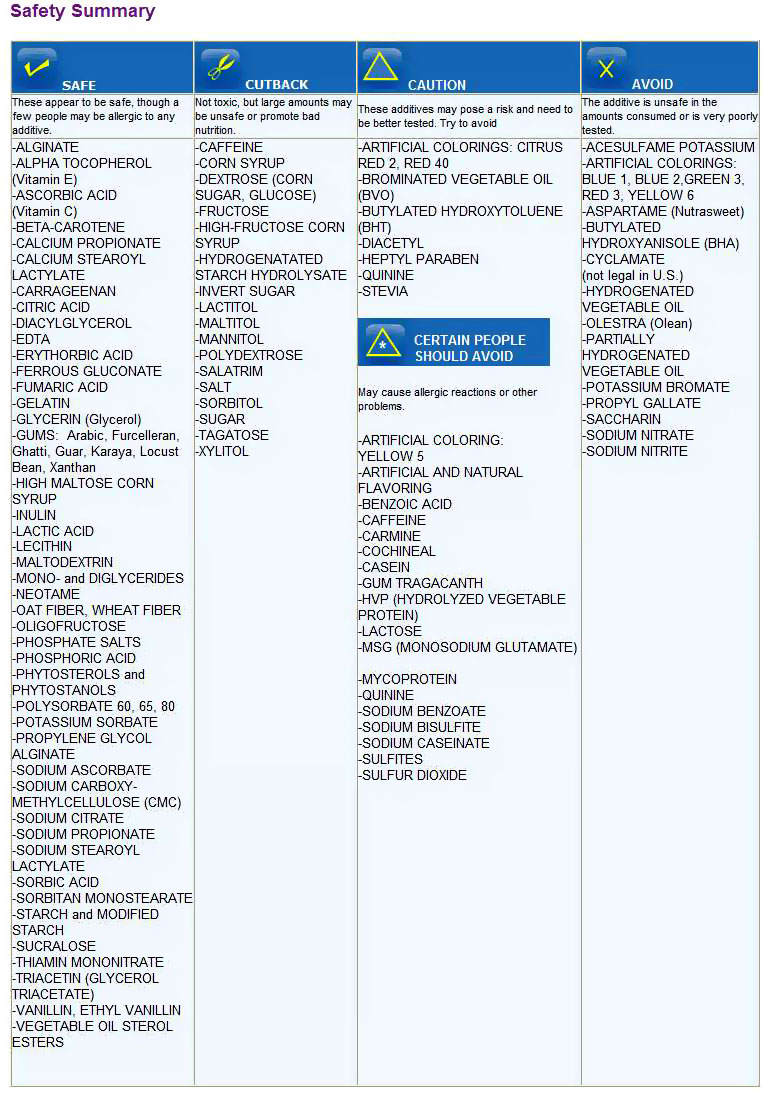
Which Food Additives are Safe & Which Ones to
Avoid
FAIRLY
Because most
food additives are not food but just synthetic chemicals, even the “safe”
additives are questionabl.. Though no additives is best and
safest, the following are regarded and safe, or at least as having no proven
objections:
1. Alginate, Propylene Glycol Alginate — Derived
from kelp; used for texturing in dairy products and thickening acidic foods.
2. Alpha Tocopherol- — Vitamin
E; used for preventing rancidity in oils.
3. Ascorbic Acid — Vitamin C; stabilizes color.
4. Beta Carotene — Converted by the body to Vitamin
A; used in butter and margarine.
5. Calcium (or Sodium) Stearoyl
Lactylate — Dough conditioner and whipping agent.
6. Casein, Sodium Caseinate —
This is the primary protein in milk.
Some people are sensitive to casein, however.
7. Citric Acid, Sodium Citrate — Acidifies and
flavors ice cream, fruit drinks and carbonated beverages.
8. EDTA — Chelating agent (same thing as used in
intravenous chelation therapy); used to remove metal
contamination in food from processing machinery.
9. Ferrous Gluconate — Iron
supplement; colors olives black.
10. Fumaric Acid — Produces
tartness and acidity in dry food products.
11. Gelatin — Made from animal bones and hoofs
12. Glycerin (glycerol) — Maintains water content in foods.
13. Hydrolyzed Vegetable Protein — Flavor enhancer
usually made from soy.
14. Lactic Acid — Acidifier.
15. Lactose — Milk sugar. Many people have trouble digesting lactose.
16. Lecithin — Emulsifier and antioxidant.
17. Mannitol — Sweetener
with half the calories of sugar.
18. Mono– and Diglycerides — Emulsifier; used in baked goods, margarine and
peanut butter.
19. Polysorbate 60 — Emulsifier
in baked goods.
20. Sorbic Acid, Potassium Sorbate — Prevents mold growth; natural fatty acid used
as anti-candida supplement.
21. Sorbitol — Naturally
occurring sweetener that’s half as sweet as sugar and doesn’t cause as rapid a
blood sugar rise.
22. Vanillin, Ethyl Vanillin — Synthetic vanilla
flavoring.
QUESTIONABLE ADDITIVES—Avoidance
Advised
1. Artificial Flavorings — Though most flavoring chemicals occur in nature, many
people are allergically sensitive to them. Hyperactivity in children has been associated
with these chemicals.
2. Aspartame — Artificial sweetener; though made from two
amino acids, numerous allergic reactions reported; 80% of all food additive
complaints to the FDA concern this product.
3. Carrageenan — From
seaweed; large amounts damaged test animals colons; possible link to ulcers and
cancer.
4. Calcium (or Sodium) Propionate — Anti-mold
preservative in bread; possible migraine link; no evidence other problems from
this additive.
5. Corn Syrup, Dextrose — Sweetener and thickener; all
the health problems of any other refined sugar.
6. Gums (Guar, Arabic, Locust Bean, etc.) — Thickening
agents; removes thirst mechanism and may stimulate continual stomach acid.
7. Hydrogenated Vegetable Oil — Artificially saturated fat used to make margarine;
used in other processed, junk foods.
8. Invert Sugar — Mixture of dextrose (corn sugar)
and fructose (fruit sugar); same health problems as any other refined sugar.
9. Monosodium Glutamate (MSG) — Flavor enhancer;
animal tests indicate nerve cell destruction; many allergically
sensitive.
10. Phosphoric Acid, Phosphates — Acidifies,
emulsifies, inhibits discoloration; phosphoric acid used in carbonated
beverages may pull calcium out of bones to buffer the acid.
11. Red #40 — Most commonly used coloring with lots
of inconclusive research; used in carbonated beverages, candy, gelatin,
desserts, pastry, pet food, sausage and other junk food.
12. Sodium Benzoate — Preservative; used in fruit
juice, carbonated beverages, pickles and preserves; can cause intestinal upset,
hives, or asthma.
13. Yellow #5 (tartrazine) —
Second most used coloring; causes allergic reactions especially in
aspirin-allergic people; only coloring that must be labeled by name; used in
beverages, sausage, baked goods, candy, gelatin.
WORST ADDITIVES (Definitely
Avoid)
1. Artificial Colorings — As a group these are
perhaps the worst for your health.
Numerous studies have shown cancer or other problems prompting the FDA
to ban several. They are almost
exclusively used in junk food that you shouldn’t be eating anyway:
a. Blue #1 — Possible cancer risk; used in
beverages, candy, baked goods.
b. Blue #2 — Possibly causes brain tumors in male
mice; used in beverages, candy, pet food.
c. Citrus Red #2 — Carcinogenic; used on some
d. Green #3 — Possibly
carcinogenic, but rarely used.
e. Yellow #6 — Animal tests showed it caused
adrenal and kidney tumors in animals, as well as allergic reactions; used in
beverages, sausage, baked goods, candy, and gelatin.
2. Brominated Vegetable Oil
(BVO) — Emulsifier and clouding
agent for soft drinks; residues accumulate in body fat; heart, liver, thyroid,
testicle and kidney damage in rats.
3. Butylated Hydroxyanisole (BHA) — Antioxidant used in cereals,
chewing gum, potato chips, oils; prevents rancidity;
contradictory tests on carcinogenicity; not really needed in these foods; may
affect liver and kidney function; banned in
4 Butylated Hydroxytoluene (BHT) — Same
concerns as for BHA.
5. Caffeine — Found in coffee, tea, cocoa, and cola
drinks; can cause miscarriages, birth defects, insomnia, fibrocystic breast
disease; many natural alternatives available.
6 Propyl Gallate
— Antioxidant used to prevent rancidity of fats in vegetable oils, meat
products, potato sticks, chicken soup base and chewing gum. One study suggests carcinogenicity.
7. Sodium Nitrite, Sodium Nitrate — Preservative and coloring agent that can form
cancer-causing nitrosamines; used in bacon, ham, hot dogs, lunch meats, smoked
fish and corned beef.
8. Sulfur Dioxide, Sodium Bisulfite
— Sulfites prevent discoloration and bacterial growth; allergic reactions
are legendary, especially in people with asthma; used in dried fruit, processed
potatoes and wine.
http://www.pacifichealthcenter.com/blog/67-food-additives/
Go to http://www.cspinet.org/reports/chemcuisine.htm
for a list of food additives from the Center for Science in the Public
Interest. Of course, some of the “safe”
additives are not safe at all.