|
Capim Grosso - BA |
|
Volunteer Centre in Capim Grosso
Residents - 2000 23,908 inhabitants Male residents - 2000 11,793 inhabitants Female residents - 2000 12,115 inhabitants Literate residents, 10 years or older - 2000 13,681 habitantes Permanent private homes - 2000 6,234 homes Permanent private homes with plumbing connected to central network - 2000 71 homes Permanent private homes with water connected to central network - 2000 4,909 homes Permanent private homes with garbage collection - 2000 5,054 homes Municipal Elections, registered voters - 2000 17,957 registered voters Live births registered per year - 1998 815 people Marriages registered per year - 1998 70 couples Deaths registered per year - 1998 83 people Divorces registered per year - 1998 11 people Registered companies - CNPJ - 1998 294 empresas Locally employed - 1998 800 people employed Banks - 2003 4 banks Value of Municipal Participation Fund (FPM) - 2000 2,773,274.88 reais Value of Rural Territorial Tax (ITR) - 2000 1,320.37 reais Resident population - 1991 19,659 habitantes Resident population - 1996 27,005 habitantes Total area- 2000 350.11 km2
Source: IBGE Base de Informações Municipais - Malha Municipal Digital 2000
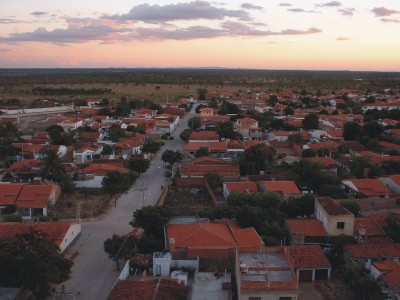
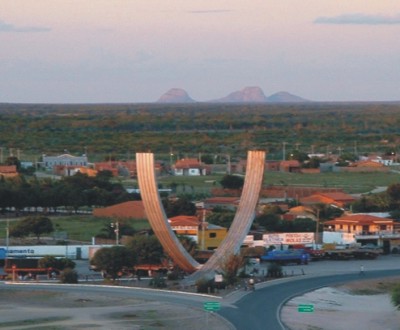
Origin of the city of Capim Grosso The region where Capim Grosso is located today came to be populated between the 17th and 18th centuries during the era of gold mining in Jacobina. The people who would begin what is today Capim grosso were born on the land of a farm owned by Sr. Joaquim Amâncio de Araújo and D. Maria Angélica da Trindade. After the death of the couple, the farm was taken care of by their son, Francisco Amâncio de Araújo. In 1916, Francisco’s daughter, Ursulina, married a cousin, Zózimo Amâncio de Araújo, who built a house on the land. The name Capim Grosso (which means “Thick Grass”), originated because of grass that grew around the pond on the farm. In 1946, the mayor of Jacobina (municipality from which Capim Grosso separated) bought a tank of water from the farm and reformed it to serve as a water supply. It was the location of the pond which attracted new residents to the region. During the great drought of 1952, many people came from the north of the country to work constructing wells and never returned to their cities of origin, establishing themselves permanently in the district (at that time)of Capim Grosso. In 1955, the farm was parcelled out, giving way to the beginning of the city. The principal reason that the city was born and received so many people in thirty years was the construction of the highways BR116 and BR324 in 1966, which transformed Capim Grosso into an important commercial and highway crossroads. On May 9, 1985, the district of Capim Grosso was raised to the condition of city, separating it from the municipality of Jacobina.
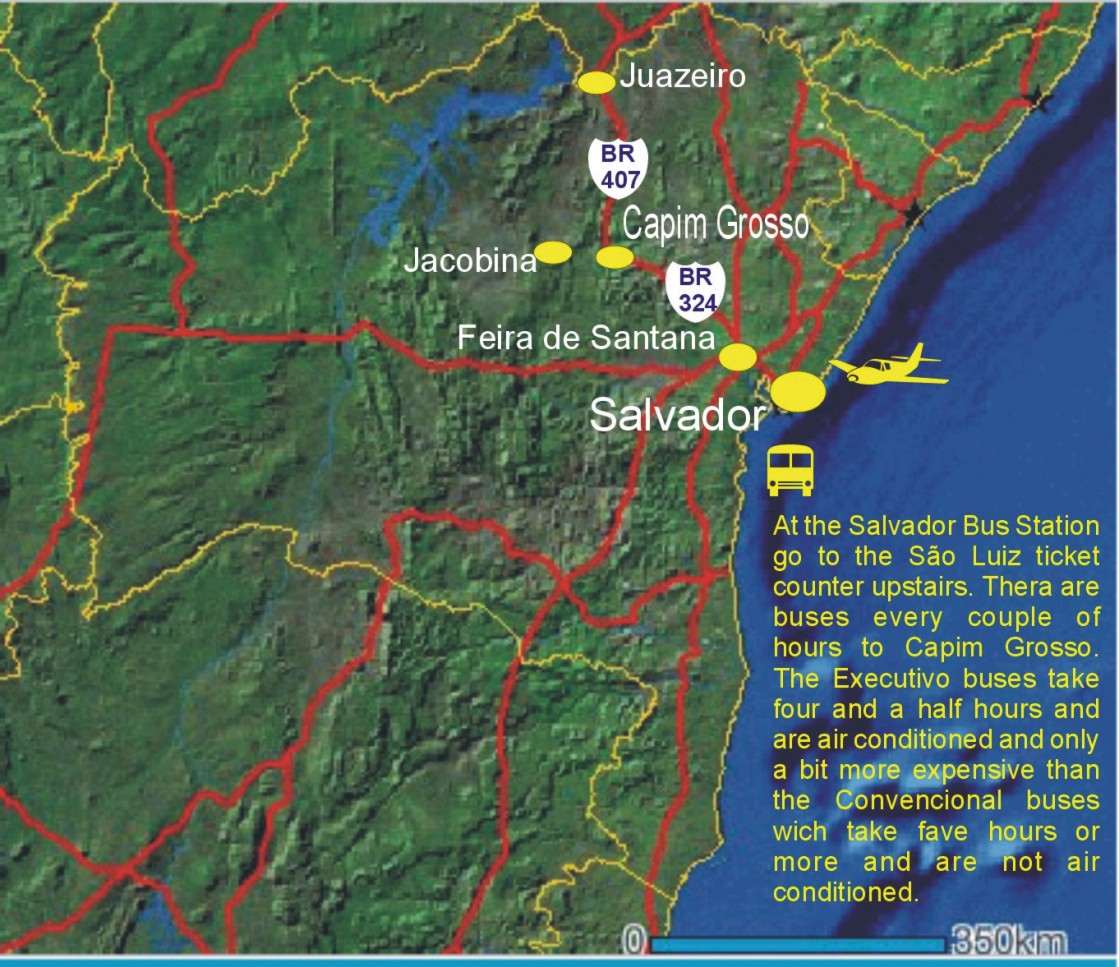
General Facts about the Municipality Population: 26,984 (70% live in the urban center) Area: 336km2 Average temperature: 23.6C Distance from the capital, Salvador: 267km Geographical location: 11.38111 degrees latitude and 40.01278 degrees longitude Postal code: 44695-000 Area code: 74 Information: +55 74 651 0481 Voltage: 220 Connecting highways: BR324, BR407, BA130
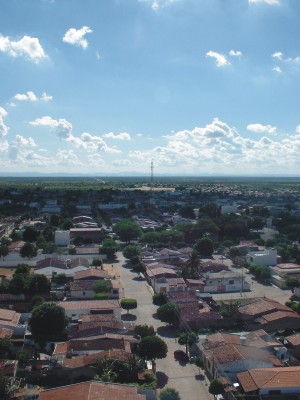
Capim Grosso is located in Piemonte da Diamantina, a semi-arid micro-region. The area of the municipality is on a plain. The most common vegetation is caatinga and the climate is dry and very hot, especially in the dry periods The irregularity of rain is not promising for livestock-raising and farming with out the help of irrigation even thought the soil is fertile.
The principal economic activity of the municipality is commerce, especially of auto-parts, due to the heavy traffic along the highways that go through the city. Services are concentrated in pousadas, bars, and restaurants which bring a bit of activity to the city center. Livestock-raising includes cows, sheep and goats. Agriculture is based in the cultivation of manioch, castor oil beans, corn, beans and ouricuri (a typical plant from the region). With the construction of a large reserve in the district of Pedras Altas, irrigation and fish-raising projects are being implemented. Industrial activity is practically non-existent.
Banks and 24 hour cash machines BANCO DO BRASIL – Cash machine (7 am – 10 pm), VISA PLUS, CIRRUS, WESTERN UNION, MASTERCARD. BANCOOB – Cooperative bank that supports small farmers and associations CAIXA ECONÔMICA – Operated by a lottery agency BRADESCO – Operated by Banco Postal in the post office
The only means of transport is through the bus station, for passengers and for loads. The city is served by the company São Luiz, which has various bus routes between Salvador, Feira de Santana, Juazeiro, Jacobina, Sr do Bonfim and Miguel Calmon. Interstate busses are operated by the companies Itapemirim, Gontijo, Planalto Viatram, Entram and Guanabara, which have routes to the states of São Paulo, Rio de Janeiro, Minas Gerais, Pará, Maranhão, Piauí, Pernambuco, Sergipe and Ceará.
The municipality is equipped with all basic telecommunication services: national and international telephone services, cellurar telephones, local dial-up Internet (128Kbps), normal and express postal service, an FM community radio station, national televison networks, and national and international cable TV.
The market is the largest in the region and takes place every Monday, offering regional products, fruits and vegetables, meats, crafts, clothes and shoes, household utensils, animals, second-hand goods, appliances, and farming and livestock products.
Drugs: Drug consumption has increased among adolescents and youth. The most frequently consumed drug is marijuana, due to the fact that the city is located between a region which produces it, Juazeiro and Petrolina, and the capital of the state, making it a natural point of distribution. Prostitution: Youth and adolescents from 14 to 25 years of age work in prostitution. The principal reasons are lack of family guidance and difficulty finding work. The large number of drivers and travellers that pass through the city maintain this activity. Poverty: Poverty is a serious problem, especially among migrants who come from other states in search of opportunities and among small farmers that live in the rural areas. The government program, Bolsa Renda, which aids needy families, serves about 660 families. The PETI (Program to Erradicate Child Labor) helps about 1300 children. The Bolsa Escola aids around 150 students. Pastoral da Criança, from the Catholic church, works to combat infant mortality. Basic Sanitation: The city is not equipped with a central plumbing system. Each house has a septic tank. Garbage collection is regular but the garbage is deposited in the open air with no type of treatment in an area four kilometers from the city
The municipality has a hospital and clinics, all with free service. There is no Intensive Care Unit. Patients in serious condition are transferred to Feira de Santana or Salvador. The most common epidemics are: Dengue, Leishmaniose, Esquistossomose and skin rashes. Hospitals - 2000 1 hospital HNSS – Hospital Nossa Senhora da Saúde Hospital beds - 2000 254 beds Health centres - 1999 8 houses
The city has public and private pre-schools, primary schools and secondary schools. A university, FABES, is in the process of starting with courses in Administration, Accounting and Teacher Training. Registered students, primary schools - 2000 7.394 registered Registered students, secondary schools- 2000 638 registered Primary schools - 2000 59 establishments Secondary schools - 2000 2 establishments
AEC-TEA Associação - Volunteer Centre working with courses of English, Brazilian Sign Language, Teacher Trainning, Arts, Ecology, Citizenship and Youth leadership.
At The Salvador Bus Station go to São Luiz ricket counter upstairs. There are buses every couple of hours to Capim Grosso. The Executivo buses takes four and a half hours and are air conditioned and only a bit more expensive than the Convencional buses wich takes five hours or more and are not air conditioned .
We use a Template Empire Design Associação Educativo-cultural Tarcília Evangelista de Andrade - Capim Grosso - Bahia - Brasil |