To the invisibility and back
(Or Is F117 really invisible?)
Is it possible to be invisible? Well, The Invisible Man would definitely say YES! But, let’s consider some facts about Electromagnetic (EM) or Radio waves, radars and F117.
Introduction
In short, EM waves are way of transmitting information through air (wireless transmission). Power and frequency
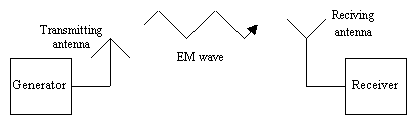
f (or wavelength l ) characterizes each wave. At the transmitter side, generator is connected to the transmitting antenna, and at the receiver side receiver is connected to the receiving antenna (Fig. 1).
Figure 1.
Generator produces variable electric current in the transmitting antenna. As a result, variable magnetic field is produced in the space near antenna. This variable magnetic field produces variable electric field, and this variable electric field produces new variable magnetic field, etc… In that way EM waves travel through the air. Well, air is not the only environment that EM waves could travel through. EM waves can travel through any environment (or material). Depending on the environment, maximum range between transmitter and receiver varies.
Now, let’s consider what happens when EM wave comes to the obstacle (EM wave is coming from one environment to the other). Two things: part of the wave runs through the obstacle and the other part reflects and goes back (Fig. 2).
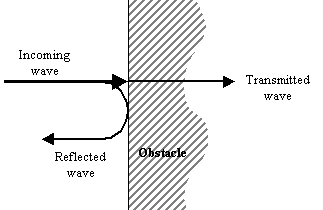
Figure 2.
Two coefficients are defined: Transmitting coefficient and Reflecting coefficient.
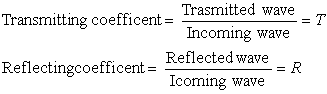
It is obviously
T + R = 1.So, what part of the incoming wave is reflected and goes back? Is it possible that this part of EM wave becomes 0 (nothing goes back)? In this situation the answer is NO. Some part of the EM wave will always go back.
But, let’s consider situation on Fig. 3 when EM wave comes from one material (environment) and the obstacle consists of two materials (one covered with other).
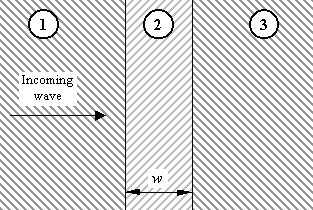
Figure 3.
In EM analysis each material (environment) is characterized with two parameters: m and e . First describes magnetic property and second describes electric property of the environment.
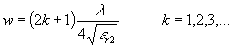
Without deeper analysis here, it can be shown that reflected wave will be 0 (nothing goes back) if worth
Equation 1.
where e r2 represents material 2 parameter (it is assumed that m is same for all three materials).
CONCLUSION 1:
By choosing proper w it can be achieved that no part of EM wave goes back, but ONLY IF WE KNOW FREQUENCY (WAVELENGHT) OF EM. If we don’t know that, we can’t choose proper w.
Radars
How does radar work?
The answer is shown in Fig. 4. Radar sends EM wave. Part of EM wave reflects from the target (obstacle) and returns to radar. By measuring time interval between sending and receiving and antenna position, radar can determine target position.
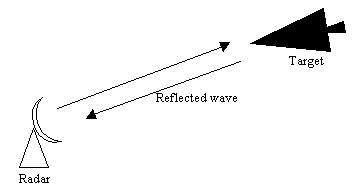
Figure 4.
So, if reflected wave doesn’t exist, radar can’t see the target, and target becomes invisible for radar!
It is possible to make an airplane, that could be invisible for radar, if Equation 1 is used – airplane is covered with material of proper
w. But if radar uses some other frequency (wavelength) airplane is no longer invisible.
F117
Material which is used for covering F117 airplane is made for frequencies of 2GHz and higher, but it still doesn’t make this plane invisible for radars. By reflecting from the F117, EM wave is attenuated for about 15dB, so airplane is not invisible. EM wave is so weak that, by the time radar determines the target, F117 already shoots rocket. That is advantage of F117.
What if radar uses frequency that is not near 2GHz?
Then F117 won’t be invisible.
CONCLUSION:
F117 is almost invisible for some frequencies (~GHz), but not for all of them. So, F117 is almost invisible for some radars, but for the not for all of them.