Klik sini untuk muat turun & cetak dalam format Words
Isyarat tangan yang diberi oleh ketua anda seboleh bolehnya di ulang oleh penunggang di belakangnya dan juga oleh semua penunggang agar semua penunggang dapat mengetahui isyarat tersebut hinggalah ke Sweeper di belakang sekali.
Runner berfungsi mengawasi simpang jalan dan memberhentikan kenderaan lain.
Hanya runner dan sweeper yang dibenarkan keluar dari formasi tunggangan kumpulan.
Selamat berkonvoi secara selamat.
 Hidupkan enjin !! Start your engines !!!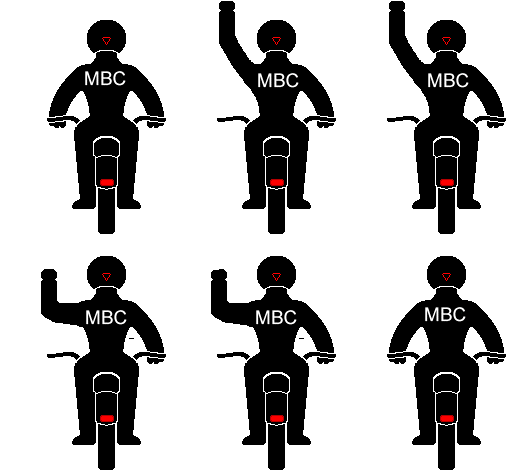
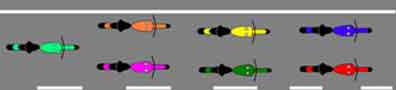
Dua barisan, bersebelahan, rapat-rapat (sewaktu dalam bandar/jalan sibuk)
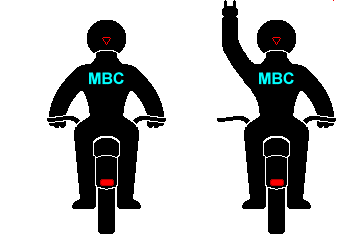
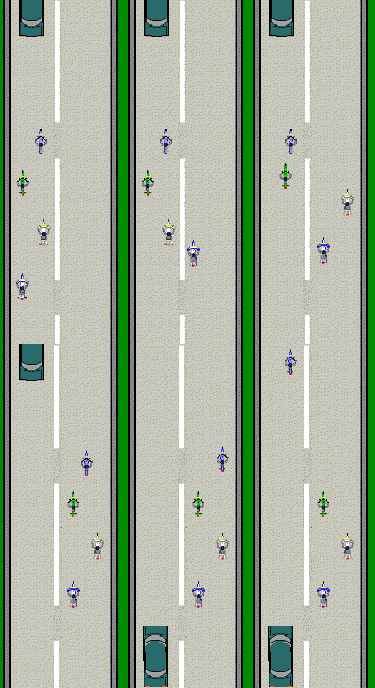

Dua barisan, zig-zag (sewaktu laju / di lebuhraya)
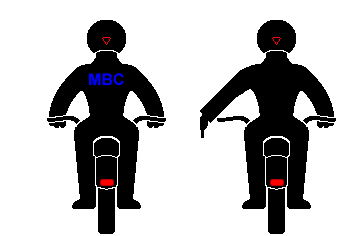 Awas lubang/lopak sebelah kiri (signal kaki juga boleh digunakan)
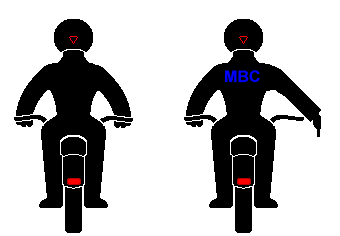 Awas lubang/lopak sebelah kanan (signal kaki juga boleh digunakan)
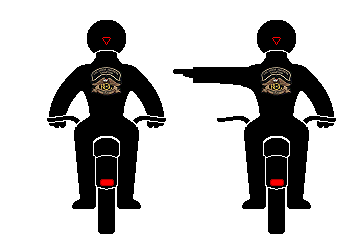 Pusing kiri
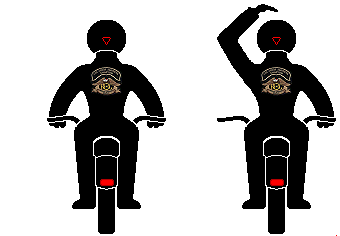 Pusing kanan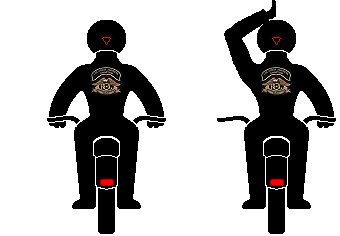
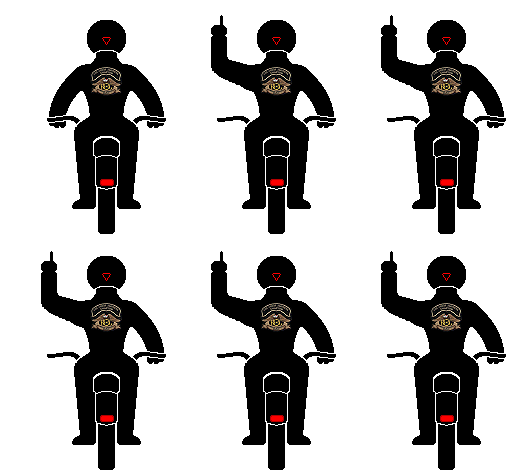
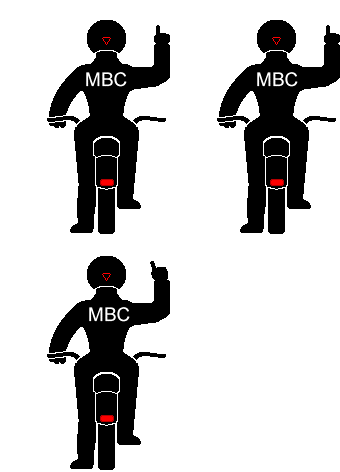
Satu barisan ! Jari telunjuk seperti nombor satu juga boleh digunakan.(Keadaan bahaya atau memotong di lebuhraya)
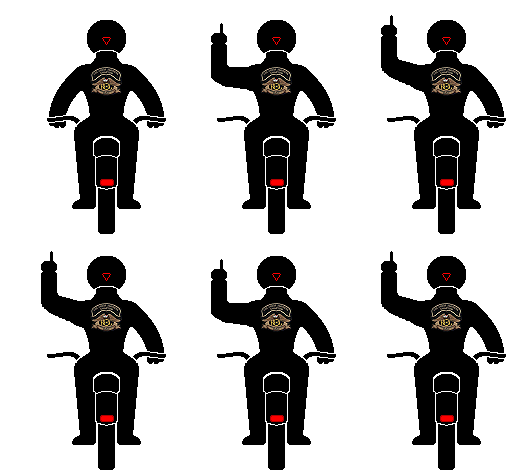
Laju sikit ! Move it, guys and gals !Lengan naik dan turun, berbeza dengan isyarat satu barisan di atas.
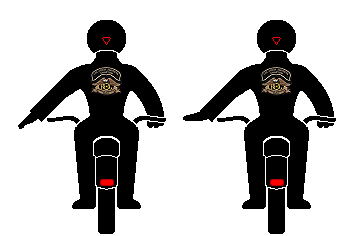 Perlahankan motorsikal anda !!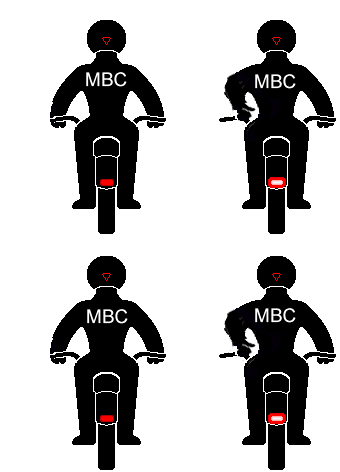
Isi minyak dulu ye !! Tangan genggam, dengan ibu jari menunjuk ke pinggang.
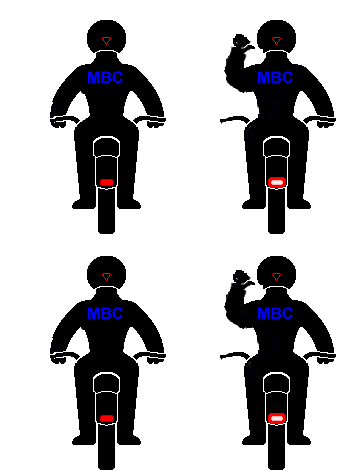
Kita MINUM dulu / moghinum dulu bah !! Tangan genggam, dengan ibu jari menunjuk ke topi keledar.
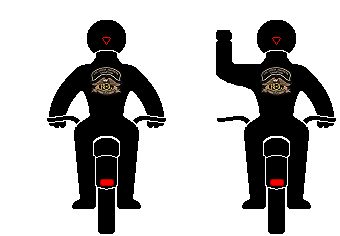
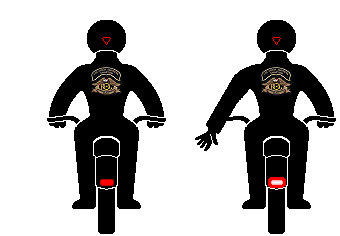
Ooop!!Berhenti dulu!!Sesiapa pun boleh memberi isyarat ini jika perlu. Adalah tugas Sweeper utuk memberitahu Leader dan penunggang hadapan melalui alat perhubungan/handphone.
Di waktu kerosakan/kecemasan, Sweeper perlu menunggu dibelakang. Kumpulan asal akan terus ke hadapan sehingga ke perhentian yang telah ditetapkan sewaktu taklimat. Motor yang mengalami kerosakan perlu di baiki, dan kemudiannya bergabung semula dengan kumpulan asal.Penting bagi Sweeper untuk membawa handphone/wireless.
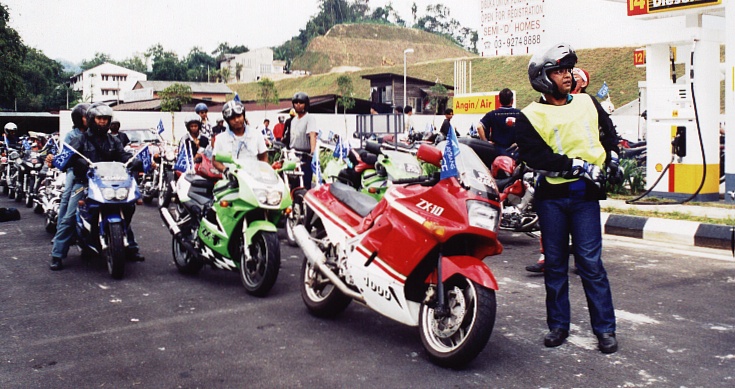
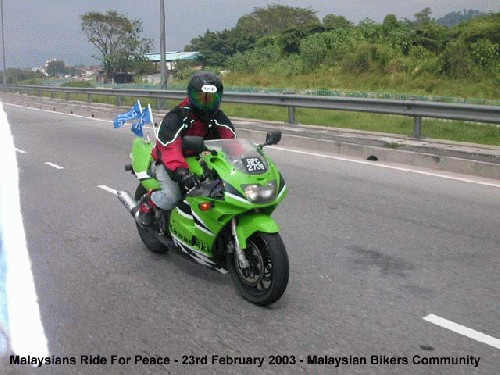
Aman Malaysia Ride 23 February 2003 "Malaysians Ride for Peace"
 Lawati lah www.malaysianbikers.com
Pre-Ride Activities:
�The meeting place should provide an adequate area so that bikers can line-up in group formation, making it safer to leave as a group. Upon departure, the group should be able to pull out without having to cross over a lane of traffic. The meeting place should be on the same side of the road as the direction the group is heading.
Group Leader
The Area Rep should appoint a rider for this task. When this is not possible, a volunteer may be the group leader. The group leader should be someone who is experienced and knowledgeable in group riding. The group leader conducts the pre-departure briefing and appoints a Sweeper / tail gunner and a Runner.
Predeparture Briefing
Determine the number of bikes in a group. Keep the
group small, no more than ten bikes. With more bikes, more groups. Demonstrate
the hand signals to be used while riding. The co-rider should relay the
signals, when possible. Bikers with first aid or mechanical experience should
be positioned at the end of the group, just in front of the sweeper to provide
assistance as needed. Assign a number to each group if there is more than
one group. With two or more groups traveling to the same destination, assign
group numbers (i.e. 1 & 2) for purposes of communicating between
groups. discuss the route or routes to be traveled to the final destination and
the rest and gas stops along the way. Review the possibility of adverse weather
conditions and insure the members have the proper gear. Assign a position for
all bikers in the group. Also, assign bikers new to group riding to the rear of
the group. This gives them more time to react to road hazards and conditions.
Bikers new to group riding should be limited to one per group. A biker
experienced in group riding should be assigned to help a biker with no or
limited experience.
All bikes should have a full tank of gas before
the group departs.
Riding Rules and Procedures: Group
Formations �
Normal roads
Two lane, two-way roads: One bike following the other bike with a MINIMUM of two seconds between each bike. Lane position of each bike will be determined by traffic and road conditions. Road and weather conditions may require the distance to be increased. - In towns or cities: One bike following the other bike with a MINIMUM of two seconds between each bike. Lane position of each bike will be determined by traffic and road conditions. - Mountain / Hill - two lane, two-way roads: One bike following the other bike with a MINIMUM of two seconds between each bike. Lane position of each bike will be determined by traffic and road conditions. This should allow the biker a better opportunity to manage time, space, and traction in the curves. The biker needs to choose the path carefully for the best surface and slope, and maximum turning radius. Each biker must ride within the limits of the motorcycle, his/her experience and knowledge, and road conditions. Remember, you never know what may be around the next curve.
Highway
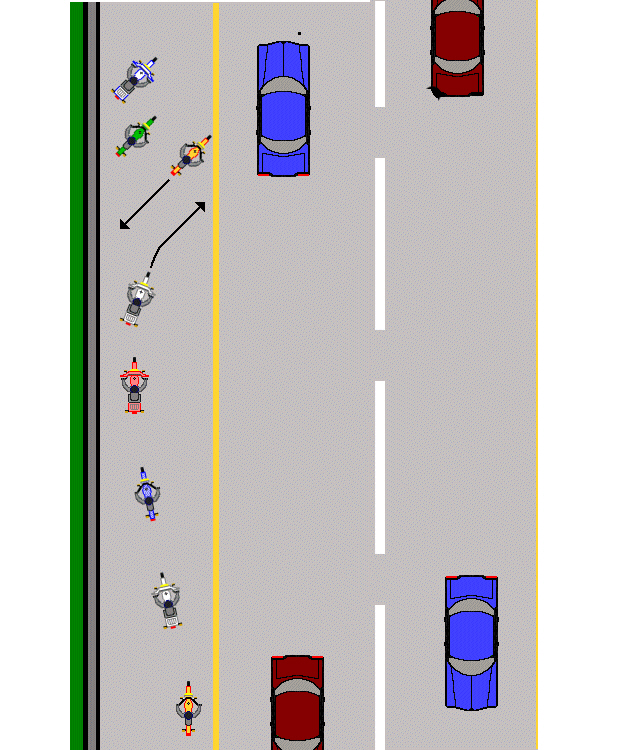
Staggered formation. That means the lead bike of each group will ride in the left portion of the lane and the second rider will ride one second behind the lead and in the right portion of the lane, with the rest of the group following suit. Each bike will stay a MINIMUM of two seconds behind the bike directly in front and one second away from the bike on the other side of the lane, only if road and weather conditions permit it.
Speed
The group leader takes and holds the lead. He / she sets the speed of the group so as to keep the bikers together. The speed should have been agreed upon by all members during the pre-departure briefing. The speed should be within the limits of all members. Also, the group leader adjusts the speed so that vehicular traffic does not stack up behind the group. If traffic stacks up behind the group, the tail gunner should advise the leader of the situation and, if necessary, the group should pull off the road and let the traffic pass, only if there is a safe place to pull off the road. It is important that the leader start out slow to minimize the "accordion affect." Whenever the leader starts out fast, the bikers at the end of the group have to go significantly faster just to keep up with the group. The "accordion effect" can create potential hazards.
Passing
When passing a car or motorcycle on a two lane, two-way road, each bike should pass in order and in turn. The group leader should continue to accelerate far enough ahead of the passed vehicle to allow room for the rest of the bikes to pass and the tail gunner should inform the leader when all bikes are around and back in formation. As each bike passes the vehicle, use the left third of the passing lane, moving around the vehicle as quickly and safely as possible. Plus, make sure there is enough space behind you for the next rider to get back into formation. Never slow down and block the bike off.
Corners
When negotiating a corner on a two lane, two-way road in a group, each biker seeks the safest path and following distance. This should allow the biker a better opportunity of managing time, space, and traction in curves. A biker needs to choose the path carefully for the best surface and slope, maximum turning radius. Each biker must ride within the limits of his/her bike, experience and knowledge, and riding conditions. Remember, a biker never knows what may be around the next corner.
Traffic Lights or Stop Signs
All group members should pull up two abreast while waiting. When starting up from a stopped position, the group leader always moves out first. The number two bike moves out only after the group leader's bike has moved; the other team members start out in turn, and the same manner, leaving the sweeper last to move out... If any part of the group is caught at a light, re-grouping should be after all of the lights and stop signs are passed. The re-grouping points should be decided before departure, if possible; if not, they should be chosen and announced by the leader over the radio. Super market parking lots or shopping centers make the best re-grouping points. Re-grouping like this tends to avoid traffic hazards.
City Traffic
Often when riding in urban areas automobile traffic will cut into the group to make turns, to park, or pass another vehicle. THEREFORE, when a group enters an area with heavily congested traffic, the safest way for bikers to get through is to proceed at a MINIMUM following distance of two seconds from each other. NO staggered formation.
Leaving The Group
Once the group is formed and the ride begins all bikers need to stay in formation, except in emergencies and when the group's riding conduct exceeds a biker's limitations. Each biker must ride within the limits of his/her experience, knowledge, motorcycle, and road conditions. The biker must never allow the rest of the group to cause him/her to exceed any of these limitations. If the rest of the group continues to exceed any of these limitations....leave the group. Each biker is completely responsible for his/her own safety.
Breakdowns
In the event a bike develops a mechanical problem of becomes disabled, only one biker should stop with the bike while the rest of the group proceeds to the next available stopping area. The group should give the biker enough room to pull off the road. The leader should be notified of the situation as soon as possible, so he/she may decide who will assist the disabled biker and where the group will wait.
Lane Changes
Lane changing takes place on a highway. When a lane change is necessary the group leader will inform the group by signal. As the lane becomes open, the sweeper will secure the lane. The rest of the group will follow the leader's signal. Ideally, this should be done from back to front, but it rarely works perfectly. The important thing is to make this maneuver safely. Even though the lane was secured by the sweeper, all bikers are responsible for their own safety. Remember, to make a head check before moving to the other lane. Use your signals at all times to let everyone know what you intend to do. As soon as possible you should regain your lane position.
Rest Stops
The group leader notifies the group well ahead of any planned stops. When parking, the leader seeks a place large enough to accommodate all bikers. When stopping for gas, position the bike next to the pump island so the bike is leaning away from the island. In this way, when the co-rider is getting off the bike or if the bike happens to fall the pump island will not be a hazard. All bikers should gas-up at one time to reduce the number of stops. Also, the bikers should not occupy all of the gas pumps at one time and once the tank is filled, move the bike so someone else can use the pump. Being courteous helps set a good image.
U-Turns
Trying to make a sharp U-turn on a highway is very dangerous, and illegal. A much safer alternative is to find a parking lot or other wide space that will allow the group to turn around and pull out without interfering with traffic. This maneuver (U-turns) should not be tried on the highway.
Emergencies
If any biker is involved in an emergency, such as a flat tire or a medical problem, the rest of the group members should try to give the biker as much room as possible to handle his/her own situation. The first person to discover the emergency should alert the group and suggest a plan of action. When the emergency is discovered, do not attempt to communicate with the person involved unless he requests you to. The biker will have his/her hands full. In general, the group should stop as soon as it is safe and render the necessary assistance. Bikers should be appointed to handle traffic control, administering first aid, collecting information of the accident scene, and establishing communications with emergency medical personnel.
Looking Behind
Group leaders have a tendency to focus his/her attention on the things happening in the group behind him. According to the Hurt Study, "more than 3/4th of all accident hazards are within 45 degrees of either side of straight ahead." The leader leads the group, with his/her attention focused primarily to the front of the group. Let the sweeper keep the leader informed of what is going on in the group.
Adverse / Bad Weather Conditions
Make a gas stop or stop at a roadside rest area and put on the rainsuits under a nice dry roof before it rains. Better yet, find a dry spot and just wait until the rain quits. Avoid stopping on the shoulder of the road to suit up. Roadside stops are dangerous. It is only a matter of time before a group of bikers gets smashed by a rain-blinded driver trying to pull off the road.
Post-Ride Debriefing
After each ride or at the end of the day bikers should gather and review what happened during the ride. The purpose is to provide constructive comments and suggestions of how to improve riding skills, increase the group's knowledge of safer riding practices, and review ways to lower the risks of group riding.
Post-Ride Trip Report
You just hear about a wonderful trip you want to take. A written report about the trip would be a good way to learn more about it. Each chapter should establish a file for trip reports for the benefit of all members. The trip report should include the following:
The routes traveled and mileage of each route.
Significant road hazards, i.e. road construction.
Number of days to make the trip.
Location of your favorite eating places.
Any other pertinent information.
Group Safety:
Most veteran group bikers agree that they only ride with other bikers whose riding habits they know. They have to be able to trust the other bikers in the group. Bikers in a group should not get caught up by the "herd instinct" and should always remember their safety is ultimately their own responsibility and not let a group lead them into trouble. Safety in group riding is paramount because riding together increases the risk of riding. Therefore, the group leader reserves the right to dismiss any biker from the group anytime the biker appears to be riding in an unsafe manner, impaired or inexperienced to the point that he/she is a threat to the safety of the group. If a biker is dismissed from the group he/she may ride behind the group or leave it altogether.