Stabbing Pins Through the Doll of Myth
By Crystal De Napoli
Voudoun is clearly more than the ritual of the cult temple. It is an integrated system of concepts concerning human behavior, the relation of mankind to those who have lived before, and to the natural and supernatural forces of the universe. It relates the living, to the dead, and to those not yet born. It "explains" unpredictable events by showing them to be consistent with established principles. In short, it is a true religion, which attempts to tie the unknown to the known and thus create order where chaos existed before.
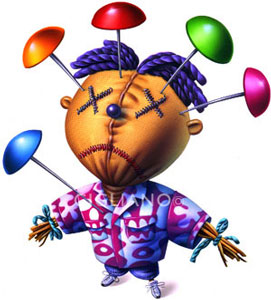
Voodoo is merely one term used for a variety of religions coming from Africa. This also includes Santeria, or "way of the saints." During the course of this paper, I hope to convey that Voodoo, or Santeria, is a veritable religion of millions of people, and not merely the culturally imposed idea that drugged-out crazy folks sit around poking pins into a doll and killing animals just to watch them bleed.
To research this topic, I spent hours online, scouring everything from official sites to crackpot theorists. I also went to multiple libraries and read every book I could find on the subject of Voodoo, Santeria, or Haiti. From all the information gathered, I wrote the following paper which best summarizes the religion of the people who practice and live Voodoo as a lifestyle on a daily basis.
Voodoo, (or vodou, vodun, voudoun, among others) is from the Krey�l language; a tongue spoken by almost the entire population of the island of Hispanola. Krey�l comes from 17th century French mixed with a Western African syntax base. It is essentially a spoken language, which evolved into a fully written one. Voodoo and Krey�l are eternally linked through prayer, proverb, and incantation.
Some books prefer the spelling vodou, as it celebrates the historical roots of the religion and its evolution from Africa to Haiti, as well as distancing the religion from foreigners who devalue Haitian culture. The term "vodou" itself is from the Fon language for "ancestral spirit and drums." Today it is used for all aspects of sacred ritual for the Haitian people. Throughout this paper, I will continue to spell it as voodoo, as this is the popular, more widespread spelling.
Popular media describes Voodoo as hexing adversaries, voodoo dolls, blood sacrifice, and turning innocent people into zombies. Voodoo practitioners see their life as merely trying to do their best to overcome the "limiting social conditions of Haiti," where poverty is merely one factor in a country that has only one physician for every 23,000 people. (Galembo)
Voodoo spawned from some of the world's oldest known religions, some beginning from as far as over 10,000 years ago. The essential wisdom of Voodoo started in different parts of Africa, far before the slave trade. The structure of Voodoo, as we know it today, was born in Haiti during the European colonization of Hispanola.
Ironically, it was the enforced immigration of African slaves from multiple ethnic groups that founded the circumstances for the development of Voodoo. European colonists believed that by isolating the ethnic groups, they could not join together as a community. However, in the misery of slavery, the transplanted Africans found faith was a common, binding thread. (Voodoo)
In 1502, African slaves started being transplanted to the island of Hispanola. In 1697, French pirates took over Haiti, while the Dominican Republic was acquired by Spain. The original inhabitants of the island, the Taino-Arawak and the Carib, were killed and otherwise left out of the new social structure. Those few who remained added some indigenous ritual to the voodoo practices, including polished stones and symbolic ground drawings, called v�v� or seremoni.
Voodoo is a fusion of rituals and cultural practices coming from a range of African groups: the Fon, Yoruba, Ibo, Hausa, Ewe, Kongo, and Toma Guinea. It is a monotheistic religion, with a single supreme god: Mawu-Lisa among the Fon people of West Africa, Olorun among the Yoruba, and Bondy� or Gran M�t in Haiti. (Galembo) A fundamental aspect to the religion is that through divination, proper character, appropriate behavior, and sacrifice, the practitioners can improve their lives on earth rather than in an afterlife. (Orishas)
Santeria was relayed to the New World by slaves imported to work in the sugar plantations. While carrying with them their old religions and traditions, the slaves of the Americas were generally converted to Catholicism. While many feigned Catholicism to assuage the upper classes, most slaves retained their ancestral roots, hiding their true religion under the guise of Catholic symbolism. (Santeria)
One website summed it up best: "The Africans accepted the Catholic saints as new guises for their orishas. They noticed simple similarities, and melded together the figures of their divine ancestors with the church's hagiography. (Overview)
The colonial policies of France, made in 1685, were known as the Code Noir or "Black Code." They stated that "all slaves on our islands will be baptized, and the practice of all religion except Catholicism is forbidden." With this decree in place, voodoo practices had to be hidden from public view. Instead, saints and Christian elements were used to cover the continuous voodoo practices. This secretism, wherein the voodoo religion was hidden by Catholicism, is termed "syncretism." (Galembo)
On Haiti, the most common name of the religion is Santeria, which started as a derogatory name given by the Spanish in order to mock the peasants. "Santeria," or the Way of the Saints, was used to claim the practitioners were "pagans" because of the unusual amount of devotion paid to the Catholic Saints in preference to Christ. The dedication paid to the orishas, who were referred to as saints, was mistaken by the upper classes as a rejection of the father God in favor of demigods. Only recently have members of the religion itself referred to Santeria in a favorable light. (Santeria: Syncretistic)
Santeria is not what is classified as a "primitive" religion, as the Yoruba people, from whom the religion originates, have had a rich history of being civilized people with a deep culture and a large sense of ethics. Practitioners believe in one god, known as Olorun or Olodumare. This supreme god is the source of ash�, the spiritual energy that inhabits all parts of life and material things within the universe. Olorun can interact with people and their world through emissaries, which are called orishas. The orishas rule over nature and every aspect of human life. Communication between the human world and the orishas is done through ritual, prayer, possession, divination, and eb� or offerings, including sacrifice. (What is Santeria)
The orishas are multi-dimensional beings, much like spirits, that represent forces of nature. Followers of Santeria, however, do not see them as remote deities, living far away in the heavens. Instead, they are living entities, which take part in everyday life. Orishas are not comparable to the omnipotent gods of many Western cultures. They are seen as living things that must be nourished, and this must be done through sacrifice and praise. According to Yoruba cosmology, this is the only world, with both visible and invisible elements within it. These invisible elements include the orishas and the ancestors. Many of these spirits can help or hinder the actions of humans, and some of them are protector spirits. (Santeria)
The orishas can also be referred to as lwa. In Island Possessed, the lwa is described as " . . . the spirit or god who possesses people or a person during cult ceremonies. The lwa, originally from Africa, may take residence in the head or occupy the entire body. Services to the lwa are the chief means of perpetuating practices brought from Africa by the ancestors, the slaves." (Dunham)
Hurbon describes the lwa in his book Voodoo: Search for the Spirit.
There are two major rites in the voodoo religion. The first is the rada rite, which came from the old kingdom of Dahomey; parts of this are included in resent day Nigeria, Benin, and Togo. This rite is the most faithful to Western African tradition. The lwa of the rada are said to be sweeter, representing the true spirit of Africa. This is the first rite at voodoo ceremonies.
The second rite is the petwo, which rose out of the New World plantations system. It has aspects of Kongo culture and elements from groups, which came from Central Africa all the way to Angola in the Southwest. The petwo rite is said to be bitter and hot, having to do with fire rituals, and full of violent behavior. Every voodoo ceremony consists of songs and dances with drums, all in honor of the lwa. (Galembo)
While the lwa exist in their own being, they can also possess a human. Possession is when people transcend their material being by becoming spirits, while the spirits renew their vigor by dancing and feasting. It is said that the lwa rides a person like a cavalier rides a horse. In order to be physically and emotionally capable of experiencing possession, a priest or priestess, known as an oungan or manbo, must become an "initiate."
There are three levels of initiation, starting with the bosal, or noninitiates. They have not yet learned to sustain the power of the lwa, and during a possession, the person experiences a displacement of their gwo bon anj, or "big consciousness," while they are taken over by the lwa.
The second level is the ounsi, or the initiates, who are known as "children of the lwa." They have not yet learned to "negotiate the path of knowledge," unlike the third level called the ounci kanzo. These people have gone through a vigorous learning process, including manipulation of fire in ceremonies called kanzo and boule zen, or "burning of the pots." The oungan and manbo have achieved these higher degrees of knowledge in ritual matters, and can therefore officiate in ceremonies and minister to the people. This includes everyday counseling as well as divination. (Galembo)
The religion of Santeria also includes sacrifice or offering, known as eb�. This sacrifice can be from many categories, from candles, fruits, and candy, to the traditionally infamous animal sacrifice. The orisha may ask a person to give up drinking or other vices, wear certain jewelry, receive initiations, or they may request an animal, usually a chicken or a dove, in order to come to the initiates aid.
Animal sacrifice is usually called for only in major situations such as sickness or serious misfortune, or when a new priest is consecrated into service during the birthing process of initiation, as every new birth must have blood. Animals sacrificed for Santeria are always done with respect for both the animal and the orisha for whom it is intended.
Modern, Western cultures are so afraid of death and have eradicated it as much as possible from their everyday lives. Meat from an animal is never seen as the creature it started out as being, with people leaving a butcher with nothing more than a paper bag holding dinner and not the respect for the animal they are eating. "We should also take into account that the poultry industry alone kills more animals in one day than the religion has sacrificed worldwide in the last several hundred years."
Any animal being sacrificed for an orisha has been taken care of as the property of the orisha. On occasion, the orisha has stated that the animal must not die, and is to live with the person doing the ritual. When a sacrifice has occurred, if the animal wasn't used to cleanse a person of illness or misfortune, it is eaten by all the participants. Should the sacrifice have been for a cleansing, the offering is to be completed at a place requested by the orisha. Eating these sacrifices would be like eating the sickness or misfortune that was removed from that person. (OrishaNet)
All voodoo rituals, especially the sacrifices, are done with the utmost respect for all those involved, yet they are still stigmatized throughout Western cultures. The 1987 constitution of Haiti recognized freedom of religion, and acknowledged voodoo as the national religion of the Haitian people. For the past 30 years, people have been openly practicing voodoo. However, the Haitian educational system still does not include voodoo mythology in its curriculum. (Galembo)
In voodoo society, nothing is an accident. Everything occurs for a reason. The supreme god manifests through the spirits of the ancestors, and can bring good or harm. The ancestors must be honored in ceremonies, as they are integral part of the religion. A sacred cycle occurs between those living the dead. Participants may ask the spirits of their ancestors for a relief from life's misery. (Voodoo) "Yoruba religion was, and is, intimately tied to a concept of family, those living and the dead." (Overview)
With the participants being closely related to the spirit world through their ancestors, voodoo roots people to their history and tradition while playing an important role in the community. Believers go through a priest or priestess for advice, spiritual guidance, or general life assistance. Most often, the priest will help through divine aid, using knowledge passed down through the religion, to heal the patron through faith or herbal medicine.
Unfortunately, the general public seems to view voodoo as a source of evil. Voodoo also has spells for healing, love, nature, purification, and joyous celebration. Spirits may be invoked to bring harmony and peace, birth and rebirth, increased abundance of luck, material happiness, renewed health. (Voodoo)
The fact is, for those who believe it, voodoo is powerful. It is also very empowering to the person who practices it. When living in a world of abject poverty and a seemingly inescapable drudgery, it seems logical for people to rely upon their own resources to help themselves. If all you have is your life as a slave, and your family, the reasonable thing to do is to tie yourself to your ancestors and the natural world around you.
I enjoyed doing this paper, as the research was fascinating. The voodoo culture is amazing, and I could see firsthand how hostile to the subject people around me were. Just by reading books with "Voodoo" in the title, I experienced glares and outright disgust that I could be studying such "evil." Yet, while I was researching, I found that there were plenty of books and articles on the subject, but they all pretty much reiterated the same things. There was a lack of true reference materials out in the world, and too many hearsay or third generation stories which lacked evidence. Hopefully, this will change, and future researchers of this topic will be able to find better, and more thorough, resources.
-Harold Courlander
The lwa are supernatural beings that can enter the human body, and they are thought to be present in all realms of nature: in the trees, the streams, and the mountains: in the air, the water, and fire. . . . The spirits provide a way of classifying the different provinces of the universe, as well as of life in society. Order and disorder, life and death, good and evil, favorable and unfavorable happenings-all take on meaning through the agency of the lwa, leaving nothing to strike the faithful as absurd.