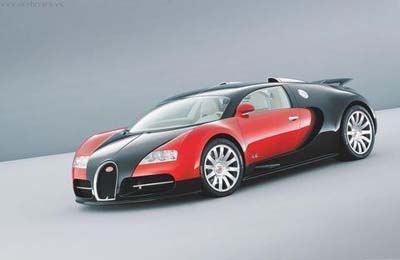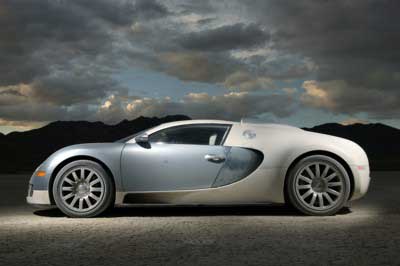
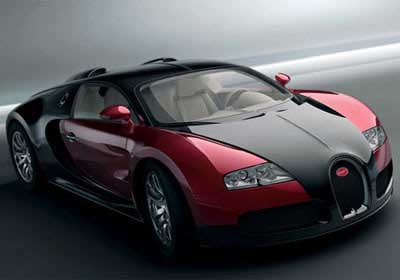
Bugatti Veyron-The Fastest Car in The World!!
Specification The Veyron features a W16 engine-16 cylinders in 4 banks of 4 cylinders. Each cylinder has 4 valves, for a total of 64, but the narrow V8 configuration allows two camshafts to drive two banks of cylinders so only 4 camshafts are needed. The engine is fed by four turbochargers, and it displaces 8.0 L(8000cc) Putting this power to the ground is a dual-clutch DSG computer-controlled manual transmission with 7 gear ratios via shifter paddles behind the steering wheel boasting an 8 ms shift time. The Veyron can be driven by full automatic transmission. The Veyron also features full-time all-wheel drive based on the Haldex system. It uses special Michelin run-flat tires designed specifically for the Veyron to accommodate the vehicle's top speed.
Curb weight is estimated at 1890 kg . This gives the car a power to weight ratio of 529 bhp/tonne. |
The Bugatti Veyron has a total of 10 radiators .
* 3 radiators for the engine cooling system.
|
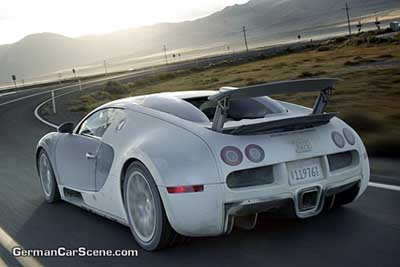
Performance According to Volkswagen, the final production Veyron engine produces between 1020 and 1040 metric hp (1006 to 1026 SAE net hp), so the car will be advertised as producing "1001 horsepower" in both the US and European markets. Top speed was initially promised to be 406 km/h (252 mph), but test versions were unstable at that speed, forcing a redesign of the aerodynamics. In May 2005, a prototype Veyron tested at a Volkswagen track near Wolfsburg, Germany, and recorded an electronically limited top speed of 400 km/h (249 mph). In October, 2005, Car and Driver magazine's editor Csaba Csere test drove the final production version of the Veyron for the November 2005 issue. This test, at Volkswagen's Ehra-Lessien test track, reached a top speed of 407.5 km/h (253.2 mph). The top speed was verified once again by James May on Top Gear, again at Volkswagen's private test track. When getting close to the top speed during the test he said that "the tires will only last for about fifteen minutes, but it's OK because the fuel runs out in twelve." He also gave an indication of the power requirements, at 249 km/h (155 mph) the Veyron was using approximately 270 BHP (201 kW), but to get to its rated 407 km/h (253 mph) top speed required far more from the engine. The power required to overcome aerodynamic friction is proportional to the cube of the speed. Therefore, to go twice the speed, you need eight times the power. The Veyron is the quickest production car to reach 100 km/h (62 mph) with an estimated time of 2.5 seconds, according to the manufacturer. It reaches 60 mph in approximately 2.46 seconds. It also reaches 200 and 300 km/h (124 and 186 mph) in 7.4 and 18.2 seconds respectively. And according to the February 2007 issue of Road & Track Magazine, the Veyron accomplished the quarter mile in 10.2 seconds at a speed of 142.9 mph. This makes the Veyron the quickest and fastest production car in history. It also consumes more fuel than any other production car, using 40.4 L/100 km in city driving and 24.1 L/100 km in combined cycle. At full throttle, it uses more than 125 L/100 km , which would empty its 100 L fuel tank in just 12.5 minutes. The car's everyday top speed is listed at 375 km/h (233 mph). When the car reaches 220 km/h (137 mph), hydraulics lower the car until it has a ground clearance of about 8.9 cm (3? inches). At the same time, the wing and spoiler deploy. This is the "handling" mode, in which the wing helps provide 3425 newtons of downforce, holding the car to the road. The driver must, using a special key (the "Top Speed Key"), toggle the lock to the left of his seat in order to use the maximum speed of 407.5 km/h (253.2 mph). The key functions only when the vehicle is at a stop when a checklist then establishes whether the car��and its driver��are ready to enable 'top speed' mode. If all systems are go, the rear spoiler retracts, the front air diffusers close and the ground clearance, normally 12.4 cm (4.9 inches), drops to 6.6 cm (2.6 inches). |
Gallery
|
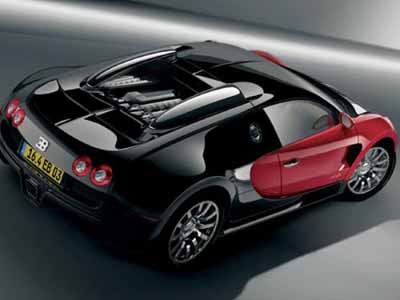 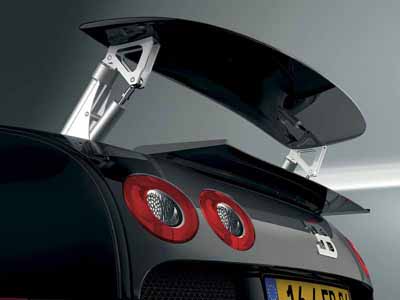 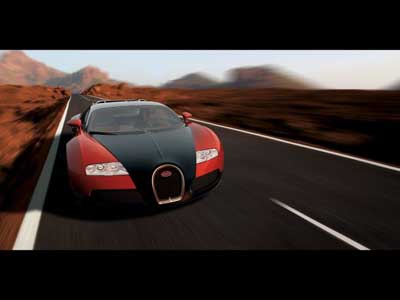 |
Review This is the fastest, most powerful and most expensive production car in history. The Bugatti Veyron 16.4 will do 253mph, has an 8 litre 16-cylinder engine producing in excess of 1000bhp, and a price of $810,000. Let's think about that for a moment: 253mph is faster than a Formula One racing car or Concorde at the point of take-off. The Veyron's power unit, open to the air behind the driver, is four times the size of the engine in your regular family saloon and, boosted by four turbochargers, 10 times as powerful. And the price is 50 times that of the average car. Of course it doesn't make sense. Nobody needs a Bugatti Veyron. But that doesn't diminish its status as an ultimate in technology. It is a billionaire's prized possession, the automotive equivalent of one of those hideously expensive Swiss watches. And it will be the stuff of dreams, the bedroom poster for a generation of young boys. Reaching 60 miles per hour in just 2.5 seconds, the Veyron has a seven-speed DSG twin-clutch transmission, a direct-injection 8.0-liter W-16 engine with 64 valves and 4 turbos and a top speed of 250 mph. This means that if you want to grab dinner in Los Angeles and a show in Las Vegas, the Veyron will get you there in one hour! The car's speed capabilities are enhanced by aluminum and magnesium components, which help keep it light. Its power output tops at 987 horses (1,001 metric horses) at 6000 rpm with 922 lb.-ft. of torque at 2,200 rpm. Toggle switches on the steering wheel sequentially switch transmission, and power is evenly distributed with continuous four-wheel drive. Speed demons will gladly trade their souls for the chance to drive this car, which not only reaches unprecedented speeds but also does so with refined technological class.Once the car reaches almost 140 mph, the normal 4.9-in ride height is lowered to 3.1 in the front and 3.7 in the rear, while the rear spoiler rises and the wing extends nearly a foot. Then, at 230 mph, the driver is required to turn a key in a lock located near the driver��s seat, lowering the car even more to a miniscule 2.6 inches in front and 2.8 in the rear. The front underbody flaps close and the rear spoiler and wing retract, as the car zooms to its top speed. While many might fall in love at first sight with the Veyron 16.4, few will find themselves with one in the garage, considering its ultra-hefty price tag. Also, the company plans to produce no more than 50 cars a year, with a maximum of 300 units overall. Yet for the lucky few who can afford it, the Veyron promises to be worth every penny. |