
1997 Dodge Stratus
Updated 2/18/05
In July 2003, I became the owner of the car I should
have bought in '98 - a Dodge Stratus. While the Neon was fun and reasonably
cheap, a Stratus would have been much better for hauling all of my stuff to
school and work. The trunk is about twice the size of the Neon's, and there are
no hinges to crush your luggage. The additions of overdrive (!), cruise control, and additional sound insulation make the Stratus a much nicer vehicle for long distance roadtrips. The Neon had character, but the Stratus is easier to live with.
My Stratus spent 4 years with my Dad before I got it, so I knew it was pretty reliable. The body is in great shape, and odometer showed around 30,000 miles fewer than my old Neon had. Oh, and then there's the engine - a torquey 2.4L DOHC 4-cylinder (basically a stroked DOHC
Neon engine). While I'm still not a big fan of 4-cylinders, I am much happier
with the 2.4L than I was with the 2.0L.
A few specs about my Stratus:
* 4-door sedan - lower-midsize class (competed with Ford Contour, Honda Accord, Nissan Altima when new)
* 2.4 Liter DOHC I4 engine with balance shafts
150 HP @ 5200 rpm
167 lb-ft @ 4000 rpm
* 4-speed automatic transmission
* Front disc / Rear drum brakes, no ABS
* SLA 4-wheel independent suspension
While there was no R/T model of the first-generation "cloud cars" in the US, there was an R/T sold in Mexico. This Stratus R/T used a 2.4L turbocharged engine that was later refined in the US for the SRT-4 and PT Cruiser Turbo. Unfortunately, it only came with an automatic transmission, and wasn't sold in the US.
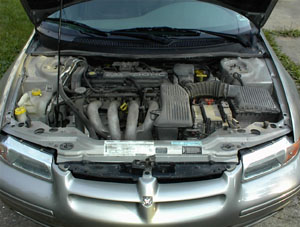
2.4 Liter DOHC 4 cylinder
With 150HP and 167 lb-ft of torque, the Stratus is much snappier around town
than my old Neon was. This is probably helped by a more intelligent
4-speed automatic as well. While hardly the smoothest engine in its class, the
2.4L Stratus is a very pleasant daily driver. The extra torque helps compensate
for the power drain created by the A/C.
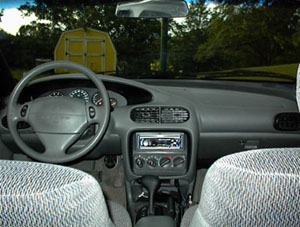
Ergonomic Interior
The first generation Stratus had a low dashboard, reasonably comfortable seats, and good control placement. Unlike the Neons, the stereo was mounted above the climate controls. Only major complaint is a lack of headroom when I raise the seat enough to get comfortable. Otherwise, this is a nice place to be for my 300+ mile trips (which
finally ended in September '03).
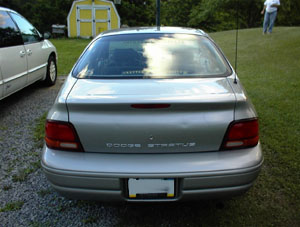
Old Bike Racks are Evil!
Look closely, and you may see two dents in the back of the trunk. An old bike rack dented the trunk where it rested. Other than giving me a chance to tease my Dad that he'd dented my car (back when he owned it), it's not a big deal.
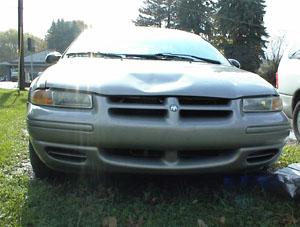
Deer are dumb.
OK, not really, but jumping onto the front of a car moving at 40 mph seems dumb to me. A deer jumped on my hood in November '04 as I made the last bend before my house. Fortunately, the damage was only to the hood.
The good news:
I had a brand new hood installed to replace this one - without bubbling rust, cat scratches, stone chips or hail dents. With just over 95,000 miles as of 2/18/05, this Stratus still looks good and runs well.
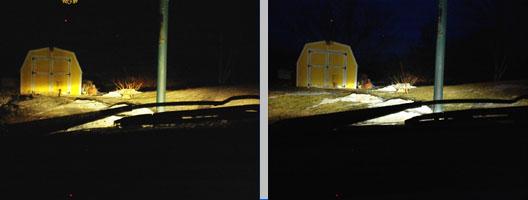
Weak Headlights
The original headlights (left) are quite weak due to a narrow reflector - typical of most Chryslers during the '90s. The image on the right is after replacing the bulbs with Sylvania SilverStars and cleaning the lenses with Meguiar's Plastx. Modern headlights tend to become hazy with prolonged exposure to UV. The lights now need to be aimed properly, but the light seems much brighter, without the blue tint popular among "riceboys".
The North American Touring Car Championship
In the late '90s, Dodge entered two highly modified Stratus sedans in the NATCC. Car #7 was driven by Dominic Dobson, and his teammate's name and number escape me at this time. While Touring Car races are popular in Europe, the NATCC only lasted for a season or two.
The vehicles used in Touring Car racing use 2-liter engines, and the basic components must be available for normal consumers to buy. Suspension geometry can be tweaked, though the basic layout must remain the same. Roll cages are added, and the Stratus' body was stiffened to improve handling. A NATCC Stratus had a horsepower/weight ratio similar to that of a Dodge Viper, although there was far less torque due to the much smaller engine.
I'll have to look into this, as I used to enjoy watching this when it was available.