A Cool Way to Train a Hot Horse, by Sylvia Burrage, continued

While the horse must have forward impulsion to turn, the turn cue without forward impulsion results in a turn on the haunches. Start with only a step or two to work up to a reinless full 360 degrees. Stop if there is any rushing by the horse. Instead of a back up you can cue the other direction a step or two. The first goal is to have the horse relaxed and responsive. Then you can easily perfect the turn on the haunches.
It will become quite easy for you to work in half, quarter, and full turns on the haunches with work on the rail. To practice these turns into the rail, nudge the horse over a bit with your outside heel at the girth so he has enough room for the length of his body to clear the fence. eventually you may want to use this for a collecting exercise by getting closer to the fence so he must round his back and neck thus bringing his hind legs underneath his body.
The first two weeks I used the rail quite a bit as my capricious mare would drift a lot. That way I only had to work on controlling one side. But once the circles got better I only used the rail as warming up on the flat figure eights. larger circles only required a light touch of my outside lead. To spiral into a smaller circle took a bit more pressure and gentle rubbing. If she was resistant, a light touch of spur (lay on flat, don't poke) got her attention, giving me my smaller circle. The horse needs a moment with no heels when changing direction, otherwise he will stop.
After several weeks with Gem lathered in frustration (only from walk and back up) she began to have some calm times. Eventually the sweating ceased. Now, I needed a strategy for the canter.
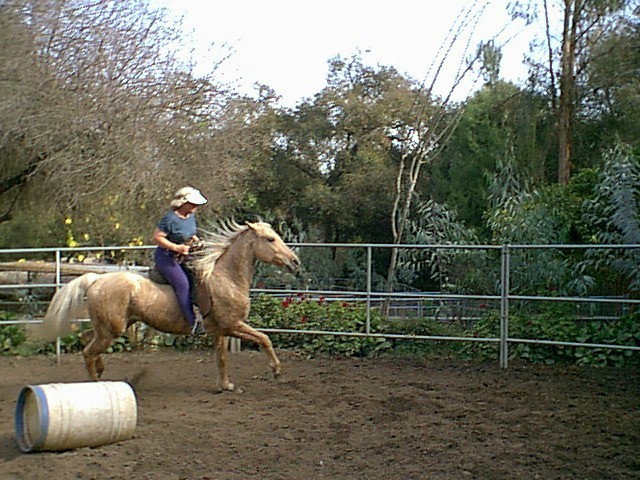
By now your steering at the walk should be almost perfect. Steering at the canter is trickier. First, the canter must be calm enough that the horse can accept other leg cues. As my mare though cantering circles was still going too fast, and I hadn't enough control of the size of the circles, I decided to rate her at a nice, slow canter. Without reins this required frequent stops, even backing up as her excitement level demanded. She did get much better, but I had to use reins to show her exactly what I wanted. She was still using way too much energy, but the explosiveness was gone. I could have stopped right here as I had achieved my goal. She was relaxed enough to accept the reins in cantering. But I was so impressed how this method got through to her I decided to see what interesting things might be done reinless. So to fix these slopy, reinless circles, I decided to use my toes on her elbows. That's where my toe is when my leg is in front of the girth. Remember, the leg behind the girth means turning, stop and reverse. If I keep using my outside heel of the canter cue, she will just canter in smaller and smaller circles. Now the toes can direct her more sensibly, almost pointing the direction. Since these cues are used only at the canter they need to be taught at the canter. To make the circle larger, use indirect inside rein and inside toe. To mae the circle smaller, use leading inside rein and outside toe. With lots of practice, the toe cues can take over for the reins.