EXISTENTIALIST AUTHORS
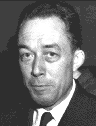
[ALBERT CAMUS]
The world grieves today as we find that one of our more influential existentialists has died last night on January 4, 1960 due to a car accident. To understand the meaning behind his works and accomplishments we must travel back to his childhood. He came from a very poor family, but because of the very sunny and cheerful climate he never felt impoverished. That is most likely why there is always hope in his writings. He lost his father when he was just oe years old.
Although Camus’s father was literate, his mother was not. Camus was a brilliant student at school. His teacher, Louis Germain, urged him to do well. Germain spent extra time with Camus and persuaded Camus’s grandmother to allow him to stay in school. Germain encouraged Camus to go for a scholarship that permitted him to go to high school. His acceptance speech for the Nobel Prize was dedicated to Germain.
Camus was very active in sports until he got tuberculosis. He learned about morality from playing sports. His tuberculosis did not stop him from entering the university at Algiers. Jean Grenier was his new mentor. Camus studied Greek literature, poetry and philosophy.
In 1936, he earned his diploma for philosophy, but since he couldn’t pass the physical he didn’t get the degree that would let him teach. That made him begin a career in journalism. He became very enthralled in politics and joined the Communist party. But in 1937 he broke all ties with the party.
By 1942, Camus became a part of the Free French and moved to Paris. The Free French were against the German occupation of France. He wrote for the underground newspaper called the Combat. Jean-Paul Sarte worked with Camus on the staff of the Combat. All the writers on the Combat wrote under fake names to avoid being caught by the Germans. Despite all the precautions taken, Camus kept on barely escaping the German Gestapo. The day before Paris’s liberation, Camus was the editor of the Combat. In 1944, Camus left journalism behind him and concentrated on different types of writing.
Camus captured the moral climate of the mid-twentieth century in his writings. During the 1940s, values were changing all over the place. The feelings of despair resulting from World War II made many people think that living was pointless. Throughout his search to break through the pervading sense of futility to discover happiness, he had a plan that would have at least three cycles. The perfect harmony he found was the certain duality in man’s nature: the love of life versus the hatred of death. He was articulate beyond words and it showed in his works.
[FRANZ KAFKA]
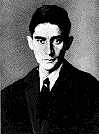
Franz Kafka died on June 3, 1924 in Kierling, Klosterneuberg, Austria a
month before his forty-first birthday.
He will be buried in a Jewish cemetary in Prague-Straschnitz,
Czechoslovakia.
Kafka was born into a Jewish family in the city of Prague in 1883.
At the time, Prague was part of the Austro-Hungarian Empire and Jews were
expected to live apart from gentiles in a ghetto area.
His mother and father operated a drygoods store in the ghetto.
Kafka’s upbringing was left largely to maids and governesses.
In
1901 Kafka entered the Karl-Ferdinand University in Prague where he earned a
doctorate in law.
For a bried time, Kafka abandont his law studies for chemistry,
then returned to law before leaving it again for German studies and art history.
He then returned once more to law and continued in that field throughout
the remainder of his education.
In 1905, a year before he finished his studies, Kafka’s wild and
demanding life finally affected his health and compelled him to recover at a
sanatorium.
There he enjoyed one of his rare pleasureable relationships with a woman.
Although his lover was quite older, Kafka apparently toyed with the
notion of marriage.
When he came back to Prague, he abandoned the affair and resumed
association with Jewish intellectuals and artists.
After his graduation from college in 1907, Kafka took a position at an
insurance office in Prague.
The next year he moved to a government job and at the same time he also
published his first short fiction in a literary magazine.
[JEAN-PAUL SARTRE]
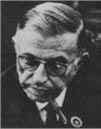
Jean-Paul Sartre (1905-1980) is considered one of the most influential philosophers of the 20th century. Sartre was one of the first authors to help develop the philosophical movement of existentialism. Many of his works are deceptively simple for he did not believe in using allegories and parable genres in his fiction, so he plainly laid out his most complex ideas into a lightly disguised narrative. Some of Sartre's works include, Being and Nothingness where he expressed a straightforward philosophical analysis; and in what is regarded as one of his most compelling plays, No Exit, written in 1944. Because No Exit was written one year after Being and Nothingness, the play is a condensed version of the larger work still effectively conveying all of its themes and symbolism. Within No Exit is Sartre's most famous line, "Hell is other people."
Sartre was deeply interested in the nature of existence. He created a new belief, the distinguishing between inanimate objects-" being-in-itself," and human consciousness-" being-for-itself." The distinction of anything by an observer creates the essence of the object purely by someone being conscious of it. Sartre stated that if a person is content it is by their own doing and choice, therefore because humans exist, they then define and choose their essence. Sartre also had strong feelings about religion.
There are two classified types of existentialists, Christians and the atheistic.
Sartre was an atheistic existentialist. The two
have one thing in common and that is that they both feel that "existence precedes essence"- which Sartre used to help define existentialism.
"Existentialism is nothing less than an attempt to
draw all the consequences of a coherent atheistic position. It isn't trying
to plunge man into despair at all. But if one calls every attitude of
unbelief despair, like the Christians, then the word is not being
used in its original sense. Existentialism isn't so atheistic that
it wears itself out showing that God doesn't exist. Rather, it declares that even
if God did exist, that would change nothing. There you've got our point
of view. Not that we believe that God exists, but we think that the problem
of His existence is not the issue. In this sense, existentialism is optimistic, a doctrine of action, and it is plain dishonesty for
Christians to make no distinction between their own despair and ours and then to call us despairing."- Jean-Paul Sartre
In 1964, Sartre was awarded the Nobel Prize but he declined to accept it on political" grounds.
