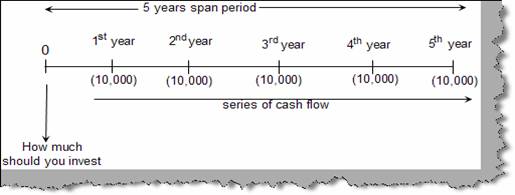
In the previous question we had only a single cash flow. In other terms we had a present value (2000) which was then carried further year by year with a specific rate of interest (10 %). Now let’s take a scenario where you need to pay cash every month with a specific rate of interest. So you have series of cash flows and you need to calculate the present value and future value. So let’s consider the below scenario of retirement planning. During the retirement stage we expect to withdraw every month 10,000 INR. We have identified a bank which pays 10% interest so how much should you invest so that you can achieve your monthly target.
Figure: - Cash flow
In this case we need to calculate the present value we need to invest so that we can get 10,000 INR every month. In the previous question we have already used PV formula. We need to use the same but with a bit twist as the scenario is of a series of cash flow and not a single cash flow. Below figure ‘PV for series of cash flow’ shows how we should use PV for series of cash flow. For series of cash flow we need to specify the ‘pmt’ value and give ‘fv’ value as zero. In this case we have assumed that the transaction will occur at the end of period so we have give type=0. So rate is nothing but the interest rate , ‘nper’ is the number of years, pmt is the expected withdrawal per month , fv is zero as it’s a single cash flow and type =0. In the same figure we have also given the output. So by investing today 37907 INR we should be able to withdraw 10,000 INR every year for the coming five years.
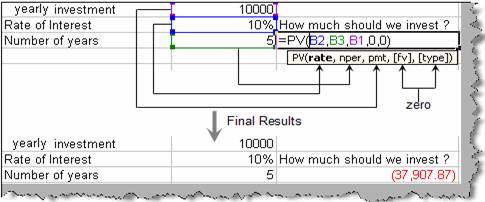
Figure: - PV for series of cash flow
Now let’s understand the same other way around. You are investing 10,000 every month, with 10% rate of interest, so how much should you get?. Below figure ‘Future value’ shows the same in a pictorial format. If you look at the problem its nothing we need to find the future value for series of cash flow.

Figure: - Future value
To find future value we need to use the ‘FV’ formula. Below is a full snapshot which shows how we can use the formula. We have specified rate of interest, period and ‘pmt’ value. As this is a series of cash flow we have specified ‘pv’ and ‘type’ as zero. So if we invest for 5 years with 10,000 INR every year with 10% rate of interest we will get 61051 INR.
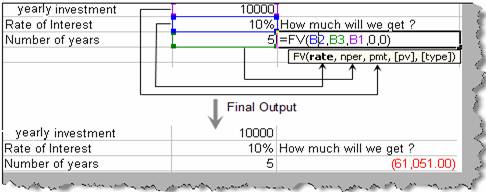
Figure: - Future value in action
Note :- One of the important points to be noted is we need to specify ‘pmt’ value when we are dealing with series of cash flow. We do not need to specify ‘pmt’ when we have single cash flow.