










Scientific Formula for Ecstacy:
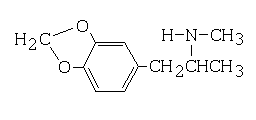
Method 1
To a well stirred, cooled mixture of 34g of 30% H202 (hydrogen peroxide)
in 150g 80% HCO2H (formic acid) there was added, dropwise, a solution of
32.4g isosafrole in 120ml acetone at a rate that kept the reaction mixture
from exceeding 40 deg C. This required a bit over 1 hour, and external
cooling was used as necessary. Stirring was continued for 16 hours, and
care was taken that the slow exothermic reaction did not cause excess
heating. An external bath with running water worked well. During this time
the solution progressed from an orange color to a deep red. All volatile
components were removed under vacuum which yielded some 60g of a very deep
residue. This was dissolved in 60ml of MeOH (methyl alcohol -- methanol),
treated with 360ml of 15% H2SO4 (sulfuric acid), and heated for 3 hours on
the steam bath. After cooling the mixture was extracted with 3x75ml Et2O
(diethyl ether) or C6H6 (benzene). Its recommended that, the pooled
extracts can washed -- first with H2O and then with dilute NaOH (sodium
hydroxide). Then the solvent is removed under vacuum to afford 20.6g 3,4-
methylenedioxyphenylacetone (3,4-methylenedioxybenzyl methyl ketone). The
final residue may be distilled at 2.0mm/108-112 deg C, or at about 160 deg
C at the water pump.
Add 23g 3,4-methylenedioxyphenylacetone to 65g HCONH2 (formamide) and heat
at 190 deg for five hours. Cool, add 100ml H20, extract with C6H6
(benzene) and evaporate in vacuum the extract. Add 8ml MeOH (methyl alcohol --
methanol) and 75ml 15% HCl to residue, heat on water bath two hours and
extract in vacuum (or basify with KOH and extract the oil with benzene and
dry, evaporate in vacuum) to get 11.7 g 3,4-methylenedioxyamphetamine (MDA).
To produce MDMA substitute N-methylformamide for formamide in the above synthesis
Method 2
This is a less yealding method usually producing only MDA. It is a two
step procedure first reacting safrole with hydrobromic acid to give 3,4-
methylenedi- oxyphenyl-2-bromopropane, and then taking this material and
reacting it with either ammonia or methylamine to yield MDA or MDMA
respectively. This procedure has the advantages of not being at all
sensitive to batch size, nor is it likely to "run away" and produce a
tarry mess. It shares with the Ritter reaction the advantage of using
cheap, simple, and easily available chemicals.
The sole disadvantage of this method is the need to do the final reaction
with ammonia or methylamine inside a sealed pipe. This is because the
reaction must be done in the temperature range of 120- 140 C, and the only
way to reach this temperature is to seal the reactants up inside of a
bomb. This is not particularly dangerous, and is quite safe if some simple
precautions are taken.
The first stage of the conversion, the reaction with hydrobromic acid, is
quite simple, and produces almost a 100% yield of the bromi- nated
product. See the Journal of Biological Chemistry, Volume 108 page 619. The
author is H.E. Carter. Also see Chemical Abstracts 1961, column 14350. The
following reaction takes place:
To do the reaction, 200 ml of glacial acetic acid is poured into a
champagne bottle nestled in ice. Once the acetic acid has cooled down, 300
grams (200 ml) of 48% hydrobromic acid is slowly added with swirling. Once
this mixture has cooled down, 100 grarns of safrole is slowly added with
swirling. Once the safrole is added, the cheap plastic stopper of the
champagne bottle is wired back into place, and the mixture is slowly
allowed to come to room temperature with occasional shaking. After about
12 hours the original two layers will merge into a clear red solution. In
24 hours, the reaction is done. The chemist carefully removes the stopper
from the bottle, wearing eye protection. Some acid mist may escape from around the stopper.
The reaction mixture is now poured onto about 500 grams of crushed ice in
a 1000 or 2000 ml beaker. Once the ice has melted, the red layer of
product is separated, and the water is extracted with about l00 ml of
petroleum ether or regular ethyl ether. The ether extract is added to the
product, and the combined product is washed first with water, and then
with a solution of sodium carbonate in water. The purpose of these
washings is to remove HBr from the product. One can be sure that all the
acid is removed from the product when some fresh carbonate solution does
not fizz in contact with the product.
Once all the acid in the product is removed, the ether must be removed
from it. This is important because if the ether were allowed to remain in
it, too much pressure would be generated in the next stage inside of the
bomb. Also, it would interfere with the formation of a solution between
the product and methylamine or ammonia. It is not necessary to distill the
product because with a yield of over 90%, the crude product is pure enough
to feed into the next stage. To remove the ether from the product, the
crude product is poured into a flask, and a vacuum is applied to it. This
causes the ether to boil off. Some gentle heating with hot water is quite
helpful to this process. The yield of crude product is in the neighborhood
of 200 grams.
With the bromo compound in hand, it is time to move onto the next step
which gives MDA or MDMA. The bromo compound reacts with ammonia or
methylamine to give MDA or MDMA.
To do the reaction, 50 grams of the bromo compound is poured into a
beaker, and 200 ml of concentrated ammonium hydroxide (28% NH3) or 40%
methylamine is added. Next, isopropyl alcohol is added with stirring until
a nice smooth solution is formed. It is not good to add too much alcohol
because a more dilute solution reacts slower. Now the mixture is poured
into a pipe "bomb." This pipe should be made of stainless steel, and have
fine threads on both ends. Stainless steel is preferred because the HBr
given off in the reaction will rust regular steel. Both ends of the pipe
are securely tightened down. The bottom may even be welded into place.
Then the pipe is placed into cooking oil heated to around 130 C. This
temperature is maintained for about 3 hours or so, then it is allowed to
cool. Once the pipe is merely warm, it is cooled down some more in ice,
and the cap unscrewed.
The reaction mixture is poured into a distilling flask, the glass- ware
rigged for simple distillation, and the isopropyl alcohol and excess
ammonia or methylamine is distilled off. When this is done, the residue
inside the flask is made acid with hydrochloric acid. If indicating pH
paper is available, a pH of about 3 should be aimed for. This converts the
MDA to the hydrochloride which is water soluble. Good strong shaking of
the mixture ensures that this conversion is complete. The first stage of
the purification is to recover unreacted bromo compound. To do this, 200
to 300 ml of ether is added. After some shaking, the ether layer is
separated. It contains close to 20 grams of bromo compound which may be
used again in later batches.
Now the acid solution containing the MDA is made strongly basic with lye
solution. The mixture is shaken for a few minutes to ensure that the MDA
is converted to the free base. Upon sitting for a few minutes, the MDA
floats on top of the water as a dark colored oily layer. This layer is
separated and placed into a distilling flask. Next, the water layer is
extracted with some toluene to get out the remaining MDA free base. The
toluene is combined with the free base layer, and the toluene is distilled
off. Then a vacuum is applied, and the mixture is fractionally distilled.
A good aspirator with cold water will bring the MDA off at a temperature
of 150 to 160 C. The free base should be clear to pale yellow, and give a
yield of about 20 ml. This free base is made into the crystalline
hydrochloride by dissolving it in ether and bubbling dry HCl gas through it.
WARNING: This information is up for educational purposes ONLY. We do not
incourage this infromation in any way. We are not in ANY WAY reponsible for
what happends to anyone reading this information. If its illegal in your
country DONT DO IT! Otherwise enjoy reading our archives and sections of
this web-page.
Copyright � 2004 Pot-Head Workshop.