|
|||||||||
|
Asian leaders hold Better Air Quality 2003 Workshop in Manila |
|||||||||
| DOE
MEDIA RELEASE December 16, 2003 |
|
||||||||
|
The road to cleaner air gets better as countries from all over Asia gather together for the Better Air Quality 2003 Workshop today at the EDSA Shangri-La Hotel in Manila. The three-day event brings together about 500 participants from governments, non-government organizations (NGOs), international agencies, and the private sector and academe from Asia and the Pacific to share experiences and expertise on how best to improve air quality in their respective countries.
"Development means improved quality of life of the people, in particular sufficient supply of energy, without compromising the environment," Secretary Perez said. The energy chief told the forum the the Philippine government as a partner in improving air quality has made giant strides in mitigating the impact of energy-related activities on air quality management. For one, the Philippine government has pushed for the increased utilization of renewable energy in the power generation mix. The National Power Corp. (Napocor) has reported high dependence on indigenous energy sources in power generation. For the first nine months of the year, the generation mix share of natural gas plants shot up to 12.1 percent from 6.43 percent a year ago. The share of hydroelectric power plants stood at 19.68 percent from 17.62 percent. Geothermal plants share was recorded at 26.75 percent. Secretary Perez also said the recent renewable energy trade mission in Europe raised as much as $150 million in potential wind, solar and mini hydro for the Philippines. The implementation of the Clean Air Act (CAA) related to the energy sector, Secretary Perez said, has been in full swing. The implementation of the January 1, 2004 mandated low sulfur content for automotive diesel was accelerated to November this year. The CAA requires oil companies to reduce the sulfur content of automotive diesel by 75 percent from 0.2 percent to 0.05 percent effective. Stringent fuel specifications for unleaded gasoline have been in placed starting this year. Effective January 1, 2004 unleaded gasoline sold in the market conatins 35 percent aromatics content from 40 percent and two percent benzene from four percent. The phase out of the leaded gasoline was made nine months ahead of the January 1, 2004 deadline. Secretary Perez also said the government has pressed for the introduction of alternative fuels for public transport. At a sideline workshop dubbed as the first Natural Gas Vehicle Industry Development Workshop, Philippine Energy Undersecretary J.V. Emmanual A. de Dios, in his address, pushed for the widespread utilization of natural gas as an alternative fuel for public transport to achieve cleaner air. The workshop, attended by 100 participants from all over Asia and the Pacific, discussed and explored opportunities and challenges in the development of the natural gas vehicle (NGV) industry.
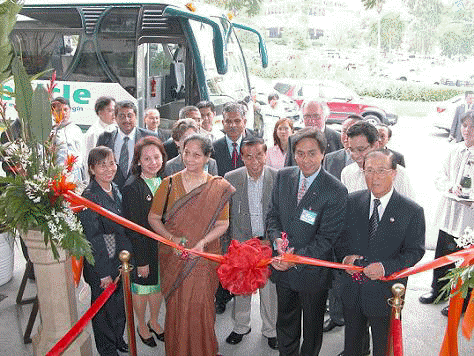
The government has been pushing for the introduction and eventual commercial operations of CNG buses in the metropolis in a bid to fight worsening air pollution. Several initiatives have been achieved, he said. For one, there are companies that have availed of the reduction in import duties for NGVs and NGVs related facilities and equipments as provided for under Executive Order No. 164 issued by President Gloria Macapagal-Arroyo early this year. PNOC was first to take advantage of the lower tariff. It has acquired additional 160 cylinders to enhance its mobile refueling facility. The Development Bank of the Philippines (DBP) through its recently-opened Clean Alternative Transport Fuel Financing Program has also approved the loan contract of RRCG transport Systems Co. Inc./Southern Carrier Co., Inc. for the acquisition of 20 original equipment manufactured CNG buses. Public utility buses, Undersecretary De Dios added, is firming up plans to purchase a total of 150 CNG buses. Two demonstration CNG buses from Ashok Leyland, India and South Korea have arrived this month as part of the energy department's efforts to introduce CNG buses. "These buses will be stationed at the Department of Energy and will be opened to bus operators for test drive. We want to educate the riding public on the viability of using CNG buses in Metro Manila and at the same time to expose the operators to the operations of CNG buses, " Secretary Perez said. "This is a new technology for the Philippines. Some bus operators have expressed apprehensions on the use of CNG buses. We are bringing in brand new CNG buses to address these concerns. We are also creating a technical working group to assess the performance and safety of CNG buses to ally these fears," he added. |
|||||||||
|
p Top |
|||||||||
|
A PUBLIC SERVICE OF EXCALIBURCNG HAULING, STORAGE & DISTRIBUTION, INC. |
|||||||||


 The
Philippine Energy Secretary Vincent S. Perez, in his keynote address,
said energy and environment makes a good mix in promoting sustainable
development while ensuring sufficient, stable, secure, accessible and
reasonably-priced energy.
The
Philippine Energy Secretary Vincent S. Perez, in his keynote address,
said energy and environment makes a good mix in promoting sustainable
development while ensuring sufficient, stable, secure, accessible and
reasonably-priced energy. In
October 2001, the government launched the Natural Gas vehicle Program
for Public Transport (NGVPPT). The NGVPPT lays down the government
policies in the downstream natural gas market to encourage active
private participation and create a healthy competitive environment for
all players.
In
October 2001, the government launched the Natural Gas vehicle Program
for Public Transport (NGVPPT). The NGVPPT lays down the government
policies in the downstream natural gas market to encourage active
private participation and create a healthy competitive environment for
all players.