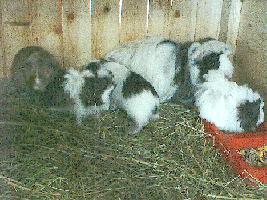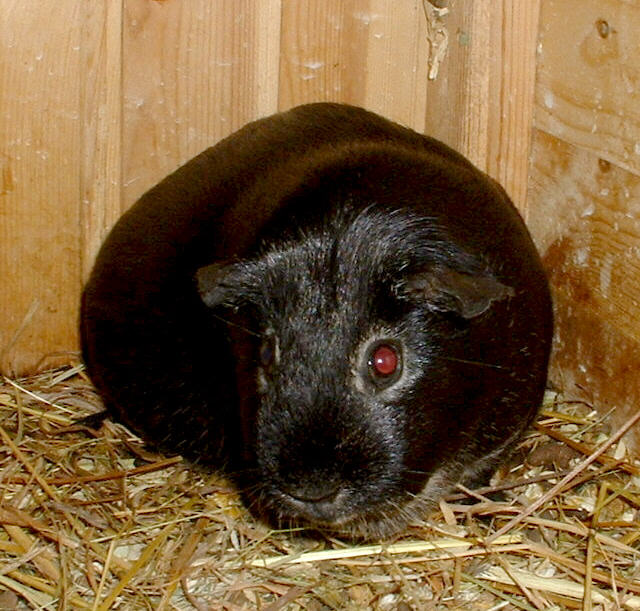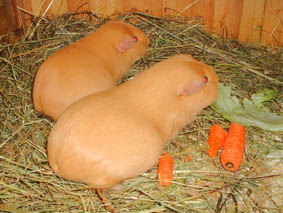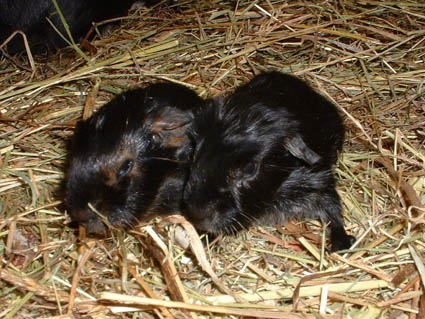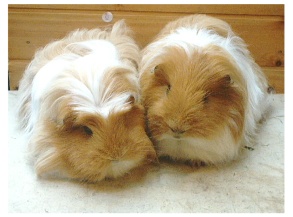
First of all I decide which two cavies I am going to pair up. When I have decided I put them into a pairing cage. I put the sow in first followed by the boar.Immediately the boar will try to mate the sow and will follow her around rumblestrutting.I just leave them be. After a while they will have settled down and will co-habit happily together. I usually keep them together for about 6 weeks or until the sow shows definite signs of pregnancy. I usually have more than 1 pair of cavies paired up and when I know the sows are definitely pregnant, I move them to the big sow cages. Cavy pregnancy usually lasts about 63-65 days so there will be some waiting before the young are born.
The pregnant sows can just be treated as usual but will need an increase in their food intake. I give my sows a dish of bread & milk (semi-skimmed) every so often. Later on in pregnancy, give the sows a multivitamin dissolved in their water. This must be done towards the end of the pregnancy and not in the early days. This can greatly reduce the chances of pregnancy toxaemia which is caused by low blood calcium levels. I give all my cavies vitamins in their water every couple of months or so and some of them, especially Joe, love the taste of it. The last time I gave Joe a multivitamin in his water he emptied his bottle in a few hours. You will know if a cavy has toxaemia because they get depressed and sometimes get wet chins from slobbering. One certain indication it is toxaemia is the smell. Affected cavies develop this certain aroma about them which is never smelt any other time. A cavy with toxaemia will die, there is nothing that can be done about it. You can have the cavy euthanised or just keep it comfortable and warm until it goes.
Sows all differ regarding pregnancy, some become grossly large and are nearly unable to walk and others just get a little plump.It is easier to see in shorthairs and when they are close to littering down you will be able to see the babies moving around inside the mother. When she sits still you can see her sides moving with the babies moving about. This cannot be seen with longhairs. When it is time for the babies to be born, the sow will stand high on her back legs with her back arched and when she feels a contraction, she will put her head down between her back legs to try and pull the baby out. She may have to do this a couple of times before the baby is born and when she does get it out she will immediately nip the sack at the babies nose to free it. She will then bite through the umbilical cord and start cleaning her baby up. Sometimes two babies can come out at once and as the mother can only deal with one at a time, one may be lost. This is why I have more than one pregnant sow in a cage, because if this happens, the other sow will usually step in and help. I have one sow who loves to be a mother and have babies and when one of my other sows gave birth she was straight in there trying to take over even though she was huge with her own babies. She helped the other sow to clean up the babies and get them on their feet. Some people don't hold with this practice as they believe it can make sows have their young before they are ready if one of the others gives birth. I have never had this problem so far.
When the mother has cleaned her babies she will eat the afterbirth which is very important. Some sows only eat a little but it is vital that they eat some for it stimulates chemical changes in their bodies which bring them into milk.
If there are any problems and the sow dies then the babies will have to be wet nursed. If anther sow has babies, the orphaned ones can be adopted to her.If wet nursing is called for it must not be attempted until after 24 hours of the babies birth. Babies are born with enough nutrition to last for 24 hours and if given food in this period they will die. A baby must be offered food from a teaspoon and not a syringe. Very young babies are unable to synchronize breathing with swallowing and if syringe fed they may breathe in the food and choke.They will learn to lick the food from the teaspoon quite quickly. They also need to be fed little and often.If there are no problems then the babies can be left with the mother until they are about 4 weeks old and then the boars will need to be separated from the rest.I usually keep my young until they are between 6 and 8 weeks of age before I sell them.