National Academy of Sciences Field Trip
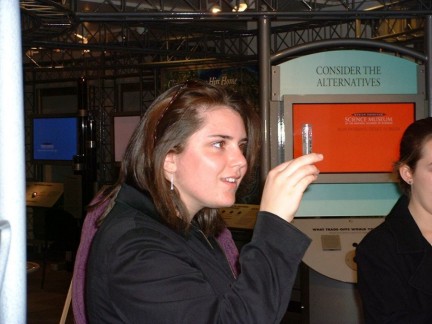
Me staring in fascination at my DNA strands (photo courtesy of T.holtz who I was ever so nice and let me steal it!)
So we went to the National Academy of Sciences Museum by the MCI Center in Dc and had a fantabulous time. The Museum is dedicated to Mary Koshland and has some very good visual, auditory and interactive learning centers that neither dumbed it down or made it so high-tech nothing made sense. One of the great things were the hand-held devices that allowed you to pick and choose what you wanted to listen to as you walked through the museum; complete with buttons to stop, rewind, and fast-forward.
Then there were the interactive stations. There were three stations with three options; light intensity changes on earth, DNA replication and a dark-matter presentation. From there you could choose what section of the earth you wanted to look at from space, rewind or Fast-forward through the DNA replication process (that had spectacular graphics btw), or compare the different solar systems in the universe (I think...it was either that or something I'm not remembering) . One of the greatest things about these interactive stations, besides the great graphics, was the sound placement. Instead of coming from speakers in front or to the side, which can lead to confusion when many different presentations are being run at the same time, the sound came from above your head, which enhanced hearing and actually made you feel as though someone was there explaining it to you. Personally, I loved the light intensity comparison.
There was also a movie about dark matter and how the expansion of the universe is actually increasing at an exponential rate (personally, I can’t wait for it to retract). Further into the museum you could get a sample of your DNA in a vial (where I “scraped my tongue-cheeks J ;) ), see why global warming and therefore dilution of ocean salinity will have adverse effects on temperature, participate in a study being conducted at the University of Pennsylvania about natural resource conservation, investigate the murder of a woman and compare the genomes of suspects, compare genotypes for 11,000 different viruses with an unknown pathogen and guess how similar human DNA is to other organisms such as monkeys, plants, mold and viruses. Did you know it would take 30 years to recite the entire Human Genome? Craziness!
Personally, I liked this museum the best, it was informative without being overwhelming and fun without being condescending. I think its good for all ages, from my little sister of 6 to grandparents, with some college students and professors thrown in for fun. Plus I've been telling all my friends to go there like the true nerd that I am. :)