NewsBites for Kidz� March
14 2004
Do We Give Our Children What
They Need? Saudi Arabia, Middle East
Too much food, not too little,
plagues U.S. children
USDA teaches food safety to kids
: Alabama, USA
Children's books market grows up
: Maharashtra, India
Virtual store that's for kids
and about kids : The World-Wide Web
Children 'miss out on basics' :
New Zealand
Sudanese children march for
peace : SUDAN, AFRICA
Children must now wear car seat
belts : BRUNEI
Therapy dog helps school
children learn to read : Wisconsin, USA
Students say M.A.T.H. is fun
:Indiana, USA
Indian kids excel in British
exams : UK
Hrithik played Holi with school
kids : India
Older students discover they're
really role models: Indiana, USA
Kids immerse selves in Africa: Indiana,
USA
More ideas from the students :
Malaysia
News for Kidz Site Map Earlier NewsBites HEADLINES
Do We Give Our Children What They Need?
Abeer Mishkhas
�
A reader wrote asking me why I consider showing blood and
gore on television a disturbing thing for us and our children.
He thought that I should concentrate on more disturbing
things that our children are exposed to every day. The reality TV program
And with a whole campaign going on here against reality TV
programs, I can see the reader�s response in context. It seems people are
apprehensive about how much these programs are being watched.
They have become hugely popular not only among youngsters
but among people of all ages.
I have not followed these programs, but from the bits I
saw on TV, they seem to be entertaining, if sometimes trivial, and they got
people�s attention � that is what make them
successful.
People who consider these programs a danger to society are
overreacting, in keeping with our habit to raise arms against anything that
sweeps people away.
How vulnerable we must be if a TV program can �destroy our
moral standards�, and teach our children bad things. If our society is that
weak, then we have every reason to stop all TV programs, close our doors and
windows and stay at home.
TV shows are optional viewing, and if anyone does not want
to see them, they can easily switch off their sets. Those who think the shows
are entertaining should be able to decide what to watch. Calls for stopping
something just because some of us do not like it are not helpful here.
In the age of satellite TV, you are exposed to all sorts
of programs, and this is where personal choice and parental guidance come in.
Control your own circle and make sure you are protecting your family from what
you think is harmful to them, but do not decide that for others.
Which leads us to a vital question: How much time do we
spend with our children? How many of us actually sit with their children and
talk to them about anything they see on TV and discuss it with them? Dare I say
very few of us do that?
A friend told me that we do not see our children except to
kiss and hug them. Then off they go to sit with their nannies or, if they sit
with us, we always ask them to be quiet so that we can continue chatting or
watching TV.
I listened to her and thought,� You are right. We do not
seem to take interest in our children�s world. They are always there to take
orders from us, and we just leave them to others to take care of them, nannies,
schoolteachers or siblings.�
A mother of three boys who are avid watchers of
I saw her point too. What do we give our teenagers? We
give them everything except the right guidance and venues to let their energy
out. So if we stop
�
http://www6.arabnews.com/?page=7§ion=0&article=40838&d=9&m=3&y=2004
� HEADLINES
Too much food, not too little, plagues
By Suzanne Leigh
3/9/2004
Hungry American children are a potent political image:
Right in our backyard, in the world's richest nation, a child may go to bed
with an empty stomach. Former presidential hopeful John Edwards, for instance,
spoke on Super Tuesday of an
In today's
The prevalence of hunger in children is on the downswing.
According to the U.S. Department of Agriculture, hunger in children was
reported by 1.1% of all households with children in 1995. By 2002 � despite the
economic downturn � the figure had shrunk to 0.7%, a drop of more than
one-third.
In contrast, the number of obese children almost
quadrupled between 1971 and 2000, reaching 15% for those ages 6 to 11. Obese
adolescents are twice as apt to live in low-income homes, according to the
Centers for Disease Control and Prevention's National Health and Nutrition
Examination Survey.
"When people are short of cash, they eat to keep
hunger at bay; they eat for immediate energy. And that type of food is
typically higher in carbohydrates and fats," says Susan Hofer of
� HEADLINES
Access also is an issue
Even if cash is available, grocery stores in low-income,
minority neighborhoods are more likely to stock Twinkies than broccoli, says
Matt Longjohn, M.D., executive director of the
Consortium to Lower Obesity in Chicago Children. He calls childhood obesity the
"most challenging public health problem we have ever faced as a
nation."
A poverty-obesity link also exists in other Western
countries where a Happy Meal costs less than a bunch of bananas. The British
government last year cited "low socioeconomic grouping" as a childhood-obesity
risk factor. And
Food banks say they are still busy serving hungry kids,
but a new priority is food with high nutrient value. When Jan Pruitt worked for
a
� HEADLINES
Children at risk
Today's obese American child is prone to diseases
potentially more dangerous than the scurvy and rickets routinely diagnosed in
malnourished children a century ago. Conditions once seen exclusively in
adults, such as type-2 diabetes and hypertension, now show up in adolescents
and preteens. A study last year by the American Academy of Pediatrics' Center
for Child Health Research found that at least 4% of adolescents and almost 30%
of overweight adolescents have developed "metabolic syndrome" � a
condition that makes them susceptible to premature heart disease. Other
research links obesity in children to higher rates of depression and suicide.
Politicians should recognize that the plague of many of
The image of the hungry American child ignores the true
dynamics of food and poverty. Child obesity, not hunger, is
Suzanne Leigh is a freelance medical reporter based in
�
http://www.usatoday.com/news/opinion/editorials/2004-03-09-edit-leigh_x.htm
� HEADLINES
�
�By Laurie Borslien
�
Wednesday, March 10, 2004
��� Statistics show
that children eat only half the daily requirement of five fruits and vegetables
as recommended by the U.S. Food and Drug Administration. In recognition of
National Nutrition Month, here are some tips on getting your children to eat
more fruits and vegetables throughout the day.
��� Breakfast
��� Serve 100
percent orange juice. Serve pancakes with pureed fruit. Top
cereal with blueberries, sliced strawberries or bananas.
��� Lunch
��� Prepare brown
bag lunches your children can take to school. Top meat and
cheese sandwiches with lettuce and tomatoes. Use all-fruit spread for
peanut butter and jelly sandwiches. Pack raw vegetables they enjoy, such as
cucumbers, carrot sticks or celery. Include a piece of fruit for dessert.
��� If your children
buy hot lunches at school, they're likely to select the french fries over the hot vegetables. Toss Ziploc
baggies of veggies into their backpacks so they can crunch on a few while
waiting in line.
��� Dinner
� HEADLINES
��� Prepare a salad
before the entree. Cook more than one vegetable with dinner. Encourage your
children to fill half their plates with vegetables.
��� Serve baked
apples, poached pears or a fruit salad for dessert.
��� Snacks
��� Kids are more
likely to eat fruits and vegetables if they're directly in front of them or
easily accessible. Store ready-to-eat vegetables in the
refrigerator at your children's eye level. Leave fresh fruit on counter.
��� Pour 100 percent
fruit juice into a popsicle mold or freeze mashed
bananas and offer them instead of ice cream.
��� Other tips
��� Be a role model
for your children. Eat your daily requirement of fruits and vegetables. When
you eat something you love, say it, but don't complain about certain varieties.
��� Add vegetables to
your children's favorite recipes. Include bell peppers on pizza, squash in
spaghetti or a wide variety of toppings for hamburgers and tacos.
��� Offer a new
fruit or vegetable every week. Let your children try it a few times before they
wave it off for good. Don't scold them for disliking different varieties.
��� Let your
children help you prepare the meals. Buy a kids' cookbook and ask your children
to pick one recipe every week they can help prepare for dinner.
���
� HEADLINES
�Sources: Dole 5 A
Day, Center for Disease
���
��� Cookbooks under
$15
�� "Everything Kids' Cookbook," by R.D. Sandra Nissenberg M.S.
�� "Kids'
Multicultural Cookbook," by Deanna F. Cook
�� "Healthy
Body Cookbook" and "The Science Chef" by Joan D'Amico
�� "Kids at
Work," by Jeannine B. Browning
��� Sources: Dole 5
A Day, Center for Disease
http://www.roanoke.com/roatimes/news/story163909.html
FIGHT BAC!
USDA teaches food safety to kids :
By
Mar 09, 2004
Second-graders at
They learned that by doing four simple things - clean,
separate, cook and chill - they can fight BAC(teria) and germs.
"It's educational, informative and enjoyable,"
said Tim Leonard, who travels with the safety mobile.
� HEADLINES
Leonard said
"The Department of Agriculture does a really good job
with the inspection of food," Leonard said. "...But that doesn't
accomplish much if the consumer doesn't fix it properly."
The bus visits senior citizen centers, health fairs,
farmers markets and schools to teach adults and children alike the importance
of safely preparing food.
Clean means washing your hands and surfaces often during
meal preparation. Separate means not mixing raw meat and vegetables. Chill
means to refrigerate food and leftovers promptly and cook means to prepare
foods at the proper temperature.
http://www.troymessenger.com/articles/2004/03/09/news/news03.txt
� HEADLINES
Children's books market grows up :
MANJU V
TIMES NEWS NETWORK MARCH 14, 2004
�
MUMBAI: Pages that pop up into castles, tornadoes and
forests; books with collapsible measurement scales that teach millimetres and centimetres;
books that have locked pages and a key to open them with.
With the children's book market growing faster than its
patrons in the last few years, selling books for kids under 12 is no longer
child's play.
Blame it on the kindergarten revolution that got underway
a few years back to redefine learning in pre-schools and primary schools.
The average spendings on
children's books, in the metros, is fast catching up with that on toys and
educational kits, if the Indian distributors of children's books are to be
believed.
According to T. N. Shanbhag,
proprietor, Strand Book Stall, who has been in the book trade for 50 years, themarket for children's book has grown "beyond
recognition" in the last decade.
"Fifteen years ago, the children's book market was a Rs 3 crore
one. Now, thanks to educated parents and spiralling
salaries, it is a Rs 100 crore market," he says.
"Today, for an average Indian parent of a pre-primary
or primary schooler staying in a metropolis, books
account for 50 per cent of the total money spent on recreation," says Madhavi Sonawala, proprietor,
Butterfly Books, one of the largest distributors of children's books in
� HEADLINES
"Till a few years ago the figure barely touched 20
per cent," she says, adding, "it will grow
by leap and bounds in the coming years."
Sonawala
corroborates her statement with the fact that in the last one year alone they
sold 200 'Black and White' books, books for newborn babies.
Priced at Rs 125, these books
use black and white pictures of concentric circles, stripes, etc. in order to
make themselves 'legible' to new-borns.
Till a few years ago, such books were not found on Indian
shelves.
"Earlier, children's reading material only meant
simple fairy tale books,with
large fonts and childish illustrations," says clinical psychologist, Bansari Tejookaya.
"Now with interactive, innovative books hitting the
markets, parents come to us with specific queries on which books to buy. A
popular genre they look for involves sex education for early teens," she
adds.
With each passing year, books seem to get more innovative,
thus pushing the standards of interactive learning to greater heights.
"You have to see it to believe it," says Kiran Karachiwala, a mother of
8-year old twins who recently bought a book titled The House of Invention.
Each of this book's pages open into an elaborately set up
drawing room, a kitchen, a bedroom, complete with microwave ovens, television
sets and cupboards popping out of the pages.
The sofa has a write-up which explains how the word
originated from the Arabic word 'suffah', meaning
cushion.
The photo frame in the drawing room says how Joseph Niepce took the first photograph in 1822, and how the
exposure took 8 hours. The letter box informs that the first envelope came in
the year 1696, the first sellotape in 1928.
The boom in Indian markets implies merry-making for
publishers based in
"Indian publishers haven't yet learnt to cater to the
specific demand for interactive, innovative books, so the market is flooded
with imported ones. But in another 15 years, we will have Indian publishers in
this arena too," says Shanbhag.
The imports from
� HEADLINES
Another indication of the children's book boom is that the
British Council Library, in collaboration with an Indian distributor, has for
the first time organised an exclusive children's
books exhibition on a large scale.
"Naturally, it arise from the demand," says Girish Kunkur, Manager, British
Council Library (BCL) Information Service. Sensing the growth of market for
children's books the BCL started a children's library within its main library
five years ago.
"We had 500 child members then, we have over 2000
now," he adds.
Another factor that has brought boom to this market is the
increased interaction kindergartens have with parents these days.
"In our orientation programmes
we tell parents to spend a minimum of 10 minutes every day to read bedtime
stories to their children," says Mona Dalal,
proprietor, Gymbaroo, which runs 28 kindergarten centres in 10 cities in
�
http://timesofindia.indiatimes.com/articleshow/559150.cms
� HEADLINES
Virtual store that's for kids and about kids
: The World-Wide Web
neopets.com is a
big hit with both players and advertisers
MARCH 14, 2004
PAT-TRICKS is hungry, and Nadya Kronis is getting
frustrated. She tries to buy a bottle of water for her pet, but it is sold out
at the store.
A plate of nachos looks tasty, but again, the store is out
of stock.
'That happens a lot,' said the eight-year-old, who lives
in
Hundreds of shops are scattered throughout Neopia, the online world at neopets.com, a website that
lets visitors create, nurture and care for cyberpets.
But there are players from all over the world who need to
feed their digital charges, so the stores are frequently out of stock.
If Nadya tires of clicking on
elusive food items for Pat-Tricks at markets that are perpetually understocked, she can go to McDonald's.
The virtual golden arches of the fast-food chain are easy
to spot at Neopets, squeezed in near the Neopian hospital, which sells sporkle
syrup as a cure for the dreaded ugga-ugga disease,
and the post office, which issues commemorative stamps featuring notable
figures like the Archmagus of Roo.
� HEADLINES
Neopets users
can also check out film releases at the Disney theatre or play video games with
the rabbit that appears on the Trix cereal box at the
General Mills Cereal Adventure.
With more than 22 million members and 27,000 new ones
joining every day, Neopets is one of the most popular
children's websites.
In
Playing is free. The website supports itself with a unique
form of interactive product placement, which turns commercial items into part
of the Neopets environment, generally by using real
products in video games. Not only does the site deliver advertising to its
visitors, it can also create detailed reports on members' behaviour
and preferences, allowing advertisers to evaluate the effectiveness of their
campaigns and plan new strategies for their next ads.
With 39 per cent of its members under 13 years old and
another 40 per cent aged 13 to 17, the Neopets user
base offers a trove of information about the habits of young people.
'We live and breathe market research,' said Mr Rik Kinney, executive
vice-president of Neopets, based in
� HEADLINES
Despite building a business around selling information
about its users, the company wins praise from privacy advocates because it
releases data about its user base as a whole, or about certain large chunks,
instead of revealing facts about individuals.
Thus, a cereal company might learn that teenage boys are
less interested than pre-teen girls in a certain cereal-related character, but
it will not be able to send samples to any of the girls who say they like the
product because Neopets offers no way to determine
individual mailing addresses.
'Privacy is extremely important to us,' Mr Kinney said. 'If we are not asking for personal
information, surveying people is not an issue.'
Mr John
Soma, executive director of the Privacy Foundation at the University of Denver College of Law, agreed. 'If they were keeping
individual data, then they would have some privacy issues,' he said. 'But as
long as they are grabbing the data and aggregating it, they are okay.
'In my opinion, this is a responsible way of dealing with
private data.'
Neopets, the
brainchild of two British university students, first hit the Internet in 1999.
Soon, it was noticed by
Players start by creating a pet, choosing from 46 species
developed by the Neopets design team. The pets can
play games, solve puzzles or go on quests through various imaginary worlds, all
to earn Neopoints, the coin of the realm.
� HEADLINES
Pet owners can then spend those points on food, toys and
other luxuries for their charges.
Taking care of these virtual companions can be addictive.
Senior analyst Leslie Marable of Nielsen/ NetRatings said the average user spends nearly five hours a
month earning and spending Neopoints, and it is the
top community website aimed at a young audience.
That appeals to advertisers, who want to market to - and
learn about - the core Neopets audience.
Mr Kinney
called the style of promotion 'immersive advertising'.
Games and activities built around specific products are
more interactive than TV commercials and therefore more entertaining, he said.
Mr Eric
Lucas, marketing vice-president of General Mills' Big G cereals group, said:
'As kids are online more, it makes sense for us to have a presence there.'
The habits of children like Nadya
Kronis back that up.
'When commercials come on TV, that's when it's time to go
to the bathroom or something like that,' she said. Playing a branded game is
more fun than watching an ad 'because that just advertises stuff'.
� HEADLINES
Young Neopets users may realise they are the targets of marketers, but their
parents may not.
'I had no idea there were ads; I never really looked,'
said Ms Inna Rozenblit, Nadya's
mother.
Nonetheless, she has no problem with her daughter's
activities being used to generate market research on what children like.
'What's wrong with that?' she said. 'They need to know.'
Research is done primarily through online polls. Members
are rewarded with several hundred Neopoints for
answering questions about their shopping habits, and users complete some 6,000
to 8,000 surveys every day.
One survey, for example, asks members whether they have
been in a Wal-Mart store in the last two months.
Neopets also
compares survey answers with users' behaviour at the
site - asking, for example, whether members have seen a specific movie and then
determining whether they played the games promoting that film.
'Without exception, awareness goes up and viewership is much higher among those who played the
activities,' said Mr Kinney. -- New York Times
http://straitstimes.asia1.com.sg/click/story/0,4386,240084,00.html
� HEADLINES
Children 'miss out on basics' :
09 MARCH 2004
Many
In a presentation to doctors and nurses at Hutt Hospital Dr Kiro called for
more collaboration between the sectors responsible for children, to turn round
some of
Dr Kiro said the
"The 2001 census shows that there are more than
20,000 children living in dwellings without heating," Dr Kiro said.
"In a world of limited financial resources, first
priority should be given to allocating resources to children.".
Harmful social conditions seriously affected health
outcomes for children, she said, pointing out that
"Mental health services appropriate to youth are
generally underfunded by district health boards and
this lack of services contributes to serious health problems," she said.
Participants at a recent youth symposium made a strong
call for access to free health and dental services to age 18 and for health
services to be available in schools.
http://www.stuff.co.nz/stuff/0,2106,2839428a7144,00.html
� HEADLINES
Sudanese children march for peace :
2004/03/08 22:56:41 GMT
Hundreds of Sudanese schoolchildren have marched to the
presidential palace in the capital
The children, from around the country, held hands and lit
torches.
In an appeal for peace the children said the war was
depriving them of "milk, food and medical treatment".
The organisers - Sudan Peace and
Dignity - plan to fly five children to
"In peace we grow, no to war!" chanted the
children, aged from seven to 14.
They carried banners and lit 29 torches, each representing
one of
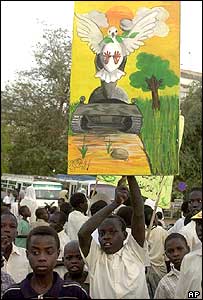
The children came from all over
� HEADLINES
'Stop the killing'
"I have come all the way from Rabakuna
in the south just to express my support for peace. With peace we can stop the
killing," said 13-year-old James Gurgal Kuwaj.
"I think I will be happy if peace comes, my family as
well."
Kuwaj will be
one of the five children flown - by the non-governmental organisation
Sudan Peace and Dignity - to Kenya to hand over an appeal to the warring
factions.
"We appeal to you, in the name of the children of
The current round of peace talks - between the government
and the rebel Sudan People's Liberation Army (SPLA) - began on 17 February.
The civil war erupted in 1983 between the mainly Christian
and animist south and the Arab and Muslim-dominated north.
It is
Story from BBC NEWS:
http://news.bbc.co.uk/go/pr/fr/-/2/hi/africa/3544965.stm
� HEADLINES
Children must now wear car seat belts
:
�
By DK Suria Rina
PHA Children under the age of 12 years must now wear seat belts in cars after a
new law was imposed to reduce the risk of kids getting injured or killed in
road accidents.
The new rule means that the young children are now
prohibited from sitting unrestrained or sitting on the laps of parents, older
brothers and sisters as well as guardians during car trips - common sights on
the roads.
http://www.brunei-online.com/bb/tue/mar9h4.htm
Therapy dog helps school children learn to read
:
By JAMAAL ABDUL-ALIM
Posted: March 8, 2004
Shorewood - Of all the
� HEADLINES
�Photo/David Joles
First-grader Natalie Dellutri,
6, reads to Khyber, a reading education assistance dog, Friday at
��
His name is Khyber, and he's quite the teacher's pet.
Specifically, he is a yellow Labrador retriever mix.
His official job title: reading education assistance dog -
or READ.
Khyber reports for duty at Atwater Elementary every Friday
with his owner and handler, Carol Knitter, ready to listen to students.
It's all part of the school's "Joy of Reading"
program, which seeks to make the process of learning to read easier, especially
for students who might need a little extra help.
There might not be a lot of research on the effectiveness
of reading education assistance dogs such as Khyber. But based on all the
smiles Khyber puts on the students' faces, it's safe to say this dog does a
good job.
Just ask first-grader Natalie Dellutri,
6, who wrote a story about the canine companion the other day.
� HEADLINES
In an impressive first draft, Natalie penned: "I like
to rede to Kibre because he
lises well."
The program's originators say that's the point.
"If you can create a reading environment that
children love and look forward to, that's going to affect their whole
lives," says Kathy Klotz, executive director of Intermountain Therapy
Animals, a non-profit organization based in
She said the program takes some of the pressure of reading
off students who might have trouble.
Klotz points out that dogs never
tell children to hurry up. And they don't laugh if the children make mistakes.
"So kids that are shy or embarrassed or dread the
situation, they don't have to because they have a safe and trustworthy environment."
The READ program began in 1999 after an Intermountain
Therapy Animals board member wondered whether therapy dogs could help kids
learn to read, according to Klotz.
What's novel, Klotz says, is that the READ program has
formalized reading to dogs and introduced the practice to schools.
� HEADLINES
Knitter brings Khyber to
The routine begins with a handshake - or a pawshake - before the children take a seat near Khyber.
Knitter is there to help the children if they make a
mistake. She gets Khyber involved by including the dog in the conversation.
When Natalie finished reading "A Ride on the
Bus" to Khyber, Knitter asked Natalie whether she thought Khyber enjoyed
it.
"Yes," Natalie says.
"I heard his tail," Natalie said, referring to
how Khyber's tail hit the floor several times when he wagged it as she read.
http://www.jsonline.com/news/metro/mar04/213274.asp
Students say M.A.T.H. is fun :
LAKE,
BY ELIZABETH EAKEN
Times Staff Writer
� HEADLINES
CROWN POINT -- Fifth-grader David Sotirovski
wowed his teammates and coach Tuesday and had them calling him a hero.
Sotirovski, a
student at
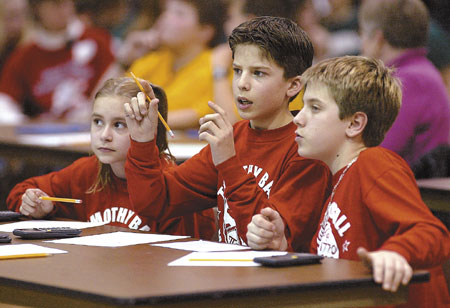
JOHN J. WATKINS / THE TIMES "Mathletes"
from Crown Point's Timothy Ball Elementary School, from left, Sierra Anderson,
Blake Zolfo and Seth Davis discuss a math problem prior to jotting down their
answer. They were participants in the annual Math Academic Teams for Hoosiers
contest Tuesday at Timothy Ball.
More than 6,000 students across
Teams are chosen by their school and allowed up to 20
members. Most coaches rotate students between rounds. Local competition sites
included
� HEADLINES
The statewide competition is organized by the Indiana
Association of School Principals Department of Student Programs and sponsored
by
Sotirovski, who is
in the sixth-grade math class, said his three teammates were busy trying to
figure out the answer when he got it and told them to "just put it
down," as the answer. They put their trust in him and his answer put the
team one point ahead of
"I'd like to think it's the genes from my family
because my parents are pretty smart," Sotirovski
said.
Kim Aiello, coach of the
"I'm thrilled. I told them on the way in I knew we
could do it," Aiello said. "I think we're all going to Dairy Queen to
celebrate."
One thing all the contestants seemed to have in common was
a love of math. They even enjoyed staying after school for months to prepare
for the competition.
� HEADLINES
"The best thing was, it was fun and we got out of
school early," said Anna Roessing, a
fifth-grader at
Elizabeth Kras, a fourth-grader
at
"It was fun just being in it," Kras said of the competition.
http://www.thetimesonline.com/articles/2004/03/10/news/region_and_state/476c39592b39dfa886256e53001839be.txt
� HEADLINES
Indian kids excel in British exams :
Shyam Bhatia
in
Indian children are top of the South Asian league when it
comes to the
Some 65.2 per cent of the Indian kids pass five exams at
grades A to C, surpassing the 51.3 per cent rate of their White counterparts.
More Indian children get better grades than their Bangladeshi� (45.5 per
cent) and Pakistani (41.5 per cent) counterparts.
But the Indians, Bangladeshis, Pakistanis and Whites are
way behind the Chinese, who have 74.8 per cent winning top grades in the annual
exams.
Black pupils from the Caribbean and
Education experts believe traditional family values and
hard work are they key factors in the success of all Asian children.
Although they are often behind their White classmates at
the ages of seven, 11 and 14, they usually manage to overtake them by 16.
Within the South Asian community Bangladeshi and Pakistani
children often have greater problems because their families tend to have less
money and are less fluent in English.
More Indian children come from middle class backgrounds,
where parents stress the importance of a good education.
http://us.rediff.com/news/2004/mar/08shyam.htm
� HEADLINES
Hrithik played Holi with school kids :
�
�
Wednesday, 10 March , 2004, 10:59
�
�
Bollywood
heartthrob Hrithik Roshan
had a unique way of celebrating the Holi festival.
Before playing with colors at Amitabh's residence on
Sunday, Hrithik played Holi
with the students of Annapurna Ashram and St Joseph
Convent boarding school in Mumbai on Friday.
He played with the children smearing gulal
over their faces and also grooved in to tunes of the �It's Magic� song from Koi Mil Gaya just to bring a
smile on the faces of the little ones. Indiafm
�
�http://sify.com/movies/bollywood/fullstory.php?id=13424292
Older students discover they're really role models:
Star report
March 10, 2004
�
� HEADLINES
Instead, they learned they are role models for younger
students who want insight into high school life.
"They wanted to know when lunch period is and how
much homework there is," said senior Ryan McElwain,
a defensive tackle. "We answered a lot of questions."
On a recent Friday, 28 football players and coach Lance Scheib rode a bus from
Franklin Central to Kitley.
"This has tremendous value for our kids to remind
them that they should be great role models in our community," Scheib said. "That message itself is one of the
biggest messages we can get across."
Kitley had a week
of "Read Across America" activities
including book trivia contests, an essay contest and a day when students
dressed as their favorite literary characters. The high school cheerleaders and
basketball team also participated in activities.
The football players went into different classrooms to
read aloud the first chapter of "The Gadget," a historical novel set
around the making of the atom bomb in 1945.
The players brought their enthusiasm into their reading.
In one class, Bryan Doss and Brandon Hubbell took turns reading characters'
lines. In another class, a player had his audience jump by emphasizing
sentences with exclamation marks.
Team members espoused skills they learned as
student-athletes.
"I was glad I told them that school comes before sports,"
said junior Sam Southworth. "I told them that
football players get to run if they don't do some things, so they kind of
laughed about that."
The younger students asked:
"What kind of car do you drive?"
"Is it easy to get lost at high school?"
"How hard are football practices?"
Concerning practices, senior Jordan Sellas
told the students, "They can be tough sometimes. If you really love the
game, it won't bother you at all. It's pretty fun."
http://www.indystar.com/articles/1/127882-6351-016.html
� HEADLINES
Kids immerse selves in Africa:
�Published March 10,
2004
SARAH RICE/For the
African-style: Samantha Patton gets dressed up like a bride from the Ibo tribe of
�
By Susan Vela
OKEMOS -
Throughout the eight-hour school day, the Nigerian girl
was surrounded by the sights and sounds of the second-largest continent in the
world.
Kenyan Mary Mwiandi told folk
tales in St. Martha's parish hall; African masks, batik cloth and vegetables
were displayed; and children dressed as gazelles and sported leopard spots on
their cheeks.
Uche, 7,
said the school's celebration of African culture made her less homesick for
relatives still in
Others felt closer, too.
"Mrs. Patton, I'm a gazelle," cried
second-grader Robby Maudrie, 8, of Fowlerville. He
was wearing a headdress with paper antlers and rushing toward the story-telling
booth.
Organizing teacher Andrea Patton said the school's 200
kindergarten through eighth-grade students have been studying
Patton said students were more enthusiastic about
participating in this year's cultural study because several students, including
Uche, come from African nations.
� HEADLINES
"The kids ... know that
For lunch, there was okra soup, coconut rice and fried
plantains. Children also beat on drums in the shadow of lions and elephants
made from construction paper.
To complete the foreign aura, many women and girls wore
lacy, colorful and tie-dyed African dress.
Principal Helen Hillman wore a lime green asooke fabric, from
"We have quite a party going on," she said,
before heading into a classroom where students were learning Nigerian words
such as the greeting "kedu."
Music teacher Terri Davis-Hayden teased that "sisi," which means "trendy little girl," is
another good word to have for their Nigerian word repertoire.
Davis-Hayden spent the entire day teaching them about
Nigerian marriage rituals, too.
"This is giving her a great awareness of the rest of
the world," she said.
http://www.lsj.com/news/schools/040310_stmartha_4b.html
�
� HEADLINES
More ideas from the students :
By Y.S. LIM
The Best School Newspaper Awards 2004 which was launched
last week heard views from six students who had taken part in last year's Star-NiE annual competition. The fifth formers from SMJK Katholik were members of the class that produced �e3�, one
of the 13 finalists in The Best School Newspaper Awards 2003.
The students were chief editor Lim Chin Chean, sub-editors Nivashini Ponnampalam and Lim Yi Perng,
reporter Kuok Yew Jhin,
photographer Aaron Lim and graphics editor Yeo Suan Aik.
Editor Lim Chin Chean
Initially, we were quite reluctant to enter the contest
but changed our minds when there was the prize of a RM500 class party dangling
in front of us.
For someone as inexperienced as me, leading 47 students
was an uphill task as I did not have a clear picture of what to do.�
Eventually, with the help of our teacher and by referring
to the contest pullout, we managed to proceed with the production of our
newspaper.
Nevertheless, some of us had to take on multiple tasks and
so I was also roped in as a reporter.�
� HEADLINES
Countless articles, corrections and discussions later, we
finally finished on time. We certainly felt relieved; it was as if we had
passed a major exam.
�
Sub-editor Nivashini Ponnampalam
My job was mainly editing the news sent in by the
reporters. The reports were equally divided among the other sub-editors.
Basically we had to correct grammatical errors, wrong use of language, and also
to adjust the length of the news.�
We also had to figure out which news went into which
section. For example, the main page would cover the latest updates in our
school, while other pages would contain entertainment or sports.
We first listed down all the events in the school before
delegating the reporters to cover the news.�
At the beginning, we only received news from the girl
reporters. We had to put pressure on the boys before we got their stories.�
There was a lot of debating before we finally decided on
the most important news to be put on the front page. However we managed to come
up with a quality newspaper.
I must say that I gained invaluable experience working
with a group of boys. We became a determined, disciplined and focused group. As
the saying goes, �Obstacles come only when you take your eyes off the road.�
� HEADLINES
�
Reporter Kuok Yew Jhin�
We were very fortunate that the major events in our school
happened in August, so the task of running around for the news was easier.
Among the events were the annual national brass band
championship, in which our school emerged second runner-up, the fundraising
campaign for our school's sports complex and the opening of our new ais kacang stall.
Our team was reluctant to start at first as it was near
our year-end examinations. But it was the constant pushing from our English
teacher which got us to work.�
As a participant, I realised
that it was crucial for us to cooperate and work as a team to achieve a common
goal. However, all these qualities are useless without something called hard
work. Like my father says, �Nothing comes easy.�
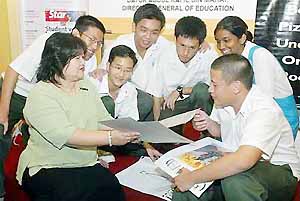
WORKING TOGETHER: SMJK Katholik teacher Lee Li Lian
(left) having a discussion with the editorial team. They
are (from left), Yeo Suan Aik, Kuok Yew Jhin,
Aaron Lim, Lim Chin Chean, Nivashini
and Lim Yi Perng.
Their presentation had the audience in stitches as they
relayed the bittersweet aspects of their journalistic foray.�
� HEADLINES
At the end of the presentation, everyone came away with a
clearer idea of what this year's competition would entail.
Sub-editor Lim Yi Perng
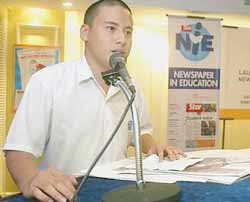
YI PERNG: It was amazing to see how the ideas of so many
different people could come together.
As one of the sub-editors, I had a seemingly simple job to
assist the editor. This meant choosing articles for the newspaper and
correcting grammatical errors. It was amazing to see how the ideas of so many
different people could come together.�
Apart from the mundane and repetitious nature of the job,
I had the pleasure of interviewing our resident trouble-maker, who I might add,
chose to remain anonymous. It was interesting to listen to and understand his
thoughts on how life worked and how the pursuit of happiness was the basis of
his life.�
Sadly, the article was ultimately rejected by the editor
due to its content and because it bore no real relation to the general flow of
our newspaper.
Working on this project has given me an invaluable
experience and I will remember it for the rest of my life.
� HEADLINES
Photographer Aaron Lim
I had to do a lot of research, that is, I had to check out
every event or happening in and around the school � from softball competitions
to open debates. I even stayed overnight at the Bukit
Jalil stadium to cover the
I would also stay back after school. Armed with a camera
and several rolls of film, I would wander around, expecting something to
happen. I would take pictures of events which I thought would interest
students. Sometimes the editors would give me specific instructions for certain
assignments.
The worst part about being a photographer was the fact
that I ended up with a huge hole in my wallet as I had to pay to develop the
photographs.
Selecting the photographs was another thing too. Usually,
the editors would choose only one photograph out of 15 submitted.
The qualities of a photographer? A sharp eye, a quick finger and an alert mind. Remember, if
you snooze, you lose.
� HEADLINES
Graphics editor Yeo Suan Aik
I was in charge of designing the masthead. The class had a
poll first on what to call our paper and after toying with the following titles
such as F4 (after a Chinese pop group), The Vibe, T3 and Blue, we chose �e3�
which means enriching, enticing and entertaining.
I was also responsible for the layout of the newspaper, that is, giving the paper visual appeal. Bear in
mind that an interesting design and layout goes a long way.
Most of the work was done at home although there was some
last-minute work at school. These were the times when I could ponteng the English class. Not a bad deal!
However, my own procrastination caused me to start work
only four days before the deadline. I spent two sleepless nights and days doing
the work but Madam Li Lian (the English teacher)
wanted a more professional look. So we opted for professional printing. We
managed to have everything perfect by the deadline.�
Overall, it was a truly enjoyable activity as it broadened
our horizons and built career interest.�
As you know, the school newspaper is the only way to
expose controversies and present our own views on things. The only opportunity
to do so, I believe.
http://thestar.com.my/news/story.asp?file=/2004/3/14/education/7516701&sec=education
� HEADLINES
News for Kidz Site Map Earlier NewsBites
NewsBites for Kidz ・is published by the News for Kidz・ website. It is a free weekly e-newsletter, sent by subscription to kids all
over the globe. It is a digest of condensed news stories published by
international media, of the news in the life of kids.
Each news story and photograph is copyright of the original news source
quoted with it.
To subscribe, please send email to [email protected] with
"Subscribe" in the subject line.