NewsBites
for Kidz � Feb.
29 2004
Kaiser
Family Foundation Releases New Report on Role of Media in Childhood
KIDS
VOTING BROWARD : FLORIDA,USA
Slum
children have a field day :INDIA
Students
told that small deeds will help world's needy : FLORIDA, USA
Free
net lessons score with kids : FLORIDA USA
Students'
lives in print :ARIZONA, USA
Little
Mr. Outdoor :MARYLAND, USA
Japanese
students turn into teachers for an afternoon : JAPAN
�
News for Kidz �� Site Map�� Earlier NewsBites
Kaiser Family Foundation Releases New Report on Role of Media in
Childhood
PR
Newswire
report today reviewing more than 40
studies on the role of media in the
nation's dramatically increasing rates of
childhood obesity. The report
concludes that the majority of scientific
research indicates that children
who spend the most time with media
are more likely to be overweight.
Contrary
to common assumptions, however, most research reviewed for this
report does not find that children's
media use displaces more vigorous
physical activities. Therefore, the
research indicates that there may be
other factors related to children's
media use that are contributing to
weight gain. In particular, children's
exposure to billions of dollars worth
of food advertising and marketing
in the media may be a key mechanism
through which media contributes to
childhood obesity.
The
report cites studies that show that the typical child sees about 40,000
ads a year on TV, and that the
majority of ads targeted to kids are for
candy, cereal, soda and fast food.
Furthermore, many of the advertising and
marketing campaigns enlist children's
favorite TV and movie characters: from
SpongeBob Cheez-Its to Scooby-Doo cereals and Teletubbies Happy Meals. The
report also cites research indicating
that exposure to food advertising
affects children's food choices and
requests for products in the
supermarket.
In
addition, the report also highlights ways media can play a positive role
in helping to reduce childhood
obesity, through programs that encourage
children to be active and help teach good
nutrition, through public
education campaigns aimed at children and
parents, and by using popular
media characters to promote healthier
food options to children.
"The
health implications of childhood obesity are staggering," says Vicky
Rideout, Vice President and Director of
the Kaiser Family Foundation's
Program for the Study of
Entertainment Media and Health.
"While media is
only one of many factors that appear
to be affecting childhood obesity, it's
an important piece of the
puzzle."
The
report, The Role of Media in Childhood Obesity, brings together research
from a variety of disciplines for the
first time in a document that looks
exclusively at the role of media in
contributing to and potentially helping
to reduce rates of childhood
obesity. It was presented to and discussed by a
panel of experts representing
entertainment media, child health advocacy,
academia, and the food industry.
Key
Findings:
The
majority of research finds a link between the amount
of time children
spend watching TV and their body
weight. While there have been several
studies that do not find such a
relationship, those have primarily been
regional studies conducted among smaller
demographic subgroups.
Interventions
that reduce children's media time result in weight loss.
Experimental
interventions indicate that there is an opportunity to reduce
children's body weight by curbing the time
they spend with media.
Most
research indicates that time spent with media does not displace time
spent in physical activities. While
logic suggests that kids who spend a lot
of time with media spend less time
in more active behaviors, a review of the
research indicates that the evidence for
this relationship is surprisingly
weak. Children who watch less TV may
be replacing TV time with other
relatively sedentary activities such as
reading books, talking on the phone,
or playing board games instead.
Many
studies indicate that children's exposure to food advertising and
marketing may be influencing their food
choices. Content studies document
that children are exposed to a vast
number of TV ads for food products such
as sodas, cereal, candy, and fast
food. Other research suggests that
exposure to food commercials influences
children's preferences and food
requests, and that ads can also
contribute to confusion among children about
the relative health benefits of
certain foods.
Policy
Options: Researchers have noted that while there are many
contributing factors to childhood obesity,
media use may provide promising
opportunities to positively affect the
problem. Leading policy options
promoted by public health experts
include: reduce or regulate food ads
targeted to children, expand public
education campaigns to promote healthy
eating and exercise, incorporate
messages about healthy eating into TV
storylines, and support interventions to
reduce the time children spend with
media.
at a briefing on Tuesday, February
24, 9-11 a.m. EST, at the Kaiser
Foundation's
will include representatives of the
Grocery Manufacturers Association and
the Nickelodeon television network,
the author of the book Food Fight, and
researchers who have studied the effects of
advertising on children and the
relationship between media and childhood
obesity.
Obesity
Background
According
to the
obesity represents an
"unprecedented burden" on children's health. The
Centers
for Disease Control and Prevention (CDC), report that since 1980 the
proportion of overweight children ages 6 to
11 has more than doubled, and
the rate for adolescents has
tripled. Today about 10% of 2- to 5-year-olds
and 15% of 6- to 19-year-olds are
overweight. Taking into consideration the
proportion who are "at risk" of
being overweight, the current percentages
double to 20% for children ages 2-5 and
30% for kids ages 6-19. Among
children of color, the rates are even
higher: 4 in 10 Mexican American and
African
American youth ages 6 to 19 are considered overweight or at risk of
being overweight.
The
Kaiser Family Foundation is a non-profit, private operating foundation
dedicated to providing information and
analysis on health care issues to
policymakers, the media, the health care
community, and the general public.
The
Foundation is not associated with Kaiser Permanente or Kaiser
Industries. Kaiser Family Foundation
Web
site: http://www.kff.org/
KIDS VOTING BROWARD :
Students
tiptoe into politics
Teachers
hope a mock election will open students' eyes to a world of local politics and
prepare them for
future civic duties.
BY
MARY ELLEN FLANNERY�
Posted on Sun, Feb. 29, 2004
In
December, American government students from
classroom debates to see the professionals
in action: They went to a City Commission meeting.
For many, it was their first
experience in local politics -- and it was an eye-opening one, said teacher
Jennifer
Vincent. After the meeting, students were required to write letters to an
elected official about a
local issue, and they did so with
enthusiasm, she said.
''It
was a really nice assignment -- the feedback I got from the kids, when they did
their reflection essays,
was that they got a lot out of it,''
Vincent said.
Kids
will vote in a mock election hosted by Kids Voting Broward. For many, that
activity will be a rare civics lesson.
Even
though local elected officials can affect young lives -- they decide where to
put skate parks, whether
to have curfews for kids, and how
much money to spend on sports teams and libraries -- many under-18s
probably wouldn't recognize them. Most
kids don't read the newspaper or attend City Hall meetings, and
their teachers are much too busy this
time of year to fill in the blanks.
With
the
studies teachers say they need to spend
all their time on last-minute studying.
Also,
in many Broward high schools, where some students actually can vote, the spring
semester of social
studies is devoted to economics.
American government -- and its analysis of democracy and elections -- is
offered during the fall, which will
coincide with this year's November presidential election.
LOW
VISIBILITY
Most
students are more interested in presidential politics anyway, teachers said. At
Taravella High in Coral
Springs,
despite the municipal races in that city, Student Council leaders have
enthusiastic plans for a
mock March election for the
presidential races. At other high schools in Hollywood and Cooper City, where
local seats also are up for grabs,
teachers don't have any big plans to incorporate local races into their
classrooms, they said.
Part
of the problem is the low visibility of municipal candidates. When students
watch TV, they regularly
see George W. Bush and John Kerry --
but rarely Pembroke Pines Mayor Alex Fekete and his
challenger
Sue
Katz.
''They're
not on TV, so my students don't hear about them,'' said Wayne Johnson, an
American
government teacher at
meeting and also has hosted elected
officials in his classroom.
City elected officials could do
more -- visiting classrooms and involving students in City Hall -- but teachers
could help too, with more field trips,
Johnson said. If students understood how elected officials affect their
lives, they'd be interested, he
promised.
'We
had a state rep come to the class a few weeks ago -- their main question was,
`What do you do to affect
us?' We discussed taxes and how
they actually have a direct influence on us.''
KIDS
WELL-PREPARED
With
those kinds of classroom visitors, Johnson's students will be well-prepared to
exercise their voting
rights on Tuesday -- even if it's just
a mock election.
Despite
the death of its executive director last year, Kids Voting Broward will bring
Super Tuesday to more
than 250 campuses -- up from about 80
last year -- including every public school and charter school, said
Kids Voting board member Henry
Rose.
At
schools in towns or cities that are holding elections, kids also can cast votes
in mock municipal
elections.
In
2002, more than 50,000 Broward students voted in the mock election for
governor,
School Board and even some faux
constitutional amendments.
'Should the words `under God' be removed
from the pledge of allegiance?'' Just
10 percent of Broward mini-voters said yes.
To
participate, students must go to www.KidsVotingBroward.org and fill out a
registration card -- just like
their parents, Rose said.
Next
month, the school district also will be helping its over-18 students get ready
for the real thing in
November,
with a voter registration drive, said Mark Quintana, the district's curriculum
specialist for social
studies. The district also encourages
students to earn community-service credits by volunteering in the
county's Supervisor of Elections Office,
he said.
�http://www.miami.com/mld/miamiherald/news/politics/8061330.htm
�Slum children have a
field day :
RAHUL
CHANDAWARKAR
TIMES
NEWS NETWORK[ MONDAY, MARCH 01, 2004 01:56:19 AM ]
�
PUNE,
MAHARASHTRA,
Sunday,
thanks to industrial lawyer Shekhar Bonagiri, the students of the Symbiosis Institute of
Business
Management (SIBM) and other Good
Samaritans in the city.
The
organisers set aside Rs
25,000 for the event, in which children from Akanksha's
seven centres, at the
Loyola
high school grounds in Pashan.
Though
most children attend municipal schools, they rarely have large playgrounds or
athletics facilities to
themselves.
Bonagiri, who in the past has held nature
camps for rural children, decided to give the children from
Akanksha this unique treat.
On
Sunday morning, the children trooped into Loyola school, neatly attired in
smart colours. A group of 15
SIBM
students, which was in charge of the logistics, led the children through an
impressive march past
and an oath-taking ceremony.
Later,
the children took part in a series of sprints (100 and 200 metres),
4x100-metre relay and longjump
events. The big-school ambience and the
cheering from fellow students saw the competitors, aged
between eight and 15, strive harder to
prove their mettle.
Laxman Amrale,
a 15-year-old from Dapodi, turned up fastest as he
breasted the tape in the 200-metre
dash, way ahead of his competitors.
"I
love to run fast. I am enjoying myself. I want to win the long jump also,"
he said in fluent English.
One
of the salient features of the training that the slum children get at Akanksha,
is that they learn English five days a week.
Flaunting
his English skills, Madan Kamble,
a 12-year-old, also from Dapodi, said: "We are
very happy. I
want to win the 4x100 metre race for my team."
The
race to win was the obstacle race, which was held last. It was a sight to see
little girls, running with a
lemon and spoon, jumping over
obstacles, stepping over bricks and gobbling up lollipops strung by a rope
without using their hands!
Bonagiri said, "I am indebted to the
whole-hearted support of Fr Kenneth Misquitta of
Loyola, who allowed
us the use of the ground."
Chaitali Sheth,
project manager, Akanksha, said, "This has been
a wonderful experience. We plan to
expose our children to competitive
sports once every week. We would also love to make this sports meet
an annual affair."
�
http://timesofindia.indiatimes.com/articleshow/527642.cms
Students told that small deeds will help world's needy : FLORIDA, USA
BY RAQUEL DIVINA AMPARO
Posted
on Sun, Feb. 29, 2004
U/Miami News Service
MIAMI, FLORIDA, USA
Almost
100 students stared wide-eyed into the empty rice bowls in their laps during a
Thursday morning
assembly at St. Mary's
Each
day thousands of needy children all over the world also stare into empty rice
bowls, but they or their
families don't have the means to fill it
with the food needed to survive.
The
message to the students: ``You can help.''
Students
from five Archdiocese of
Agatha and St. Coleman -- listened with
increasing attention as representatives from the Catholic Relief
Services
and others suggested that they could save the money spent on a soda or a snack
every day.
The
money the children collect to fill the cardboard rice bowls throughout the
40-day Lenten season will be
donated to families in need.
The
Archbishop of
Ave.,
encouraging the children to give up a meal at McDonald's and accept the
challenge.
Referring
to a bumper sticker that read: ''It's All About Me,'' he urged the children to
reject the me-only
philosophy and to value the importance of
helping others.
''There
are people out in the world that need you,'' Favalora
said.
The
Archdiocese of
poor and disadvantaged in other
countries.
The
organization's annual Lenten project is Operation Rice Bowl, a program that
started in 1977 in
project since its inception, said Brian
Stevens, the archdiocese's social advocacy director.
During
that period it raised $220,777.87, including $5,000 last year, he said.
The
CRS in
Vincent
de Paul Society at the Notre Dame d'Haiti, a church
in Little
The
remaining money goes to CRS' national office, Stevens said.
Responses
from the students on how much money they planned to raise ranged from the typical
''I don't
know''
to $100.
But
some of the students were hopeful this year's donations would continue to help
Haitian refugees as
well as the people of
''I'm
going to try to raise at least a dollar a day to help,'' said Ashlee Villard, 13, an
eighth-grader at St.
Mary's.
http://www.miami.com/mld/miamiherald/news/local/states/florida/counties/miami-dade/cities_neighborhoods/north/8063206.htm
�
�
Free net lessons score with kids : FLORIDA USA
BY
EILEEN SOLER
Special
to The Herald
Feb.
29, 2004
No
matter how often they make a point -- or miss the ball entirely -- the final
score is always ''love'' for kids
who take tennis lessons at
''It's
my favorite sport,'' said Andrew Brockman, 9 -- high praise from a kid who also
plays soccer, football,
baseball and basketball.
But
the best thing about the Saturday morning lessons is tennis teacher Teresa Thorngren, who does it all
for free.
Terri Weech,
recreation supervisor at Frost Park, said Thorngren
walked into her office about three months
ago and volunteered for a position
that did not exist.
After
Thorngren, 49, submitted a r�sum� and the city did a
background check on her, park officials could
not say no.
''Teresa
was like a godsend. She asked us for rackets, tennis balls and an hour a week
on the courts. She
does the rest,'' Weech
said.
So
at 9 a.m. on Saturdays, Thorngren meets with about 10
children ages 3 to 15 to teach them the game
that has treated her so well.
''I
wanted to give something back for everything I've accomplished because of
tennis,'' she said.
Thorngren was raised in a tennis family in
taught the game to her five children.
Thorngren played competitively through
high school and then college at
taught private lessons to help pay her ungraduate and graduate school costs.
A
management consultant, Thorngren now works for Matrix
Home Care in
She
even enlisted her boss at Matrix, Pernille Ostberg, to assist her at
Thorngren started playing tennis at Frost
Park about three years ago, after moving from
Hollywood with her husband,
Jeffrey Seiler.
Children
liked watching her play, and soon they began talking. The kids eventually asked
Thorngren to
teach them the game.
''I
had to do something, but the kids didn't have tennis rackets or balls,'' Thorngren said.
Andrew Brockman's mother is
thrilled Thorngren is teaching her son the game.
Julie Brockman is vice
president, and her husband, Chip, is
president, of the Optimist Club of Dania, which operates programs for
baseball, soccer and flag-football at
''Now
our son gets to play tennis, too, and I get to just sit, relax, watch and
enjoy,'' Julie Brockman said.
�
http://www.miami.com/mld/miamiherald/news/local/states/florida/counties/broward_county/cities_neighborhoods/hallandale/8063654.htm
Students' lives in print :
�Project makes 6th-graders autobiographers
Angela
Cara Pancrazio
The
Feb.
29, 2004 12:00 AM
The
sixth-graders of Madison Park elementary school did not behold such a lofty
goal as writing the great
American novel.
They
did not invoke the name Hemingway.
No,
they were faced with a more daunting task: mining their 11- and 12-year-old
lives to write an
autobiography.
On
Saturday, they became published authors.
Inspired
by BookPALS, an all-volunteer children's literacy
organization sponsored by the Screen Actors
Guild,
and funded by a grant by the Starbucks Foundation, dozens of the
received a hardbound version of the lives
they illuminated, complete with text and photographs.
In
this student autobiography project, a few of the authors stepped up to the
microphone at the Starbucks
at
Others
shared their books with parents who had not yet seen what had been written.
The
grist from their true stories touched on everything from favorite colors, pets
and music to divorce and
even death.
Addison
Gardner, 11, wrote about the time a swing cut her eyebrow.
The
world now knows that 11-year-old Morgan Ritterbeck
loves the color black and is obsessed with the
music of Good
Someday,
Diego Mendivil, also 11, hopes to return to
And
12-year-old Dave Riley said he had always wanted to write a book, and with BookPALS and Starbucks,
he was given the means to do so.
Dave
was proud of what he had produced. So he stood in front of the crowd and read
from his book.
He
said that more important than the book was that he found out more about his family
history and was
able to express his feelings in
published words like these:
"My
mother's name is Jacqueline Marie Riley. My relationship with my mom is good
because she's my best
friend and I love her very much. My
stepfather has been taking care of me ever since I was a few months
old.
"No
one could ever take his place.
"I
love him with all my heart and I am proud to call him my Dad.
"A
very significant event to me is when my aunt, Rosemary Harmon, and my
great-grandmother, Melissa
Parker,
died.
"My
life changed because now when I go home to
http://www.azcentral.com/arizonarepublic/local/articles/0229Student-authors29.html
Little Mr. Outdoor :
By
Richard Kendall, Daily Banner
Feb
29, 2004
HURLOCK
- The Bradshaw household is normally a busy place. There is seldom a dull
moment for Tom
and Donna, both 37, as they look
after their children, Matthew, 6, Will, 4, and Katherine, 3. This week, they
are a little busier.
On
Saturday, at the
annual National Outdoor Show. The
Little Mr. Outdoors contest was instituted in 1981.
Indicative
of the close-knit nature of Dorchester, the Hurlock family has roots in
"My
father and mother, Leroy and Francis Bradshaw, have been custodians at the
School
for over 20 years," Tom Bradshaw explained.
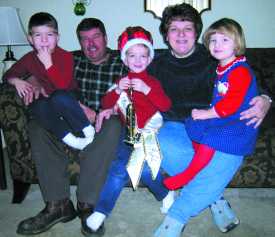
The
Bradshaw family posed for a photo last Thursday in their living room. Pictured
from the left were
Matthew, Tom, 2004 Little Mr.
Outdoors Will Bradshaw, Donna and Katherine. Daily Banner Photo/Richard
This
year, for the first time, they decided to allow their children to participate
in the annual event.
"Both
Matthew and Will competed," Mrs. Bradshaw said of her sons.
At
the show rehearsal, both of the Bradshaw brothers participated and received instruction
in how to walk
down the runway, stop at the X marked
on the floor, wave and then walk back, no problem.
On
Saturday afternoon, the Little Mr. contest preceded
the Little Miss event. Each boy came out and talked
a few minutes with Master of Ceremonies
Pat Weilgosz. There were 16 Little
Mister contestants. Tom and
Donna
Bradshaw waited patiently. Will was contestant number 14 and his brother,
Matthew was number 15.
"Mr.
Weilgosz asked each contestant questions based on the
information provided in the application by
their parents," Mrs. Bradshaw
explained.
"Will
got onto the subject of riding on the back of 'Pop-Pop's tractor, being driven
by his daddy," Mrs.
Schuyler
recalled. "He put his arm on Mr. Weilgosz's
shoulder and told him they had found a toy snake that
day - he called it a decoy snake.
The crowd was really laughing and I sat there thinking to myself that Will
was explaining it more like he was
54 years old rather than a 4 year old."
When
it was time for all the contestants to be brought back on stage, Will was a
no-show, at first.
"He
was out in the hall with Smokey the Bear," his mother remembered.
"But, he made it back on stage in
time to be crowned Little Mr.
Outdoor."
"We're
not sure he really knows what has happened and what it means," Mrs.
Schuyler said of her son, Will.
The
young man of the hour was asked how it felt to be named Little
Mr. Outdoor.
"Good,"
he said with a big smile. "I've never won anything before. I won a trophy
too. Wanna see it?
With
that, he was off to his room and returned a moment later with his title trophy
and sash.
He
might not know exactly what it means to be Little Mr.
Outdoors. But, it was evident that Will Bradshaw
knows full well that he won and it's a
good thing.
http://www.newszap.com/articles/2004/03/01/cambridge/news02.txt
Japanese students turn into teachers for an afternoon : JAPAN
By
KYLE LOWRY
March
01, 2004
A
little bit of
presentation incorporated many of the
Japanese students living in the area. They performed several
musical numbers and demonstrated fun
activities that take place in Japanese culture, including a
three-legged race.
�The
students love to learn about what other kids do in other countries,� said
Jeanette Burbank, the
school�s English as a second language
teacher.
The
mothers of the Japanese students scripted and choreographed the program in its
entirety. The group
began planning the event in November
and have been rehearsing since January.
�Teaching
younger kids about my culture is neat,� said fifth-grader Mayuna
Ito.
Ito
came to the United States five years ago when her father, Hirotoshi,
took a job at Aisan
and another fifth-grade student,
Shun Ozawa, will return to
their education.
��We get new students in March and April
because that�s when the semester ends in
spend four to five years here,�
Ozawa
said it took him approximately three years to speak English fluently and he has
concerns about
re-acclimating himself to life at a Japanese
school.
�I�ll
miss playing sports, like basketball with my friends,� he said.
However,
Ozawa said he is excited about getting to see his family again, especially his
grandparents. Aisan
also employs Ozawa�s father, Hiroshi.
http://www.tribtown.com/Main.asp?SectionID=1&SubSectionID=1&ArticleID=9587
News for Kidz �� Site Map�� Earlier NewsBites
NewsBites for Kidz � is published by the News for Kidz�
website. It is a free weekly e-newsletter, sent by subscription to kids
all over the globe. It is a digest of condensed news stories published by
international media, of the news in the life of kids.
Each news story and photograph is copyright of the
original news source quoted with it.
To subscribe, please send email to
[email protected] with "Subscribe" in the subject line.