NewsBites for Kidz
This is what
happened to, about and by kids this week
THEN AND NOW: No child's
play- Singapore
KIDS HELPING KIDS-
Public answers plea to
help- U.S. Iraq
Formula for fitness
U.S.A.
Getting schooled on classes
U.S.A.
Lakeland kids 'publish' their books
U.S.A.
Children thrive with a pet pal in the family U.S.A.
N.Y. law encourages kids credit unions
U.S.A.
ROLE MODEL
- Woman's Love Of Children Makes Her A
Hero In Their Hearts U.S.A.
ROLE MODEL-Jaguars teaching kids teamwork
U.S.A.
Kids serious about sport
U.S.A.
BOOKS- Mushrooms
U.S.A.
Karate kid
U.S.A.
Children's
gathering in Tutong Brunei
SCIENCE/TECHNOLOGY-Bringing
stars to earth �-India
SCIENCE/TECHNOLOGY
BRINGS KIDS TOGETHER - Uganda, Tanzania
HEALTH- Vitamin
D lacking in kids
Student
Astronauts -India
Earlier NewsBites ������News for Kidz
Home
________________________________________________TOP
THEN
AND NOW
Loretta Ann Soosayraj
PAPER planes, home-made go-karts, tree houses and camping.
These are the memories evoked when anyone mentions "childhood" to
31-year-old Riaz Sailendra.
Despite growing up in the '80s in
While traditional games such as kunda
kundi and congkak were
something they played in school, and there was a computer in the study room, it
was the great outdoors which was the preferred choice when the boys had it
their way.
With the help of their father, the three boys built a
tree-house in their garden, where they spent endless hours
just chit-chatting or playing board games.
"For a while, carroms was all we wanted to play ... something our dad
introduced us to."
Camping in a makeshift tent in their backyard during the
school holidays was usual, where the neighbourhood
boys were invited along for a snack around the campfire.
One of the best things Riaz
remembers doing as a 10-year-old was building a go-kart with his brothers.
Using old rollerskates, wood and lots of nails, and a
well-positioned foot as brakes, the ol' bucket of
bolts made the Sailendra brothers the envy of the
street.
"Before we knew it, everyone was copying our design.
They even came to us for our 'expert advice'!"
But parents today are more careful about - or protective
of - their children. Twenty years ago, roaming the neighbourhood
on a bicycle was normal. Today, scheduled time on the bike, at the park, under
the watchful eye of an Indonesian maid, is commonplace. Parents prefer sending
the tots to enrichment centres where supervised play
is the order of the day.
But Riaz insists that when he
eventually has children of his own, he "would definitely allow them (to
play freely) ... no, no, I would encourage them to get out there and play
outside with other kids. That's the only real way for a child to discover his
capabilities for himself. That's what my father gave me, and I want to do the
same. My father would insist that in the evenings, from
"Parents these days are very concerned about safety
issues, and who can blame them, really? But if you teach your child to protect
himself, he should be all right. It's all right to be cautious, but you have to
draw the line at being over-protective. A restricted childhood is no fun at
all.
"My brothers and I had the advantage of growing up in
an area by the jungle which we were constantly exploring. This was great for
character-building, and I would want the same for my kids."
And it is when you are left to your own devices that you
improvise, and the creative juices flow freely.
When Sharifah Aishah Syed Zainal
Abidin, 57, and her five siblings were growing up,
she remembers being very inventive.
"Without even knowing that such things such as paper
dolls existed, for example, we made our own! We cut out male and female figures
from magazines and old mail order catalogues, as well as pictures of clothes.
They looked pretty good!
"We only played games like congkak
and kunda kundi with our
cousins when we went back to the kampung for Raya. While the adults cooked, we kids would have a field
day playing galah panjang
from morning to
This mother of four says that while her own children spent
their formative years in similar outdoorsy fashion, the same can't be said of
her grandchildren.
"It's sad ...you can't ever bring back those things.
I tried teaching my grandkids how to play congkak and
they just didn't like it. They prefer riding their bicycles, and there's
nothing traditional about that!" she laughs, somewhat wistfully.
"Perhaps the kids in the kampung
are still playing congkak, tops and marbles, but for
the kids in the city, it is a whole different world. It's all about how many
monsters they can tembak in computer games." Not
how many marbles you can knock out of a ring.
Says Riaz: "One thing I realise is that when you're a kid, the stuff you play is
all seasonal. For a time, everyone carried bottlecaps
in their pockets, ready for battle. All the girls had their own pretty-pink
five stone pillows. Then a month later, the boys would be bitten by the galah panjang bug. Girls would
hear nothing of batu seremban,
because getah was the 'in' thing."
"Really, it was about trends," recalls
small-town-bred Benjamin Stern, 27: "The joke in school used to be:
seasonal until the teacher confiscates our stuff! But what we were into all
depended on what everyone else was doing ... so in the same way, I guess that
is what is happening to kids these days. If all their friends are glued to
PlayStation 2, you can't really expect them to work the congkak
board furiously, can you?"
http://www.mmail.com.my/Current_News/NST/Monday/Features/20031013082755/Artic
le/
________________________________________________TOP
�KIDS
HELPING KIDS
Supplies, and gifts not expected, pour in for 'Kyle's
schools' in
By DAVID PERLMUTT
Charlotte (N.C.) Observer
�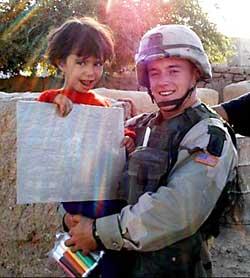
PHOTO COURTESY OF KYLE BARDEN
�
Army 1st Lt. Kyle Barden of
�
Oct. 15-The acts come in checks, small and not so small,
dollar bills, and change from a child's piggy bank.
�
A fifth grade in Maiden in
All for Kyle Barden's schools in
Three weeks ago, Army 1st Lt. Barden
of
Kyle's brother, Taylor Barden, a
After a story in The Observer, the
letters and donations have come from all corners.
At
Each of the school's 805 students is writing a letter or
drawing a picture that will be attached to 805 boxes of colored pencils.
"We want these students to understand that they have
a responsibility to contribute to their community and to the world, since our
community is in the world," said Dot Branson, an assistant principal.
"... I was watching the news last night, and saw soldiers throwing bottles
of water to the children.
"It hit home, that children are the same everywhere.
They love to laugh. They love to be happy; they have the same
needs."
More than $5,000 has been raised. Taylor Barden had planned to use much of that money to buy 8,000
notebooks, 3,300 pencils, 2,000 pens, 40 desk or wall-mounted sharpeners, 100
boxes of Crayons and 100 boxes of colored pencils.
Kindness intervened.
Friends had scoured businesses for contributions -- going
to office supply stores for price breaks. They found Ron Longo, manager of the
Office Depot store in Pineville.
The idea of helping children
appealed to Longo, but he'd have to go to his higher-ups.
Days later, he called Taylor Barden:
"If it were up to me, I'd give it all to you. But
it's not up to me. I went to my manager. He went to his manager. And frankly
the best we can do is (pause) ... give it all to you for free.
"So use that money for
something else to help these kids -- because you're getting it all for
free."
WANT TO HELP?
Make out checks to "Kyle's Schools," and mail
donations to:
Bank of
Attn. Fred Wolf
To
donate supplies or for more information, e-mail [email protected].
�
http://www.thestate.com/mld/thestate/news/nation/7019259.htm
________________________________________________TOP
Barbara Yost
The
Lena Campbell loved her son so much for what was in his
heart that she missed the signs his body was growing too big, too fast for an
11-year-old. It was a fifth-grade field trip into the
Bo is one of thousands of
school-age children who have suffered from obesity.
"One of the key issues is that kids who are
overweight may not have a lot of obvious health problems now, but down the road
there are health issues that could come up," says Peggy Stemmler, a physician and president of the Arizona chapter
of the American Academy of Pediatrics.
There's reason to be optimistic.
"The younger you are, the easier it is to change
behavior," Stemmler says. "You have a real
window of opportunity."
Since 1976, obesity rates have increased in American
children from 7 percent to more than 15.3 percent and in adolescents from 5
percent to more than 15.5 percent, according to the American Obesity
Association. Complications can include diabetes, high blood pressure, heart
disease, bone and joint problems and depression.
Nutritionists say it's often difficult for parents to spot
the warning signs or see their children as anything but perfect.
"If we can do it, anyone
can," the
[Read about Bo as a baby and young child at
http://www.azcentral.com/health/diet/articles/1015obese15-CP.html]
It was on that trip to the
"I beat myself up for not
seeing it," Lena Campbell says. "It made me sick inside."
Success was only a treadmill away. Scott Campbell found Bo
an exercise specialist, J.D. Durso of Maximum Fitness
in
"We talked about nutrition, the overindulgence of
carbohydrates and choosing better carbs," Durso says. "
Durso advised
the
They don't eat late anymore. Treats come sparingly. Lena
Campbell packs him nutritious lunches, but Bo can occasionally choose to buy
lunch at school, even if it's a little off his diet.
Bo is 12 now and in the seventh grade. He's 5-6 and weighs
140 - that's a BMI of 22.6, or normal. He likes to shop for kid clothes - baggy
pants, cool T's. His attitude has changed, too.
"I'm more energetic. I'm more included now than
excluded," Bo says from a friend's recent birthday party. "I'm able
to do a lot more. I'm stronger."
Bo learned from Durso that he
can still have all the foods he loves, including party pizza, just not every
day and not in excess. Changing his lifestyle was difficult at first, but Bo
says it paid off.
"I really enjoyed it because
I had success," he says, adding that Durso makes
a workout fun.
Durso says
not every overweight child needs a personal trainer to lose weight, but he
considers it money well spent. Most important, he says, is for parents to spot
the warning signs that their family's lifestyle is a recipe for obesity.
Classic signs are classmates' ridicule, overweight children crying when they go
up a size in clothing and being embarrassed to be seen in a bathing suit.
With a family's support, kids can
get back into the swim.
"I think the children can be successful if they have
the desire to be," Durso says. "The
lifestyle has to change."
http://www.azcentral.com/health/diet/articles/1015obese15-CP.html
________________________________________________TOP
Getting schooled on
classes
Parents get taste of what kids learn at Edu-Prize
school
Lindsey Collom
The
Anne Ascoli of Ahwatukee Foothills traced a circle in red with her index
finger while hovering over her 13-year-old grandson, who was painting a
sword.
"It kind of looks like
corn," seventh-grader Chris Ascoli-Beyette said,
examining his creation.
The 55-year-old Ascoli laughed,
saying that was her guess. They were painting petroglyphs
as part of Edu-Prize's quarterly Cottage Fair.
Every nine weeks, families are invited to participate in
classroom activities with their children and see what they've learned.
"We focus on the multi-sensory approach . . . and
this gives parents a chance to experience for themselves
if they're brave enough to step up," said Keith Marshall, a junior high
social studies and language arts teacher. "It's a real family
environment."
Parents went through their child's class schedule,
switching rooms every 20 minutes while teachers helped with activities that
mirrored recent studies. Science teacher Chris Burt had groups play a flashcard
game that included terms from genetics and cellular reproduction. Parents visiting
Shakira Norman's social studies class deciphered
whether certain texts contained bias or reinforced stereotypes.
Giving parents a feel for their child's classroom
experience entices them to get involved,
"This gives them the confidence and desire to be a
part of the system,"
Findings from a January 2003 report from the
Chris said he feels fortunate that his grandmother wants
to be involved in his education. She went with him to the school's open house
and has been enthusiastic, he said.
"She loves me a lot," he
said. "She really would do anything to have me feel supported."
Thomas Mike, 44, of
"It's a great
experience," Mike said. "The knowledge is
overwhelming."
http://www.azcentral.com/arizonarepublic/tempe/articles/1015Geduprize08Z10.html
________________________________________________TOP
By Linda Theil, The State Journal
HAMBURG TWP, Oct. 14- �Haylee
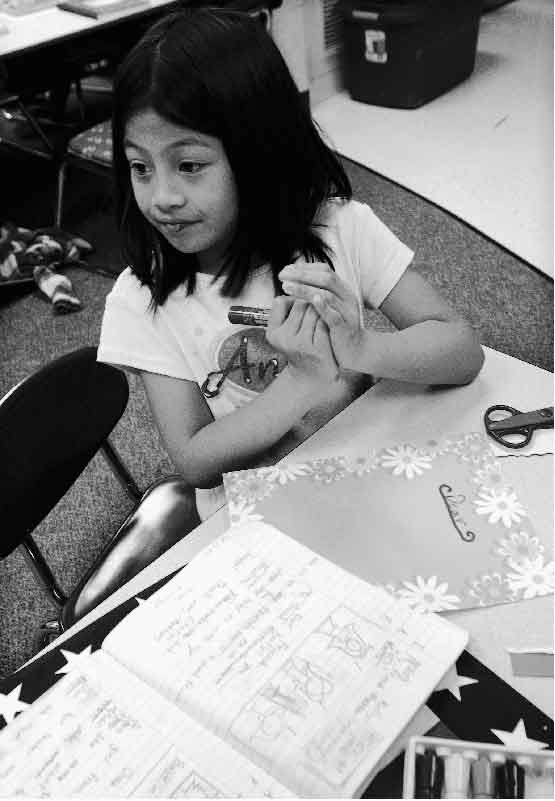
Black, 7, waited patiently for her turn at the publishing center in Lakeland Elementary's media center.
Two parent volunteers used ClarisWorks software to take
dictation from individual students.
When it was her turn, Haylee read from her "draft book" of work in
progress.
"I have a kitten. Her name is
After Haylee retrieved her
writing from a printer, a parent volunteer proofed the document, and Haylee departed for her second-grade classroom to begin the
task of illustrating her work.
"I put my cat in it. I put me in it. I put sparkles
on. After that, I tell someone the story, and after that, we put it in the
publishing box, and after that, we're all done with
our piece of writing," Haylee said. "It's
fun."
JOHN M. GALLOWAY/Special to the State Journal
The publishing center is a project
of
In the spring of 2002, the committee decided that
publishing a single individually created book once a year as they had
previously done was not meeting the students' literacy needs.
"The school improvement team decided that one book
each year didn't support reading and writing the way we wanted it to,"
said Laura Heatwole, 40, a parent and team member.
"We wanted to make the publishing center more a part of the culture of the
school instead of a one-time thing."
Balanced literacy is designed to teach a child the
relationship between reading, writing, speaking and listening and guides each
child individually through the process.
Kids hit the ground
"writing" in kindergarten.
"Years ago, we used to do a Letter People
program," said Fran Cox,
Using the balanced literacy approach, children are
encouraged to think of a subject, plan how they want to draw the subject, draw
the picture and then write about it.
Cox proofreads their writing and puts it in book-perfect
form. Initially, the book-perfect form is created by the teacher hand-printing
words the student has spoken and attempted to write.
As the teacher introduces the idea of
"publishing," she prints the student's words in a page format from
her classroom computer or sends the student to the publishing center.
"As our understanding of balanced literacy grew, we
saw the importance of the publishing center," said literacy coach and
second-grade teacher Sue Ruggles.
"The whole idea is getting students' writing in text
form so they see their writing as they're reading. They illustrate the writing
and share the writing with their class."
http://www.lsj.com/news/schools/031014_learn_4b.html
________________________________________________TOP
Children thrive
with a pet pal in the family
By Celia Hall, Medical Editor
Oct. 14-The spirits of Tom Kitten, Mrs
Tiggywinkle and Jemima Puddleduck
live on. New research has found that one child in five plays dressing up with
the family pet while one in 10, especially young girls, push their pets around
in prams.
The survey also found that contemporary culture had an
impact on children's activities with their pets. More than half, 53 per cent,
watched television or videos with their favourite
animal.
A total of 176 pet-owning families took part in the
survey. They had between them 338 children, 129 dogs, 94 cats, 22 fish, 30
assorted mice, rats, gerbils and hamsters, 35 rabbits, 18 guinea pigs, seven
reptiles, 17 birds in cages, one pony and six groups of poultry.
Nearly half the children went to their pet if they were
bored or upset and a third sought out their pet, in this case mostly a dog, if
they felt scared. A third went to their pet if they felt poorly, 85 per cent
used their pet as a playmate and 37 per cent had their pet beside them when
they were reading or doing their homework.
The survey, to be released today at the conference of the
Society for Companion Animals, also looked at the risk of zoonoses
- animal diseases that can pass to humans.
Dr June McNicholas, a health
psychologist at
Her survey showed that pets had wide access to the
household and that hand washing after contact with pets was either rare or not
insisted upon.
Children frequently shared food with pets, even when they
were not supposed to. Some of them shared their beds. The report says:
"Hand washing routines, however desirable, are almost impossible to adhere
to.
"For example, many pets are fed at human mealtimes
and many share snacks whilst the child watches TV - the one for you, now one
for me type of snacks, like crisps and sweets."
Elizabeth Omerod, the chairman
of the society said yesterday: "Contact with animals in the first year of
life can protect children against allergies and there are other social
benefits. Children learn patience. They learn to consider the needs of another
and not to put themselves first."
________________________________________________TOP
N.Y. law encourages kids credit unions
By MICHAEL GORMLEY
ASSOCIATED PRESS WRITER
So what's next? Credit unions for
elementary school students, under a law signed by Gov. George Pataki last
week.
But rather than providing a new clientele to pile up more
debt, schools and credit unions say the banking facilities will provide children
credit to learn how to avoid being adult debtors.
Savings accounts have been in
schools for decades.
But credit unions that offer savings and checking
accounts, debit cards, ATM cards, even credit cards and loans have cropped up
in recent years. The goal is for students to learn to build and protect credit
and to budget. Students who seek to be the tellers and managers also learn to
handle job interviews and others' money, the credit union officials said.
Credit cards are usually restricted to fifth graders and
above and only with a co-signing parent. Loans also are cosigned and balances
for credit cards and loans are kept low, usually to no more than $200 or
$300.
The
No students have been ensnared in credit debt from the
credit unions, according to financial officers in two long-standing programs.
"Our experience has been wonderful," said
Natalie McLaughlin, education partnership coordinator with the Community
Federal Credit Union based in
About 1,200 students in 17 schools are members of the
credit union. They can apply at 13 or 14 years old for a Visa credit card with
parental permission, but that is rare, she said. Most students get the card
when they are 15 or 16.
"Parents have really been requesting that students
get credit cards so they can learn to use them before they go to college, so
that allure of having multiple credit cards can be controlled by parents
better," she said.
Students use credit to buy on the Internet and to secure
cellular phones as well as for emergencies. One boy borrowed against his
savings to buy printing supplies for brochures to advertise his own business of
doing chores around the neighborhood. A girl borrowed for a new bike for a
newspaper route and paid it off from her earnings.
"My kids used debit cards and they learned a
lot," said Leni Hockman
of Alternatives Federal Credit Union that has operated the Dollars and Dreams
program in the Ithaca, N.Y.-area for 13 years.
"My son has been a great example of a kid who
couldn't keep a quarter in his pocket," she said. "Somewhere along
the way he learned the value of savings ... so as a little one wanting a Sega
(computer game system) he saved enough money to do that and it sort of changed
his whole way of thinking around, that 'I can do it by savings.' That's the
point."
�http://seattlepi.nwsource.com/business/apbiz_story.asp?category=131
0&slug=Kid%20Credit%20Unions
________________________________________________TOP
ROLE MODEL
Woman's Love Of Children Makes Her A Hero In Their
Hearts
--Angela Lee
84-year old, Buna Wood, of
Wood has taken care of children most all of her life,
starting at the age of nine, she walked the younger
kids to school. She adds, "I went to homes, and took care fo kids and took them to school,
cause we had three miles to walk.� That
is really far and they were too little to go by themselves."
She is the oldest of seven, a
mother of ten and even now, helps to take care of seven little ones.� She helps to get them ready for school and
even prepares a little snack when they return. Granddaughter, Paula Sullivan
adds, "She still goes.� She's had
two hip surgeries.� That is more than I
could ever handle. Every morning she watches my daughter and feeds her before
she reads to her and she takes care of the other kids, way more than I can ever
do." Sullivan says her grandmother has an unconditional compacity of love, and that she's a woman who's never
turned her back on anyone.
Wood says it is important that, if you can do something to
help somebody, it also helps you. She adds, "Never, ever think you're
better than anyone else; Never. And look around and
there's always somebody that can use your help if you want to put it out."
Wood advises,
simply make your bed every day and that will give you a good day.
Buna Wood was nominated by her teenage granddaughter,
Cassie Wood of�
http://www.ktvotv3.com/Global/story.asp?S=1480770&nav=1LFsIVYL
________________________________________________TOP
ROLE MODEL
Jaguars teaching kids teamwork
By Nyree K. Bowen, Community
Relations
�
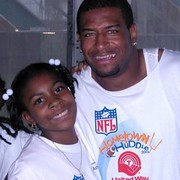
Oct. 13-Tuesday, October 7 was a special day for NFL
players in all 32 league cities. Over 300 players volunteered at local
Despite rain throughout the day, Jaguars players and
staff, along with volunteers from
This year's activity took place on the Jaguars' old
practice field adjacent to ALLTEL Stadium. The event featured an exciting field
day experience designed to emphasize the importance of teamwork and what it
takes to be a team member in the community. The event highlighted seven key
reflections of TEAM: Accountability, attitude, respect, compromise,
cooperation, tolerance, and togetherness.
The Jaguars players partnered with participating youth to
reinforce these important fundamentals through the field activities.
The program kicked off with a roaring welcome from a few
of The Roar cheerleaders and a short motivational talk from defensive back
James Trapp. Some of his fellow teammates who joined him on this special day
were linebacker T.J. Slaughter, wide receivers Cortez Hankton
and Matthew Hatchette, offensive lineman Marques
Ogden, quarterback Quinn Gray, defensive tackle Matt Leonard, running back Joe
Smith, center Brett Romberg, punter Chris Hanson, long snapper Joe Zelenka and corner back Kiwaukee
Thomas.
http://www.jaguars.com/Story/3203.asp
________________________________________________TOP
The young
competitors on the BMX circuit dream of being high-earning professionals.
By JOSEPH MALDONADO, Daily Record
correspondent
October 13-As Christopher Fisher of
Christopher was one of 843 racers to compete at last
weekend�s Quaker State Nationals, an official BMX event at
Christopher throws his bike to the ground, and cries openly
in frustration. Though he is only 8 years old, he places a lot of pressure on
himself to win, according to his father, William.
Christopher is not alone.
Over and over, kids come across
the line and perform the same bike-throwing ritual.
�In about five minutes, he�ll be
over it,� William Fisher said.
In fact, as his 3-year-old sister, Courtney, rushes over
to congratulate him on a good race, Christopher grins and goes back to enjoying
himself. Most of the kids angry about losing recover in about the same amount
of time.
Most of the riders in the big weekend event were young
amateurs like Christopher.
Some racers didn�t seem old enough to be in kindergarten.
In many instances, the trophies were bigger than the children who won
them.
But while the pressure got to some of them, a majority of
competitors came across the finish line with smiles.
Hundreds of parents took turns waiting at the finish line
to give their racers hugs and high-fives. Soon after that, they were on the
phone making celebratory calls, as if their child had just won the Super
Bowl.
�As parents, we really are proud of them no matter what,�
William Fisher said. �But it�s a race and some of these kids care a lot about
winning.�
It is the dream for some of these racers to turn professional
some day. If they can make it to that level, the reward for winning and cost of
losing will increase dramatically.
The entry fee to compete this weekend was $45. Much of
that money went into a pool that professionals can earn from. It will also help
pay for trophies and other overhead.
�Pro races paid anywhere from $80 to $875 this weekend,�
said Clayton John, president of the American Bicycle Association, which
sanctioned the event.
But some racers will have paid a lot of money to travel,
sleep, eat and race in
�We live two miles away and still spent between $400 and
$500 this weekend,� said Dave Cunningham of
Dave and his wife Kelly had two children race over the
weekend � 13-year-old Brandyn and 8-year-old
Heather.
They say the sport is sometimes nerve-racking to watch.
Heather has already been involved in a face-first accident this year that left
her face bruised.
�Her helmet absolutely saved her,�
Kelly Cunningham said.
But Heather was quick to get back
on her bicycle to race again.
�I can�t believe she keeps doing it,� her mother said.
�But our kids� desire for competition makes our support worthwhile.�
http://ydr.com/story/sports/14426/
________________________________________________TOP
BOOKS
Help kids learn about mushrooms in their yards
CAROLINE PARR
Date published:
IF YOUR LAWN looks anything like mine,
you've got a terrific crop of mushrooms this fall.
They come in all shapes and sizes, from ghostly white ones
the size of dinner plates, to delicately fluted ones in shades of brown and
gray, to bright orange ones with dark speckles.
Mushrooms appear so mysteriously
and look so enticing that children are drawn to them.
But anyone who's read "The
Story of Babar" by Jean de Brunhoff
knows what can happen if you eat wild mushrooms.
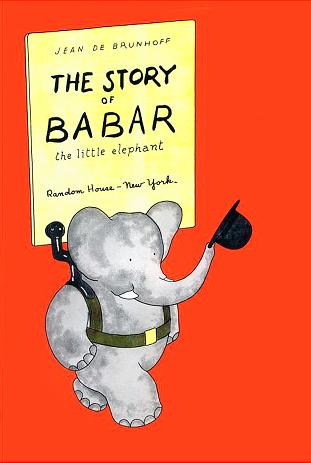
When Babar the elephant leaves
the city for a visit to his childhood home in the forest, he finds that the old
king "had eaten a bad mushroom. It poisoned him and he became ill, so ill
that he died."
No child who sees the picture of the wrinkled old
elephant, green with illness, lying next to a pair of bright red, spotted
mushrooms, will ever forget it. (The story ends happily, of course, when Babar himself is crowned the new king and marries his
beloved Celeste.)
Peter Murray explains just how
mushrooms grow in his easy science book, "Mushrooms."
First he shows readers the mycelium and explains how it
feeds the fungus. Then, a bit of wet weather helps the mushroom to reproduce,
and next thing you know, those ghostly umbrellas are pushing up through the
ground.
In her book, "Mushrooms," science writer
Millicent Selsam begins with a bit of history.
"Mushroom stones" that may have been used in religious ceremonies
were carved in
Today, mushroom growers use compost to grow the fungus
commonly known as button mushrooms, the ones found in the local grocery store.
The black-and-white photographs are not as dramatic as
Sylvia Johnson has also entitled her book
"Mushrooms," but this offering for older readers combines beautiful
photographs with more detailed information about the differences between fungi
and ordinary green plants. Everything from parasitic mushrooms (including one
that sprouts from the pupa of a moth!) to the origins of fairy rings to the
beautifully named puffballs, earthstars and stinkhorns is covered.
"The Wonderful Flight to the Mushroom Planet" by
Eleanor Cameron may not be scientifically accurate, but this simple science
fiction tale has been a favorite of third- and fourth-grade readers for
generations. Chuck and David are two ordinary boys who answer an ad in their
local paper for "a space ship about eight feet long, built by a boy, or by
two boys, between the ages of eight and eleven
"
With guidance from a mysterious astronomer, Mr. Bass, who
adds the all-important rocket engine, the boys fly to the planet Basidium, where they must save the mushroom people from a
most horrible fate. Luckily, their pet chicken, Mrs. Pennyfeather,
has joined them on the voyage, and she plays a key role in saving the Basidiumites.
Finally, share Mirra Ginsburg's
picture book, "Mushroom in the Rain," with your preschooler to find
out what happens to a mushroom in the rain. You and I won't be a bit surprised
to discover that it grows!
http://www.freelancestar.com/News/FLS/2003/102003/10142003/1121910
________________________________________________TOP
By Parna
Sarkar-Basu / News Staff Writer
WESTWOOD -- Nine-year-old Matthew Haddad recently earned
his black belt in martial arts, making him the youngest student in Westwood and
possibly in
Haddad, like coach
Steve DiOrio and family, is extremely proud of his
accomplishment.
"I feel great because I've
made history," said the young student. "I worked hard at
it."
"Matt is a very willing student. He got the maturity
and discipline sooner than most kids do," said DiOrio. "In addition to physical skills, he is very disciplined and self motivated."
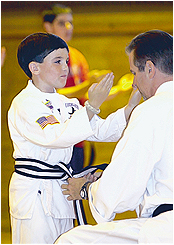
"As far as I know, in our style" Matt is the
youngest student in
"This is really a milestone," said his mother,
Debora, an
Haddad joined the Recreation Department's karate class
while in pre-school. According to his mother, that was the only class he could
attend that did not conflict with after school activities.
"He is very
focussed and really enjoys the program," Debora
said.
Getting a black belt is more than just mastering the kicks
and chops. In addition to repeating the moves, "they have to show some
ability to teach," DiOrio said.
"I teach them the art and they internalize it,"
said DiOrio. "I inspire it but in the end, it
does come out of the kid. Every junior black belt is an apprentice
teacher."
Westwood has eight junior black belts with an average age
of 11 to 12 years old and Matt is an assistant instructor to DiOrio.
"Little kids look up to him
and he really enjoys it," said his mother.
This summer, eight martial arts students took the test,
five for first degree and three for second degree black belts, said the
instructor, who has been teaching professionally for the last 12 years.
"The purpose of the test is to make them do things
they have done hundreds of time but do it under pressure," said DiOrio. It is to see how the students respond under
pressure, not "bring fighters into this world."
http://www.dailynewstranscript.com/news/local_regional/wstw_karatekid10142003.ht
m
________________________________________________TOP
Children's gathering in Tutong�
�
By Abd Hamid HAR,
�
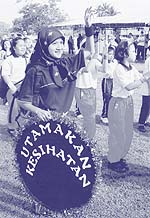
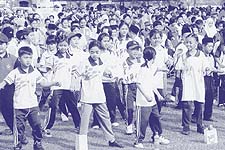
Aside from some of the fun activities organised
- such as 'blow the balloon till it pops', treasure hunts, quizzes and
'sweets-collecting race' - students from Tutong I and
II also put up an aerobic exercise show. There were performances by Sekolah Rendah Sengkarai as well.
http://www.brunei-online.com/bb/tue/oct14h21.htm
________________________________________________TOP
SCIENCE/TECHNOLOGY
This dome brings stars to earth for children
Express News Service
New Delhi, October 13: Stargazing is always fun but as the
students of DAV School, Sreshtha Vihar,
found out today, one needn�t crane the neck looking skywards.
The students had a dome-shaped giant planetarium as
classroom and a computer-generated starfield
simulating before them images of the night sky. We are talking about a portable
planetarium that brings astronomy, earth science and weather right into the
classroom.
Dehradun-based
Constellation Mobile Education & Learning Technologies (CMELT) showcased
the portable Starlab Giant Planetarium from the
stable of Learning Technologies Inc. Deep Bali, partner in CMELT, said: ��The
planetarium is designed as a learning instrument and meant to trigger
scientific enquiry among students.��
Claiming this to be the first in
The planetarium consists of an inflatable dome with an
array of projection cylinders. The dome is made from nylon-reinforced, flame
retardant and industrial grade fabric. It can accommodate up to 90 children at
a time. It has an entrance tube 4.5 feet high and 4 feet wide. Air vents keep
the temperature comfortable. The dome can be made ready in 10 minutes.
Students enter the dome and sit around the borderline.
Using a rotating projector and projection cylinders, images are revealed on the
dome�s periphery from inside.
At Rs 100 per student for a
one-hour show, it was fun at its best. ��We had till now read about galaxies
and the Milky Way in books. Today, it was as if these had come alive,�� said Ankur, a student.
Instructor Siddharth Trivedi, who is also a partner in CMELT, said the focus in
such programmes is on interaction. ��Students are
free to ask questions at any time during the show,�� he said. The topics vary
from astronomy, earth science, physical science, geography, weather patterns to
navigation.
��As far as astronomy is concerned, over 3,000 stars are
projected to a limiting magnitude of 5.5 with the 14 bright stars individually lensed to produce intense pinpont
images,�� said
He informed that the global tectonic projection is based
on the work of Dr Paul D. Lowman on the continental drift theory at the Goddard
Space Flight Centre. This map shows active ridges, faults, spreading centers
and volcanic activity over the past 1 million years.
�
�
http://cities.expressindia.com/fullstory.php?newsid=65584
________________________________________________TOP
SCIENCE/TECHNOLOGY BRINGS KIDS TOGETHER
By Wairagala Wakabi,
The East African (
Schools in
The project will link thousands of students from around
the world in one of the largest educational events ever attempted on the
Internet.
 The Global Schoolnet Alliance is part of activities
by the UN to mark the 55th anniversary of the Universal Declaration of Human
Rights on December 11.
The Global Schoolnet Alliance is part of activities
by the UN to mark the 55th anniversary of the Universal Declaration of Human
Rights on December 11.
Some 40 educators from around the world will travel to
At WSIS, world leaders will discuss how to increase the
use of and access to information and communication technologies (ICT),
particularly in developing countries.
"Students will explore the impact of information and
communication technologies on the right to give and receive information as well
as the right to education as described in Article 19 and Article 26 of the
Universal Declaration," said Bill Yotive,
project manager of the UN Global Teaching and Learning Project.
Students from
 Arthur Ndela, the leader of the Tanzanian schools benefiting from CyberSchoolBus, said
At the conclusion of the three months of student
interaction, the CyberSchoolBus and European Schoolnet will invite educators responsible for computer
networks that link thousands of schools in over 40 countries to
�
A series of online activities, set up and managed by the
UN's CyberSchoolBus website in partnership with
European Schoolnet, will guide their explorations.
These will conclude with a live interaction, via the Internet, between students
and a head of state at the WSIS.
Shashi Tharoor, the Under Secretary-General of the UN Department
of Public Information, said he hoped the project would show teachers,
governments and donors what can be achieved for so many students with a simple
computer and a telephone. "Schools, in particular, are playing a critical
role in equalising access to new technologies -
across gender, race, socio-economic grouping, and geographic location. In
developing countries, computers installed in schools have become a key tool for
both education and community development," he added.
The activities offered by the project cover five topics:
the Universal Declaration of Human Rights, free speech, ICT and learning about
different cultures, ICT's contribution to developing
peace, and the digital divide.
Read more about the Global Schoolnet http://www.globalschoolnet.org/
http://allafrica.com/stories/200310140805.html
________________________________________________TOP
HEALTH
Doctors are now worried about the lack of vitamin-d in children
Paul Ferrante
The body absorbs vitamin-d when we spend time in the sun,
but with more kids spending more time indoors on the computer they could be
setting themselves up for serious health problem.
Doctors say: osteoporosis and rickets are just some of the
diseases that can come about from a lack of vitamin D.
The second best way to get vitamin "D" is to
drink a lot of milk.
Teenagers who *don't* can be at risk for stunted growth and
bone fractures.
http://www.hoinews.com/news/features/1/394541.html
________________________________________________TOP
The Hindustan Times on Wednesday was full of praise for
Delhi-based Saatvik Agarwal,
16, and Vignan Pattamata,
14, from the southern state of Andhra Pradesh, who will join 14 other student
astronauts at NASA� Jet
Propulsion Laboratory in

Vignan Pattamata
The paper said the American Planetary Society had been
impressed by essays written by the Indians on how they would use the two Mars
space probes, named Spirit and
Spirit and
WATCH THIS KID!!
This kid wants to be the first on
Mars
Ehtasham Khan in
He dreams of being the first person to step on Mars and
his inspiration is none other than President A P J Abdul Kalam.
Meet 14-year-old Saatvik Agarwal, a Class X student at
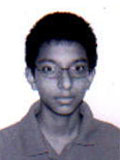
Saatvik is
among 16 students selected through a global contest to work as 'student astronauts'
with NASA scientists. The students will spend two weeks next year learning at
the Jet Propulsion Laboratory -- NASA's centre for robotic exploration of the
solar system -- in
Saatvik will be
part of the Science Operations Working Group on the project Red Rover Goes to
Mars between January-March 2004.
Speaking to rediff.com, Saatvik revealed his love for stars, space and Kalam.
He says, "I want to work with him (Kalam) one day. He is not just a great scientist but also a
great human being."
He says he wants to take the President's blessings before
leaving for the
"The best thing is that I will work with the scientist who are actually commanding the project on Mars. I
am excited to go there and I am working hard for it," said Saatvik, the only son of his parents. Another student who
has been selected,
The Planetary Society, a US-based space interest group,
had interviewed 60 students across the world. The students were short-listed
after an essay-writing competition. Saatvik was asked
to write an essay on 'What would I do with a robot if I get to control it for
two days on Mars'. He was then interviewed on phone.
He recalls: "The topic of the essay was good. It
required a lot of research. I had to study how a robot works, what it can do
and lot of other things. Then I read a lot on Mars. All these helped me to
write a good comprehensive essay.
"The interview was nice. They asked me some
scientific questions but generally they wanted to know how aware I was on space
science. It was a good experience."
Saatvik wants
to study aeronautical or computer engineering at MIT in the
Strongly critical of brain drain, he says: "It is an
established fact that Indians are very intelligent. Our engineers and
scientists are doing so well in the
"There is something lacking here and we will have to
create an environment to correct this. I want to work in my own
country."
Saatvik had
earlier won the 'Original Mind' award instituted by the Infosys
Foundation and an award for his 75-page Web site on space, given by Kiran Bedi's India Vision
Foundation.
When he is not busy with the Internet, he reads about
space science, physics, mathematics and science fictions. "I am passionate
about space because we know little about it. It makes me curious," he
says.
He is now a celebrity in his
school and his teachers and friends are proud of him.
Bharati Sharma,
school principal, says: "He has made us proud. I expect him to do even
better in life and make the country proud. I want to see him as a great
scientist and wish his dreams come true."
Rajeev Agarwal, his father, who
is an Internet consultant, says: "We all are happy. But this is just the
beginning."
http://us.rediff.com/news/2003/oct/15khan.htm
More
info:http://story.news.yahoo.com/news?tmpl=story&u=/afp/20031015/wl_sthasia_afp/india_space_031
015061149
Read more about the
project:http://www.planetary.org/rrgtm/pr20021015.html
________________________________________________TOP
Earlier NewsBites ������
NewsBites for Kidz
� is published by the
is published by the News for Kidz™ website. It is a free weekly e-newsletter, sent by
subscription to kids all over the globe. It is a digest of condensed news
stories published by international media, of the news in the life of kids.
Each
news story and photograph�
is copyright of the original news source quoted with it.
To subscribe, please send email to [email protected] with "Subscribe" in the subject line.