NewsBites for Kidz Sep
29- Oct 5
This is what kids all over
the world did last week
Moving for
adoption –
AOL spins
Web for kids online- World Wide Web
Watch out
for backpacks!-
Colts aid in
Iraqi football camp for kids-
Kids got chance
to vote at Declaration's exhibit-
Text
messaging makes cell phones even hotter among kids-
EDITORIAL: Shoeshine man brightens day for kids- U.S.A.
Kids learning from
kids- U.S.A.
East Greenbush students grow with their garden-
Computer
game teaches fire safety to kids- -
BOOK REPORT: New wizard of
children's fiction-
Successful
Start to 'Kids in Kruger' Project-South
ADVICE Children need down
time, too- -
Kids get TV
news show-Australia
TRAVEL Medieval castle charms
young and old in southern France-France
COLUMN Inside Mexico: A remote education- Mexico
Fire Ants Are a
Rainy Season Treat-Venezuela
Children's Parliament
Launched By Government And UNICEF- Congo
Don't free your
fish by flushing, kids –
Without toys
but not without dreams –
Kids keeping active at the gym-
Earlier NewsBites News
for Kidz Home
_____________________________________TOP
http://www.etaiwannews.com/Taiwan/2003/09/30/1064886213.htm
Moving for adoption
World Vision
2003-09-30 / Central News Agency /
Mr. and Mrs. Lee Hung-kuang, who lost their
only six-year-old daughter several months ago, seem to have regained meaning in
their life recently after adopting two children in
Accompanied by Hank Du, president of World
Vision
The Lees were so overwhelmingly enthusiastic that they probably emptied an entire department store's children's section before heading to Ulan Bator, according to Du. The Lees spent more than one hour in their first meeting with their new son and in their first meeting with their new daughter just on handing out gifts, Du said.
Du accompanied several "new
parents" from
"We now need 500
In Arvayheer, World Vision Taiwan is not only taking care of children who are orphans or from poor families, the organization is also helping the locals to start up their own vegetable farms- a daunting task in a windy desert-like place without an irrigation system, Du said.
Lee, who traveled with Du's mission to Arvayheer, said World Vision
"The Arvayheer residents' resilience in surviving harsh conditions and striving to make a living moved me greatly," Lee said.
According to Du, 36 percent of the Mongolian population has an average daily income of less than US$1, while some 4,000 poor children are regularly out on the streets to earn a living because their parents have no income.
Du said he personally saw
hundreds of children spend cold winter nights in underground sewage systems in
He said he couldn't stand being in the sewage system for more than three seconds because of the stench down there, but the pipelines are the only shelter that the poor Mongolian children could find to survive in the snow blizzard-stricken country.
Since 1993, World Vision
In
Currently, about 3,000
The number of Mongolian children who have been aided by Taiwanese exceeds 10,000 over the past 10 years, the staff member said.
World Vision
At present, the
_____________________________________TOP
BUSINESS
http://dayton.bizjournals.com/dayton/stories/2003/09/29/daily6.html
AOL spins Web for kids online
Businesses have known forever that the best time to build loyalty is when your customers are young. America Online, which needs to replenish its shrinking subscriber base, is taking aim at children.
AOL says it is introducing a new service called KOL, for children online. It says the new service will be "kid-centric" and parent-friendly and include features designed for those 6-12 years old. It's also introducing another service called KOL Jr. for preschoolers.
AOL says 46 percent of children go online at least four times a week, and nearly 20 percent go online every day. Children also are among the fastest-growing online audiences.
The KOL service will include content from companies like the Cartoon Network, Looney Tunes, DC Comics and Sports Illustrated For Kids. It also includes monitored chat rooms.
The KOL Jr. service also will have what AOL calls "a virtual online playground for preschoolers and parents to explore together."
AOL says both new services are available free to existing subscribers using its version 9.0 software.
© 2003 American City Business Journals Inc.
_____________________________________TOP
http://www.prnewswire.com/mnr/aca/11280/
Watch out for backpacks!
As Kids Head Back to School, They Should Watch Their Backpacks
WASHINGTON, Sept. 29 /PRNewswire/ -- Two new studies showing that heavy backpacks can lead to both back pain and poor posture in schoolchildren underscore the need for parents to educate their children on the proper use of backpacks as they head back to school, according to the American Chiropractic Association (ACA).
The first study, published in the medical journal Spine, found that the
use of backpacks during the school day -- and the weights of
the backpacks -- are associated with back pain. Another study, presented
during a meeting of the
This news comes as no surprise to the ACA, which has educated the public for years about backpack "ergonomics." In fact, the ACA believes the issue is so important that it passed a resolution urging schools across the country to put textbooks on CD-ROM -- so children won't need to lug heavy books in their backpacks.
"This new back pain trend among kids isn't surprising when you consider the amounts of weight they carry in their backpacks -- often slung over one shoulder," said Dr. Scott Bautch of the ACA's Council on Occupational Health and a noted ergonomics expert. "Many of these kids are carrying a quarter of their body weight over their shoulders for a large portion of the day. That's the equivalent of a 180-pound man carrying around a 45-pound load."
Luckily, backpacks have undergone a radical evolution since their rather humble origins -- with many backpacks now designed ergonomically to reduce stress on a child's body. Years ago traditional schoolbags, many of which were nothing more than sacks, were the rage. But the backpack of today has adapted to keep up with our changing lives. Kids not only pack heavy schoolbooks into their backpacks, many of them also strap popular electronic devices -- such as laptops, cellular phones, MP3 players, CD players, and personal digital assistants (PDA) -- into specially designed compartments inside their backpacks that distribute the weight more evenly.
But even ergonomically designed backpacks must be worn properly and not overloaded with unnecessary items, says the ACA. Backpacks should not weigh more than 10 percent of a child's body weight, they should have wide, padded straps, and should be worn over both shoulders.
Source: American Chiropractic Association
_____________________________________TOP
http://www.wthr.com/Global/story.asp?S=1462090
Colts aid in Iraqi football camp for kids
WTHR Indianopolis
The 800th US Military Police Brigade held a football camp for Iraqi
orphans in
The Colts, along with the New Orleans Saints, donated the jerseys and footballs.
The children aged seven to 13 learned passing, catching and kicking techniques.
"Part of this is the Army mission," says Dave Sider. "We are trying to win hearts and minds of all the Iraqi people. And if we can bring a bunch of kids out and work with them and interact with them, surely it is going to help international relations in the future."
The children got to keep the jerseys and other NFL paraphernalia.
The Ministry of Justice and the Ministry of Youth and Sport helped to organize the event.
_____________________________________TOP
http://www.oregonlive.com/news/oregonian/index.ssf?/base/exclude/1064836830287050.xml
Kids got chance to vote at Declaration's exhibit
--
Those 14 and younger voiced opinions, rejecting school uniforms but embracing public service
Youngsters visiting the Declaration of Independence on view at the Oregon Historical Society had a chance last week to see a fundamental American freedom at work: the right to vote.
Electronic voting booths gave youths the opportunity to voice their opinions about lowering the voting age, wearing school uniforms and requiring public service as a part of schooling, among other topics.
Organizers of the Declaration of Independence Road Trip, which opened
in
In voting results tallied and released Sunday, the students gave big support to community service as a requirement of high school graduation. They were slightly less certain about having student representatives serve on local school boards but still approved the idea.
On the question of being required to wear uniforms to school, however, the students were clear: 751, yes; 2,552, no.
In the over-14 age group, students favored requiring community service to graduate and requiring a transportation system that uses energy other than petroleum. But they strongly opposed lowering the legal voting age to 16.
Nearly 21,000 people visited the exhibit, which closed Sunday. The exhibit featured a rare original copy of the Declaration of Independence and other items of historical interest.
_____________________________________TOP
http://seattlepi.nwsource.com/lifestyle/141809_texting30.html
Text messaging makes cell phones even hotter among kids
By KRISTIN DIZON,
gr8 prt last wkend. I met sum1 there. hcit. bfn.
-If you read that with ease, you're probably an instant messaging pro.
For the rest of us, the translation is: Great party last weekend. I met someone there. How cool is that? Bye for now.
Instant messaging has become a way of life, especially for young people, from preteens through mid-twentysomethings. Now, a newer wave of communication -- text messaging -- is taking the skills and lingo of IM-ing portable.
Rather than delivering a message between computers, as in IM-ing, a text message is sent from one phone number to another, or to multiple numbers. The cell phone screen limits the display to 140 to 160 characters at a time.
If it takes off, expect to see flying thumbs tapping away at a cell phone keypad, texting friends and family.
A new selection of phones with full miniature keyboards is already popping up to serve the texting generation. "American Idol" fans could vote for Clay or Reuben by texting through AT&T Wireless. Others use text messaging to get sports scores or other alerts or bulletins.
Text messaging is just one more reason kids are clamoring for their own cell phones, at younger and younger ages.
"Only one or two of my other friends has cell phones," says
Katie, 13, an eighth-grader at
Katie texts friends in
If more of her friends had cell phones, Katie says she'd be texting more often. But she avoids texting or using the cell phone at school, where it must be turned off or silent, or it may be confiscated.
Text messaging, or SMS (short message system), has been far more
popular in
In the States, most people pay a set amount for a monthly plan and often have leftover minutes, so there's usually little cost advantage to text instead of calling.
Until last year, the six major wireless phone companies didn't let users send messages between networks.
But that's changed. After the carriers came to an agreement last year, awareness of texting and its use shot up. As with many new technologies, young people are leading the way.
Linda Barrabee, a senior analyst with the Yankee Group, a research firm, says 50 percent of wireless customers ages 18 to 24 are texting, as are 30 percent of 11- to 17-year-olds.
Texting is often casual and phonetic. Shorthand rules the medium. Punctuation? Ha! Capitalization? No way!
"We type really fast. It's like a conversation, so you can't go slow," says Amber Eriksen, a
15-year-old
Still, Eriksen says it takes too long to pound out a message, since she has to scroll through each number key to type the desired letter. A "Z" takes four taps on the 9 and an "S" means pressing the 7 button four times.
She uses plenty of shorthand, such as G2G for "gotta go" and BRB for "be right back."
Her friend, Stephanie Johnson, 16, creates her own abbreviations: eva = ever, yooh = you, and r = are.
Johnson, a Nathan Hale student, says she sometimes accidentally uses the lingo in her schoolwork, but has always caught and fixed it before turning in assignments.
Neither texting or IM-ing leaves the same electronic trail that e-mail does. Unless you save or print a message, it's gone once the user logs out or finishes the back and forth.
With IM, people have a list of buddies and can tell who's online at the same time. In texting, people usually have a list of people and their phone numbers saved in a directory for easy access.
Users say texting is less intrusive than phoning, especially if you want to check in with someone but think they may be in a meeting or busy. Unlike voice mail, you don't have to dial an access code to get a message. It simply pops up onscreen, with a little delivery beep.
It can be a simple way to send a love note or a flirtatious missive. In
And, it's one way for parents to communicate with their children without the kids groaning in embarrassment for being asked where they are and what they're doing.
As text messaging and portable IM-ing take root, it's anyone's guess what's next. "I'm sure there's a new technology that precious few of us have thought of that will be the next generation's IM," said Lenhart.
_____________________________________TOP
http://www.thedailyjournal.com/news/stories/20030930/opinion/355945.html
Shoeshine man brightens day for kids
EDITORIAL The Daily Journal
Originally published
Albert Lexie is a man with a small wallet but a big heart.
Over the past two decades, Lexie has donated thousands of dollars to help pay the cost of medical care for children. And he has done it one pair of shoes at a time.
Lexie, of
On the shoeshine box he sometimes carries around is written a simple statement: "Please Help Albert's Kids." To Lexie, all children who need a doctor's care are his kids.
In this world seemingly filled with news of terrorism, conflict and strife, it's refreshing to hear of a person like Lexie, a man without bitterness or hatred who does what he can to help others.
On Tuesdays and Thursdays, Lexie takes two separate buses to travel the 20 miles to the hospital. You know he's there if you see people walking around in their socks. You see, they are waiting for Lexie to shine their shoes while they go about their hospital rounds.
Although Lexie is 61 years old, he doesn't want to stop now. He has set his sights high. His ambition is to raise more money than Jerry Lewis, whose famous fund-raising telethons help fight muscular dystrophy.
We wish him well. Lexie is an inspiration to all of us and is making the world a kinder, better place to live.
_____________________________________TOP
http://www.capitalnews9.com/content/headlines/?ArID=42054&SecID=33
Kids learning from kids
By: Capital News 9 web staff
Two classes of seventh graders at
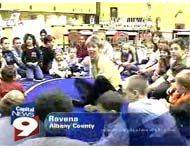
Teacher Alice Lammly said having the bigger kids study on the smaller kids is an effective way to get the lesson across.
She explained, "You can't beat the real, live child. They're unpredictable, and the big kids get to find that out. It's good for them to hear them cry, good for them to see them smile."
Seventh grader Nick Picarazzi said, "It went better than I thought it would. It was fun."
Some of the activities included reading, singing and making arts and crafts.
_____________________________________TOP
http://www.capitalnews9.com/content/top_stories/default.asp?ArID=42516
Updated:
By: Capital News 9 web staff
To market they go in

Students are learning to talk to customers, do math, and make change; and more importantly, they're learning to give back to the community.
Charlotte Cray said, "We're helping everybody because we donated a lot of stuff during the summer."
All proceeds from this year's sale will go back into the garden for next year.
_____________________________________TOP
http://winnipeg.cbc.ca/regional/servlet/View?filename=mb_game20030929
Computer game teaches fire safety to kids
WINNIPEG.CBC.CA
"We're losing kids every year to house fires because the first thing they want to do is hide."
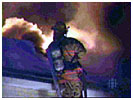
–Game creator Shane Ferguson
A new game called "The Great Escape" is meant to help children make smart decisions when faced with a fire.
The Firefighter's Burn Fund put up $50,000 to bring the game to life.
It's a personal mission for the game's creator,
"The message is getting out, but they're not retaining it," he says. "We're losing kids every year to house fires because the first thing they want to do is hide."
The game is aimed at students from kindergarten to Grade 8.
"It shows the way how you're supposed to get out of the house when there's a fire," says Paige Buss, a six year old who has tried the game.
While the older students acknowledge the game is for younger kids, they seem to enjoy it.
"It's for little kids mostly, but it's pretty good," says 12-year-old Danelle Cloutier. "It teaches you what to do and what not to do if there's a fire."
"I knew most of it, but I didn't know you should check the batteries in your flashlight, so that was a new thing for me," adds Meagan Ferguson, also 12.
The game is already played in 215
_____________________________________TOP
http://news.bbc.co.uk/2/hi/entertainment/3149310.stm
New wizard of children's fiction
by Emma Saunders, BBC News Online Entertainment staff
Children's writer Jonathan Stroud talks to BBC News Online about his new novel.
The last 12 months have been a whirlwind for children's author, Jonathan Stroud.
The 33-year-old's fourth novel, The Amulet of Samarkand, became the subject of a bidding war between four top publishing houses last year.
It resulted in a seven-figure deal with Random House and a £1.3m contract with film company Miramax.
Stroud had only written 92 pages when the book was snapped up.

The Amulet of Samarkand is one of a trilogy about a demon - or djinni - called Bartimaeus, who has been summoned by a twelve-year-old apprentice wizard, Nathaniel.
Stroud knew the idea was special when it came to him in 2001 but was taken aback by the frenzied interest.
"It was unreal, the weirdest thing," he says of the auction.
Flattered
The pressure was then on for him to finish the book and he managed to write the first four chapters in just two days.
"The idea came to me when I was out walking on a really dismal day last October and I pretty much had it mapped out from there," he says.
The book will inevitably draw comparisons with JK Rowling, whose hugely successful Harry Potter books centre around a boy wizard.
Stroud was touted around as the new Rowling when the book deal was first announced.
How does he feel about the comparison?
"I am honoured but also amused by the Rowling tag because it gets passed so rapidly from one person to the next," he says.
"I enjoyed the Harry Potter books and children's fantasy is doing brilliantly at the moment.
"I wanted to put a different spin on the fantasy thing and try something new - with the genie, rather than they boy wizard, being the central character."
Bartimaeus is a witty and likeable character, who does not slot easily into the good or evil category.
"I didn't want a po-faced dichotomy of good versus evil," says Stroud.
The genie's cynicism and dry sense of humour should ensure the novel appeals to adults as much as children.
Juggling
"The book is really for anyone, probably twelve plus. Adults will be able to get the book on different levels, like the humour and the references to history and myth," says Stroud.
The author, who gave up his editing job at a publishing company to write full-time in 2001, has a busy time ahead - his wife is expecting their first baby in December and a deadline for the second book looms early next year.
The first film will go into production in spring 2004.
Despite his success so far, Stroud has a bigger long-term ambition.
"As long as the books are still in print in 10 or 20 years time, that's what I'd like. There is a fantasy surge at the moment, so we'll see.
"But the best books survive fashion."
The Amulet of Samarkand is published by Doubleday, part of Random House, on 2 October.
_____________________________________TOP
http://allafrica.com/stories/200309290713.html
Successful Start to 'Kids in Kruger' Project
By Dirk Nel, BuaNews
(
September 29-A groundbreaking project has been successfully launched in
communities near the
During the month of September, the project's first Teacher Development Workshops were held, to prepare educators for their role in a 'Kids in Kruger' initiative, which will see thousands of learners paying day visits to the Park.
This pilot project, launched by the 'My Acre of Africa' organisation, in partnership with South African National Parks, is linked to the Environmental Education Programme developed by the national education department.
Facilitator Rob Janesch of 'My Acre of Africa' and local coordinator, Lidiwe Cuma have reported growing community interest in the project.
The initiative is seen by many as an example of the excellent opportunities offered by partnerships between the private and public sectors, to promote community development.
'Each workshop participant receives a relevant resource pack, and follow-up sessions are held to assist and guide the educators in the issues being raised,' Mr Janesch explained.
He said the concept of 'sustainability', one of the cornerstones of the course, had been introduced in phases, after establishing prevailing attitudes and value systems in local communities.
'There will be a holistic, integrated approach, and as such the process will not focus initially on environmental education in the classroom, but evolve from a personal exploration of the benefits of living in harmony with nature.
'The aim has been to expose educators to the importance of environmental issues in education, so they can understand that their learners hold the key to future sustainable life on the continent,' Mr Janesch added.
Copyright © 2003 BuaNews.
_____________________________________TOP
http://www.thedesertsun.com/news/stories2003/features/20030929012709.shtml
Children need down time, too
Strike a balance between home, school activities
The
September 29th-After much thought, Laurie Beth Pool decided her schedule just couldn’t give.
Balancing schoolwork, music and family was enough. There wasn’t room for softball.
At 13, Laurie Beth is one of a generation of children learning what it took most Americans to figure out after they finished college and got their first full-time job: how to split time among work, play and family.
With extracurricular options as varied as soccer, basketball, piano, violin, painting and photography, kids today are struggling to find the time for schoolwork and family, much less relaxation. And parents are struggling to keep their children from burning out before they hit puberty.
"A child needs downtime to play," says Kathleen Waldron, who teaches parenting classes at Arizona State University West.
She says that’s one reason several families limit their children to one athletic and one artistic endeavor at a time. Laurie Beth and her three siblings -- Aaron, 14, Rachel, 9, and Elizabeth, 8 -- are allowed just one extracurricular activity, not including school clubs, per semester.
That’s helped the Pool children handle their high-wire scheduling act, as has an intricate organizational system set up by their mom, Nancy.
"Paper and pencil is a huge tool in this house," says Nancy, who in addition to being the master scheduler of the family, volunteers at her children’s three schools. It’s nonstop activity at the Pool house with two children attending the neighborhood elementary school.
If the children need something from the store, they’re responsible for adding it to the proper list, whether it be the grocery list, the Target list or the Home Depot list.
Each child has a magnetic clip on the refrigerator, with permission slips, party invitations, IOUs, anything their parents need to know about.
At least once a week, over dinner, they pull out the family calendar and figure out who needs to be where when. Piano lessons for Laurie Beth and Elizabeth. Soccer for Rachel. Cross country for Aaron.
But not all families are as organized. Waldron says that too often, kids are stretched too thin among a variety of structured activities or become so obsessed with just one that they burn out.
So how much is too much?
"Parents need to ask themselves: Does my child seem content?" Waldron says. The key is striking a balance. Children shouldn’t be tired. They should get decent grades. They should have family time. And their lives shouldn’t revolve around one activity, particularly if that activity is a sport. Parents can sometimes push their kids too hard in sports, Waldron says, hoping for college scholarships or professional contracts.
To some extent, parents can let their children pick and choose activities, even when they’re as young as 5.
Waldron says parents should guide their children by outlining concerns. But because younger kids don’t have the experience to understand the sacrifices they’ll have to make, they often want to do everything.
Let them try, Waldron advises, as long as they don’t have to commit for a full season. After a few weeks of little free time, they’ll learn they can’t do it all and they’ll make a decision.
In the end, though, parents do need to stress family time. Nancy and husband Bill Pool, for example, vetoed a gymnastics class that was held during the dinner hour.
"It’s really important for parents to look at the family’s life as a whole," Waldron says. "Sometimes, you have to make sacrifices, but ask, ‘Is it having any truly negative effects on the family?’"
_____________________________________TOP
http://www.sundaytimes.news.com.au/common/story_page/0,7034,7416999%255E10431,00.html
Kids get TV news show
By Robert Fidgeon, The Sunday times
The Ten program is based on the ABC's Behind the News, which was axed by the national broadcaster in August as part of its $26.1 million budget cuts.
The 30-minute Behind Ten News will explain the week's main news stories in a format school-age children can relate to.
It will go behind the stories, linking topics to related or broader subject matter.
Ten chief executive officer John McAlpine said his network was proud to take up the challenge to provide a primary school news program.
_____________________________________TOP
http://edition.cnn.com/2003/TRAVEL/DESTINATIONS/09/29/sprj.ft03.carcassonne/
Medieval castle charms young and
old in southern
By Jenna Milly, CNN
"Over here, over here," 5-year-old Romain
screams when he discovers a brightly colored basket of swords for sale. Just
beyond him, his 2 1/2-year-old brother, Simon, plays by the dusty drawbridge
that marks the entranceway to the castle's old city, one of the top tourist
destinations in

Two defense walls, measuring nearly 2 miles long,
and 52 towers equipped
For many American tourists, an out-of-the-way international destination
may not seem like a natural spot for children or a traditional family vacation.
But recently, parents are traveling farther to enrich their children's lives
with new and different experiences, says Cathy Lanigan,
author of Lonely Planet's "Travel with Children," which recommends
"Castles are fascinating for kids because they've got that fantasy aspect and exploring potential and are different and exciting," she says.
Inside the walled city
On a recent summer day, throngs of people, most packaged into
picturesque families of four, surge through the narrow cobblestone streets of
the
The city receives 3.2 million people a year, and its officials couldn't be more pleased about the news of its increasing popularity.
"This is always been a place for children," said Philippe Miro, promotional director for the city's tourism bureau.
Two-thirds of the visitors are French, while the rest come from international
destinations, with
"It's the largest fortress in
"When you're small, when you're six, seven or eight years old, when you play, you love a castle."
A castle fit for a fairy tale
img src="http://www.geocities.com/evirtualkid/0929photos/hanging.jpg">
For $10 ($5 for children), visitors can attend a three-act re-enactment of a medieval show. Here, Charlotte Pouvreau, 15, amuses onlookers.
Miro, who says the city started a
campaign in the 1950s to attract American tourism, boasts that
The Disney corporation could not confirm which chateau, if any one in
particular, influenced Walt Disney's design decisions. But they did note that
the theme park king visited the
The connection is undocumented, but the similarities between the ancient castle and Sleeping Beauty's trademark manor are striking – and both have an enormous effect on children.
"It's not a vacation for us, it's a vacation for them," says Simon and Romain's mother, Annie Cuenot, who traveled 11 hours by car with the children and her husband, Jean-Luc, to see the castle.
Meanwhile, her husband lifts the boys on his back and swings them around like monkeys. "They are having fun, but it's been quite difficult to travel with them," she says.
Lanigan, an expert on traveling with kids, has heard that complaint before.
She advises families to take it easy and focus on the children during trips, as there is usually so much to do and so little time.
"I think the biggest mistake parents can make is trying to rush too much and trying to travel like you did when you were single," Lanigan says. "You have to slow down."
But it may be hard to pace in bustling
There are no entrance fees into the castle city, where children search the streets for the legend of Robin Hood. The 1991 movie starring Kevin Costner was filmed on location inside the chateau's walls.
Parents can enjoy sitting outdoors in one of the many street cafes, tasting some of the region's red and white wines and sampling the rustic specialties like cassoulet, a stew of white beans, duck confit, sausage and local spices – a few of the treats visitors expect to find in France.
A country known for indulging in "joie de vivre,"
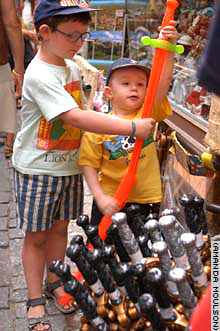
Brothers Simon and Romain marvel at play swords in the main entrance to the castle.
Louise O'Brien of the French Government Tourist Office says her office
campaigned to win back American tourists after the fallout earlier this year
from political disagreements between France and the
"A number of Americans were interested in traveling to
Lanigan credits a child's
vacation experience, whether it's to a castle in
"The world is a bigger place than their hometown," Lanigan says. "Capturing a child's imagination can stay with them a long time and make a big impression. It gives them a broader impression of what's out in the world."
Annie agrees. She smiles and nods her head as she watches her children laughing and running around with plastic swords.
"I think they will remember a lot and have memories of playing with Mama and Papa," she says.
_____________________________________TOP
http://www.upi.com/view.cfm?StoryID=20030929-014447-4981r
Inside
By Ian Campbell, UPI Chief Economics Correspondent
COLUMN
I asked how many children there were in the school and they looked towards a blackboard behind them on which were chalked up three figures in a column that added up to 71. The three rows were for the three years in the school, of children between about 12 and 15 years old. Three years and three teachers, but more teachers were brought to the children by television.
The school was a tele-secundaria, they explained, because it had a satellite connection and received lessons prepared by the education ministry. The lessons were fifteen or twenty minutes long. The children had a work book with exercises which they completed after watching the lesson. They could ask the teachers any questions.
I asked how well this remote education worked. "Very well," one of the teachers, a bearded man of about forty said. "We are a year ahead here of the ordinary secondary schools."
They showed me the work-book. "You have just seen a lesson,"
it wrote, "in which..." Then it asked some questions. "Do the
children learn English?" I asked. "Very little," one of the
teachers replied. "Is it included in the television course?" I asked.
"Yes," he replied, and he opened the study book to show me an English
lesson. "Where does the English language originate?" the book asked,
and offered three different answers: (a)
It was not a bad question. I have on more than one occasion in
Across the way boys were crowding at the door of one of the classrooms. One of the teachers shouted to them to get on with their work. "What are they doing?" I asked. "A chemistry project," the teacher said.
I asked what the children go on to do. "The prepas," they said, the preparatory schools that take children after secondary education, "are in Ezequiel Montes and Tequisquiapan," they said. To each of these towns the journey would take time and money.
"What about work?" I asked.
"In San Juan del Río," one of the teachers replied, "there are some jobs. But it costs.." and here he added up fares, "nineteen pesos fifty cents to get there and back. And there is food to buy as well."
When a workman's wage is about one hundred pesos (roughly $10) per day,
almost twenty was a big slice. And people from
"About seventy-five per cent of them go to the
"And what about examinations?" I asked. "Yes, we test them," one of the teachers said. "With a national test?" I asked. "No, just us," the teacher said.
No standardized national examination: nothing to work to; nothing for the pupil or the school to be judged by. No one would be held accountable for anything.
The teachers had been very kind and I thanked them and made ready to leave. "We also teach them about looking after rabbits and growing citrus fruits," one of them said.
"Do you do sports, too?" I asked as I put on my cycling helmet. In a neighboring room I had noticed a multitude of cups.
"Yes, basketball and football," one of the teachers said.
"Football (soccer) was my favorite in
Inside
_____________________________________TOP
http://www.newsday.com/news/nationworld/world/wire/sns-ap-exp-ants-anyone,0,2843831.story?coll=sns-ap-world-headlines
Fire Ants Are a Rainy Season Treat
By ALEXANDRA OLSON, Associated Press Writer
VISTA ALEGRE,
A storm has flooded anthills surrounding this Pemon Indian village of 20 clay huts, forcing the leaf-cutter ants -- known here as bachacos -- out by the hordes.
Slapping away at bites, the kids stuff the winged ants into plastic containers so their mothers can stir up a spicy concoction considered a diversion for Pemon who largely subsist on a vegetarian diet.
The children can't resist eating a few raw ants on their way home. Just pluck off the wings, feet and head. Crunch! Tastes a bit like blood.
They giggle, struggling to keep the ants from flying out of the containers. One toddler isn't so happy: He runs down the mound in tears, clutching his crotch.
For their parents, the hunt is worth it. Year-round, the Pemon in Vista Alegre eat casabe bread with tuma, a sauce based on a spinach-like leaf called aurusa that is boiled in water and manioc juice, then spiced with red, yellow and green peppers, or aji.
Normally, Pemon eat tuma for breakfast. And lunch. And dinner. Bachacos -- spiced ants -- offer a sweet variation.
Guillermina Zogala dips her hand into a pot of water and pulls out a handful of drowned ants. Sitting on a log, she tears off the wings before tossing the ants into a dark green tuma bubbling on an open fire.
"We don't eat the food you foreigners eat -- pasta or rice. Only spice. We don't have money for that other stuff," Zogala says.
Using leaves as pot holders, she brings the steaming pot to a wooden picnic table. Children bring a pile of casabe, a dry flat bread made out of manioc that is a Venezuelan staple.
They also carry a bucket of kachiri, a slightly alcoholic pink drink made out of manioc and purple sweet potatoes that tastes like a cool bitter potato soup without the milk. It's passed around in orange bowls crafted from squash shells.
Diners dip pieces of casabe into the sauce, making sure to scoop out at least one bachaco with every bite.
The ritual underscores how the Pemon thrived in a wilderness of towering mesas called tepuys, swift and violent storms, and seemingly scarce food before missionaries came.
A vast, rolling land dotted with forests, laced with rivers and home to
Many Pemon didn't see a Westerner until the
early 1900s, nearly a century after
Villagers along Route 10, the only highway in the Gran Sabana, live off tourism. They sell crafts, organize tours and serve roasted chicken -- and bachaco -- to weary hikers.
Visitors can take home jars of bachaco cooked in an auburn sauce. The ants aren't spicy; the aji-based sauce is.
But the takeout ants are skinny and shriveled -- not the robust insects children find in places like Vista Alegre, about 10 miles from Route 10 on a rocky, bone-rattling trail.
Several miles from the village, 55-year-old Margarita Gonzalez lives in a solitary hut in a forest clearing. That's how the Pemon lived before missionaries came and settled them into villages.
Gonzalez prepares tuma over a fire, tossing in sardines because a year-old girl has just finished the last of the bachaco.
From a distant hilltop come gun-toting men and their dogs, fresh from a failed deer hunt. It's been three weeks since anyone caught a deer; when they do, they share the meat among several families.
The men dunk cassava into the mix, chug kachiri and joke about their hunt as Gonzalez contemplates the only significant change in preparing tuma over the years.
"When I was a little girl we used clay pots," she says. "Then my father went to work for missionaries and brought back steel pots. It's much faster to cook in those."
On the Net:
Leaf-cutter ants: Ant Colony Developers Association: www.antcolony.org/leafcutter/leafcuttermain.htm
Copyright © 2003, The Associated Press
_____________________________________TOP
http://allafrica.com/stories/200309300103.html
Children's Parliament Launched By Government And UNICEF
UN Integrated Regional Information Networks
Brazzaville, September 30- A national children's parliament was inaugurated on Friday in the Republic of Congo, with the objective of providing the youth a platform to communicate the concerns of children and women in the country, the UN Children's Fund (UNICEF) in Brazzaville told IRIN.
The creation of the parliament followed a two-day national forum on Congolese children at the national parliament. Comprising 36 members, the children's parliament will be headed by an executive council of four girls and one boy.
UNICEF external relations officer Luce Saint-Pierre told IRIN that the children's parliament would serve as an official body entrusted with promoting children's rights, particularly in accordance with the Convention on the Rights of the Child [www.unicef.org/crc/], and with finding solutions to problems that affect children
_____________________________________TOP
http://www.mvgazette.com/news/2003/09/29/kids_mini_derby.php
http://www.fishupdate.com/news/fullstory.php/aid/1565/Don't_free_your_fish_by_flushing,_kids.html
Don't free your fish by flushing, kids
U.K., October 01-After hundreds of children 'liberated' their pet fish down the toilet following the launch of "Finding Nemo" in the United States, two environmental organisations are keen to avert a similar catastrophe when the animated block buster opens in the UK on 3rd October 2003.
_____________________________________TOP
http://www.jsonline.com/news/metro/oct03/174068.asp
Without toys but not without dreams
Makeshift playthings bring fun and tears
Fourth of five parts
None.
No dolls. No action figures. No board games.
There are a couple of basketballs, one of which a kid "borrowed" from a school playground, and two hoops: one an orange milk crate nailed to a dead tree, the other, a portable backboard and hoop held upright with a couple of old tires and some rubble.
"I don't play with toys," says Tay-Tay. Tay-Tay seems proud of this, as if toys were the sort of things that belong to an entirely different kind of 10-year-old.

After getting in trouble for going out into the street, Tavish, 8, takes refuge in a window at his home on 22nd and Lloyd streets. He'd been out front playing with his brother and friends
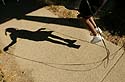
Paige, 7, is shown in shadow as she jumps rope with a discarded phone cord on a sidewalk near 22nd and Lloyd streets. The children have few actual toys to speak of. An orange milk crate nailed to a dead tree serves as a basketball hoop.
"Me, too," says 4-year-old Puna, imitating his older brother's bravado. "I don't play with no toys, either."
Tay-Tay says, however, that if he could have one wish, it would be for a big house far away from 22nd and Lloyd - "in a different country," he says - on a street of its own. No one would live there except his family and Ton-Ton, who is both his best friend and cousin.
Ton-Ton is sitting on the porch steps at 22nd and Lloyd with Tay-Tay and Puna. Ton-Ton, who is 11, is perhaps a foot taller than Tay-Tay and is very thin. His arms bulge at the elbows and wrists, his legs at the knees and ankles.
"You'd take me with you?" he asks.
Tay-Tay rubs Ton-Ton's shaved head.
On the sidewalk are Ton-Ton's sister and brother: Paige, who is 7, and Tavish, who is 8.
"How come you wouldn't take me?" Tavish asks.
" 'Cause you cry too much," Tay-Tay says.
"I never cry," says Tavish.
"You always crying," Ton-Ton says.
While a good loud argument is fine for breaking up an otherwise dull summer afternoon, Tavish isn't interested in a confrontation. He and Paige are busy turning a discarded inner tube into a jump rope. They cut the tube to form a stretchy rubber hose, with the metal valve stem poking out from the exact center of its length. The hose isn't very long, and only a small child can fit within its spinning arch.
Paige tries first. The valve stem nicks her hair and ankles, so she hands the tube to Tavish. Tavish makes several successful jumps, but when he tries to spin the tube in reverse, the valve stem smacks him in the nose.
He drops the tube and runs to the back of the house. There's an old wooden fence that covers 21/2 sides of the backyard. A yellow house just beyond the fence was torn down a few weeks ago, and today men are putting seed down where the house used to be.
Tavish leans against the fence and, thumb in mouth, watches the men and the birds that fly down to pick at the seeds; he tries, without success, not to cry.
If you were to sit here, on this porch at the corner of 22nd and Lloyd, it is likely that Tavish, who has a gentle spirit, would come sit beside you. He would suck his thumb while he touched your hair, stroked your arm, rubbed your back.
And if he were to see you walking through the neighborhood alone, he might worry for your safety. He might run up and say hello and take your hand and walk with you, and it wouldn't matter where you were going. That is his manner.
Tavish has a deep sympathy for loneliness. The palms of Tavish's hands are rough. His hands look like the hands of an old man.
Tavish has lead poisoning so severe that he can barely read his own name or even tie his shoes. It is an invisible assault. You cannot know, from simply looking at Tavish's smile, what it is like to be smaller than everyone else, slower than everyone else, more vulnerable. You cannot know what it is like to be more unseen and afraid.
_____________________________________TOP
http://www.capitalnews9.com/content/health_team_9/?ArID=42202&SecID=17
www.capitalnews9.com
Kids keeping active at the gym
By: Marcie Fraser
In
Concerned parents keep their kids active by enrolling them in programs
like My Gym in
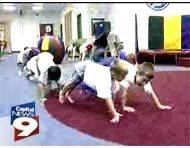
Parent Theresa Trump said, "I think it's very important to have our child get involved from a very young age so that it becomes something fun for them that they incorporate into their lives."
Each week, kids 6 months to age 9 take a one hour class. Most begin with a warm up, followed by stretching, various balance activities, rebounding, games and more.
Jacques said, "We teach them basic gymnastic skills of tumbling, balancing, hanging, hand-eye coordination and more."
Fun, fitness, and making new friends can translate into confidence.
Allyson Maltz said, "I like going to gymnastics 'cause I'm really good at it."
On weekends, the gym hosts special events like birthday parties. One all time favorite attraction is the Space Flight.
One of the reasons for the Space Flight is to build upper body strength. The best reason, which keeps the kids coming back, is how much fun it is.
_____________________________________TOP
Earlier NewsBites News
for Kidz Home
NewsBites
for Kidz™
is published by the News for Kidz™ website. It is a free weekly e-newsletter, sent by
subscription to kids all over the globe. It is a digest of condensed news
stories published by international media, of the news in the life of kids.
Each
news story and photograph
is copyright of the original news source quoted with it.
To subscribe, please send email to [email protected] with "Subscribe" in the subject line.