NewsBites for KidzTM
This is what kids all over the world did this week:
 Meet Goya, the gigantic rodent
__________________________________TOP
http://straitstimes.asia1.com.sg/singapore/story/0,4386,210666,00.html?
 Wheels of friendship
Nurul's friend
Shi Hwee wheels her to classroom
By Alexis Hooi
They were selected from more than
3,000 nominees.
At
She then wheeled her to her
classroom and attended to her every need for the next six hours of the school
day.
The Primary 3 pupil of
Nurul's mother,
Madam Jamilah Moefta,
turned up at the presentation ceremony to show her gratitude and support for
her daughter's soft-spoken buddy.
'It makes me really happy,' said
the 35-year-old McDonald's worker.
'I have wondered sometimes why a
Chinese girl would help out my daughter when Malay classmates don't even want
to be friends with her.'
__________________________________TOP
http://story.news.yahoo.com/news?tmpl=story&u=/ibsys/20030919/lo_WCVB/1796440
 5-Year-Old Has Big
Heart
5-Year-Old Has Big
Heart
The
NewsCenter 5's Liz
Brunner reported that at just 5 years old, Annie Sasena
has already had three major heart surgeries.
This weekend, she'll take
important steps to help other kids just like herself.
Annie's nightmare began when a routine
ultrasound during her mother's pregnancy revealed that her heart only had three
developed chambers, not four. When she was born, little Annie was immediately
wheeled into major open-heart surgery, leaving her parents to wait and hope.
"Her first three weeks in the hospital were up and down and I think at the
time when they sent us home, they really didn't think that she would
survive," said Annie's mother, Santa Sasena.
But she did survive. Doctors had
successfully re-engineered parts of Annie's heart. While it's not 100 percent
perfect, she is able to live like a normal 5-year-old.
"She's done things we never
dreamed possible. She skis, she dances, she's funny -- just kind of an
effervescent personality, a true wonder," said Santa Sasena.
Each year, 40,000 babies are born
with a damaged heart. It's the number one birth defect in the country.
This weekend, Annie and her
parents will participate in the Boston Heart Walk. The walk hopes to raise $1
million for research and community education programs about heart disease and
defects.
"Just the fact that she's
here today, my husband and I feel it's important to give back and to help
others that are going through the same journey that we went through," said
Santa Sasena.
Annie's journey will continue, but
she's not too young to realize she's lucky.
"Doctors helped me, for
making me healthy," said Annie Sasena.
The Boston Heart Walk starts at
__________________________________TOP
http://drkoop.com/template.asp?page=newsdetail&ap=93&id=515104
 Breaking
arms to break records
Breaking
arms to break records
Fractured Futures: More Kids
Breaking Their Arms
Some fear lack of calcium could
lead to osteoporosis down the road
By Amanda Gardner, HealthDay Reporter
The incidence of fractures due to
recreational activities almost doubled.


"Certainly recreation changes,"
says Dr. Stephen Honig, director of the
Khosla, who is
a professor of medicine at the Mayo Clinic in
"But among these
possibilities is that they're not acquiring optimal bone mass because they're
not getting enough milk," he adds.
The study authors point out that
between 1977 and 1996, the consumption of soft drinks among girls aged 12 to 19
increased from 207 to 396 grams per day, while milk consumption fell from 303
to 189 grams.
"That would suggest that
they're substituting for dairy products," Khosla
says. Overall calcium intake fell slightly from 784 to 771 milligrams per day
for girls and remained about the same for boys, although both values were below
the recommended dietary allowance.
Further studies are needed to see
what characteristics might distinguish kids who have fractures versus those who
don't -- in other words, is there a difference in level of activity or obesity.
Also, researchers need to follow these kids into adulthood to see if they
continue to have lower bone density and more osteoporotic
fractures as they age.
__________________________________TOP
http://reuters.com/newsArticle.jhtml?type=worldNews&storyID=3453718
 Cycle of Poverty
UNICEF Sees Children Caught in
Cycle of Poverty
Reuters
The agency saw a bright spot in
But the overall picture was bleak,
with some 123 million young people in all going without an education.
With most children in the
developed world back in school for the new term, recent surveys show that about
46 million in sub-Saharan Africa and the same number in south-east Asia have
never seen the inside of a classroom, UNICEF said.
"This is a disheartening
reality in a world where education is the right of every child. And it is a
major impediment to any effort to reduce poverty," said the agency's
Executive Director Carol Bellamy.
"The more children we leave
out of school today, the more adults we leave behind a few years down the
road."
While the gender gap has narrowed
over recent years, girls still account for more than half of those
not in school.
Children who do not attend school
are much more likely to suffer from disease [and danger] and girls are
particularly vulnerable, UNICEF said.
On the other hand, girls who get
an education grow up to take much better care of themselves and their families.
"This is key to breaking cycles of poverty,"
Bellamy said.
__________________________________TOP
http://calgary.cbc.ca/regional/servlet/View?filename=ca_wang20030916
 Child Prodigy plays on Leno Show
Child prodigy to play on Leno
CBC Alberta
And while performing at the front of
a hall filled with hundreds and releasing a CD is quite a coup for any
elementary student, Tuesday his audience will increase by untold numbers when
he plays on The Tonight Show with Jay Leno.
Harris'
"He seems to really rise to
the occasion," Mahood said. "When he has a
concert he's a different little person. He puts his whole heart into it, he's very emotional and very expressive when he's on
stage."
Harris prefers to play pieces that
are fast, exciting and colourful – and he only began
taking lessons two years ago. His first concert was put on a year later, when
he was six.
Harris Wang
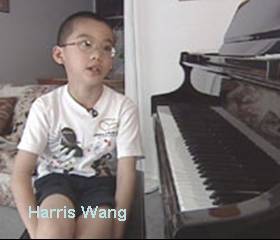
In an interview this summer,
Harris said he's good at the piano because he practices.
"And because my mom gives me
a reward and every time I get a reward, I know I'm doing good,"
he said, although he's not sure where his talent came from. 'Well, my dad's a professor, he doesn't know anything about music. My mom
sings Chinese songs when she was little."
Harris' future plans include
holding another concert before he turns eight and becoming either
a doctor, a professor or a concert pianist.
"Or probably all of
them," he said.
In the meantime he'll continue to
make his mark on TV – another American talk show has already called to book
him.
__________________________________TOP
http://www.timeforkids.com/TFK/news/story/0,6260,487850,00.html
 Downloaders
Face the Music
Downloaders
Face the Music
The World Wide Web, Sep.17 - The
recording industry is singing the blues and suing music fans. Listen up, music
lovers! on Sep.8, the Recording Industry Association
of America (RIAA) filed lawsuits against 261 people. The message: Swapping
songs free of charge over the Internet is illegal.
The RIAA represents
have shared more than 1,000 music
files each.
Music
Fans Tune In To The Latest Technology
About 60 million Americans use
Internet file-sharing networks (KaZaA is a popular
one). The networks allow users to locate and download almost any song and copy
it onto a CD without paying. This breaks
Last Tuesday, Sylvia Torres of
software is
easy. Owning it is legal. Using it to take copyrighted music is not. Critics
argue that lawsuits are not the way to teach fans to respect artists' rights or
boost sales. "CDs are far too expensive," singer Sarah McLachlan told TFK. "Kids wouldn't be so interested in
downloading if CDs were reasonably priced!"
Universal Music says it will lower
its CD prices on October 1.
McLachlan hopes
for a harmonious ending:
"We can find a way to make
the Internet work for everybody."
Should record companies sue
free-music downloaders?
Photodisc/ TIME FOR KIDS
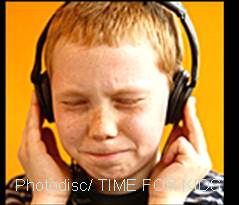
What do you think? Should people
be punished for downloading songs from the internet?
Click
here to see what TIME for Kids editors feel about this.
__________________________________TOP
http://story.news.yahoo.com/news?tmpl=story&u=/ap/20030910/ap_en_mu/john_denver_1

John
Denver Song Made Into Child's Book

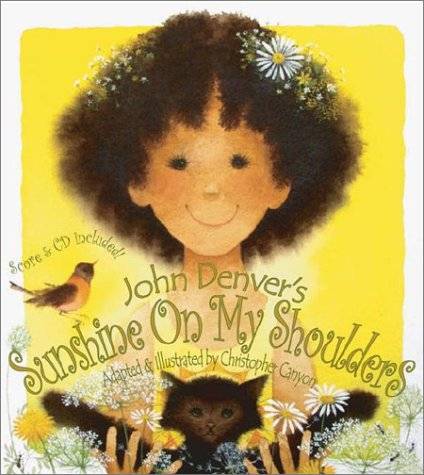
"Sunshine On
My Shoulders" will be the first in a series of kids' books based on

__________________________________TOP
http://www.augustachronicle.com/stories/091903/met_LG0428-1.000.shtml
 Children get drive for business
Associated Press
Peachtree City, Ga, U.S.A., Sep.18 - The Hot Dog Hut - actually a
golf cart that doubles as a snack stand serving hot dogs, nachos, chips and
drinks - is smaller than most lunch carts, but the three siblings who run it
are smaller than most business owners, too.
The Ritchies
- Alex, 14, and his 12-year-old identical twin sisters, Becca
and Krista - run the Hot Dog Hut after school.
They station their golf cart at
sporting events around
They recently set up shop outside
Starr's
"I've learned that you should
always keep gloves on while serving food and know how to count money really
fast," said Alex, a Starr's Mill pupil who acts as the money man and
general manager.
Krista, a
"I get a little nervous when
I'm setting up," Krista said.
The Ritchie family is looking to
take the cart to other sporting events such as soccer and baseball games.
About 25 percent of the business'
proceeds are donated to the organization that sponsors the event.
Becca, also
at
"The hard part for me is
going home to face homework at a late hour," she said.
"My kids are learning lessons
about responsibility, starting a business and all the hoops you need to jump
through." - David Ritchie, who bought the cart for his children
__________________________________TOP
http://www.sciencenews.org/20030920/fob1.asp
Week of Sep..
20, 2003; Vol. 164, No. 12
http://www.timeforkids.com/TFK/news/story/0,6260,488650,00.html By Jill
Egan
 Meet
Goya, the gigantic rodent
Meet
Goya, the gigantic rodent
TIME FOR KIDS &
SCIENCE NEWS
Think the rodents you've seen in movies
are scary? Scientists who've analyzed the fossilized remains of an extinct
South American relative of guinea pigs say that the ancient bruisers were as
large as bison.
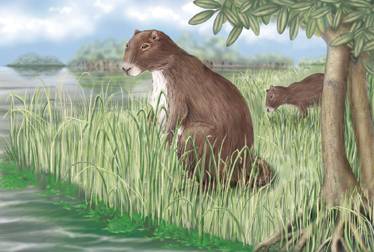 HIDE
THE CHEESE. A bison-size rodent, Phoberomys pattersoni, grazed on aquatic grasses and roamed the riverbanks
of ancient
HIDE
THE CHEESE. A bison-size rodent, Phoberomys pattersoni, grazed on aquatic grasses and roamed the riverbanks
of ancient
Imagine a nine feet long, 4.2 foot
tall, 1,500 pound guinea pig. It may sound like
something out of a bad horror movie but paleontologists have proof such a
creature actually existed. They recently uncovered the fossil of a now-extinct
rodent that was as big as a buffalo!
The discovery, reported in Science
magazine, was made in a dry region of
A
Look at Goya the Guinea Pig
Goya lived alongside giant turtles
and catfish, chewing on grass with its long teeth. The furry creature had small
ears and eyes and a long tail that helped balance its weight as it moved and
hunted for predators.
Goya probably didn’t have too much
trouble spotting one of its main predators, a 33-foot long crocodile!
Today, the largest crocodiles
average about 14 feet in length. Goya also had to watch out for other meat
eaters, like giant cats and gigantic birds called phorracoids.
The scientific name of the rodent
is Phoberomys (FOE-ber-o-mees)
pattersoni. The term pattersoni
was given to
the animal in honor of Brian Patterson, a professor who led a fossil-collecting
expedition to
All
in Goya's Family
Goya’s modern
relatives are other rodents like squirrels, beavers, mice and rats. Scientists
say that the closest living relative is probably the pacarana,
a rare rodent that grows up to 33 pounds and lives in the tropical forest of
the western
__________________________________TOP
http://www.timeforkids.com/TFK/news/story/0,6260,488302,00.html
 Isabel Hits the Coast
By Dina El Nabli,
TIME for Kids
Howling winds roared at 100 miles
per hour, downing trees and damaging beachfront homes. Heavy rain fell across hundreds
of miles of land. More than 4.5 million people lost power and over 1,500
airline flights were canceled. Hurricane Isabel stormed its way ashore on
Thursday, moving into
The huge storm was blamed for at
least 17 deaths: nine in
This
satellite picture shows the eye, or center, of Hurricane Isabel early Thursday
morning.
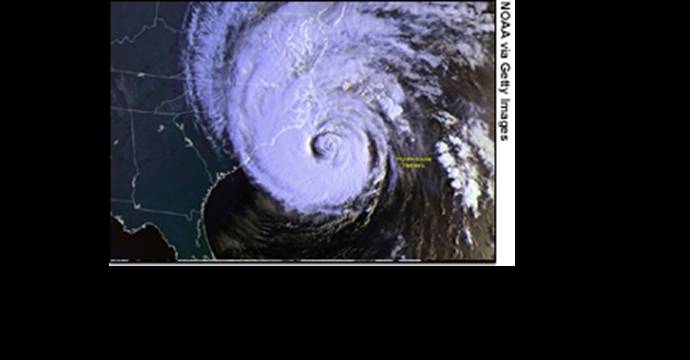
Eye
on Isabel
Hurricanes in the Northern
Hemisphere rotate in a counter-clockwise (west to east) direction around what
is called an eye. Isabel's eye pushed ashore Thursday afternoon along the
southern Outer Banks, according to the
Like most hurricanes, Isabel
weakened as it moved further across land. That's because hurricanes gain
strength from the heat and energy found in warm ocean waters. By Friday, Isabel
turned into a tropical depression as it traveled toward
Hurricanes are classified into
five categories, based on their wind speeds and potential to cause damage.
Weather forecasters called Isabel
a Category 2, which has winds of 96-110 miles per hour. Earlier in the week,
out in the
Hurricane preparations had been in
the works for a few days. In the nation's capitol, federal government offices
were shut down Thursday. The governors of
The
Good News
Despite its strong winds, Isabel
did not do as much damage as weather forecasters had predicted. It did manage
to dump as much as 4 inches of rain in
National Hurricane Center Director
Max Mayfield said Isabel posed a threat because ot its size, roughly equal to that of
__________________________________TOP
http://www.madisoncourier.com/main.asp?SectionID=4&SubSectionID=253&ArticleID=14157
 Youngsters
hanging out with the big kids
Youngsters
hanging out with the big kids
By: Jenny Jones, MadisonCourier Staff Report
As Shaver and her big buddy, Michela Jones, a freshman at
program had
planned for the first day with their little buddies.
"Her name is
With a surprised look, Jones told
Shaver that her name wasn't
"I want to call you
that," Shaver said with a toothless grin. "I can't remember
anything."
MENTORING: Dylan Truesdell,
6, and 14 other children from
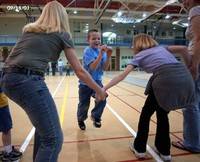
Madison Courier/ Ken Ritchie
Jones and Shaver are two of 30
members of this year's Hanover College Mentors for Kids program. Fifteen first
graders from
During their visits, the
Southwestern students, or little buddies, tag along with
The goal of the program is to give
little buddies positive role models who can provide stability to the kids and
who can encourage them to achieve in school and to attend college.
"It's just to have someone
there to inspire them, to be a positive influence in their lives," said
Sarah Allen, a senior at Hanover and president of the Hanover College Mentors
for Kids program. "I think there really is a need for it in this
community."
Southwestern first-grade students
are selected for the program by the elementary school administration every
three years and may stay in the program through fourth grade. When a student
complete the final
year in
College Mentors for Kids, he or she is recommended for the Big Brothers, Big
Sisters organization.
On their first official day together,
the big buddies took their miniature sidekicks to the Horner Health and
The children looked wide-eyed
through the windows that surround the school's basketball courts and watched
intently as the school's physical therapists aided athletes.
Then they got their chance to
play.
After finishing
laps around the school's indoor track, the little and big buddies took to the
courts where they formed two lines for a game of Red Rover.
"Red rover,
red rover, send Jayson right over," the
buddies yelled.
When Jayson
Chapin broke through the other team's line, the big buddies congratulated him
with high fives.
At the end of their session the
big buddies and the little buddies spent time talking and filling out their
journals, a task that will be completed every week.
"I just want you to know that
I'm very impressed" with how you all behaved, said Amy Scholz,
a senior at
__________________________________TOP
http://web.worldbank.org/WBSITE/EXTERNAL/NEWS/KIDSNEWS/0,,contentMDK:20102165~menuPK:150092
~pagePK:107739~piPK:107732~theSitePK:106839,00.html
 Tangerines, toys, T-shirts, and trade
The World Bank explains world trade
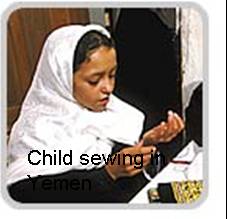 Child
sewing in
Child
sewing in
Take a look around you. All things
in your room, including your clothes, come from someplace. Check out the
labels: Made in
You play with toys made in
Trade lets countries sell goods and
services to other countries, and buy other goods and services from the same or
different countries.
“People sell things they are good
at making to other people who like or need those things,” says Ian Goldin, an economist and World Bank’s vice president for
external affairs.
To be able to trade with one
another, countries have come up with international rules that regulate trade
among nations. There is even an international organization that oversees these
trade rules. It is called the World Trade Organization. Its goal is to come up
with trade policies and agreements to help producers of goods and services,
exporters, and importers conduct their business with people around the world.
But many countries in the world
are dissatisfied with some trade policies. They consider them unfair. They
sometimes think that trade will hurt them more than benefit them. They become
afraid that their own farmers and factories will suffer if they import similar
products from abroad—especially from a country where people earn less money or
supplies are cheaper. They are also afraid that, as a result of competition,
some local workers who make those products will lose their jobs. Many experts
think these policies hurt poor nations more than rich
ones.
Government officials (mostly
finance and trade ministers) meet regularly through the WTO to talk about these
trade rules and to try to come up with fair ones. The rules need to be updated
every few years because circumstances change. At the current WTO meeting in
This is important because open and
free trade benefits consumers around the world. All countries can make and sell
things that other countries need and want.
__________________________________TOP
http://www.internationaldayofpeace.org/story/index.htm
- Story about Peacekids
http://www.internationaldayofpeace.org/kids.htm
 Sep. 21-
International Day of Peace
Sep. 21-
International Day of Peace
A worldwide movement for a better world has been growing,
bringing us hope for a more peaceful, just and sustainable future.
The United Nations has proposed a tangible goal that will help
unite our global community and shift our consciousness. The world is joining
together to create a Global Ceasefire and humanity's first day of peace in our
homes, our communities and between nations on the International Day of Peace,
September 21, 2003.
If we can create one day of peace, we will realize that we can
work together to create a culture of peace, one day at a time.
Each of us can help create a better and safer future by working together to
make Peace Day the biggest event in history.
Last year, Peace Day events and activities on the International
Day of Peace took place in 98 countries. This year, the United Nations,
governments, states, cities, groups, organizations and ordinary citizens aim to
inspire more than 1 billion people to be involved in Peace
Day activities on September 21.
The
International Day of Peace Vigil is a 24 hour vigil for peace and
nonviolence organized in places of worship, neighborhoods and communities all
around the world.
A major effort is being made to convince governments and the
peoples of the world to heed the United
Nations call for a Global
Ceasefire on the International Day of Peace.
A global Proclamations
for Peace campaign is creating a tangible way to measure support of the
International Day of Peace on the international, national, state and local
levels.
A simple Peace Pledge is
empowering both young and old to be involved in helping to create this day of
peace, inspiring the theme of a culture
of peace to become the center of dialogue in our communities and between
nations. How will you share the spirit of
peace on September 21?
Organizations and groups around the world are urged to become supporters
of the International Day of Peace.
The international community can share flyers, ideas and other resources that
can be printed from this website, making it easier to help spread awareness
about Peace Day and the many events and activities that will be taking place on
September 21.
A Countdown to Peace was launched to build up awareness and
excitement in the growing Peace Day campaign as we countdown together to the
International Day of Peace.
There are so many ways that
you can help to spread hope for humanity's first day of peace.
Help build a better world one day at a time. Join the Countdown
to Peace Day today.
__________________________________TOP
Until next week!
Earlier
NewsBites News
for Kidz Home
__________________________________
NewsBites
for Kidz™ is
published by the News for Kidz™ website. It is a free
weekly e-newsletter, sent by subscription to kids all over the globe. It is a
digest of condensed news stories published by international media, of the news
in the life of kids.
Each news
story and photograph
is copyright of the original news source quoted with it.
To subscribe, please send email to [email protected] with
"Subscribe" in the subject line.