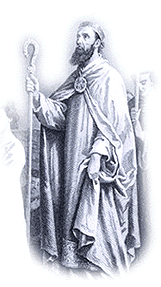
The history of St.Patricks Day is not widely known among the people who celebrate St.Patricks Day. St. Patrick is the patron saint of Ireland even though he was not born in Ireland. He became a very important part of the Irish heritage during his services through the 15th century. St.Patrick is known to be born in the 4th century A.D., but no one knows his exact place of birth. His real name was probably Maewyn Succat, and Paticious was his Romanize name. Patrick was the son of a Roman-British army officer. Patrick was captured by pirates when he was a young boy and sold into slavery in Ireland. He was imprisoned for 6 years. Here he found God. Legend says he was directed by God to escape with a getaway ship.
Finally, after 6 years, he did escape and went to Britain and then to France
where he joined a monastery and studied under St. Germain. He spent 12 years
in training. When he became a bishop he dreamed that the Irish were calling
him back to Ireland to teach them about God. Patrick had a book called the
Confessio which was his spiritual autobiography.
He set out for Ireland with the Pope's blessing. While in Ireland he converted
the Gaelic Irish, who were mostly Pagans, to Christianity. Patrick was '...sure
in the Lord...' and he journeyed far and wide baptizing and confirming. Through
active preaching he made converts even in the royal families. He traveled
for 20 years all throughout Ireland, establishing things called
monistaries. He set up schools and churches, and developed a native clergy. The fact that he was doing all of this upset the Celtic Druids and Patrick was put into jail several times and escaped every time.
Patrick's teachings were considered orthadox and have been interpreted as
anti-Pelagian. He is not really known as a man of learning. A few of his writings
remeain which include his Confession, a reply to detractors and many letters,
and The Lorica, a hymn book attributed to Patrick.
By the end of the 7th century he had become quite a legendary figure. The
legends have continued to grow and grow since then. One legend is he is said
to have used the three-leaf shamrock to explain the concept of the Trinity,
which refers to the combination of the Father, Son, and the Holy Spirit. That
is why the Shamrock has such a strong association with his day and name. One
other legend was that is associated with Saint Patrick is that he put the
curse of God on venomous snakes in Ireland and drove all the snakes into the
sea where they drowned.
Most of these are legends, true, but after 1500 years the legends have been
inseparable combined with the facts and together they have helped us know
about the Saint behind the spirit of the day. Patrick's mission in Ireland
lasted for over 20 years. He died on March 17, AD 461. That day has been commemorated
as St. Patrick's Day ever since. The day's spirit is to celebrate the universal
baptism of Ireland. Though originally a Catholic holy day, St. Patrick's Day
has evolved into more of a secular holiday Or, rather, 'be an Irish Day '.
And the Irish has borne it as part of their national tradition everywhere
they have populated and prospered. The Catholic feast day for this most loved
of Irish saints has become a holiday in celebration of the Irish and Irish
culture. The leprechaun, a Celtic fairy, has become the chief symbol for this
holiday ,as is the shamrock, an ancient symbol for the goddess bright. It
is fitting that this holiday should fall at a time of year that the return
of spring begins to be seen.