 |
| "After many halting starts, Congress passed the Public Broadcasting Act of 1967, which led to the creation of the Corporation for Public Broadcasting, and soon thereafter of PBS and NPR. The commercial broadcaster finally agreed not to oppose public broadcasting, primarily because they believed the new public system could be responsible for doing the unprofitable cultural and public affairs programming that critics were constantly lambasting them for neglecting. There was a catch however. The initial plan to have the CPB funded by a sales tax on the purchase of new radio sets and television sets, somewhat akin to the BBC method, was dropped, thus denying the public broadcasting a stable source of income necessary for planning as well as editorial autonomy. At the outset it was determined that Americans would have a public system, but it would be severely handicapped. We would have only a system the commercial broadcasters would permit." |
| "Although U.S. public broadcasting has produced some good fare, the system has been supremely compromised by its structural basis, and it is fracical in comparison to the powerful public service systems of Europe. Indeed, in international discussions of public broadcasting, the term "PBS-style system" is invoked to refer to a public system that is marginal and ineffective. It is the fate that the BBC, CBC and others wish to avoid." |
| "The funding system is the primary culprit. The U.S. government only provides around 15 percent of the revenues; public stations depend on corporate donations, foundation grants, and listener/viewer contributions for the balance. In effect, this has made PBS and NPR stations commercial enterprises, and it has given the large corporations that dominate its subsidy tremendous influence over public broadcasting content, in a manner that violates the fundamental principles of public broadcasting. It has also encourage the tendency to appeal to an affluent audience, rather than a working-class audience, because upscale viewers/listeners have farmore disposable income. Ironically, it is well-heeled base of support that gives public broadcasting the leverage it has in negotiations for federal monies, as much as any argument for "public" media. If the federal subsidy were fully eliminated, the bias toward corporate interests and an upper-income target audience would be magnified." |
|
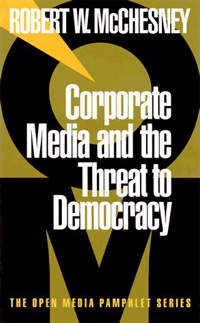
| The following is an exerpt from Corporate Media and the Threat to Democracy (Robert McChesney), concerning the threat to public broadcasting. |
 |
 |
 |

|
| As Time Goes By |
 |