Goodison Park An Objective
View
Late in 1995 this article was
published on the Internet by John Burns. It was to stimulate much discussion,
debate and thought among Evertonians starting the Internet campaign promoting Everton's
move to a state-of-the-art stadium.
The Motto of Everton Football
Club is the Latin, Nil Satis Nisi Optimum. It translates to Nothing
But The Best Satisfies. This also applies to the ground the club plays
on, Goodison Park. Until recently this was very true, by English standards.
Goodison Park, Everton's fourth home, from its early conception was superior to
all English league grounds. The only ground ever with four double-decker
stands. It was so far ahead of its English counterparts that it hosted the 1966
world cup semi-final between West Germany and the USSR. There wasn't even a
close second. This was an illusion. The standards of sports stadia in similar
sized countries on the European continent have generally been vastly superior
to Britain. Goodison Park was not satisfying the club motto.
How times have changed. Goodison
Park was rejected in favour of Evertons' previous home, Anfield, to host the
EURO 96 championship finals. Many club's now have grounds that may be not as
capacious, but are superior in the modernity, viewing positions and amenities
they offer. To name a few, Arsenal, Liverpool, Manchester City, Manchester
United, Middlesborough, Newcastle United, Sheffield Wednesday, Tottenham
Hotspur and Wolverhampton Wanderers. Goodison Park has declined to a second
status of English League club grounds.
The ground has lacked
investment, and more importantly there has never been any serious "long
term plan" to develop the ground into a "complete high quality
stadium". If there was a plan it certainly was not followed.
The ground consists of
uncompromising individual cheaply made structures on all four sides, with only
one corner accommodating spectators, but only on an upper deck. The ground has
one of the largest capacities in England, of over 40,000, which by European
super-club standards is minuscule.
UNSUITABLE SITE
The site is, and has been for
most of its existence, too small for the clubs' requirements. It is excessively
hemmed in on three sides by dowdy Victorian terraced houses that have exceeded
their builders envisaged life cycle and a church site that is only a few yards
from the pitch. The site reflects the clubs small beginnings.
The club had outgrown the site
at the turn of the century.
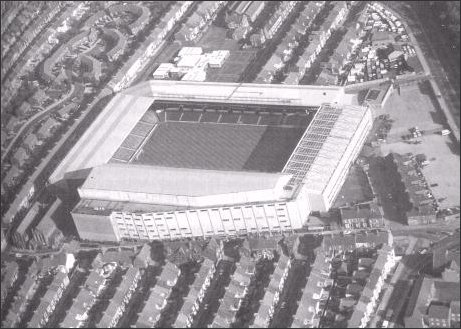
Hemmed In : Road Cuts
Into The Site : Church Takes Up Corner
The old 1907 Park End stand was
built around one of the end corners of a row of terraced houses. This angular
intrusion into the stand was clearly visible from inside the ground. The row of
houses was demolished to improve the stand's access for the 1966 world cup.
Space to expand has always been a problem, that to build the Gwladys Street
stand in the 1930's a row of terraced houses was purchased and demolished.
The site is not a complete
rectangle. Goodison Road cuts into the site near the Stanley Park end,
noticeable from inside the ground by the severe incline of the back wall of the
Main stand.
Being surrounded on three sides
by dense residential housing the club is a nuisance to residents on match days.
Supporter's access to this inner-city ground is less than ideal due to the
enclosed proximity.
This enclosed proximity raises
safety questions. As a 40,000 crowd is filing out of the ground all the local
roads are excessively crammed with people and cars. If a fire breaks out in one
of the local houses, access to the vicinity by the emergency services would be
greatly hampered, maybe resulting in serious injury or loss of life.
In the early 1920's football was
being firmly established as Britain's, and the worlds, major sport. With
attendance's rising rapidly, the club should have been realistic and moved to a
more suitable site, before embarking on the re-building of the Bullens Road and
Gwladys Street sides of the ground.
THE CANTILEVER REVOLUTION
The first cantilever
stanchionless stand in England was a small construction at Scunthorpe United in
1958. The first major cantilever stanchionless stand was the wonderful large
side stand at Sheffield Wednesday. Built in 1961, it set the standards for all
to follow. Liverpool followed in 1963, with the Kemlyn Road stand, and
Manchester United implemented for the 1966 world cup a side stand, complete
with private boxes.
Unlike Liverpool, Sheffield
Wednesday and Manchester United had long term "stadium" plans to
extend their stands to all four sides to create complete bowls. Manchester
United took 30 years to accomplish their plan. Unfortunately Sheffield
Wednesday abandoned theirs, subsequently building cheap piecemeal structures -
the tragic Leppings Lane stand being one of them. Recently even Newcastle
United - who, for a large club, occupied an appalling ground - have completed a
stanchionless bowl of a stadium featuring in EURO 96.
Newcastle United are considering
a proposed move to a larger stadium of approximately 70,000 capacity. The new
Amsterdam Arena is being analysed and maybe used as a role model. Despite
investing substantial millions in the present stadium, John Hall the Newcastle
United chairman, is prepared to look to the future invest and move.
THE MAIN STAND - A WHITE
ELEPHANT
In 1969 the old Archibald Leitch
designed, Goodison Road stand, of 1909 was demolished to make way for its
replacement, the Main Stand, opened in 1971.
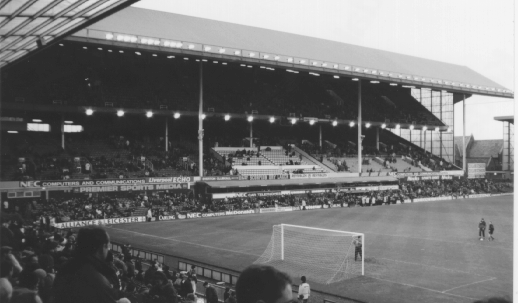
Main Stand From The Park
Stand. See how close the church is to the pitch.
What an ugly white elephant this
turned out to be. A cheap double-decker construction with an unusually large amount
of large support stanchions supporting the upper balcony and large forward
leaning roof. It was clearly obvious that this stand was not part of any
serious long term stadium plan.
Extending cleanly to the other
sides of the ground is extremely difficult, if at all possible. A stairwell
shaft at the Stanley Park end of the stand fills in that corner of the ground,
and the church site at the other corner hinders any proposed extension.
Ten years after Sheffield
Wednesday established the cantilever standard, which the major clubs were
following, Everton build yet another structure with view obscuring support
stanchions. Many seats under the top balcony are excessively obstructed, making
viewing uncomfortable. Only a few years later, Chelsea built a superb,
triple-decker stanchionless stand, designed to expand and form a complete
stadium. A fine example of how to do it properly, although unfortunately
Chelsea never extended the stand.
THE BULLENS ROAD AND GWLADYS
STREET STANDS
The Archibald Leitch creations,
the Bullens Road and Gwladys Street stands, date from 1926 and 1938
respectively. They have a large wood content in their construction, with far
too many support stanchions obscuring spectators' views of the playing pitch.
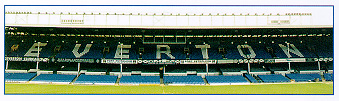
Bullens Road From The
Main Stand
The rake of the bottom tiers,
which is converted terracing, is seriously shallow with the stands too near the
playing area. This combination causes spectators to stand to view playing
action near the touchlines. Re-construction is required to both of these sides
of the ground.
THE NEW PARK STAND - ANOTHER
WHITE ELEPHANT
The only side of the Goodison
Park site that has room to expand is the Stanley Park end. In 1994 a new single
tier cantilever stand was opened to replace the old 1907 double-decker
construction.
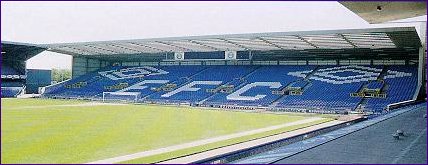
The inadequate Park
Stand
This individual stand-alone effort
broke with the double-decker tradition of Goodison Park. It does not complement
any of the adjacent structures, the Main and Bullens Road stands, and appears
not to be a part of any "long term stadium plan".
The roof actually protrudes
under the higher overhanging roof of the Main stand, obscuring views of a
section of seats on the top balcony of the Main stand. A lot of criticism was
directed at the club due to its very small capacity. It occupies the only side
of the ground that has any area for easy expansion. It has the appearance of
many of the cheap structures seen in English first division grounds.
One can only assume that this
was constructed as the Football Trust contributed a substantial amount towards
its construction. Did the club accept the money because it was available,
resulting with a wholly unsuitable structure? This appears to be short term
gain, long term loss. One hopes that this structure is regarded by the club as
temporary.
THE FUTURE
What of the future? The club
have never been wholly open about any immediate or long term plans for Goodison
Park. Is there a master plan that will eventually turn Goodison Park into a
Twickenham? or a move to an indoor arena? If so will it be adhered to? The old
Twickenham, with its double-decker Archibald Leitch stands was very similar to
Goodison Park.
The finest team sport stadium in
Britain is the new Twickenham rugby stadium. Ideally an indoor Twickenham with
a retractable roof would have been an even better prospect, eliminating the
unpredictable, cold, wet British climate. When the remaining one end is
complete, Twickenham will be a triple tier, 80,000 plus seater, covered,
stanchionless bowl. It is a magnificent structure with superb amenities. A fine
example of how to build a stadium in phases. Although currently the best in
Britain, Twickenham is very basic in comparison to the state of the art stadia
elsewhere.
If Everton want to live up to
its motto then the Amsterdam Arena is surly the stadium to emulate. The new
home of Ajax Football Club, opened in autumn of 1996, it is the most advanced
stadium complex in Europe. It is the first stadium in Europe that is a complete
entertainment complex featuring a retractable roof. It consists of cinemas,
pubs, restaurants and crèche facilities among others. It is designed from the
outset to host concerts as well as football, featuring a semi-synthetic grass
pitch. Car parking is beneath the stadium in levels with access directly from a
highway, which also runs under the stadium, alleviating urban traffic
congestion. There was 65,000 season ticket applications for a 52,000 capacity.
A green field site, the complex was a joint venture with many parties including
the City of Amsterdam. This complex is without doubt the model facility Everton
should be aiming for.
If Everton occupied a scaled
down version of a Twickenham style of stadium or the pretigious Amsterdam
Arena, it would be in contention to stage England international matches and
European competition finals. A great boost to the "big European club"
image Everton are supposed to aspire.
Proposal 1 - A New Green
Field Site
Many English league clubs have
abandoned their existing grounds and moved to new green field or suitable
sites. Modern construction techniques and in some cases inventive joint
business deals with other parties, have made it cost-effective to construct
complete stanchionless mini-stadiums. Huddersfield, Middlesborough and Millwall
have fine recent examples. Many more clubs have plans to move to new sites,
Bolton Wanderers, Luton Town, Portsmouth and Southampton among them. Sunderland
as to clear the site of their new stadium.
The high value of the inner-city
sites many of the old grounds occupied offset the total construction costs,
rendering these projects feasible. No club that has moved has encountered
problems with their support. The vast majority have openly accepted the new
stadiums, and are more than happy with the vastly improved amenities and road
access the new stadiums now provide.
The days have long gone when most
clubs were supported by the immediate local community. As most clubs now have
wide catchment areas of support, these moves have provided excellent transport
communications vital for club expansion. The improved amenities have resulted
in increased attendances. Everton occupy a valuable inner-city site.
In the last century, Everton
moved from Anfield to Goodison Park, situated in the Walton district of
Liverpool, resulting in increased attendance's. The supporters openly welcomed
the move to a superior ground. Everton had abandoned a ground on which they had
won a championship and hosted an international match - England v Ireland.. The
fans approved of the resulting progress. A new green field site with a
Twickenham style or Amsterdam Arena complex adjacent to rail, local road and
motorway arteries, would improve the clubs support and image greatly.
Proposal 2 - Combine With
Other Local Sports Organisations
Combining with other local sports
organisations in the immediate area makes economic sense. There is great
potential for growth by all parties concerned. In the past it had been
suggested that Everton, Liverpool and the Aintree racecourse authorities
combine to build a large stadium at the course. The idea was never taken
seriously, but that was before the Taylor report cast a new aura over football
ground design.
Large stadium sharing is common
in Italy, were all the sharing clubs and fans benefit greatly. A stadium at
Aintree could house restaurants, conference facilities, private suites and
boxes that would be suitable for use on race and match days. A back-to-back
main stand could double function for football and racing. The facilities could
also be used on a general commercial basis.
The course has an adjacent
Merseyrail underground station that links with main line British Rail at Lime
Street, and excellent local road and motorway links. A complex which is home to
the worlds greatest horse race spectacle and two famous old football clubs
would bring prestige to all parties and the Liverpool area.
Wimbledon share Selhurst Park
with Crystal Palace. This is a less than ideal arrangement were Wimbledon are
tenants, with little say, if any, in the development of the ground. They have
also moved out of their support catchment area. Wimbledon are contemplating a
new green field site stadium closer to Wimbledon. Crystal Palace's previous
tenants Charlton Athletic, moved out because of the same restricting situation.
Wimbledon, a club with minuscule attendance's have managed to maintain ten
years in the top division. The reduced overheads of not having to maintain a
single ground, have reflected on this small clubs success.
The prospect of stadium sharing,
with joint ownership, may sound abhorrent to a minority of Everton and
Liverpool fans, but this is sound economic sense. Both have the same support
catchment areas. Stadium sharing in Italy has not resulted in a lack of
partisanship or local rivalry. The prestige and image boost all parties and the
Liverpool area would gain is incalculable. There would be a domino effect of
future investment into the area, as has occured in US cities, boosting the
local economy.
If the thought of stadium
sharing with Liverpool is so abhorrent to Everton, one hopes that they are not
so narrow mindedly bigoted, Everton and the Aintree authorities could pursue
this idea together with the Amsterdam Arena as the role model. Both parties
would greatly benefit.
Shamefully no organisation in
the City of Liverpool entered a proposal for the recent national stadium
competition. If a similar joint proposal was tendered, there was a high
probability of winning. Being the most famous British city, apart from London,
Liverpool is the only city that can seriously compete with the capital.
Proposal 3 - Expand and
Develop the Existing Site.
To achieve a Twickenham or
Amsterdam Arena style of stadium, or any other style, at Goodison Park would be
impossible with the existing site. It is far too small. The church site, the
school located at the corner of Gwladys Street and Bullens Road, the Bullens
Road surface itself, a number of terraced houses that run off Bullens Road and
the remaining terraced houses behind the Park stand would need to be purchased
and/or demolished to accommodate a modern Twickenham style of stadium.
The purchase of immediate
buildings and land to create a larger stadium would render this an expensive
project for minimal return. With an increase in capacity, supporter's access
will be further hampered due to the closed-in site. Local residents would
naturally oppose such radical planning proposals to their environment, maybe
resulting in lengthy delays and court cases.
INTO THE NEXT CENTURY
Everton have to encompass
radical change for the coming millennium. The existing Goodison Park site is a
legacy of the clubs small beginnings, gaining its support from the immediate
local community. The site is now wholly unsuitable, and the club should fully
recognise this.
The image of the club on a
British and European level, despite the team success in the past twelve years,
is lacking. It is below the levels of Liverpool, Manchester United and the two
large North London clubs. The conservative parochial attitude of the past has
to be replaced with a European super-club attitude. This is what the club is
supposed to aspire to.
All large European super-clubs
have large modern stadiums. Bayern Munich moved from a small ground to the
impressive Olympic stadium and never looked back. They were raised to European
super-club status. The increased support and image resulted in the necessary
funds to promote the team and club, maintaining the status, image and success.
Very few British people in the 1950's and 1960's had heard of this German club.
Manchester United, who currently occupy the finest league ground in England,
realising the potential won the right to occupy the proposed Olympic stadium if
the city of Manchester were awarded the games.
Everton need to embark on a
major feasibility study leading to a meaningful construction programme. The
preferable conclusion would be a break with the past resulting with a green
field site or stadium sharing. The values and traditions of the club will not
die, they will continue as they always have, are very important, and are more
than a firm base to build upon. You have to know where you come from to know
where you are going. A firm vision of a progressive future should be "cast
in concrete", preferably in a "long term corporate plan". Once
constitutionalised, there is a high probability that future administrations
will adhere to it.
There was radical change in 1892
when the club moved from Anfield to Goodison Park. Everton took the lead and
produced Britain's first developed football ground, setting the standard for all
others. The club never looked back and benefited greatly. Everton should again
take the lead in standards and develop the next phase of British football
stadia with the Amsterdam Arena firmly focused as a role model. Moving to a
superior facility and location is merely another phase in the evolution of an
old, historical and innovative club.
Radical change is beckoning for
the millennium. Nil Satis Nisi Optimum.