The Homes Of Everton FC
Everton
F.C., a club not to sit back on its laurels, created two of the foremost
football grounds in England. They created Anfield in 1884, now home of Liverpool
A.F.C., and later the pioneering Goodison Park in 1892. Goodison Park was the
world's first purpose built football ground that set the model for all others
to follow.
Everton
have had a total of four homes:
The First - Stanley Park : 1878 - 1882
Everton
F.C. were founded by St. Domingo's Methodist church, in the Liverpool district
of Everton, in 1878. St. Domingo's F.C., they were named, playing on an open
pitch in Stanley Park, just east of the district of Everton. The park is
situated between Goodison Park and Anfield. The club rapidly rose in
popularity, drawing support and players from the immediate district, Everton.
In recognition the name of the club was changed to Everton FC a year after
formation. Everton played adjacent the house of local alderman and Conservative
MP John Houlding (the house is still standing adjacent the Anfield Road stand
of Liverpool FC), who took a great interest in the club that attracted a very
large following. He was soon to become a member of the club and known as "King
John of Everton". Within four years, in 1882, unofficial attendance's had
risen to around 2000. It was decided that an enclosed ground, with suitable
changing facilities, where the club could charge admission would be acquired.
St.
Domingo's church was in Brekfield Road North between St. Domingo Vale and St.
Domingo Grove. It was demolished in the 1970s, being replaced by an old
people's home. The area where Everton first played is now a car park opposite a
sports centre and Anfield football ground. Many Evertonians park their cars on
the site where Everton first played.
The Second - Priory Road : 1882 - 1884
Mr
Houlding acquired a suitable site, donated rent free by a Mr Cruit, for Everton's
first enclosed home in Priory Road, opposite Stanley Park on its eastern side.
It was a pitch surrounded by fences, changing facilities and a small stand. The
growing success of Everton and its growing large noisy following disturbed the
site owner, Mr Cruit, who lived next to the ground. He complained of the noise
and litter and was reluctant to allow Everton to remain at the site.
Irrespective of Mr Cruits complaints, the following of the club was so large an
even larger home would have to be found. Expansion prompted another move after
only two years at Priory Road.
Residential
houses now occupy the site
The Third - Anfield Founded : 1884 - 1892
While
at Anfield, the internal politics of Everton F.C. created probably the most
interesting piece of football history in Britain, if not the world. It may be
unpalatable to many Evertonians, however Everton's roots are at Anfield, not
Goodison Park. The pioneering work that made Everton into one of England's
largest and most successful club's was all done at Anfield. Goodison Park
happens to be the ground Everton have occupied the longest..
Everton:
- Founded Anfield.
- Became a professional club while at Anfield.
- First played in the FA Cup while at Anfield.
- Were founder members of the Football League while
at Anfield.
- Hosted their first international while at
Anfield - England v Ireland.
- Won their first championship at Anfield.
- Introduced the goalnet to top class football at
Anfield.
- Became the first big rich club in England while
at Anfield.
- Made Anfield the best club ground in England of
over 20,000 capacity, before leaving for purpose built superior Goodison
Park.
Everton
founded and played at Anfield for eight years between 1884-92. A split within
the club resulted in Everton leaving to create Goodison Park. The minority that
remained believed they were Everton, and called themselves so, as Everton
played at Anfield. They wanted to keep their place in the 1st division of the
expanded two division English Football League, and play Everton's fixtures. Intervention by the League forced the
Evertonians remaining at Anfield to form another club, now local rivals
Liverpool.
In
1884, Mr Houlding acquired for Everton a field he partly owned in Anfield Road.
Houlding also acted as agent for the landlord of the other part of the field, a
Mr Orell. The nearby Sandon Hotel, owned by Houldings Brewery, became the
club's headquarters and changing rooms.
The Sandon Hotel pub still exists to this day. The first game played at Anfield was against Earlestown on
September 27, 1884, with Everton winning 5-0.
Everton’s first Football league match was played at Anfield against
Accrington Stanley on September 8, 1888, with Everton winning 2-1.
On
entering the new Football League in 1888, Everton paid Houlding a rent of £100.
The new Football League was highly popular; Houlding sought to take financial
advantage and increased the rent to £250 after the second league season,
1889-90, when Everton finished 2nd. Houlding also had the sole
rights to sell refreshments at Anfield.
Unhappy
with Houldings greed, and being under the influence of the whims of one man,
the Everton committee met to assess the situation. Prompted by member George Mahon, a decision to look for another
ground was reached. Some of the committee were reluctant to lose their
investment in fixtures at Anfield. The ground was adequate for their needs,
being host to an international match between England and Ireland in March 1889.
The committee offered Houlding a compromise rent of £180 for the coming 1890-91
season. Houlding ignored their offer.
For
the next year the relationship between Houlding and the Everton committee
deteriorated further. This rift became a matter principle to the committee, as
£250 was a small amount to pay in rent compared to the income of the club. A
profit of £1,700 was recorded for the 1890-91 championship season. As time
progressed both sides held their stance. Surprisingly this internal discord did
not affect the team.
Eventually,
Houlding made a move to resolve the dispute offering to sell Everton the entire
ground for £6000. A fair deal. Everton were in a strong position; they won the
championship in 1891 after finishing second the season before. They were one of
the leaders of English football, with a large following.
At a
committee meeting in January 1892, in response to Houldings offer, George Mahon
announced that Everton, who had acquired a rich benefactor, a Dr James Baxter,
had already secured a suitable site to build another ground on the side of
Stanley Park in the Walton district. Everton refused Houdings offer to buy
Anfield. Houlding responded by serving Everton notice to quit. Irrespective of
the order, Everton were already about to move, glad to be rid of the
dictatorial, fleecing Houlding.
Houlding
promptly registered another company (club) to be based at Anfield, of which he
had control; officially named Everton F.C. and Athletic Grounds Limited playing
in blue and white quarters. There
was now two Everton's in existence. Under protest from the original Everton
F.C., the League ruled at a meeting in London with Houlding and Everton
committee members, that Houlding's club was a new club and not the original
Everton. They ordered Houlding not use the name Everton. He considered a few
names and eventually renamed his company Liverpool A.F.C., only after protests
from Liverpool Rugby Football Club. This was not the first ever football team
named Liverpool. A representative
Liverpool existed that composed of players from all the local Liverpool club’s
including Everton. If the League had
allowed "King John of Everton" to retain the word Everton in the
title of his new club, the city of Liverpool would have had an Everton and an Everton
Athletic.
For
their new home Everton bought the 30,000 square yard site in Goodison Road for
£8090, a high price in Victorian England. Successful and fired with ambition
and vision, they were prepared to invest in the now highly popular game of
football. They could have been rid of Houlding and stayed at Anfield, complete
with facilities and stands, for £6,000. The ground was one of the country's
leading at the time, being of international standard. However, the Everton
committee wisely chose to move to a superior location and build from scratch a
far superior ground befitting a top English football club.
The
local rival to Everton while occupying Anfield was Bootle F.C., founder members
of the first second division in 1892-93. Bootle were rapidly eclipsed by the
emergence of Liverpool A.F.C., who benefited greatly from Everton's legacy; the
facilities they created and the immediate rivalry offered as one of England's
top club's.
Anfield
remains one of the country's leading grounds, being one of the hosts of Euro
96, being selected over Goodison Park by the drawing of lots.
The Fourth - Goodison Park : 1892 - present
Goodison Park was the
world's first major purpose-built football stadium, all others being little
more than open fields. Only in Scotland were grounds relatively developed. The
USA could offer more advance facilities in the 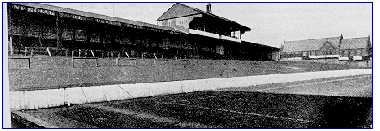 new baseball grounds being constructed; however only by a
narrow margin. Everton spent up to £3000 over the initial £9090 on laying out
the ground and erecting stands on three sides - unheard of in those days.
new baseball grounds being constructed; however only by a
narrow margin. Everton spent up to £3000 over the initial £9090 on laying out
the ground and erecting stands on three sides - unheard of in those days.
Goodison
Park proudly opened on the 24th August 1892 by Lord Kinnaird and
Frederick Wall of the FA. No football was played. The 12000 crowd watched a
short athletics meeting followed by music and a fireworks display. Everton's
first match at Goodison Park was on 2nd September 1892; sporting the
then club colours of salmon and dark blue stripes, Bolton Wanderers were beaten
4-2. From its inception to when Wembley stadium was opened in 1923 Goodison
Park was Britain's foremost sports venue.
The
description that follows comes from "Out Of Doors" published in
October 1892:
|
"Behold Goodison Park! no single picture could take
in the entire scene the ground presents, it is so magnificently large, for it
rivals the greater American baseball pitches. On three sides of the field of
play there are tall covered stands, and on the fourth side the ground has
been so well banked up with thousands of loads of cinders that a complete
view of the game can be had from any portion". "The spectators are divided from the playing piece by
a neat, low hoarding, and the touch line is far enough from it to prevent
those accidents which were predicted at Anfield Road, but never happened...
Taking it all together, it appears to be one of the finest and most complete
grounds in the kingdom, and it is hoped that the public will liberally
support the promoters." |
Goodison
Park was honoured in 1894 when it was awarded the FA Cup final, not merely a
replay - the first League ground to bestowed this honour. Notts County beat
Bolton Wanderers, watched by crowd of 37,000 - not full capacity due to
inflated admission charges. All FA Cup finals after this date, except replays
and wartime finals, were played in London at neutral non-league grounds. The
inadequate Crystal Palace was chosen.
Not
content with the initial developments, Goodison Park was improved even further.
A new Bullens Road Stand was built in 1895 at a cost of £3407 with the open
Goodison Road side covered for £403. Goodison Park had cover on all four sides;
once again unheard of in those days.
The
double-decked Goodison Park of today began to take shape after the turn of the
century. In 1907 the building of the country's first double-decker stand at the
Stanley Park end, named the Goodison Avenue stand cost £13,000. Due to the
hemmed in location, this stand was built around the end corner of a row of
terraced houses. Such planning regulations would never be allowed today. The
angular intrusion into the rear wall of the stand was clearly visible. This
intrusion was there until 1966, when the impeding row of twelve terraced houses
were demolished, to bring the ground up to standard for the world cup.
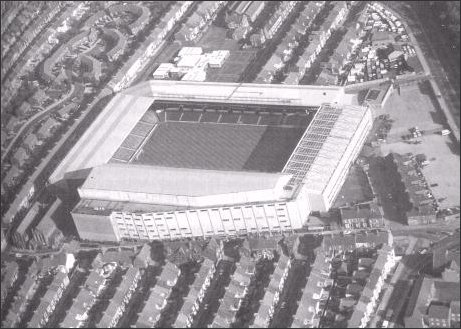
It
was clear that after only fourteen years the Goodison Park site was unsuitable
for future requirements. The site was severely hemmed in on all four sides
compounded by not being rectangular. Even to this day a church takes up an
entire corner of the ground, being only a few yards from the pitch. This space
restriction has curtailed the expansion and refinement of Goodison Park ever
since, compromising most stands that were built. In preparation for the 1966
world cup, Mr. John Moores, the Everton chairman, stated that Everton would
have a ground rivalling Wembley if the club had adequate space to expand.
In
1909, two years after the Goodison Avenue stand was built, the large Archibald
Leitch designed main stand on Goodison Road, named the Goodison Road stand, was
constructed for £28,000. Another double-decker, it bore his famous criss-cross
trademark on the front of the upper deck. This stand housed all the offices and
players facilities. Simultaneously the terracing was concreted and a new cinder
running track laid.
Yet
again the hemmed in site had an impact on stand design. Due to the line of
Goodison Road impeding into the site at a severe angle at this point, most of
the stand was angled to the pitch. This angled intrusion gave the terracing a
mounded appearance with the highest point being at the end nearest to the
Gwladys Street end of the stand and the lowest nearest the Stanley Park end.
The stand had an odd appearance, being angled following the line of Goodison
Road behind, varying sized support stanchions along its length and terracing
tapering to one side in front. Nevertheless it was Britain's premiere and
largest grandstand. The "Athletic News'" published a piece in the
summer of 1909:
|
"Visitors to Goodison Park will be astonished at the immensity of the new double-decker stand". |
The finest
ground in the country, Goodison Park hosted the 1910 FA Cup Final replay
between Newcastle and Barnsley, with an attendance of 69,000. On 13 July 1913
Goodison Park became the first League venue to be visited by a reigning
monarch. George V and Queen Mary inspected local schoolchildren at the ground.
After
the First World War, when Goodison Park was used for Territorial Army drill
practice, the US baseball teams Chicago White Sox and New York Giants played an
exhibition match. One player managed to hit a ball clear over the large Main
Stand.
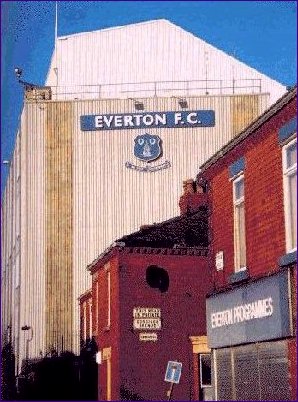
Four Double Decker Stands
Not
being content with two double-decker stands, in 1926 at a cost of £30,000,
another double-decker was built. It was loosely similar to the Main Stand in
appearance, but smaller, with little depth due to space limitations of the site
on the Bullens Road side. The design rendered cheap construction, becoming a
standard off-the-shelf design used by architect Archibald Leitch in other
league grounds. Although adequate, the stand was of no architectural merit,
containing view obscuring support stanchions. State-of-the-art cantilevered
construction techniques, that were being pioneered in the United States at the
time, were not applied.
|
|
The
one remaining end at Goodison Park that did not contain a double-decker stand,
the Gwladys Street goal end, was brought into line with the other sides in 1938.
The club bought and demolished a row of terraced houses to build the new stand.
The opening date was many months late due to problems evicting a resident from
one of the houses. King George VI and Queen Elizabeth, the present Queen
Mother, opened the stand. The cost being £50,000.
The
stand was angled in one corner where it joined onto the Bullens Road stand; the
upper deck being slightly higher than the upper deck of the side Bullens Road
stand. Archibald Leitch, yet again the architect, did not allow in his design
to utilise the space in the corner of the ground under the upper deck of the
new stand, where meeting the Bullens Road stand. Yet again no cantilevered
techniques were utilised.
Goodison
Park became the only ground in Britain to have four double-decker stands. A
feat that has not been surpassed even to this day. Despite not having a
long-term ground plan, not utilising all of the space available - two available
corners were unused, being severely restricted by lack of space and not utilising cantilever techniques,
Everton had managed to create the country's finest club ground. At the time,
the configuration of most other top British grounds usually consisted of three
barn-style roofs with an open terraced end. Writers referred to Goodison Park
as "Toffeeopolis", a pun on the club's nickname. Compared to
all other British football grounds, Goodison Park was vastly superior.
Due
to its close proximity to the Liverpool docks - Liverpool being the main convoy
port - Goodison Park was heavily bombed by the Luftwaffe during the Second
World War. Considerable damage was inflicted, mainly to the new Gwladys Street
stand. Everton received £5000 compensation from the War Damage Commission.
Following the conflict, on 18th September 1948 Goodison Park had its highest
ever attendance, 78,299 for the visit of Liverpool in Division One.
Floodlights
were installed at Goodison Park in October 1957. The original set was mounted
on four extremely tall pylons, the tallest ever at any English ground, being
inaugurated for an Everton v. Liverpool friendly on the 9th October.
The
next year, at a cost of £16,000, 20 miles of electric wire was installed under
the pitch. The system melted ice, however the drains were not suitable. In 1960
the pitch was again dug up and new drains installed.
The
next development was a new extending roof on the Bullens Road stand in 1963.
This roof extended over terracing in front of the stand and over the pitch
surface by a few feet. Seats were also installed under the upper deck of the Bullens
Road stand. Yet again no cantilevered techniques were utilised.
In
1966 Goodison Park played host to five matches in the World Cup. Brazil played
all of their matches at Goodison Park. The ground was considered so good it
staged the West Germany v USSR semi-final. No other venue, apart from Wembley,
staged so many World Cup matches. In preparation for the tournament, Everton
bought and demolished the Victorian terraced houses that intruded into the rear
wall of the Park End stand, in order to improve access from Stanley Park.
The
year 1969 saw the next and largest ever development when the first phase of
demolition of the 1909 double-decker Goodison Road stand was undertaken. Even
though it was being demolished, this stand was still regarded as one of the
best in the country at the time. It was to be replaced by a massive new
double-decker Main Stand, with the lower deck in two consecutive tiers. Opened
in phases and finally completed in 1971, this new stand cost £1 million being
the largest in Britain. The stand was the first to have executive club
facilities: the 500 and 300 clubs. Private boxes were ruled out with members
having their own sections of the stand with facilities below. Escalators took
fans to the upper deck. The new stand reduced the overall capacity of Goodison
Park to over 56,000; however it seated over 25,000 people, the largest seating
capacity in the country. Again the angled intrusion of Goodison Road into the
site resulted in the rear wall of the stand being severely angled, giving a
falling down appearance at the end nearest to Stanley Park.
Surprisingly,
the stand was not in keeping with the well established cantilevered
construction techniques of the time, having many large thick support stanchions
causing some severe obstructions to spectators on both decks. The new stand
presented the most severely obstructed views of any part of the ground.
Cantilevered stands were pioneered nearly fifty years earlier and were no
longer expensive state-of-the-art constructions.
The
height of the new Main Stand entailed the demolition of the giant floodlight
pylons. Lights were erected on gantries along the front of the forward leaning
roof. The roof of the Bullens Road stand opposite also had similar gantries
installed. The 1907 Goodison Avenue goal stand was renamed the Park End stand.
As
first choice Goodison Park was having major construction works undertaken in
1970, it lost out to hold the FA Cup final replay between Leeds United and
Chelsea. It was staged at Old Trafford, Manchester.
The
Safety of Sports Grounds act of 1977 temporarily reduced Goodison Park's
capacity from 56,000 to 35,000. The entrances and exits were outdated with the
wood in the structures of
|
|
|
Outgrowing the Walton site; notice how hemmed in the ground has become |
the
three older stands requiring fireproofing. The terracing directly under the old
1907 Park End stand was boarded off as the terrace steps were of wooden
construction. The concrete terracing at the front of the stand remained. After
conforming to the regulations, the capacity was reduced to 53,419.
Again
first choice Goodison Park lost out to a major football event in 1977. Due to
the temporary reduced capacity imposed by the Safety of Sports Grounds act, the
Wales v Scotland World Cup qualifying tie was staged at neighbouring Anfield.
Private
executive boxes were fitted to the front of the rear tier of the lower deck of
the Main Stand in 1980, replacing some terracing. The boxes do not run the
complete length of the stand, taking up only the centre section, clearly giving
a disjointed add-on look.
In
1988, the Gwladys Street stand had its roof replaced by a similar structure to
the roof installed on the Bullens Road stand in 1963. The roof meshed into the
roof of the Bullens Road stand creating a continuous roof on two sides of the
ground.
The
Taylor report, following the aftermath of the Hillsborough tragedy, forced
Everton to adopt an all-seat design. All terracing was converted. The Park End
terracing remained, however was only opened for big matches due to a proposed
plan to construct a new stand.
|
|
The
19th January 1994 was last time spectators stood on terracing at
Goodison Park. It was during a F.A. Cup third round replay against Bolton
Wanderers, with maybe fittingly so, Bolton fans standing on the terracing.
Bolton Wanderers were the first team to play at Goodison Park.
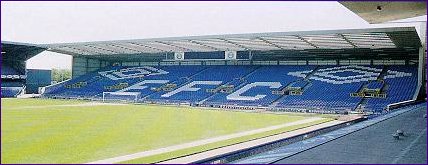
The
historic 1907 Park End stand, the first double-decked stand in the country, was
demolished soon after to make way for a new single tier, at last, cantilevered
construction stand of 6,000 capacity. The original design was a cantilevered double-decker
that curved and seamlessly meshed into the side Bullens Road stand. The design
was amended for a cheaper smaller alternative. Everton changed administration
during construction; the new people tried to halt building, however they were
too late. This stand broke with the Goodison tradition of the double-decker
format. New facilities were incorporated under the new structure. The new stand
was renamed the Park Stand and was opened on 17th September 1994.
This was the first time in 99 years that Everton had opened a new single tiered
stand. The Football Trust contributed £1.3m to its construction. The Park Stand
brought the capacity to just over 40,000, small, however one of the largest in
the English League at the time.
Although
Goodison Park has been the finest league ground in England for most of the
years since its inception in 1892, it is now hopelessly outdated. It has been
eclipsed by recent major developments in other league grounds, and new
state-of-the-art green field site constructions. Does
"Toffeeopolis" live on? Not at the Walton site!
The Fifth - The Proposed New Stadium At King's Dock : 2003 - ?
The
Everton board announced that Everton will abandon Goodison Park and move to a
purpose built state-of-the-art stadium. The site has outlived its usefulness
compounded by the poor local infrastructure, unable to cope with the
requirements of a modern stadium. The
fans were approached for their opinions on the proposal, voting by 84% to move.
The club stated that no site has been chosen and no design has been
finalised. In the meantime severe
restrictions in expanding Goodison Park were imposed by Liverpool City Council,
forcing the club to pursue an alternative site come what may. The King's Dock site, next to Albert Dock
near the city centre is favourite, with firm backing from the Liverpool City
Council. There is a site available in Gilmoss, on the M57 Liverpool ring
motorway, as a fallback and one at the end of the M62 motorway. Consultants
have been engaged to determine the design, which is to feature a retractable
pitch and roof. The Everton board stated that the new stadium would be among
Europe's finest.
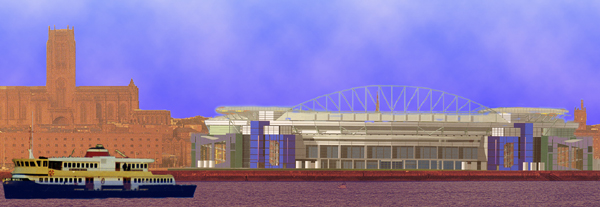
Artists Impression of
the Kings Dock Proposal