BY ROBERT SINDORF
Today�s basement is a far cry from the old-fashioned cellar. Concrete walls and floors have taken the place of the old stone foundations and the bare earth floors of the past.
While the modern paneled basement �rec� room may provide a lot of family fun, the basement no longer plays its old, vital role in a family�s existence.
Before refrigerators, freezers and handy supermarkets, rural families two or three generations back had to store most of the food they needed to carry them through the fall, winter and spring. Into the cool, protecting cellar went vegetables, meat and fruit in many forms.
The cellar�s forerunner was the pioneer�s root cellar, usually located only a few steps from the family cabin. On the prairie it also served as a secure retreat from cyclones.
As the log cabin or sod shanty gave way to the frame farmhouse, so the root cellar came inside the home. Some were little more than pits reached from a trapdoor in the kitchen. Others were added years after the house was built, either laboriously dug out by hand or scraped out by a horse or mule hitched to a �slush bucket.�
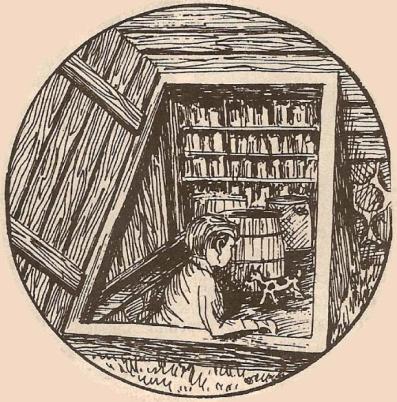
Later, cellars were dug out before the house was built and the walls were laid up with native fieldstone or locally made brick. Outside stairs not only provided easy access for hauling in potatoes or wood but the sloping doors which covered the entranceway also had their uses.
They made an excellent spot to dry onions, and served as a slide for the children. The family dog often used it for sleeping, or soaking up the reflecting heat.
Off in one corner of the cellar might be the huge cistern which captured runoff from the roof. Up in the kitchen was the small hand pump which brought up the soft rainwater for washing clothes or hair - but never for drinking.
Filling the basement larder began in early summer with the canning of wild and domestic berries. Then mother put up a succession of crops as they matured. There were peas, string beans, carrots, corn and beets, to name a few.
These were followed by various kinds of pickles: dill pickles, mustard pickles, bread-and-butter pickles and perhaps a half-dozen other varieties. Also pickled were beans, peppers, watermelon rinds, beets, peaches and sometimes even eggs.
Let�s not forget the jellies and jams. Among them were apple, crabapple, thorn apple, currant, gooseberry, blackberry, blueberry and sometimes even tomato jam. The same fruits and berries were also put up as sauces and preserves.
Row upon row of jars began to fill shelf after shelf in the fruit cellar until sometimes they even lined the foundation wall beside the cellar stairs.
In the fall a crock or two of sauerkraut was put to work, generating an aroma strong enough to knock down a mule at 20 paces. Perhaps some head cheese would also be curing to add its pungent scent to the already heavy air.
Potatoes went into a bin in a dark corner. There were barrels of apples. Beets, carrots and turnips were buried in a box of sand which the family cat sometimes also found useful. Dried onions were spread out on the floor or on a shelf.
Golden pumpkins and knobby Hubbard squash were stored for future pie making. Black walnuts and butternuts, as well as jugs of cider - soft and hard - were added to the hoard.
Fall was also the time for butchering and meat, too, went down into the cellar. Sausages packed in stone crocks were covered with hot lard to keep them from �getting old.� Smoked hams and bacon were hung from the first floor joists.
Also into the cellar went firewood to stoke the parlor stove and the ever-hungry kitchen range. On a dairy farm, the cream separator was brought down into the cellar at the first hint of winter.
When every bit of food and other supplies it could hold were carefully stowed away, the well-stocked cellar was an especial source of pride to the wife and mother. All around her were the tasty products of her culinary art and hundreds of hours of labor. Her family, she knew, would be well fed until the next harvest season.
But a cellar was far more than a place to store food. To the children it was a place of adventure. Being sent �down cellar� by the light of a shadow-casting oil lamp could be a highly exciting experience.
The cellar�s very darkness, of course, helped prevent the stored food from spoiling. Milk and eggs could be safely kept under the steps or in a milk cupboard. Gelatin could be taken down cellar to set.
While in those wood-stove days there was no central heating system to keep the cellar warm, the warmth of the earth itself kept the cellar and its contents well above freezing - provided, of course, that Pa had banked the outside of the foundation heavily with manure.
On stormy days the cellar was a place for children to play. What a wonderful space for a game of hide-and-seek or hopscotch!
The cellar was also a temporary home for a hen and her chicks, or a place to nurse early lambs or piglets to a healthy start in life. In the spring it was a place to sort out the wrinkled, sprouting potatoes that remained in the bin, separating those which could be eaten from those which would be used as seed for the coming year�s crop.
As the food and other supplies dwindled in the spring, the cellar began to lose its significance. The day finally arrived when Mother coerced Dad and the rest of the family into helping clean it. Cobwebs were swept down, the floor broomed clean and the windows opened to clear out the winter�s accumulation of stale air.
From then until early summer the cellar stood idle. But with the first berry crop of the season, it resumed its role as winter warehouse for family provisions.
Back to Hard Times