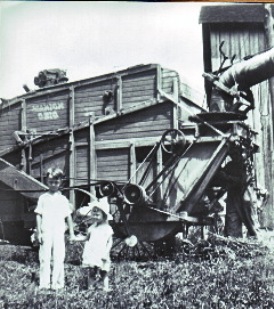
Author with Sister Betty, 1935.
Threshing time on Aunt Vin and Uncle Will Hupp's farm, near Dupont, Indiana.
BY HAL SWIFT
Written April 24, 2009
I was born December 17, 1928, on the 25th anniversary of the Wright brothers� successful flight at Kill Devil Hill, near Kitty Hawk, in Dare County, North Carolina.
This was during the presidency of Calvin Coolidge. Folks called him �Silent Cal,� because he never was much of a talker. A favorite story of the time was that, leaving church one Sunday morning, a reporter asked him what the pastor talked about. �Sin,� said Mr. Coolidge. The reporter insisted, �What did he say about sin?� And Mr. Coolidge replied, �He�s agin� it.� Some say it was Coolidge�s avoidance of public speaking that lost him the presidency to Herbert Hoover.
It was in October of 1929, during Hoover�s tenure, that the so-called Great Depression began. You can find more information than you may care to read, online, and at your library.
Even in hard times, some find humor. It was a dark humor that said, �Due to the number of financiers leaping to their deaths from tall buildings, a pedestrian was in more danger of being struck by a falling body, than by pigeon droppings.� As I say, it was dark humor, indeed.
In 1933, President Franklin Delano Roosevelt, in office only a matter of days, ordered all financial institutions in the United States to close their doors. This included banks, mortgage companies, savings and loan companies, all of them.
After a time of assessment and adjustment, forty percent of them reopened again. People who had money invested in the other sixty percent, lost everything.
An indication of how severe the financial situation was world wide, comes in a report out of Germany. Americans had no difficulty believing it. It was said that the German currency was so worthless, that a person might literally take a wheelbarrow full of it to market, and only be able to buy enough groceries to fill a small paper bag. The situation in Germany created a populace that was willing to listen to the proposed solutions put forth by a former World War One army corporal, Adolph Hitler.
Here at home, the �alphabet agencies� began coming into being. The Works Progress Administration (WPA) probably was the grandaddy of all of them. It provided funds and labor to build many public projects nationwide: libraries, museums, parks, swimming pools, courthouses, and many other projects. The Civilian Conservation Corps (CCC) recruited young men to join in cleaning up the country�s forests and wild lands. In 1933, 67-year-old Dr. Francis E. Townsend, conceived the idea for an old age pension plan, to be under government control and operation. He wrote a letter to a Long Beach, California newspaper, describing his plan, which was picked up by Washington, and this was the beginning of the SSA, the Social Security Administration.
I became aware of the Great Depression when my father came home from work one day, and told my mom that the trust company for which he worked, had been closed. At the moment, he had no idea if it would ever reopen.
As I recall, Mom didn�t cry, she just hugged my dad and said, �What will we do?� I don�t remember exactly what my dad replied, but it was to the effect that, no matter what, we�ll be able to get through it.
We lived in Indianapolis, Indiana at the time, and one of the things in favor of our surviving the hard times to come, was that we had, I believe, three �truck gardens.� These were pretty much a natural for my parents, both of whom were farm country folks. My dad was born in Lebanon, Indiana, and my mom in Dupont, Indiana. Both had close ties to relatives who farmed for a living and, for whom, the financial crisis wasn�t all that much of a concern.
My mom and dad used his time off from the bank to plant our three gardens as completely as possible. And, as a result of the loss of jobs, we had pretty much a constant stream of relatives who came to live with us, �Just until we can get on our feet again.�
Our family was blessed in that we lived in a two story, four bedroom home that had a basement. It was in the basement that my dad constructed an �apartment� for our guests. I think his parents were the first to take up housekeeping in our basement. When they were able to find a rental apartment, they moved out, and my dad�s younger brother moved in.
I first learned about �Indiana Chili� during this time. Just by happenstance, friends or relatives would stop past the house at dinner time and Mom, of course, would invite them to stay. I asked about the phenomenon once, and Mom said these were people we loved, and they didn�t have enough to eat. Because of our gardening, we always had enough, �and to spare,� she said.
The thing about the �Indiana Chili� was that, when Mom saw company coming, she�d put on a big pot of spaghetti to boil, and add it to whatever she�d fixed already. I don�t know how it came to be called �Indiana Chili,� but I�ve since heard it was also a treat in other states, as well, and by other names.
The time span from my grandparents to my aunt and uncle�s living with us was several years�from 1933 to 1937. By that time, Dad�s younger brother and wife had moved to Muncie, Indiana. That�s when we moved to another home, but only for a year.
My baby sister, four years younger than I, developed asthma. Doctors then had one ready recommendation for all asthma patients, �Move to the dry desert land of Arizona.� Which is what my mom, and my sister and I did. Dad, and my next up brother, stayed in Indiana, and rented rooms from family friends in Claremont, Indiana. That was, by the way, where our largest �truck garden� was located.
Mom and my sister and I rode the train to Phoenix, Arizona, but only lived there for a year. I guess being apart was more than my mom and dad could stand--maybe more than they could afford. I don�t know.
We found a run down house in Ben Davis, Indiana, a few miles west of Indianapolis, and fixed it up. It had been poorly cared for. I recall helping scrape chicken and pig droppings off the oak wood floor. When my folks finished with the place it was beautiful. We got an electric pump for the well in back of our house, and Mom got running water in the kitchen for the first time in a long while. Before that, we went outside to pump buckets of water in order to take Saturday night baths.
That was an experience none of us kids cared to repeat. Ever. Mom would put newspapers on the kitchen�s linoleum floor, and set a galvanized wash tub on it. The tub was about three feet in diameter, and about a foot deep.
On the kitchen�s gas stove, we boiled buckets of water and filled the tub. My little sister got the first bath, because she was smallest and, presumably, cleaner than we boys. When she was out of the tub and dried off, Mom put more hot water into the tub, and it was my turn. My next up brother got the last bath, and hated it.
I don�t know how or when my mom and dad bathed.
Eventually, we got rid of the outhouse, and dug a pit for a concrete septic tank. A walk-in closet was turned into a walk in bathroom. We all enjoyed that.
The trust company, for which my dad worked, was one of the sixty percent of financial institutions that reopened their doors. Dad�s hours were increased, and his pay decreased. To bring in extra income, Dad worked part time for a real estate agent. Mom had been taking in washing and ironing for several years already, and continued to do so until long after the Great Depression ended.
Dad rigged clotheslines in the hallway that ran from the front to the back of the house, and it seemed like they always were filled. It seemed, too, that Mom always was at the ironing board in the dining room.
When I returned home the afternoon of September First, 1939, I discovered Mom sitting in front of our old Philco �floor model� radio. She was crying softly. I ran to her and asked what was wrong. �Oh honey,� she said, �Germany and Russia have invaded Poland, and they�re killing everyone.�
Here at home, it was a while before the fighting overseas had any great effect on the Great Depression. It continued without let up. The emphasis at our house wasn�t so much on earning money, as it was, finding food. At the tender age of eight, my father gave me a rolling block, Stevens Junior, 22 caliber rifle. And, with it, I became a provider of wild game, rabbits and squirrels, for our family�s meals. Which, in addition to feeding us, also fed some of those unexpected guests who often �just happened by at dinner time.�
At the age of eleven, I found I could earn a meager income by becoming a hired chicken-killer in our small rural neighborhood. I had two prices, five cents, and ten cents. For the greater amount, I also cleaned the chickens, so they were ready for the cooking pot.
The following year I turned 12, and got a job at a local hardware store, earning five dollars a week for forty hours work. I had only worked there for a few weeks when, one day, I gave a customer too much change. He had given me a five-dollar bill, and I thought he�d given me a ten. I was fired, very dramatically, on the spot.
This was in the spring, and the time was right for me to get a job as a janitor, and lawn boy for a county summer camp for underprivileged children. Looking back on it, I was young enough to have qualified as a guest of the camp, but I needed the money. I got a big raise in pay to ten dollars a week. I was elated.
It was fall when that job ended, and I went back to school. I was walking to a Sunday evening youth group meeting on December 7, 1941 when, passing a friend�s house, he shouted to me, �The Japanese are bombing Pearl Harbor!�
First off, I didn�t believe him, and following that, I didn�t know where Pearl Harbor was. It wasn�t long before everybody knew where it was, and the Great Depression was over.
Our country�s factories boomed, turning out the ships, and planes, and tanks, and trucks and all the other machines needed to prosecute, and win, a major war. There were those who said World War Two was a scheme of world leaders to end the Great Depression. Yes, there was more than enough work for everyone, literally. But I didn�t believe it then, and I don�t believe it now.
Media folks seem to be finding great similarities between the �Great Depression� and what we�re experiencing now. Even to saying that �now� is worse than �then.� However, I would recommend not paying too much attention to graduates of the �Chicken Little School of Journalism.� We may be experiencing �Hard Times,� but the sky is not falling.
Here in the early Twenty-First Century, the world is being bombarded daily with dire predictions from global warming advocates, implying that the sky may, indeed, be falling. Or, at least, becoming extremely unhealthy.
In early 2009, scientists reported the Sun is in an unusually extended quiet period, which could mean the Earth�s temperatures may, instead of warming, be cooling drastically. Some speculate another Ice Age may be just around the corner.
I don�t plan to dispose of all my earthly belongings based on either group�s predictions.
During times of financial and emotional unrest, there seems to be a tendency for people to turn to anyone who claims to know what the future holds.
During Hard Times, intelligent people apprise themselves of the various information available, and make decisions that help them to make the best of whatever comes to pass.
Sometime during the 1930s, I think it was, I recall hearing about a pastor in a Midwest state who convinced his congregation that the trials and tribulation the world was experiencing were proof that Jesus was about to return. The pastor convinced his people to give away all their �earthly belongings� and to join him on a hilltop to await the event.
In the morning hours that followed, law enforcement officers had to be called to save the pastor from being lynched by his angry and embarrassed followers. You see, Jesus didn�t return, and the world didn�t end.
The Great Depression really wasn�t �all that great,� but it wasn�t the end of the World. Now, as then, with hard work and faith in the future, Hard Times can be survived and conquered.
Back to Hard Times