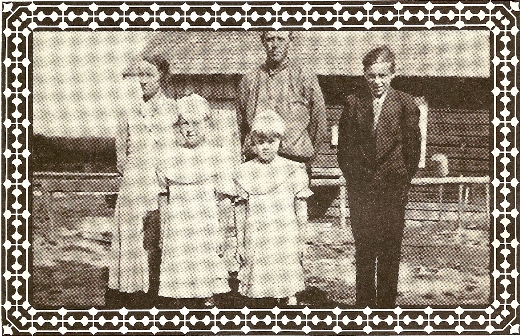
The author's parents and family. The Depression touched people on both sides of the Atlantic - in America and in Sweden.
BY INGA MOLING
The things that stand out most in my mind, while growing up during the Depression years in Sweden, was that we were poor in every way. As a girl, I felt it most in the clothing department. Sure, food was restricted to things we grew or raised on our small acreage, but we got used to living on boiled potatoes, salt herring and salt pork, homemade bread - "rispa" and "tunnbread" (thin bread). The noon meal was either sandwiches for our school lunch, or if we were home, milk dumplings, or rice cooked in milk or a barley flour mush with skim milk and lingon or blueberry sauce to make it more palatable. The menu seldom varied. Cream was skimmed off, or separated, in order that Mother could make butter to sell or trade at the store for things we didn't grow ourselves.
My memory is a little weak as to what I wore before I started school, but at no time while I was going to school do I remember having more than three changes of clothing. Yes, that included the homemade underwear! The shortage of clean clothing was felt more acutely during the winter, when washing and drying were at a premium, due to cold weather. The way my mother had her washing situation worked out was thus: we wore one set of underwear for one whole week, Sunday we sponged off (no bathtubs then), and got our second set of clean clothes. Next Sunday, repeat the process.
During the week my mother would wash, by hand, on the old washboard. If it was extremely cold, she would not hang the clothes outside, but would haul them up to the attic to hang them on makeshift lines. Of course, it was cold there too, so little by little, the stiff-frozen garments would be brought down and dried over the cook stove in the kitchen.
The kitchen was the hub of our existence. It served as living, dining and sleeping area for our parents, my sister and I, and younger brother (who slept in a cradle by my parents bed). My older brother slept in a sparsely heated bedroom off the kitchen. Heaven help you if you had an "accident" and messed up the underwear when there were no clean things ready. That meant a hurry-up job of washing and drying.
As for dresses, they were of wool so they could not be washed, but had to be spotted with turpentine, then hung out to air. During such a time, we might be permitted to wear our Sunday dress, if we were very careful not to get it soiled, but mostly we resorted to wearing the other school dress, thus saving the Sunday outfit.
Aprons were a great addition to our wardrobe. Made of flour sacks or cheap yard goods, they could be had pretty cheap. They were simple to sew so we usually had three or four aprons. It helped in preventing soil on the dresses, and somewhat brightened the attire. Stockings and shoes were another story, homemade, as well.
Stockings were knit by hand, although I recall an aunt who had a stocking knitting machine. Mother would bring her carded, homespun wool yarn to her. I don't know how it happened since our yarn was gray, but the stockings that came back were black!!! Yes, coal black stockings that were held up by a vest-like garment with a piece of elastic (buttonholes every inch or so) to button to the stockings. A fear we always lived with was that that button would come off - and it did, at the most inappropriate moment! Then we had two choices: let the stocking fall down in wrinkles around the ankle, or hold on to the thing until you got home.
Snow was usually pretty deep (maybe it seemed that way because I was shorter then) but walking or skiing to school, we managed to get thoroughly wet. Having only two pair of those awful black itchy stockings, I hung them over the stove again so they would be dry by morning. If you've never smelled the odor of wet wool stockings over a hot stove, you haven't lived.
The shoes were made by a shoemaker. They were soft-soled, cut from one piece of leather, with a separate piece of the instep. Where the instep was sewed to the rest of the leather, a horn-shaped toe protruded, which I really hated.
Maybe that's the only way they could be sewn, or Heaven help me, maybe it was the style; I don't know, but they were some ugly shoes. These shoes were water-proofed when new, and periodically afterwards, with creosote.
Our schoolroom held twenty-four students. Can you imagine the smell when that many kids had their shoes waterproofed? It's a wonder the teacher didn't leave!
If you were blessed with an older sister, you never had to look forward to any new clothes, because hand-me-downs were very much in evidence. Not until I grew taller than my sister, did I get a coat of my very own.
A friend of the family was a seamstress. She came to our house, used our sewing machine, and came up with a pretty respectable looking coat, made from one of my uncle's overcoats. We ripped it open, pressed and turned it wrong side out. It had been a fish-bone pattern on the right side, but turning it to the wrong side it became a pretty plaid.
As I recall, the seamstress was there three days, steadily working on that coat. It was a challenge to get all the pieces of material to stretch.
In spite of all these hardships, I enjoyed school, and growing up. I was sad to finish the seventh grade, because that meant the end of free schooling. Only the wealthy could send their children for further education. The only work available for a country girl was to hire out as a combination baby sitter and house maid. It didn't pay well, but was an improvement over staying home and being a burden to the family, a far cry from the way our children have it today!
And yet, I wouldn't have wanted to grow up in any other way, time, or place.
Back to Hard Times