Play Equipment From Yesterday
BY EMMA C. JOHNSON
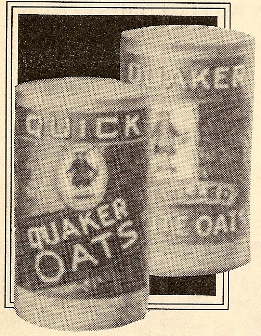
"That's over the goal!" my brother George shouted as the Mother's Quaker Oats box with its pilgrim label rolled over the faint chalk line drawn on the oiled pavement of the federal government highway.
"It is not! It is only partly over!" came the rejoiner.
We had to make up our own rules those days. After all, an oatmeal box did not exactly constitute a football nor did it bounce the same, and the playing field was considerably narrower than the conventional playing field, but the spirit of the game was there.
Modern day youngsters plaintive cries seem to be, "I haven't got anything to do!" Having tired of the TV game of Little Brick Out or fresh out of funds for the Saturday afternoon matinee, they seem at a loss as to what they should do with their time.
Our family's play equipment during the Depression years had to stem from our imaginations. If any one of us youngsters suggested we did not have anything to do, that situation was soon remedied. There was wood to chop, water to draw from the cistern, lamp chimneys to be relieved of their carbon soot or kerosene to be gurgled into the ever thirsty lamps. No, everyone could find something to do! The recesses of the mind provided a stimulus for conjuring up whatever equipment was necessary to play the game.
Take checkers. We didn't own any of those fancy red and black boards that would fold together for storage. A large enough piece of cardboard, usually cut from the back of an old school tablet, was the basic ingredient needed to construct the checkered surface dotted with a variety of button sizes. If we were lucky, no one lost any of the white or black buttons. Occasionally our mother would confiscate them to sew on the blue chambray shirts that always seemed to decorate the cantilevered shelf of her old treadle Singer sewing machine.
Then there were the games we made up by putting fingers over the number describing catalog selections of materials to try to guess their sequence. Quite often there was a pattern in the numbering system which presented a challenge to figure out.
We couldn't afford commercial jacks to play with but the right size stones made an adequate substitute and a rock for a ball developed real hand dexterity. It was a challenge to throw the "ball" up in the air, pick up the "jack" and retrieve the "ball" before it fell to the ground with a thud.
Paper doll books were unheard of, but the old Montgomery Ward catalogues were a gold mine for boys and girls in almost the latest fashions - at least only one season past the latest "in" look! It really didn't matter as long as all appendages were there, that is all the arms and legs. Commercial artists were not particularly cognizant of this necessary fact and had portions of figures overlapping one another, or they apparently thought only the top half of a figure was necessary if a jacket was the principal product to be marketed.
The comic strips, too, were a source for a paper doll inventory. The full figures were a prize discovery in this context since most often cartoonists would depict partial figures to carry on the necessary dialogue between the cartoon characters.
The Campbell kids alongside the pictures of the Campbell soups advertised in national magazines were a fine addition to the paper doll storehouse. However, since these came out only once a month, it took a long time to acquire a fairly large number of these characters.
String was assiduously saved and rolled onto the ball that was measured countless times to determine if it was sufficiently large to be encased in old pieces of leather laced together to make a softball. The hand hewn and shaped baseball bat was jealously guarded from the elements so that it would not become warped or water soaked.
Then there was the old rubber tire swing precariously perched on the limb of a maple tree that threatened to break if too many occupants decided to clamber onto it at one time.
I remember the rubber automobile tires we rolled up and down the hills and along the straight-away. In my mind's eye, one became a beautiful black mare, galloping across the plains, its silky mane flowing out.
Since I was raised on a coal mine way out in the country, there were sixteen-inch-diameter black metal powder kegs which, when rolled on their sides, became a teaming herd of cattle.
Merry-go-rounds were available only once a year when the carnival came to town, but the spinning wheel of an overturned Model-T Ford out in the middle of the foothills made a marvelous substitute. Granted, the circumference was rather limited so the total distance traversed in a circular path was minimal, but the basic concept was there. However, I remember a too rapid whirling was instrumental in achieving a rather dizzy sensation after twirling around and around.
Our high jump was rather unique. The two posts provided a support for the bamboo rod which could be adjusted in height over the jutting nails from the posts. Occasionally these supports leaned precariously so that the levelness of the rod provided a number of disruptions among the contestants as to whether the claimed height of jumping had in actuality been achieved.
The outdoor picnics with blackened potatoes roasted in charred embers in the snug enclosure of the sandstone boulders of the foothills were more delicious, I am certain, than the fanciest McDonald's touted delicacies.
We had a fantastic ski hill. It was a towering mound of black slack from the coal mine. Of course, skis were an unknown item. However, we securely tied dull, brown gunny sacks about our legs that kept them mostly in place as we slid down the slick piles. They worked splendidly.
Then there were those marvelous swimming holes - not the municipal swimming pools, but a special hole eroded by time and water under the overhanging branches of a cottonwood alongside the irrigation canal. Evening swims were best - just as the sun was setting. The water felt deliciously warm after heating all day in the hot sun, and so when the cool evening breeze pricked your skin, you snuggled down into the water and let it caress your body.
The real climax came when we uncapped the bottles of homemade root beer that had been "aging" for three weeks in the cool, dark dampness of the coal mine tunnel. Then the tingling liquid tickled the tongues as we savored the flavor. The time spent sucking the rubber hose to create a vacuum so that the liquid would trickle over the twenty-five-quart stone crock into the brown bottles seemed time well spent. Even the tedious cleansing of the bottles with the black whiskered wire bottle brush seemed handsomely repaid.
There were countless other incidents of pleasures created by the imagination and fortitude. Somewhere along the way, children of today seem to have lost the technique of using the imagination to create pleasurable pastimes. If it is not packaged and promoted by the purveyors of televisions touted commercials, a thought never seems to insinuate itself into the recesses of the cranium to provide a spark to meet the challenge of "I haven't got anything to do!"
Back to Hard Times