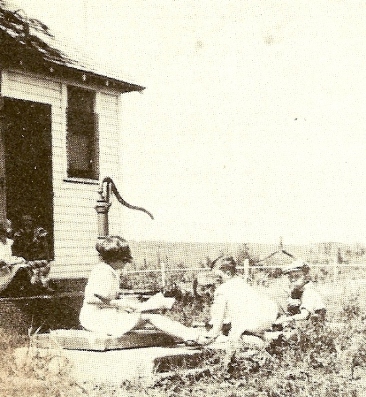
Author Lyon and assorted family members beside the water pump.
BY EVELYN LYON
Perhaps it was because we were country people, or perhaps it was because I had a Scotch-Irish mother and Scotch grandmother, or perhaps it was the sign of the times, but when I was growing up we wasted nothing - absolutely nothing. Certainly, water was one of the main things we conserved.
Looking back, there was really no need to do this; our use of water was not all that great. Back in the '20s and '30s electricity had not reached our little community, so there were no electric pumps, no watering hoses, and no irrigation systems. Our attainment of water was very simple - hand pumps and a windmill, but my family felt that water, like all other natural resources, was a God-given commodity and not to be taken lightly.
We were blessed with a good water system. There was a deep well in our back yard, with a big iron pump, affording good water. My dad had installed a pitcher pump inside the kitchen, thus bringing in "water in the house." This came from a cistern just outside the kitchen door where the water from the eaves filled the cistern when it rained. There was also a big rain barrel at the edge of the wash house to catch any rain water coming off the roof. This had many uses. Every drop of water everywhere was utilized.
Down in the barn lot there was an enormously deep well that my dad bragged about being so deep it could "never be pumped dry." This had a big heavy iron pump and a tall squeaky windmill. The water was cold and clear and delicious, our favorite well.
It was just second nature with us to conserve water though. None was ever thrown out nor wasted. Nothing was more frustrating than to arrive home later than we had planned, only to find the windmill had pumped too long and over-flowed the water tank. Dad worried about it for days, such a loss of water, and - certainly, woe unto anyone who was supposed to shut off the windmill and forgot to do it. This was a cardinal sin!
It seemed even the livestock cooperated; they would approach the water tank very sedately, get drinks, shake heads, and move on, never splashing any on the ground. All but the geese and ducks - this was Mother's great complaint about them; they "dabbled in the water, and wasted it." This necessitated taking water to them more often than she planned.
Our household tasks and meals were planned with great precision, thus conserving every drop of water. When vegetables were washed for use, the water was carried to the garden or flower beds and poured around young plants. The water the vegetables were cooked in was either used for gravy or thickened with the vegetables and a little cream added to make a delicious cream sauce. It was NEVER poured down a drain. Dishwater was always saved and put in the hog feed; Dad had the feeling that the suds helped the hogs. Leftover coffee, tea and drinking water from the table was used to water the house plants.
We had no indoor plumbing, but did have a sink in the kitchen where we washed our hands. The water from this operations ran down underneath into a bucket - this became water for the chickens, geese and ducks. Usually my job was to carry it to them.
Baths were taken in a big round galvanized washtub. This water was saved and carried out the next morning and used to water garden and flowers in the summertime; in the winter it was heated on the back of an old black cook stove in the kitchen and used to warm the chickens drinking water.
But, wash water from the laundry really went the rounds. Used first for washing our clothes, the sudsy water was then used to scrub the kitchen and pantry floors, then on out to the porches and later on to the outhouse, where a good job of scrubbing was done. These were weekly tasks. Whatever was left then finally found its way to a flower bed, garden or around the base of a tree or shrub.
The water caught in the rain barrel was special - it was soft. This was used to wash hair, silk hose, and delicate laundry, and in that order. Whatever was left was used for small cleaning jobs such as windowsills, cabinet fronts, kitchen chairs, table legs and porch railings. My mother was a meticulous housekeeper and scrubbing was one of her greatest virtues.
Well, the years have come and gone and I have moved away from that little farm, but the conservative values still linger. I find it very hard to turn on a faucet and just "let the water run," or see gallons of water gush through a lawn hose, or hear it gurgle through an automatic washer and on down into a sewer. I'm sure there is no way we can go back to the "good old days," and certainly modern conveniences have brought us great comfort, but my thrifty upbringing compels me to have great respect for water.
In our age it is very important that we make the most of our natural resources and energy and really conserve them wherever we can. All it takes is a little conscientious thinking and deliberate action. Perhaps it would be good for us to try some of those conservative tricks of our ancestors.
Back to Hard Times