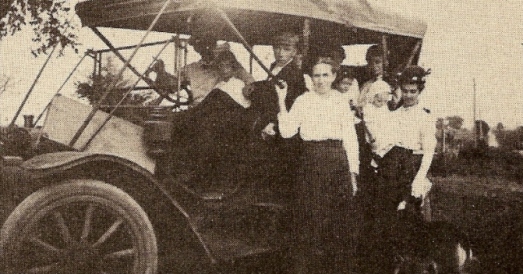
The author's family loading up for a drive. Wood as fuel only required cutting; fuel for this
automobile had to be purchased at the tune of 12 1/2 cents per gallon.
BY ARTHUR HOLLIDAY, JR.
(Written in 1988)
Does the thought of high priced fuel bills this winter cause a premature chill to run through your veins? Then come and journey back through time with me sixty years and that chill will turn to warmth, even perspiration as we have a grand time gathering in our winter's fuel.
We didn't dread gathering fuel; we looked forward to it. A family turned loose in the woods could have some never-to-be-forgotten experiences. Some of the late varieties of wild plums were still about and the black and red hulls were in their prime. The black hulls had a flavor unlike anything I can describe. The red hulls tasted like apples, maybe better, but they were so small. Father's hardest job was not chopping and splitting but keeping track of his inquisitive, overactive brood.
We younger ones had the job of finding deadfall limbs and small dead trees that we dragged back for the older boys to make short pieces of kindling of them. These were used to start fires in both the great heating stove and in Mother's Kitchen Queen.
Some kindling was very superior to others. Dead, completely dried, sycamore was good, but the green wood of the same variety was worthless. Our favorite kindling was from the red bud tree, sacred to the Osage Indians, who had lived in those very woods only about two generations before. Occasionally we would find a stone hatchet, a grinding stone, or maybe even a perfect hunting arrowhead or a war head. Ever so often we would have to cease our searchings and hurry back, dragging a limb or small tree, panting and wiping our foreheads as though we had been working hard all the time.
About the time of the first frost, the pawpaws, or wild bananas as some called them, were at their best. Father loved them and it was not time wasted to gather them - as long as he got his share.
While collecting the wood, we usually managed to collect several bags of black walnuts, a bag or two of inferior hickory nuts we called "bull nuts", and maybe a bag or so of the superior shell bark variety, if we could beat the squirrels. My oldest brother knew where there was a tree of nuts we all considered delicious that was called 'chinquapins' locally. He would never disclose its locations to any of us, even though we threatened and pleaded.
Father and the older boys did not have as much time to wander as we younger ones did. The older boys worked crosscut saws and felled the larger trees and Father followed with a sharp, double-bited axe. He trimmed the limbs off the logs and marked them into lengths for the boys to saw. After being cut into lengths, those too heavy to lift were split with wedges. Later all logs and poles that could be handled were loaded on the running gears of wagons with high standards to keep them from rolling off. They were unloaded at home in one gigantic pile.
Mother went to the woods with us. She would not have missed it. Her wicker picnic hamper was crammed with unbelievable goodies. The woods gives one a terrific appetite. Also, she carried along a couple of three gallon milk buckets and a large soup spoon. She wandered happily and aimlessly about looking for dead stumps and logs that were mostly decayed. Whenever she found one, she spooned the rich organic dirt into the buckets as proudly as though she had struck gold. That was one reason her house plants surpassed all others in health and beauty.
Dinner was a fine time. After eating more than our fill, we relaxed on our backs in the deep leaves, smelling the fresh chips and other wood smells. Father always attempted to nap, but the older boys would soon start bickering with each other and finally wrestling. Father would get to his feet, stretch and announce, "Time to put some of that surplus energy on a saw handle. Hop to it!"
Cutting the wood into poles and logs and hauling it home was only part of the job. While we were cutting and hauling, the entire neighborhood was doing the same. Giant piles of logs were stacked neatly, never crossed, with the butt ends close to where the great buzz saw would be staked down. When everyone had enough heating wood to last the winter, and enough cook wood to last the year, we were ready to start buzzing. Someone in the neighborhood always kept a good circle or buzz saw and had acquired the knowledge to keep it set and sharpened. Usually the motor to run it was his also, and the long, endless belt.
After the saw was staked and the belt lined up, the motor was sped until the blade whistled a high tune and the teeth became a blur. Then the operator gave the signal to begin. He usually fed the saw himself because improper feeding could harm the blade.
Two to three men carried each log or arm load of poles. Two or three more were picking a load out of the great pile or holding an arm load, waiting their turn at the saw.
The log was laid on a platform made to tilt easily into the shining saw blade. As each stick was severed, it was taken by a man called the "off bearer" and tossed into a growing pile. Often he started three piles, one for heating stove lengths, one of shorter pieces and easily split pieces for the cook stove, and occasionally small dry pieces for kindling. The feeder and the off bearer had to make the decisions as to length and type of wood. Some wanted nothing but ash for cook stove; some only oak for heating. These two men had to think fast, because the action was fast and furious. There was no horseplay around such dangerous machinery, but they always strove to do more each day than the day before as a matter of pride.
The dinners were feasts. They compared with threshing dinners, maybe even better, because the chill in the autumn air gave everyone enormous appetites. The women started gathering about an hour after the men. That gave them time to bring their visiting up-to-date and have the dinner ready by twelve sharp.
When one man's wood was finished, they moved on to another man's until the entire crew had their winter's supply cut and piled.
I have lived many winters now and God has allowed me to have things I have been proud of. Other than a loving wife and some good children, I believe the thing that still gives me the most pleasure is an enormous pile of wood and winter not really here yet.
Back to Hard Times