AP European History – Mr. O’Donnell
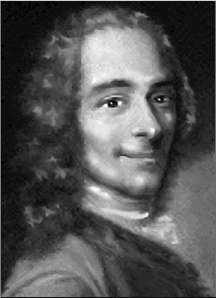
Voltaire
Author and Philosopher

1694 - 1778

Those who can make you believe absurdities
can make you commit atrocities.

                                           —Voltaire


Francois Marie Arouet (pen name Voltaire) was born on November 21, 1694 in Paris. Voltaire's intelligence, wit and style made him one of France's greatest writers and philosophers.

Young Francois Marie received his education at "Louis-le-Grand," a Jesuit college in Paris. He left school at 16 and soon made friends among the Parisian aristocrats. His humorous verses made him a favorite in society circles. In 1717, his sharp wit got him into trouble with the authorities. He was imprisoned in the Bastille for eleven months for writing a scathing satire of the French government. During his time in prison Francois Marie wrote "Oedipe" which was to become his first theatrical success and adopted his pen name "Voltaire."

In 1726, Voltaire insulted the powerful young nobleman, "Chevalier De Rohan," and was given two options: imprisonment or exile. He chose exile and from 1726 to 1729 lived in England. While in England Voltaire was attracted to the philosophy of John Locke and ideas of mathematician and scientist, Sir Isaac Newton. He studied England's Constitutional Monarchy and its religious tolerance. Voltaire was particularly interested in the philosophical rationalism of the time, and in the study of the natural sciences. After returning to Paris he wrote a book praising English customs and institutions. It was interpreted as criticism of the French government and in 1734, Voltaire was forced to leave Paris again.

At the invitation of his highly-intelligent woman friend, "Marquise du Chatelet," Voltaire moved into her "Chateau de Cirey" near Luneville in eastern France. They studied the natural sciences together for several years. In 1746, Voltaire was voted into the "Academie Francaise." In 1749, after the death of "Marquise du Chatelet" and at the invitation of the King of Prussia, "Frederick the Great," he moved to Potsdam (near Berlin in Germany). In 1753, Voltaire left Potsdam to return to France.

In 1759, Voltaire purchased an estate called "Ferney" near the French-Swiss border where he lived until just before of his death. Ferney soon became the intellectual capital of Europe. Voltaire worked continuously throughout the years, producing a constant flow of books, plays and other publications. He wrote hundreds of letters to his circle of friends. He was always a voice of reason. Voltaire was often an outspoken critic of religious intolerance and persecution.

Voltaire returned to a hero's welcome in Paris at age 83. The excitement of the trip was too much for him and he died in Paris. Because of his criticism of the church Voltaire was denied burial in church ground. He was finally buried at an abbey in Champagne. In 1791 his remains were moved to a resting place at the Pantheon in Paris.

In 1814 a group of "ultras" (right-wing religious) stole Voltaire's remains and dumped them in a garbage heap. No one was the wiser for some 50 years. His enormous sarcophagus (opposite Rousseau's) was checked and the remains were gone. (see Orieux, Voltaire, vol. 2 pp. 382-4.) His heart, however, had been removed from his body, and now lays in the Bibliotheque nationale in Paris. His brain was also removed, but after a series of passings-on over 100 years, disappeared after an auction.


Plot Overview of Candide

Candide is the illegitimate nephew of a German baron. He grows up in the baron's castle under the tutelage of the scholar Pangloss, who teaches him that this world is "the best of all possible worlds." Candide falls in love with the baron's young daughter, Cunégonde. The baron catches the two kissing and expels Candide from his home. On his own for the first time, Candide is soon conscripted into the army of the Bulgars. He wanders away from camp briefly for a walk, and is consequently brutally flogged as a deserter. After witnessing a horrific battle, he manages to escape and travels to Holland.

In Holland, a kindly Anabaptist named Jacques takes Candide in. Candide runs into a deformed beggar and discovers that it is Pangloss. Pangloss explains that he has contracted syphilis and that Cunégonde and her family have all been brutally murdered by the Bulgar army. Nonetheless, he maintains his optimistic outlook. Jacques takes Pangloss in as well. The three travel to Lisbon together, but before they arrive their ship runs into a storm and Jacques is drowned. Candide and Pangloss arrive in Lisbon to find it destroyed by an earthquake and under the control of the Inquisition. Pangloss is soon hanged as a heretic, and Candide is flogged for listening with approval to Pangloss's philosophy. After his beating, an old woman dresses Candide's wounds and then, to his astonishment, takes him to Cunégonde. Cunégonde explains that though the Bulgars killed the rest of her family, she was merely raped and then captured by a captain, who sold her to a Jew named Don Isaachar. At present, she is a sex slave jointly owned by Don Isaachar and the Grand Inquisitor of Lisbon. Each of Cunégonde's two owners arrive in turn as she and Candide are talking, and Candide kills them both. Terrified, Candide, the old woman, and Cunégonde flee and board a ship bound for South America. During their journey, the old woman relates her own story. She was born the Pope's daughter but has suffered a litany of misfortunes that include rape, enslavement, and cannibalism.

Candide and Cunégonde plan to marry, but as soon as they arrive in Buenos Aires, the governor, Don Fernando, proposes to Cunégonde. Thinking of her own financial welfare, she accepts. Authorities looking for the murderer of the Grand Inquisitor arrive from Portugal in pursuit of Candide. Along with a newly acquired valet named Cacambo, Candide flees to territory controlled by Jesuits who are revolting against the Spanish government. After demanding an audience with a Jesuit commander, Candide discovers that the commander is Cunégonde's brother, the baron, who also managed to escape from the Bulgars. Candide announces that he plans to marry Cunégonde, but the baron insists that his sister will never marry a commoner. Enraged, Candide runs the baron through with his sword. He and Cacambo escape into the wilderness, where they narrowly avoid being eaten by a native tribe called the Biglugs.

After traveling for days, Candide and Cacambo find themselves in the land of Eldorado, where gold and jewels litter the streets. This utopian country has advanced scientific knowledge, no religious conflict, no court system, and places no value on its plentiful gold and jewels. But Candide longs to return to Cunégonde, and after a month in Eldorado he and Cacambo depart with countless invaluable jewels loaded onto swift pack sheep. When they reach the territory of Surinam, Candide sends Cacambo to Buenos Aires with instructions to use part of the fortune to purchase Cunégonde from Don Fernando and then to meet him in Venice. An unscrupulous merchant named Vanderdendur steals much of Candide's fortune, dampening his optimism somewhat. Frustrated, Candide sails off to France with a specially chosen companion, an unrepentantly pessimistic scholar named Martin. On the way there, he recovers part of his fortune when a Spanish captain sinks Vanderdendur's ship. Candide takes this as proof that there is justice in the world, but Martin staunchly disagrees.

In Paris, Candide and Martin mingle with the social elite. Candide's fortune attracts a number of hangers-on, several of whom succeed in filching jewels from him. Candide and Martin proceed to Venice, where, to Candide's dismay, Cunégonde and Cacambo are nowhere to be found. However, they do encounter other colorful individuals there, including Paquette, the chambermaid-turned-prostitute who gave Pangloss syphilis, and Count Pococurante, a wealthy Venetian who is hopelessly bored with the cultural treasures that surround him. Eventually, Cacambo, now a slave of a deposed Turkish monarch, surfaces. He explains that Cunégonde is in Constantinople, having herself been enslaved along with the old woman. Martin, Cacambo, and Candide depart for Turkey, where Candide purchases Cacambo's freedom.

Candide discovers Pangloss and the baron in a Turkish chain gang. Both have actually survived their apparent deaths and, after suffering various misfortunes, arrived in Turkey. Despite everything, Pangloss remains an optimist. An overjoyed Candide purchases their freedom, and he and his growing retinue go on to find Cunégonde and the old woman. Cunégonde has grown ugly since Candide last saw her, but he purchases her freedom anyway. He also buys the old woman's freedom and purchases a farm outside of Constantinople. He keeps his longstanding promise to marry Cunégonde, but only after being forced to send the baron, who still cannot abide his sister marrying a commoner, back to the chain gang. Candide, Cunégonde, Cacambo, Pangloss, and the old woman settle into a comfortable life on the farm but soon find themselves growing bored and quarrelsome. Finally, Candide encounters a farmer who lives a simple life, works hard, and avoids vice and leisure. Inspired, Candide and his friends take to cultivating a garden in earnest. All their time and energy goes into the work, and none is left over for philosophical speculation. At last everyone is fulfilled and happy.


Key Facts

Full title - Candide, or Optimism

Author - Voltaire (pen name of François-Marie Arouet)

Type of work - Novel

Genre - Satire; adventure novel

Language - French

Time and place written - Schwetzingen, Prussia; and Geneva, Switzerland; 1758–1759

Date of first publication - January or February, 1759

Publisher - Gabriel Cramer

Narrator - Anonymous satirical narrator

Point of view - The narrator speaks in the third person, focusing on the perspective and experiences of Candide. Events and characters are described objectively most of the time. Occasionally, they are described as Candide sees them, but this is always done with an ironic tone.

Tone - Ironic; melodramatic

Tense - Past and present


Setting (time) - 1750s

Setting (place) - Various real and fictional locations in Europe and South America

Protagonist - Candide

Major conflict - Candide and Pangloss's optimistic world view is challenged by numerous disasters; Candide's love for Cunégonde is repeatedly thwarted.

Rising action - Candide is expelled from his home for kissing Cunégonde; he wanders the world attempting to preserve his life and reunite with his beloved.

Climax - Candide finds Cunégonde enslaved in Turkey; the two are married.

Falling action - Candide, Cunégonde, Pangloss, and their friends struggle with boredom; they find solace in gardening.

Themes - The folly of optimism; the uselessness of philosophical speculation; the hypocrisy of religion; the corrupting power of money

Motifs - Resurrection; rape; political oppression

Symbols - Pangloss; the garden; the Lisbon earthquake

Foreshadowing - There is virtually no foreshadowing in this wildly chaotic narrative. Candide's repeated musings about what Pangloss would think of events foreshadows Pangloss's "resurrection."


Hosted by www.Geocities.ws

1