AP European History – Mr. O’Donnell
RENE DESCARTES (1595-1650)
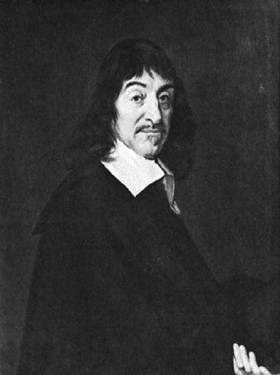 "I am thinking therefore I exist."
(Latin: Cogito ergo sum)
from the Discourse on Method
Rene Descartes
was a famous French mathematician, scientist and philosopher. He was arguably
the first major philosopher in the modern era to make a serious effort to
defeat skepticism. His views about knowledge and certainty, as well as his
views about the relationship between mind and body have been very influential
over the last three centuries.
Descartes was
born at La Haye (now called Descartes), and educated at the Jesuit College of La Flèche between 1606 and 1614.
Descartes later claimed that his education gave him little of substance and
that only mathematics had given him certain knowledge. In this lament he joins
a chorus of seventeenth century philosophers including Bacon, Hobbes and Locke.
In 1618 he went to Holland to serve in the army of
Prince Maurice of Nassau, in travelled to Germany with that army. On the
night of Nov ember 10, he had a series of dreams which he interpreted as signs
that he would found a universal science. The most important influence on
Descartes at this time was the mathematician Issac Beeckman, who stimulated
Descartes by posing a number of problem s and discusiing issues in physics and
mathematics with him. His first substantial work was the Regulae or Rules
for the Direction of Mind written in 1628-9 but not published until 1701.
This work shows Descartes interest in method which he shared with many
sixteenth and seventeenth century scientists, mathematicians and philosophers.
One source of
this interest in method was ancient mathematics. The thirteen books of Euclid's Elements was a
model of knowledge and deductive method. But how had all this been achieved?
Archimedes had made many remarkable discoveries. How had he come to make these
discoveries? The method in which the results were presented (sometimes called
the method of synthesis) was clearly not the method by which these results were
discovered. So, the search was on for the method used by the ancient
mathematicians to make their discoveries (the method of analysis). Descartes is
clearly convinced that the discovery of the proper method is the key to
scientific advance. For a more extended and detailed discussion of these
methods, see John Cottingham , The Rationalists, Oxford University
Press, Oxford, 1982. Chapter 2.
In November 1628
Descartes was in Paris, where he made himself
famous in a confrontation with Chandoux. Chandoux claimed that science could
only be based on probablitiies. This view reflected the dominance in French
intellectual circles of Renaissance skepticism. This skptical view was rooted
in the religious crisis in Europe resulting from the
Protestant Reformation and had been deepened by the publication of the works of
Sextus Empiricus and reflections on disagreements between classical authors. It
was strengthend again by considerations about the differences in culture
between New World cultures and that of Europe, and by the debates over
the new Copernican system. All of this had been eloquently formulated by Montaigne
in his Apology for Raymond Sebond and developed by his followers.
Descartes attacked this view, claiming only that certainty could serve as a
basis for knowledge, and that he himself had a method for attaining such
certainty. In the same year Descartes moved to Holland where he remained with only
brief interruptions until 1649.
In Holland Descartes produced a
scientific work called Le Monde or The World which he was
about to publish in 1634. At the point, however, he learned that Galileo had
been condemned by the Church for teaching Copernicanism. Descarte s' book was
Copernican to the core, and he therefore had it supressed. In 1638 Descartes
published a book containing three essays on mathematical and scientific
subjects and the Discourse on Method. These works were written in
French (rather th an Latin) and were aimed at the educated world rather than
simply academics. In 1641 Descartes followed this with the Meditationes
de Prima Philosophia (Meditations on First Philosophy). This short
work is more metaphysical than scientific, and aims to establish the certain
foundations for the sciences which Descartes had announced in his confrontation
with Chandoux in 1628. (For a more detailed account of this work see Structure
of the Meditations. The work was published together with
Objections and Replies from a six (and then seven) philosophers and
theologians, including Thomas
Hobbes, Pierre
Gassendi and Antoine
Arnauld.
After the Meditations,
Descartes produced The Principles of Philosophy in 1644, the most
complete statement of his mature philosophy and of the Cartesian system in
general. Part 1 explains Descartes metaphysical views. Part II gives a detailed
exposition of the principles of Cartesian physics. Part III applies those
principles of physics to give a detailed explanation of the universe, and Part
IV deals with a wide variety of terrestial phenomena. Two more parts were
planned, to deal with pl ants and animals and man, but were not completed. In 1648
Descartes published "Notes against a Program" -- a response to a
pamphlet published anonymously by Henricus Regius, Professor of Medecine at the
University of Utrecht. Regius had been an early
and enthusiastic supporter of Descartes. But when Regius published his Foundations
of Physics Descartes complained that Regius had shamelessly used
unpublished papers of Descartes to which he had access and had distorted
Descartes' ideas. The "Notes" both illustrate the kind of academic
controversies in which Descartes was involved during this decade, but also
provides some insight into his views about mind and his doctrine of innate
ideas.
Descartes last
work Les Passions de l'áme was written as a result of the
correspondence which Descartes carried on with Princess
Elisabeth of Bohemia. The work was written in French, and published in Amsterdam and Paris in 1649. This work (like
the Principles) is composed of a large number of short articles.
Princess Elisabeth had raised the question of how the soul could interact with
the body in 1643. In response to Elisabeth's questions, Descartes wrote a short
work which developed into the Passions of the Soul. The work is a
combination of psychology, physiology and ethics, and contains Descartes'
theory of two way causal interaction via the pineal gland.
Two months
before the publication of the Passions Descartes set sail for Stockholm, Sweden, at the invitation of Queen
Christina of Sweden. Descartes' death in Stockholm of pneumonia, has
regularly been attributed to the rigours of the Swedish climate and the fact
that Descartes (no early riser) was sometimes required to give the Queen
lessons as early as five in the morning. However unpleasant these conditions
may have been, it seems plain that Descartes acquired his fatal malady as a
result of nursing his friend the French ambassador (who had pneumonia) back to
health.
Descartes Time
Line
1596 31 March:
born at La Haye near Tours
1606-14 He
attends Jesuit college of La Fleche in Anjou
1616 Descartes
takes doctor of law at University of Poitiers
1618 He goes to Holland and joins the army of
Prince Maurice of Nassau
1619 He travels
in Germany; on 10 November in Ulm has dream of a unified
scientific system based on mathematics
1622 He returns
to France, during next few years
spends time in Paris, but also travels in Europe
1628 (or 29) He
composes Rules for the Direction of Mind (which was first published in
1701);
1628 In November
Descartes distinguished himself in a confrontation with Chandoux, who claimed
that all science is based on probability while Descartes claimed that only
certainty could be the basis of human knowledge and that he had a method for
attaining certainty. Following this, Descartes was encouraged by Cardinal
Berulle to develop his system.
1628 Descartes
leaves for Holland which is to be his home
until 1649
1629 He begins
working on The World
1633 The condemnation
of Galileo leads Descartes to abandon plans to publish The World
1635 The birth
of Descartes' natural daughter, named Francine, baptized 7 August (died 1640)
1637 Descartes
publishes Discourse on Method, with Optics, Meterology
and the Geometry
1641 Meditations
on First Philosophy published together with the first six sets of Objections
and Replies
1642 Second
edition of the Meditations published along with all seven sets of
objections and replies. Descartes meets Princess
Elisabeth of Bohemia
1643 Cartesian
philosophy condemned at the University of Utrecht; Descartes' long
correspondence with the Princess Elisabeth of Bohemia begins.
1644 Visits
France: The Principles of Philosophy published.
1647 Descartes
is awarded a pension by the King of France; he publishes Comments on a
Certain Broadsheet; begins work on The Description of the Human Body
1648 He is
interviewed by Frans Burman at Egmond-Binnen which leads to the publication of Conversations
with Burman
1649 He goes to
Sweden on invitation of Queen
Christina; the Passions of the Soul published
1650 11
February: dies in Stockholm