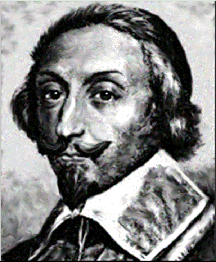
Cardinal
Richelieu
Prime Minister of France
1585
- 1642
 If
you give me six lines written
If
you give me six lines written
by the most honest man, I will find
something in them to hang him.
—Cardinal Richelieu
Cardinal Richelieu was born Armand Jean du Plessis in Paris
on September 9, 1585. He
took the name Richelieu from the name of his family's
estate. Armand was extremely intelligent and at the age of nine was sent to
College de Navarre in Paris. In
1602, at age seventeen he began studying theology seriously. In 1606 he was
appointed Bishop of Luçon, and in 1622 Pope Gregory
made Richelieu a Cardinal.
Cardinal Richelieu rose from his provincial post in Luçon
to become France's
Secretary of State for foreign affairs in 1616, and then on to head the royal
council as prime minister of France
in 1624. His powerful, analytical intellect was characterized by a reliance on
reason, strong will, the ability to govern others and
use political power effectively.
Even before becoming Prime Minister, Richelieu's
political views were well-defined. He had a clear idea of how society should
function. Everyone played a specific role in the system, making their unique
contributions: the clergy through prayer; the nobility with arms under the
control of the king, and the common people through obedience. Richelieu
believed in the divine right of the king, whose role it was to promote peace
and order in society.
Richelieu adhered to the maxim that "the ends
justify the means." Although he devoutly believed in the mission of the
Roman Church, he sought to assign the church a more practical role. Richelieu
argued that the state is above everything, and that religion is a mere
instrument to promote the policies of the state.
When Richelieu rose to power France's
King Louis XIII had not solidified his authority in France.
A combination of political corruption, an independent
nobility, and the power of a Protestant group called the Huguenots, threatened
the monarchy's rule. In 1627 Richelieu set out to secure
the authority of the crown through force and political repression. By 1631 he
had crushed Huguenot resistance, severely punished nobles who plotted against
the king, and replaced his enemies in the government. In addition, he expanded
the king's authority in the provinces through the use of royal agents called intendants.
Richelieu insisted that the king apply the law with
severity, otherwise the state could not survive. He emphasized that rigorous
punishment of even small crimes would forestall greater ones. Through this
reasoning, Richelieu provided his sovereign a rationale
for the harsh rule he knew to be requisite with strengthening and maintaining
the authority of the French State.
Cardinal Richelieu has been admired by many historians for his intelligence
and energy. During his service as prime minister he helped France
become the leading power in Europe. He supported the
French navy and the establishment of French colonies in Africa
and the Caribbean. Richelieu was
also a great patron of the arts. He rebuilt the Sorbonne in Paris,
supported promising writers and founded the French
Academy. Many French historians
consider Richelieu as the founder of French unity, as
well as the person who released France
from its medieval nature.