STUDY GUIDE FOR THE
RENAISSANCE
TIME LINE
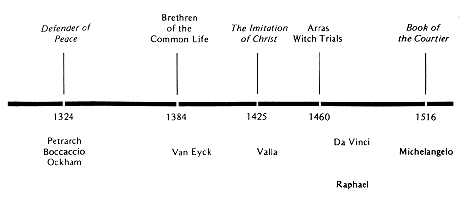
THE RENAISSANCE
The term "renaissance" ("rebirth" in French) was
introduced by Giorgio Vasari (1511-1574), an Italian
art historian who wrote of the rebirth of art in
These views overlook the accomplishments of medieval European civilization, especially those of the High Middle Ages from about l000 to 1300. During this period, Romanesque and Gothic architecture emerged, the first universities were established, and scholastic philosophy developed.
What occurred in
How distinctive was the Renaissance as a period in European history?
The Italian Renaissance, many historians agree, was not a complete break with
the outlook and institutions of the Middle Ages;
rather, it was an artistic and intellectual transformation of an urban elite,
characterized by rationalism, secularism, individualism, and humanism.
A wealthy merchant and banking class enriched by trade and commerce in the
cities of
Political Theory
In the realm of political theory, Machiavelli (The Prince 1513), revolutionized the science with his pragmatic prescriptions for obtaining and maintaining power. Since men are naturally selfish and corrupt, Machiavelli wrote, the prince must be as cunning as a fox and as ferocious as a lion in his dealings with them. He must be able to manipulate men's emotions and feelings, understanding that it is better to be feared than loved by his people. Christian teachings were irrelevant in the prince's pursuit of power. Political ends justified whatever means, however brutal, the prince employed.
Realism in Art
An artistic breakthrough to realism is found in the works of Michelangelo, da Vinci, Raphael, and Botticelli that illustrate the ways in which Christian and Greco-Roman themes converge. Michelangelo's David conveys the Greek ideal of beauty with its classical proportions, anatomical perfection, and glorification of the human body. The biblical David is portrayed as an independent moral agent who embodies reason and free will, and exhibits virtu, the striving for personal excellence. The Medicis placed the statue before the city hall in Florence as a symbolic defender of the republic. To the humanists, republican government was a superior form because it invited the participation of citizens in the dialogue of governing on which human progress depended.
Literary Criticism
The humanists studied the Latin classics and literary culture of the ancient world with deep interest. A famous humanist was Lorenzo Valla (1407-1457), who used historical criticism to discredit an eighth-century document giving the pope Italy and the entire Western empire. Analyzing the language in the document, he proved that it could not have been written in the fourth century and was, in fact, forged in the eighth century.
NORTHERN RENAISSANCE
Growing prosperity and the printing press carried Renaissance culture to northern and Western Europe, to England and the Low Countries (now Belgium and Holland). The Christian humanists Erasmus (In Prise of Folly, 1509) and Thomas More (Utopia, 1516) were advocates for the deeply religious character that distinguished the northern Renaissance from its Italian counterpart.