STUDY GUIDE FOR THE
THE RELIGIOUS WARS
TIME LINE
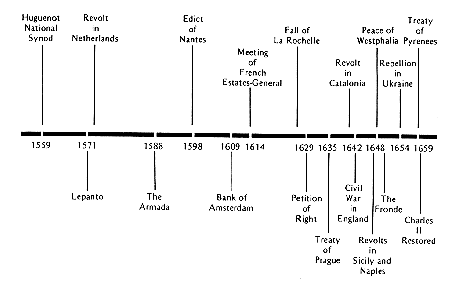
THE RELIGIOUS WARS
The Peace of Augsburg failed to solve the religious question in the Hapsburg
ruled territories. While Lutheranism was recognized as a legal religion that
the ruling prince could choose for his subjects, Calvinism was not. The issue
of Calvinism became especially troublesome in the
PROTESTANT REVOLT IN THE
Charles V had rebuked religious reformers. His successor, Philip
II, would prove harsher. When Charles V abdicated in 1556, his brother
Ferdinand (1556-1564) received
Defeat of the Spanish Armada
Their response was bitter. Calvinists destroyed the art works and libraries
of the Roman Catholic churches in their country. Mercenary troops led by the Duke
of Alva (1508- 1582) were called in to put down the rebellion, initiating a
ten-year civil war (1568-1578) between Catholics and Protestants, who were
united under Prince William of Orange (1572-1584). The upshot was
division in the
RELIGIOUS WARS IN
Religious upheavals affected
RELIGIOUS STABILITY IN ENGLAND
The ideological struggles over religion and the chil wars they unleashed were avoided in England once Elizabeth I ascended the throne in 1558.Tranquillity was maintained until her death in 1603. She said: "I desire to open a window into no man's conscience." In short, she did not want religious divisions of opinion to surface and create disputes. Catholic and Puritan extremes threatened a tenuous stability. Elizabeth, therefore, insisted on external conformity to ensure political order but showed no concern for people's private thoughts. Everyone had to attend the Anglican church under punishment of fine. The church had both Catholic and Protestant elements and was thus comprehensive enough in doctrine and dogma to win the support of most of the loyal English.
RELIGIOUS WARS IN GERMANY
While France, England, Spain, and the Dutch were achieving national unity, Germany was not. Religious issues resurfaced in 1618 with the closing of Protestant churches in Prague, in the kingdom of Bohemia (formerly Czechoslovakia). Enraged Protestants hurled Catholic officials from a castle window, so the story goes. This event known as the defenestration of Prague set off the Thirty Years' War. Denmark and later Sweden led by its able king Gustavus Adolphus (1594-1632) entered the war, hoping to thwart Hapsburg ambition to unify all of the German states. France, although a Catholic country, also supported the Protestant camp to reduce the power of the Hapsburg ruler Ferdinand.
THE PEACE OF WESTPHALIA
The war dragged on-on German soil-until 1648, when the Peace of Westphalia was signed. Each prince, whether Lutheran, Catholic, or Calvinist, had independent sovereign power and could choose the established creed of his territory. Political and religious authority rested in the hands of approximately three hundred German princes. The Thirty Years' War effectively destroyed Germany's economy. Over one third of the population had been destroyed. The peasants were hardest hit. Many became day laborers for nobles and landlords who bought up their landholdings and thus created a new serfdom in the empire.
EXPLORATION AND EXPANSION
While religious and political wars raged on the Continent, adventurous Europeans were discovering new trading routes to the Orient and India and new routes for the exploration and exploitation of a new world across the Atlantic Ocean. They included Prince Henry the Navigator, Francisco Pizarro, Hernando Cortez, Ferdinand Magellan, Christopher Columbus, Bartholomew Diaz, and Vasco de Balboa. Governments helped sponsor the voyages, most notably the Dutch East India Company, the organ of Dutch conquest and exploration. The mixed motives of seeking glory, finding gold, and proselytizing for God set the Portuguese, Spanish, English, French, and Dutch on their overseas voyages.
RESULTS
The wars of religion brought mixed results. While King Philip II of Spain succeeded in reducing the power of the Moslem Turks in the Mediterranean, he failed in his efforts to restore Roman Catholicism in England and lost control of the heavily Calvinist Dutch Netherlands. France remained a predominately Catholic country, although it continued to have a significant Huguenot minority. In the Holy Roman Empire the Hapsburgs failed to detroy Protestantism and in the process, suffered a further decrease of their own power. The power of the Spanish Hapsburgs declined, as well, and by the mid-seventeenth century, France had become the most powerful state on the European continent.