
 |
 |
Russia - Information.
October 1994 - St. Petersburg (Hermitage, Aurora, Summer Palace, Petrovoderts), Train, Moscow (Red Square, Kremlin, Sparrow Hills, Gorky Park, Gum Department Store, St. Basils Cathedral, Bolshoi Theatre, Mac Donald's).
Strange happenings: New Zealander does Haka on train in middle of night and get's a police kalashnikov pointed at him. Prior to the train journey, we were at a kiosk buying a few bottles of vodka. A local came up and offered myself and the New Zealander money for the services of a woman that was with us.
Propositioned in Red Square at midnight by a couple of prostitutes - even though I was with a group of five women.
Travel Advice and Information: Russia has many attractions, noticeably in St. Petersburg (Hermitage / Winter Palace, Peter and Paul fortress and of course, the Aurora which fired the shot that started the Russian Revolution. There is also the Summer palace in the village of Puskin outside St. Petersburg and Petrovoderts nearby). Moscow also has many attractions (the Kremlin, Red Square, Bolshoi Theatre, one of the numerous Mac Donald's and for shoppers, Gum department store and Arbat street), though due to redevelopment in the 1930's, much has gone.
Haggling is possible and in fact a way of life for many Russians. Lowering prices is hard work, but reasonable reductions are possible.
There is also the famous Trans-Siberian express, though there is more than the one option. These include:
1) Trans-Siberian express from Moscow to Vladivostok.
2) Trans-Mongolian express from Moscow to Beijing in China via Mongolia.
3) Trans-Manchurian express from Moscow to Beijing via Manchuria.
4) Another option takes you across China from Beijing and Xi'an via Urumqi to Almaty in Kazhakstan and from there, you can go direct to Moscow or to Tashkent in Uzbekistan and stop off to visit Samarkand and Bukhara.
All but the last go via Siberia and stopping off at Irkutsk for Lake Baikal (the largest fresh water lake in the world) should be considered a must (unfortunately I don't speak from personal experience).
Try 'The Imaginative Traveller' for more information on the Trans-Siberian Express.
A Little History: The earliest traces of Russia as a nation date back to the time of the Vikings, who used the Volga, Don and other rivers as trade routes between Scandinavia in the North and Persia, the Byzantine Empire and the northern branches of the Silk Road in the South. 'Rus' was the name given to the Vikings by the indigenous Slavic inhabitants - the Vikings also settled these lands, intermarried with the locals and 'Rus' eventually came to be the name for one of the local principalities. 'Russia' means land of the 'Rus'.
The earliest of these to become a real centre of power was Kiev in modern day Ukraine. However, the Mongol invasion starting in 1220, broke Kiev's power by 1249 and under Mongol suzerainty, Moscow (Muscovy, locally Moskova) grew in confidence until they finally tried to break free of Mongol rule under Ivan I. It took 100 years to finally break the Mongol (or Tatar) grip on power under the bloody thirsty Ivan IV (1530-1584), better known as Ivan the Terrible. However, Ivan's purges, triggered by the death and alleged poisoning of his Queen Anistasia (the first mention of the Romanovs) , weakened the new Russian state so much that the Tatars managed to get one more go at Moscow before their power finally passed into history.
The next 'Tsar' (meaning 'Caesar') of major historical note was Peter the Great (1672-1725), who in order to improve trade and links with Europe, ordered the construction of a new capital, founded in 1703, on marshy ground - this became St. Petersburg. Peter the Great was a moderniser in what at the time was seen as a backward country and lead very much by example - he even trained in the Netherlands to become a shipwright, to encourage others to follow and assist in the reconstruction of the Russian navy. Wars with Sweden and Turkey saw expansions in Russian territory and influence. Catherine the Great (1762-1796) continued the building of St. Petersburg and as well as bringing the Ukraine and parts of Poland under Russian control, she was also known for her love affairs with various favourites. The 'peasant's revolt' occurred during Catherine the Great's reign in 1868 (which she managed to put down), the first real go at changing things in Russia.
It was Alexander I (1801-1825) who had to face the Napoleonic invasion of 1812. This was dealt with by a 'scorched earth' policy - nothing was left for the French army to feed upon on their advance to and retreat from Moscow. When French got there, the capital was set on fire by it's inhabitants and a demoralised French army was forced to march back to Poland along the same 'scorched earth' path they had originally come. Alexander I made a number of liberal reforms, which nearly extended to the abolition of serfdom - this was blocked by the aristocracy. Nicholas I reversed most of these reforms and had to survive an attempted revolution by a group known as the Decembrists. His reign came to an end with the Crimean War with Britain and France, 1853-1856.
Alexander II was the great reformer and finally abolished serfdom - during this time, access to education amongst ordinary people was greatly extended and an educated populace wanted change. He was finally assassinated by a student in 1881 for his troubles. Alexander III, who started building of the Trans-Siberian Railway, was followed by Nicholas II. In 1905, Russia was heavily defeated in a war with Japan - this was accompanied by a further uprising. Russian military disaster in the First World War saw Nicholas II finally have to abdicate power in February 1917, which fell into the hands of socialist Alexander Kerensky's Provisional Government. Kerensky was persuaded by the western powers to continue the war with Germany - further defeats resulted in more unrest and the Bolsheviks led by Lenin finally seized power in October 1917. Nicholas II and the rest of the Romanov family were moved eventually to 'The House of Special Purposes' in Ekaterinburg (before the White Army took it from the Bolsheviks), where they were finally shot - the question as to whether the Tsarovich Alexei and most famously the Princess Anastasia survived or not, has not been answered conclusively to this day.
Russia and the land it controlled was renamed the Union of Soviet Socialist Republics in 1918, but it was not until 1920 that near-full Communist authority was established across the country, after a the Civil War with the so called counter-revolutionary White Army. Lenin, after a failed assassination attempt, died in 1924 and Stalin took power in a reign marked by purges, exiles, gulags (prison camps) removal of real and perceived threats to his power, great show trials conducted as an example to other 'potential' threats and the early years of the Cold War. Despite this, Stalin gained almost legendary status amongst Russians due to his victory over the Germans in the Second World War (know to the Russians as 'The Great Patriotic War') between 1939 and 1945 - this was marked most notably by the sieges at Leningrad (St. Petersburg) and Stalingrad and the successful defence of Moscow. The Russians were first into Berlin at the end of the Second World War.
Stalin died in 1953 to be replaced by Kruschev, who eased some of the regulations of the Stalin Era and closed the gulags. After the near disaster in 1962 that was the Cuban Missile Crisis, he was forced to resign in 1964, for mismanaging the Russian economy and clumsy foreign policy. Brezhneyev followed, in a reign marked on one hand with the partial reopening of the gulags and on the other hand by the policy of Detente with America. The invasion of Afghanistan 'at the invitation of it's leaders' in 1979 blighted the end of Brezhneyev's reign and he was followed in 1982 by KGB chief Andropov, then Chenyenko. It was Gorbachev (1985-1991) who finally oversaw the withdrawal of Russian forces in 1988 from Afghanistan - Gorbachev apparently wanted to withdraw much earlier. The social and economic reforms of Gorbachev, the final closure of the gulags, plus the withdrawal of Russian troops from Mongolia and Eastern Europe made Gorbachev very popular in the west. However, the changes displeased many back home, hardliners and ordinary people alike, who saw their standard of living collapse. The failed hard-line coup of 1991 set off a sequence of events which firstly saw the Baltic States break away and secondly allowed liberals like Yeltsin to snatch power and on December 26th 1991, Gorbachev's resignation meant the end of the Union of Soviet Socialist Republics.
Yeltsin may have overseen the development of democracy in the Russian Federation and other 'Commonwealth of Independent States' countries (former republics of the USSR, minus the Baltic states), but this period was also blighted by economic problems, further social unrest (notably the siege of the 'White House' in 1993 - the then Russian Parliament Building), the wars in Chechnya and the rise of reactionaries. The Communist Party also saw it's popularity return, with people disillusioned by the economic reform process and Yeltsin's liking for a few vodkas. Yelstin nominated former KGB chief, karate black belt and tea-totaller Putin as a successor, who was duly elected President in 2000 - Putin's firmer rule has proved popular amongst many Russians.
Weather: Weather is highly variable at any time of year, with high temperatures and sunny conditions likely to be replaced by colder, rainier conditions in less than a day. That said, summers can be warm, on average being in the twenties, but the low thirties being possible in Moscow. There is a prolonged winter, with the possibility of temperatures falling below freezing between mid-November and early March. There can be much snow during this time. St. Petersburg, being reasonably close to the Baltic, has at times a slightly more moderate climate.
Siberia and the far north are colder, with snow on the ground for six months or longer. That said, it makes doing the Trans Siberian Express during the winter, with possible picture postcard scenes, an interesting possibility. Summer temperatures in Siberia (for example, around Lake Baikal) can still reach the mid-twenties.
Travel Companies: As for the main centres of Moscow and St. Petersburg and cruises on the Russian (and Ukrainian) waterways, 'Intourist' are the main option. You get what you pay for. Pay a lot, you get good central hotels. Pay the cheapest price possible, you get a bog standard hotel of dubious quality on the outskirts. Other companies steer clear, due to difficulties with organised crime.
Currency: The rouble is the official currency, though dollars are preferred widely by street traders. Deutschmarks and (more reluctantly) British pounds are also sometimes accepted.
Beer and Beverages: There are a fair number of local beers in Russia. I myself tried a brand in St. Petersburg called Baltica, which I have to admit I found drinkable, but not something I'd go out of my way to try again. Heiniken is readily available on import, however, the Russians are more famous for that pleasant little drink known as vodka. Try once in the traditional 'knock it back in one go' style, but remember you've got to get back to your hotel room afterwards.
By the way, if you ask for tea, firstly, don't be suprised to see it served out of a samovar (a big metal heated container). Secondly, if anything is added to it, it is most likely to be a slice of lemon. You quickly begin to learn that milk in tea (or should that be chai) is very much a western thing.
Language: Obviously Russian. English is understood by more educated people. Want help reading street and metro signs? Here's the cyrillic alphabet to help you - it was devised by St. Cyril and St. Methodius to provide an alphabet for the Russians that were not quite covered by the Greek (no, I've not been to Greece, but it's amazing what you pick up as you go along) or Latin (Western) alphabets.
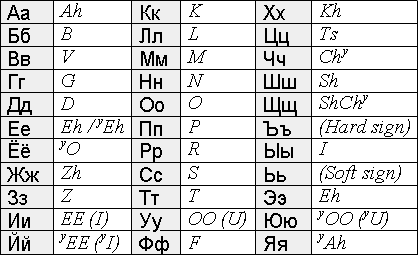
Many of the various minorities in the Russian Federation also speak their own languages, including some Turkic and Mongolian tongues.
Religion: Russian Orthodox Christianinty is the main religion (though many do not actively follow it). Sunni Islam is followed in the south and there are two groupings of Lama Buddhism, in the Kalmyk republic on the Caspian coast (descended from people who left Mongolia in the 17th Century) and around Ulan Ude, near Lake Baikal. Shamanist traditions are still followed by many in remote tribes in Siberia.
|
|
|