
 |
 |
Italy.
September 2000 - WORK TRIP: Conference in Acquafredda di Maratea, near Sapri (200 km south of Naples) in southern Italy.
April 2002 - Day trip from Teesside Aiport to Naples (Napoli), Pompeii, Vesuvius.
Strange Happenings: Another place where nothing really strange happened. The best one I can think of is being forced to pay 50,000 lira (£15) for a fifteen minute taxi ride, which only cost 10,700 lira ("Thrree peoplle, surrcharrge, luggaage, surrcharrge, giva mea the monney nowwa."), but that doesn't really count, cause rip offs like that happen everywhere.
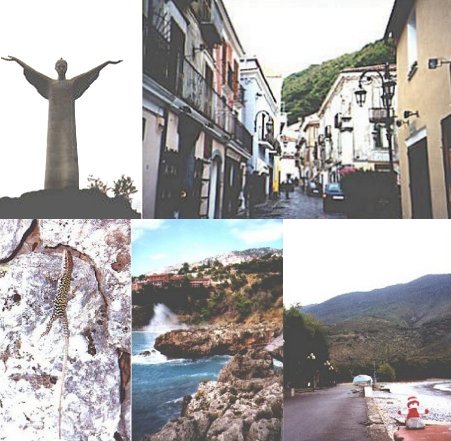
Oh, I forgot, the church up next to the statue of Christ on the hilltop above Maratea and the church in Old Maratea itself used electronic candles instead of real ones, when you made an offering (See the 'Maratea Old Town and Statue of Christ' photo for more information).
Also, Italy is an expensive country, especially the cities. It is also one of the big homes of fashion and yes, the Italians can really turn on the style. But what is the truth?
The truth is that even in places like Milan, many Italians will probably do some window shopping around the brand name stores, then nip round the corner to a discount store, to get what they want for a fraction of the price. This I got from one of the pocket guides, so I'll let you make up your own minds on Italian style. Everyday clothes? They can be just as scruffy as you or me.
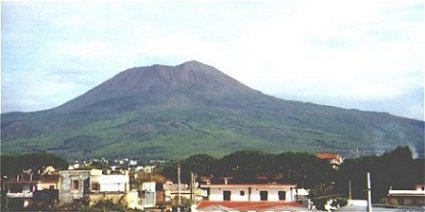 |
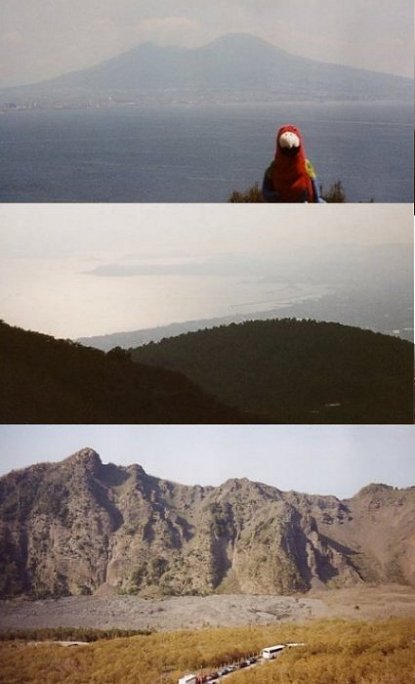
| Mount Vesuvius The most famous eruption of Vesuvius (1,277 m or 4,190 ft and 25 minutes drive from Naples) was on August 24, AD 79, burying the neighbouring Roman cities of Herculaneum, Pompeii and Stabiae in ash. There have also been many minor eruptions, though some historically have flattened other towns and villages in the locality. The mountain is kept under observation, in case other eruptions occur that pose a danger to the surrounding areas. The last time was in 1944, when the cone collapsed in on itself and blocked up the volcano - for now. Here's Poll admiring the view from the other side of the Bay of Naples. Also shown is the Bay of Naples from the side of Vesuvius. Hazy day, so not the best photo quality. There is also a lesser peak, Monte Somma at 1,132 m or 3,713 ft, shown in the very bottom picture. A lava flow is noticeable in the valley that threatened Naples in the 19th century - apparently it's now covered in a lichen that is only found on Vesuvius. The lichen forms on the lava as soon as it is cool enough and gradually breaks it down, so other plants can after 100 years or so, take root. |
 |
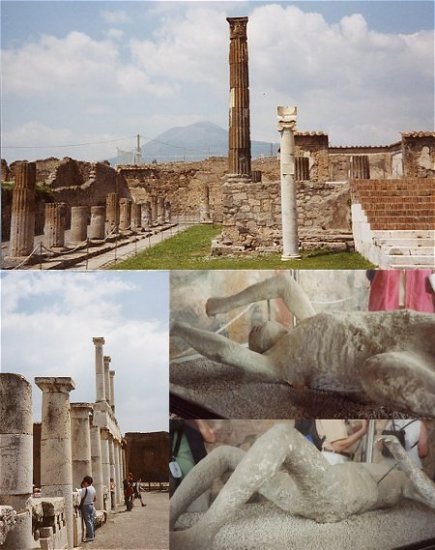 |
| In and Around Pompeii The ruins of Pompeii are very extensive and anyone seriously into Roman history and archaeology will need at least a day to get a decent overview of the site. To see everything, that'll take longer. Pompeii was founded around 600 BC by the Oscans, was later invaded by the Samnites and became part of the Roman empire in 80 BC. Pompeii got to be a nice pad for the rich and famous of the time, despite it and neighbouring Herculaneum and Stabiae being at the base of a rather large volcano, we now call Vesuvius. You'd think they'd have got the hint in AD 62 when an earthquake damaged the city, but they rebuilt and continued as before. In AD 79, Vesuvius did it's worst - lots of pumice (which didn't really pose that much of a danger in this case, it was so light) and a number of pyroplastic flows (extremely hot choking burning winds with lots of ash, hot unbreathable gas and debris) finally finished the place off and the Romans never reinhabited the site. The two figures bottom right are plaster casts - the pumice completely surrounded the bodies where they lay and years later when the site was excavated, the archaeologists were able to pour plaster into the cavities left behind when the bodies rotted away with time. The detail is quite amazing, considering, with facial features etc. clearly visible. These two are all that's left (and stored in glass cases), the rest now stored elsewhere for safe keeping. |
 |
| Pompeii 'Artwork', Zebra Crossings and
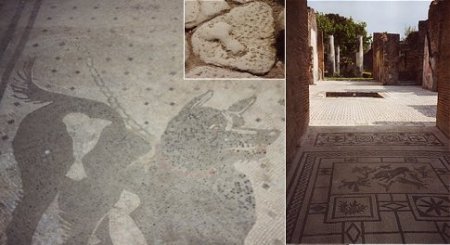
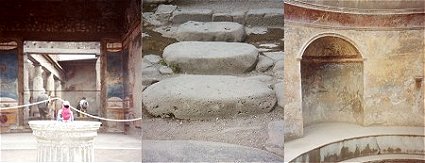
Baths The volcanic eruption preserved a lot of the Roman's 'artwork', some artistic and some, well, let's say erotic. The above floor designs of animals, possibly from a Roman love of hunting, were soon forgotten about when you saw the graffiti (above on one of the roads through town) and artwork on the 'pleasure houses'. This is a family site, so I'm not showing the explicit stuff - I know children look at this site from the messages I've received in the past. So I'll avoid any pictures which could lead to awkward questions from the kids - has to be seen to be believed though and a lot of Greco-Roman art is, unavoidably, let's say (at the risk of repeating myself) erotic! I'll let the guides on site explain what it all means if you go there... Below, well, you can't keep a good parrot down and Emperor Poll is giving the 'thumbs up', so his subjects and gladiators are in the clear today. There is an amphitheatre which was used for Roman sports such as gladiatorial contests at the far end of the Pompeii site, but one day is not long and I didn't have time to get there. The middle photo is, you could say, an early version of a 'zebra crossing' (pedestrian crossing) - the idea is that pedestrians would walk over the stepping stones, whilst the wheels of carts and chariots would pass between them. On the right, a roman bath - Pompeii was a Roman town and the Romans were into cleanliness in a big way. Piped water was another big plus for the Romans and the richer people could have lead pipes fitted to get running water into their houses. Some of the lead pipes are still visible around Pompeii today. Water was supplied to poorer people via municipal fountains in the streets. |
 |
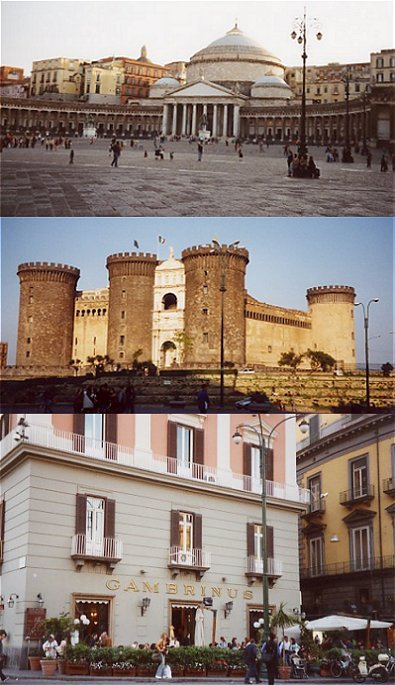 |
| Naples ...or Napoli as the Italians call it. Above are a few photos of the area around the Opera house, which was too large and too close to other buildings for be to even get a photo. The café is Gambrinus, which is supposed to be extra trendy and one of the places to be seen in Naples. If you want something here, make sure you've plenty of money with you, as the prices are extra trendy too! |
 |
|
|
 |
| Mediterranean Sunset
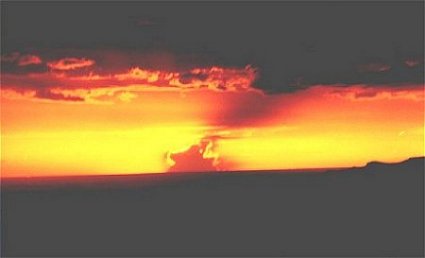
The sun setting behind a thunder cloud, one of a number of storms that plagued my time there, made for one of the most memorable sight of my time in Italy. The rain cleared just in time and a spectacular sunset was the result. Shows what a normal compact camera can do. |
 |
| Maratea Old Town, Statue of Christ
, Acquafredda di Maratea and Beefy on
Sapri Seafront
The old town of Maratea, yet again a good example of a traditional Italian town with stunning mountain backdrop scenery. This turned out to be a good place to buy souvenirs and for some, that other much sought after thing, Italian fashion. The picture on the right is of the statue of Christ on the hilltop above Maratea, which dominates the skyline for miles around. One question that arose is why the statue of Christ faced inland, away from the sea. The best suggestion I have been given to date is that it is facing east, towards the Holy Land. Any readers, correct me if I'm wrong. Oh, the church up next to the statue and the church in Old Maratea didn't have candles you could burn as offerings. Instead, you made your donation, pressed a button next to an electronic candle, which proceeded to flash in random patterns for a few minutes after you made the donation. When I asked why, someone replied that it was at least more environmentally friendly. Also, don't forget to visit the port area of Maratea, just a nice as the old town up above on the hillside. It's a good place to waste half an hour with a decent outdoor café and when I was there, some very expensive private yachts were in port. Acquafredda di Maratea was the site of the conference. I'll not tell you what the conference was called, as you'll fall straight asleep. However, the location was specifically chosen, so that no-one could easily leave to sight see or shop (as you alledgedly do in Italy - the organisers wanted to keep people at the conference). Put it this way, Naples and Pompeii were the nearest attractions and they were over 100 miles away. Conference aside, there's not very much you can do in a small, pretty village, especially for five days. The picture on the left is of one of many examples of the local wildlife, a small green lizard, able to climb vertical cliff faces without any effort and for what I and my colleagues saw, there were apparently hundreds of them. Didn't I see one of these in 'Turkmenistan' (Uzbekistan page)? Sapri, well I've not much to say about this place, except it is typical of the kind of seaside resort the Italians themselves would go to. That said, a walk around town made for an interesting experience, as some of the more secluded back streets were on the pretty side. The most noticeable feature about this town are the mountains towering above Sapri in the background, which to be honest and with a bit more time, I would have loved to have walked up. But, there was a conference to attend and work to be done. Such is life. |
|
|
|