SCIENCE: ITS LIMITATIONS AND PRESUPPOSITIONS
Copyright by Emerson Thomas McMullen, 2004
(A talk given at the Univesity of Cajamarca, Peru, 9 June 2004)
Introduction
Buenos Dios. It is a privilege to speak to you on Science: Its Limitations and Presuppositions. You may have heard
that I have a Bachelor of Science and a Master of Science in engineering and that I conducted or managed research at three
different United States (U.S.) government laboratories. At the Air Force Institute of Technology, I also taught scientists
and engineers how to conduct research at U.S. government laboratories.
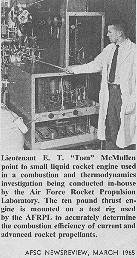
At the right is a newspaper picture of me published some 40 years ago. It was taken at the first of those three laboratories, what
then was the U.S. Air Force Rocket Propulsion Laboratory. I am shown pointing at a small liquid rocket combustor at the
front of a test stand. This test stand handled fuels, mostly hydrazine, and oxidizers, the most dangerous of which was
chlorine pentaflouride. Then there was a sampling system, which included vacuum and diffusion pumps, connected to the
combustion chamber. The samples from the combustion chamber were analyzed in a time-of-flight mass spectrometer.
This was an important job to me, because at that time I thought science might have the answers to the big questions:
"Where did we come from?" and "How did the universe and everything else happen as it did?" If you asked me about God,
I would have answered that we could not prove His existence and therefore belief in God was required.
In my mind I had separated the answers to the big questions into two categories. One category was science, which I
viewed as factual. The other was religion, which is belief-based. This worldview is not new. A recent exposition of this
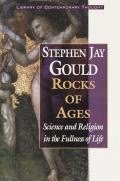 worldview of a division between science and belief is in Rocks of Ages (1999). Here, Stephen Jay Gould refers to this
division as "non-overlapping magisteria." (Magisteria means domain of authority in teaching.) Essentially, science and
religion can't be unified, but neither should they be in conflict; each has its own discrete magisteria - the natural world
belongs exclusively to science and the moral realm to religion. However, my goal is to show you that this separation of
science and belief is incorrect.
worldview of a division between science and belief is in Rocks of Ages (1999). Here, Stephen Jay Gould refers to this
division as "non-overlapping magisteria." (Magisteria means domain of authority in teaching.) Essentially, science and
religion can't be unified, but neither should they be in conflict; each has its own discrete magisteria - the natural world
belongs exclusively to science and the moral realm to religion. However, my goal is to show you that this separation of
science and belief is incorrect.
When I was doing scientific research, I was conducting what Thomas Kuhn would label "normal science." I was
extending scientific knowledge by discovering new facts about nature, but I was unaware of the weaknesses and limitations
of science. In time I learned about these limitations and weaknesses. I eventually earned a Master of Arts and Doctor of
Philosophy in the History and Philosophy of Science. From my experience and education, I will share with you that modern
science, like religion, is also based on belief. I will say that again: Modern science is based on belief. I will show you why.
Science brings a tremendous burden of baggage with it and, I will unpack that baggage to achieve my goal in this seminar.
Let me start this story with the facts that I was so enamored with as a young man.
Facts + Social Constructs
FACTS refer to events or entities based in reality, independent of any human institution. An example of an event is that
yesterday I heated a thermometer and the mercury in it expanded. An example of an entity is the mercury itself. Facts do
not refer to universal claims. An example of a universal claim is that all metals expand when heated.
If you think about it, the facts of science are very limiting. A lot of the appeal of science involves what I have described
here as universal claims. I categorize these universal claims as Social Constructs.

Social Constructs are created by humans and do not necessarily have any relationship to reality. The tallest mountain in
the world is a reality independent of any human. That is a fact. However, the name "Mount Everest" is a human construct.
Other names for this Social Construct, "Mt. Everest," are Peak XV, and the Tibetan name Chomolungma, which means
Goddess Mother of the Earth. The most important thing to note is that Social Constructs may or may not have any
relationship to reality. An excellent example of a Social Construct is the entire field of mathematics.
Mathematics
As far as modern science is concerned, the most important tool is mathematics. Galileo Galilei is often quoted as saying
that the book of the universe "is written in the language of mathematics" (e' scritto in lingua mathematica). Rene' Descartes
asserted in his Rules for the Direction of the Mind: "Of all the sciences so far discovered, arithmetic and geometry alone are . .
. free from any taint of falsity or uncertainty." However Galileo and Descartes never proved certainty for arithmetic,
geometry, or mathematics in general. To them, all this was intuitively self-evident. They assumed certainty and went about
the business of science - like most scientists do today. But they were, and are, wrong.

In the twentieth century, Kurt Godel proved that there is no certainty in mathematics. In the book, Godel's Proof
(1958), Ernest Nagel and James Newman summarize the situation: ". . . mathematics, including the familiar arithmetic of
cardinal (or "whole") numbers, were supplied with what appeared to be adequate sets of axioms . . . it was tacitly assumed
that each sector of mathematical thought can be supplied with a set of axioms sufficient for developing systematically the
endless totality of true propositions about the given area of inquiry.
"Godel's paper . . . presented mathematicians with the astounding and melancholy conclusion that the axiomatic method
has certain inherent limitations, which rule out the possibility that even the ordinary arithmetic of the integers can ever be
fully axiomatized . . . it is impossible to establish the internal logical consistency of a very large class of deductive systems -
elementary arithmetic, for example . . . no final systematization of many important areas of mathematics is attainable, and no
absolutely impeccable guarantee can be given that many significant branches of mathematical thought are entirely free from
 internal contradiction."
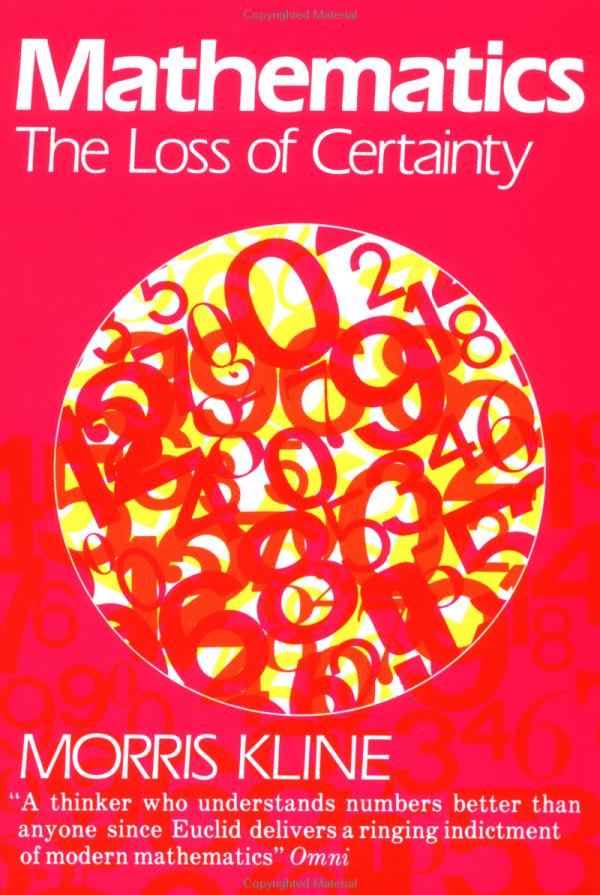
Morris Kline develops this subject further in his book, Mathematics, The Loss of Certainty,published by Oxford
University Press (1980). The flyleaf of this book begins: "Most intelligent people today still believe that mathematics is a
body of unshakable truths about the physical world and that mathematical reasoning is exact and infallible. Mathematics:
The Loss of Certaintyrefutes that myth . . . today there is not one universally accepted concept of mathematics . . ."
Morris Kline was professor emeritus of mathematics at New York University and formerly associate editor of
Mathematics Magazine. In an interview in U.S. News and World Report,(1981) he states "Mathematics is a man-made,
artificial subject - not the truth." In other words, mathematics is a Social Construct - something that may or may not be
true. How many scientists even consider that the mathematics behind their theories can be wrong? But the fact is that they
could be wrong!
The Scientific Method and Theories
Let us move on and discuss the scientific method. THE SCIENTIFIC METHOD is gathering and classifying data
about nature, formulating ideas about nature, usually in the form of testable universal statements, and then testing these
ideas as rigorously as possible. (Nontestable ideas about nature are not scientific and constitute part of a person's
worldview.) I have categorized ideas about nature and universal statements as Social Constructs, but we can also call them
theories.
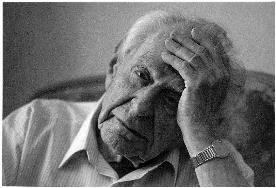
The late Sir Karl Popper is a famous philosopher of science. His idea is that, for a theory to be scientific, it must be
testable. In his book, Science: Conjectures and Refutations (1968), he writes: "One can sum up all this by saying that the
criterion of the scientific status of a theory is its falsifiability, or refutability, or testability." Also, Popper states that a
theory can never be proven true, only false.
Interestingly, all this fits a statement by Pope John Paul II: Message to Pontifical Academy of Sciences October 22,
1996: "A theory is a metascientific elaboration, distinct from the results of observation but consistent with them. By means
of it, a series of independent data and facts can be related and interpreted in a unified explanation. A theory's validity
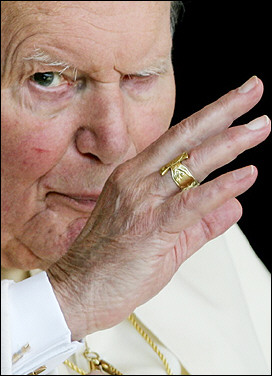 depends on whether or not it can be verified, it is constantly tested against the facts; wherever it can no longer explain the
latter, it shows its limitations and unsuitability. It must then be rethought." Note that "A theory's validity depends on
whether or not it can be verified, it is constantly tested against the facts. . . ." Theories must be tested constantly. Why is
this? Because theories are at best probabilistic and, as Popper stated, they can never be proven true, only proven false. The
problem is that most scientists think their theories are almost certain. This high confidence level in theories is dangerous.
depends on whether or not it can be verified, it is constantly tested against the facts; wherever it can no longer explain the
latter, it shows its limitations and unsuitability. It must then be rethought." Note that "A theory's validity depends on
whether or not it can be verified, it is constantly tested against the facts. . . ." Theories must be tested constantly. Why is
this? Because theories are at best probabilistic and, as Popper stated, they can never be proven true, only proven false. The
problem is that most scientists think their theories are almost certain. This high confidence level in theories is dangerous.
Theory-Driven Observation
The first danger of high confidence in theories is theory-driven observation.
This idea was first introduced by Norwood
Russell Hanson in this book, Patterns of Discovery (1965). A theory can influence a scientist's observation. An example is
one of Percival Lowell's drawings of the canals of Mars. (1) Eventually this champion of extraterrestrial intelligence (ETI) on
Mars would report over 700 canals sighted in the early twentieth century. But we now know that there are no canals, or
anything like them, on Mars. Lowell's theory that ETI existed, may have been why he thought he saw more than 700 canals
on Mars when there were none at all. Popper tends to support Hanson's thinking when he states: "There can never be
anything like a completely safe observation . . .."
Theory-Driven Interpretation
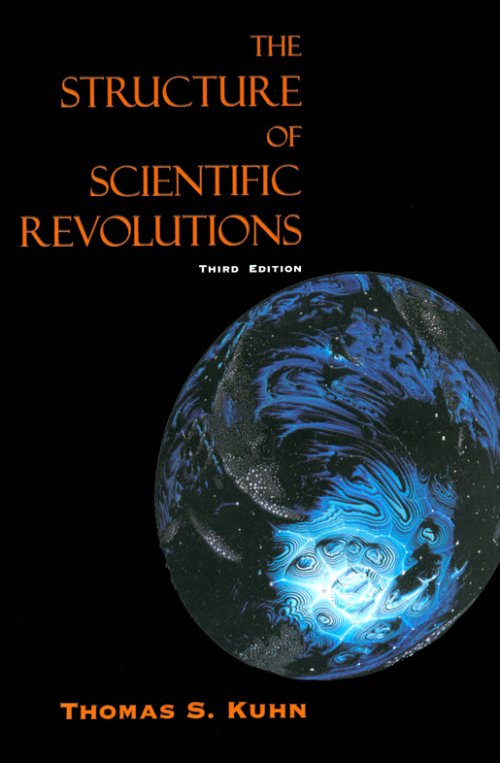
Thomas Kuhn presented theory-driven interpretation in his well-known book, The Structure of Scientific Revolutions
(1970). In the Introduction, he states that research is "a strenuous and devoted attempt to force nature into the conceptual
boxes supplied by profession education . . . Normal science, the activity in which most scientists inevitably spend almost all
their time, is predicated on the assumption that the scientific community knows what the world is like . . . Normal science,
for example, often suppresses fundamental novelties because they are necessarily subversive of its basic commitments . . .."
The conceptual boxes Kuhn refers to are paradigms, a theory or collection of theories that is taught to students as
science. In general, scientists remain boxed in the paradigm they were taught, extending the scope and precision of scientific
knowledge, but not overturning the paradigm. Kuhn continues: "Nor do scientists normally aim to invent new theories, and they are
often intolerant of those invented by others." Kuhn bases this claim on research reported by Bernard Barber, "Resistance by
Scientists to Scientific Discovery," Science, CXXXIV (1961), 596-602.
Kuhn goes on to write that "No natural history can be interpreted in the absence of at least some implicit body of
intertwined theoretical and methodological belief . . .
If that body of belief is not already implicit in the
collection of facts . . .
it must be externally supplied, perhaps by a current metaphysic, by another
science" or by one's worldview. Note Kuhn's use
of belief here, (which I highlighted).
Also, I have added worldview to his list. Facts need to be interpreted and so a
scientist can be influenced by his beliefs or worldview in providing an interpretation. So what I am calling theory-driven
observation and interpretation is where the theory could be defined as almost anything, and certainly does not have to be
scientific, that is, capable of being tested.
If scientists' thinking is contained by the current paradigm, then how does science change? Kuhn points out that anomalies
are produced in the process of normal science. They are facts that cannot be explained by the existing paradigm or theory.
Some scientists do not see the anomalies because of theory-driven observation. Others ignore the anomalies. A few
scientists are bold enough to propose a replacement theory or paradigm.
Kuhn states that "The man who embraces a new paradigm at an early stage must often do so in defiance of the evidence
provided by problem-solving. He must, that is, have faith that the new paradigm will succeed with the many large problems
that confront it, knowing only that the older paradigm has failed with a few. A decision of that kind can only be made on
faith . . . There must also be a basis, though it need be neither rational nor ultimately correct, for faith in the particular
candidate chosen. Something must make at least a few scientists feel that the new proposal is on the right track." Thus, according to Kuhn, faith
is needed for science to advance. Also this faith may have no rational basis to it at all,
(I highlighted faith in Kuhn's quotations).
Finally, Kuhn describes how the new paradigm finally emerges: "Rather than
a single group conversion, what occurs is an increasing shift in the distribution of professional allegiances. . . Gradually the
number of experiments, instruments, articles, and books based upon the paradigm will multiply. Still more men, convinced
of the new view's fruitfulness, will adopt the new mode of practicing normal science, until at last only a few elderly hold-outs
remain."
As is usual, philosophers of science have picked away at Kuhn's ideas, especially going after the definition of paradigm.
Nevertheless, Kuhn's thought has influenced others, including scientists. Therefore, we see a greater awareness of
subjectivity in science. We also see the use of Kuhnian terminology. Here is but one example. It is from last month's
Science Magazine, in which Kuhn's term "paradigm" is used extensively. In this case, the authors point out where they
think the old paradigm about the Earth's structure has too many anomalies: ". . . core-mantle boundary (CMB), has long
been pictured as a simple dividing zone. Recently, however, this neat model has been directly challenged by a broad range
of discoveries." The scientists then propose a new paradigm: "Because of these findings, researchers have created a new
paradigm, in which deep-mantle layering and heterogeneity exist globally, with notable regional variations." They are
exhibiting a degree of faith because the new idea has some shortcomings: ". . . many of the details of this
new paradigm remain enigmatic . . .." (2) So here we have a good, current example of Kuhn's thinking in action. Also, I can
verify this from my own experience involving scientific research and from my study of the history of science. In general, this
is how science changes, and it takes a step of faith to make that change.
Science and History
Science fails nearly completely when it comes to correctly explaining historical events. That is because theories or
explanations for historical events cannot be tested. The event of interest is in the past, and scientists do not have a time
machine to use to go back and test their theories. As one Far Side cartoon shows, the scientists are out of gas when it
comes to time machines. Two examples of this are the battles of Waterloo and Midway.
Waterloo
If scientists were taken to Waterloo, Belgium, and told to investigate the area, what would happen? Probably, they would
find a large number of bullets and examine them. With great precision, they could analyze the composition of the bullets and
any other artifacts found there. They might conclude that a nineteenth-century battle happened there. But they would be
hard-pressed to tell you that the French, English, Dutch, Belgians, Prussians, and other Germans fought there. They could
not tell you the battle details or even who won. Unless they found an historical document, they would not know that
Napoleon lost and Wellington won. They would have to read history books to know all these things, and that this battle was
a turning point in history.
Midway
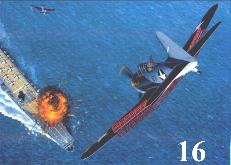
Another turning point in history was the Battle of Midway in World War II. A few years ago Robert Ballard went to the
battle site to look for the five carriers that had sunk there. If anyone could find them, Ballard was the one because he
had found the Titanic. However, all Ballard found in the Pacific was the United States' carrier, Yorktown. Well, suppose he
did not know about the battle details, what would he conclude? On the basis of what he found, he would think that the
Americans lost and that the Japanese won. But actually, Japan lost the battle and four carriers, the Kaga, the Akagi, the
Hiryu, and the Soryu were sunk. Ballard never found even one of the four Japanese carriers. He would have to learn from
history books the critical impact of the battle: Japan had the strategic offensive before this battle, but lost it after the battle,
and never regained it.
These two examples, the Battles of Waterloo and Midway, show the extreme weakness of science in explaining historical
events. This is important because, in the area of origins, scientists have put forth explanations. The origin of "natural laws,"
matter, energy, the universe, galaxies, the stars, solar systems, planets, moons, the earth, life, and humans are all historical
events that are not happening now. Without a time machine there is no way a scientist can test an historical explanation.
What can we conclude from this? It is that any explanation of origins by scientists is suspect. We should not put much trust
in it.
Scientists can make precise statements, such as the composition of the bullets at Waterloo, but is that the important thing
about the battle? No way! When it comes to historical events, scientists major in the minors, and minor in the majors.
Also, scientists could be way off track in their interpretations based on the scanty evidence, like the experienced Ballard only
finding the Yorktown when the odds were 80% that he should have found at least one of the Japanese carriers instead. So,
even if an experienced, well-known scientist were to give us an historical explanation that included precision scientific
statements, we still should not trust it. There is too much room for error.
Theory-Driven "Data"
When scientists try to explain historical events and instead find a scarcity of data, then this is when we may encounter
theory-driven "data".
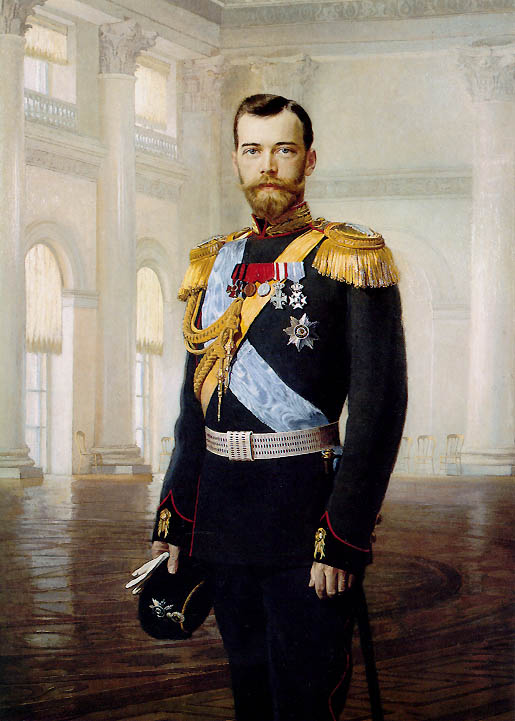
An example is in an article from Science,
"Calibrating the Mitochondrial Clock." (3) Scientists can use mitochondrial
DNA (mtDNA) to trace human ancestry and it is easier to retrieve than nuclear DNA. However, it is necessary to know the
mutation rate in order to get a meaningful result. ". . . Evolutionists have assumed that the clock is constant, ticking off
mutations every 6,000 to 12,000 years or so. . . The most widely used mutation rate for noncoding human mtDNA relies on
estimates of the date when humans and chimpanzees shared a common ancestor. . . . In humans this yields a rate of about
one mutation every 300 to 600 generations, or one every 6,000 to 12,000 years (assuming a generation is 20 years). . . .
Those estimates are also calibrated with other archaeological dates, but nonetheless yield wide margins of error in published
dates. But a few studies have begun to suggest that the actual rates are much faster. . . . For example, after working on the
Tsar's DNA, Parsons was surprised to find heteroplasmy popping up more frequently than expected in the families of
missing soldiers. . . . He began a systematic study of mtDNA from soldiers' families and Amish and British families. . . . they
were "stunned" to find 10 base-pair changes, which gave them a rate of one mutation every 40 generations, or one every 800
years. . . . the rate has held up as the number of families has doubled. . . Howell's team independently arrived at a similar
conclusion after looking deep within the pedigree of one Australian family affected. . . . a rate of one mutation every 25 to
40 generations. Both of our studies came to a remarkably similar conclusion. . . . researchers have calculated that
"mitochondrial Eve" - the woman whose mtDNA was ancestral to that in all living people - lived 100,000 to 200,000 years
ago in Africa. Using the new clock, she would be a mere 6,000 years old."
So what is happening here? Scientists are using a mutation rate based on evolutionary assumptions. Naturally they get
an age of the human race compatible with evolution. This follows logically - an evolutionary premise will give an
evolutionary conclusion. But if one uses a mutation rate based on real people, like the Tsar's family, soldiers' families, and
British, Amish, and Australian families, then the age of the human race is 6,000 years old. This does not fit evolutionary
time frames and so the scientists rejected it based on their worldview. Data based on real people is rejected in favor of
"results" based on a theory. And, ultimately the theory is untestable. Scientists would need a time machine to know when,
and even if, humans and chimpanzees had a common ancestor.
This is a great example where the theory, or paradigm, drives the data instead of the other way around. It is also an
example of Kuhn's normal science where an anomaly is ignored. From Popper's standpoint, the use of real data falsifies the
theory and so the theory should be discarded. Either way, it is not science.
If any of you are serious about science and how it works for origins, this example should make you sit up and take
notice. It has so many implications - more than I have presented here. But for now, let us move on.
Scientific Inference
This list of origins I used earlier included natural laws. Not only can we not explain the origin of "natural laws," we do
not really know what they are. All we can say is that we observe certain regularities in nature. We call these regularities
"natural laws," but we do not know if they are "natural" or even if they are "laws." We obey the laws of our society,
but how does matter and energy follow natural "laws?" What makes them obey as they do? We don't know. They
definitely fit the category of being a Social Construct.
Since we know nothing about the observed regularities we call natural laws, we do not know if they will work tomorrow.
Scientists avoid this problem by assuming natural laws will work tomorrow, but there is no basis for this assumption, except
for past regularity. This is part of what is called the problem of scientific inference. It was discussed by Robert Boyle and
 others in the seventeenth century. David Hume popularized it in the nineteenth century, and Wesley Salmon, a philosopher
of science, wrote about it in the twentieth century.
others in the seventeenth century. David Hume popularized it in the nineteenth century, and Wesley Salmon, a philosopher
of science, wrote about it in the twentieth century.
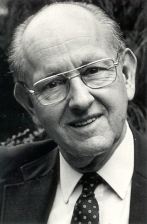
Wesley Salmon
In his book, The Foundations of Scientific Inference (1979), Salmon discusses the "Significance of the Problem: . . there
is something intellectually disquieting about a serious gap in the foundations of a discipline, and it is especially disquieting
when the discipline in question is so broad as to include the whole of empirical science . . . The crucial fact is that science
makes acognitive claim, and this cognitive claim is a fundamental part of the rationale for doing science at all . . . If science is
basically a matter of faith, then the scientific faith
exists on a par with other faiths . . . Science has no ground on which to
maintain its cognitive superiority to any form of irrationalism, however repugnant. . . I find it intolerable to suppose that a
theory of biological evolution, supported as it is by extensive scientific evidence, has no more rational foundation than has its
rejection by ignorant fundamentalists. . . It seems to me extremely important that some people should earnestly seek a
solution to this problem concerning the foundations of scientific inference."
Notice Salmon correctly states that because of the problem, science is faith-based, (again I highlighted faith). One has to
believe in science to do science. Also, note that Salmon's worldview belief is in evolution. He says that evolution has
evidence, but the whole book states we cannot trust that evidence, as does Hanson's and Kuhn's books.
Further, Salmon does not say what evidences support evolution. This is because evolution is an historical event and we
have seen that science cannot address these well at all. The idea of evolution is supported by theory-driven observation,
interpretation and "data," such as the case where the Tsar's and others mtDNA were ignored.
In the United States, our legal system is based on adversarial proceedings. When a lawyer has little or no support for his
position, then his tactic is to attack his opponent. This is what Salmon is doing here. He has resorted to name-calling -
saying, in effect, that his opponents, the creationists, are ignorant fundamentalists. At least Salmon is honest enough to
admit that his faith in evolution has no more rational basis to it than the creationists' faith. Here is a clash of worldviews and
both are based on belief.
Sadly, most other scientists are not honest enough to admit that their worldview beliefs underlie their faith in science, so
Salmon deserves some credit here.
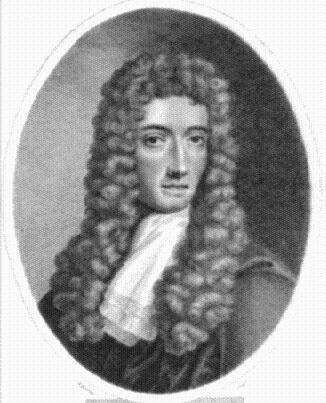
Robert Boyle
I mentioned that Robert Boyle in the seventeenth century had also discussed the problem of Scientific Inference. He was
a strong Christian who thought science would tell us more about God. He helped establish the Royal Society in England
and is noted for discovering what we call today Boyle's Law. But Boyle did not think in terms of natural law. He concluded
that the regularities observed in nature were grounded in God's immutability. Therefore, he expected that these regularities
would also occur the same way tomorrow because God does not change. This is his answer to the Problem of Scientific
Inference. Boyle would probably be unhappy that the pressure-volume relationship he discovered for gases would be called
a law, and a natural law at that.
The foundation of Boyle's scientific thinking is God. So for Boyle, there is none of the distinction between the natural
and supernatural that we make today. He is for supernaturalism and would object strongly to the naturalism that now
dominates modern science. NATURALISM is explaining the observed world by natural causes only - as opposed to
employing supernatural causes. Boyle would consider this a Social Construct.
For Boyle, Isaac Newton, Johann Kepler, and others in the Scientific Revolution, the basic cause underlying everything
else is God. Newton thought this was especially so for gravity. Also, Boyle was so strongly theistic, that he argued that
there was no such thing as chance. CHANCE describes a spontaneous event, or uncaused happening, which indicates the
absence of design. We would not ask what is the chance of a six coming up on one roll of a die, but what is the probability.
Similarly, I did not meet a student at the bookstore by chance; rather, we met byaccident. The reasons/causes were that I
went there to check on the amount of books for my class, and she went there to buy a book. Boyle would also consider this
a Social Construct.
Now an atheist, a person who says there is no God, argues that everything is natural and that the origin of everything,
including us, was by chance. However, for Boyle, God established and maintains the laws of probability as well as
everything else that we call a natural law. For Boyle, everything is supernatural. Therefore, not only is there no such thing
as "natural laws," there is no such thing as "chance." When the wealthy Boyle died, he established and funded in his will a
series of lectures using science to refute atheism.
At the start of this talk I said that some forty years ago, I was not sure God's existence could be proven. That left me
open to the worldviews of chance and naturalism. They were influencing me and that is why I was thinking science might
have the answers to the big questions. Unfortunately, many modern scientists have incorporated these worldviews into their
science. However, I am here to tell you that forty years or so ago, I was in error. I am much older and a little wiser now.
Science does not have the answers to the big question concerning the origins of all things. When I examined the foundations
and presuppositions of science, I realized that science is belief-based. It takes faith for science to operate. Today, I am like
Robert Boyle; I believe God created all things, including the so-called natural laws. That is my worldview now. I hope you
will carefully evaluate yours in light of what I have said this morning.
SUMMARY: SOME SOCIAL CONSTRUCTS
1. All of Mathematics
2. All Universal Statements about Nature
3. All Theories and/or Paradigms
4. All Historical Explanations by Science, including:
a. The Origin of Energy.
b. Matter Formation.
c. The Big Bang.
d. Star and Galaxy Formation.
e. Solar System Origins:
i) Planets.
ii) Moons.
iii) The Earth.
f. The Occurrence of Life.
g. Human Origins
5. Natural Laws
6. Naturalism
7. Chance
SUMMARY:LIMITATIONS OF SCIENCE
1. Universal claims cannot be proved - so modern science is only probabilistic at best.
2. Subject to theory driven:
a. Observation (Hanson).
b. Interpretation (Kuhn)
c. "Data" (McMullen)
3. Assumes, without proof:
a. That nature is orderly.
b. That nature is intelligible. c. That "natural laws" exist.
d. That "natural laws"will operate tomorrow as today
4. Is weakest when explaining past events - in which case, worldviews may override reasoning/objectivity.
Additional References
1. See P. Lowell, Mars as an Abode of Life, N.Y: Macmillian, 1908.
2. E.J. Garnero, "A New Paradigm for Earth's Core-Mantle
Boundary," Science, 304:834, 7 May 2004.
3. Ann Gibbons, "Calibrating the Mitochondrial Clock,"
Science, 279:28-29, 2 January 1998.