 copyright E.T. McMullen) copyright E.T. McMullen)
Did you know that occasionally, judges in Bulloch County will exile persons from the county as punishment for a crime? There was something similar to this in ancient Israel. But since there was no established judicial system back then, a person guilty of manslaughter exiled himself by fleeing to the closest city of refuge before the avenger of blood caught him. There were six cities of refuge in Israel, each roughly equivalent from each other. (See Deut 19:2-5)
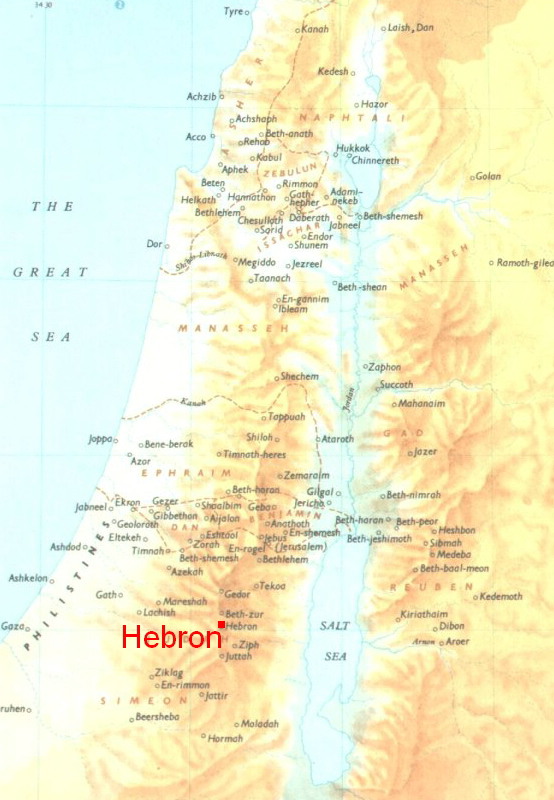
An example of fleeing to a city of refuge like Hebron is in Deut. 19:5,6: "For instance, a man may go into the forest with his neighbor to cut wood, and as he swings his axe to fell a tree, the head may fly off and hit his neighbor and kill him. That man may flee to one of these cities and save his life. Otherwise, the avenger of blood might pursue him in a rage, overtake him if the distance is too great, and kill him even though he is not deserving of death, since he did it to his neighbor without malice aforethought." (Hebron is highlighted in red on the map.)
Reading between the lines, it would appear that the offender's crime was improper care of his axe. When any axehead starts to get loose, then it and the handle should be soaked in water for some time. The wood of the handle will expand, and thus grip the axehead and keep it from flying off and hurting someone. This Biblical account may be the origin of the expression "Don't fly off the handle." In the case just described in Deuteronomy, the irresponsible person did not care for his axe and someone was killed as a result. Because the killing was unintentional, the person is allowed to live but, as punishment for his irresponsibility, he lives in exile at a city of refuge.
One of God's fundamental principles for all mankind is accountability and responsibility before Him. As we know, Adam and Eve failed to be responsible and God exiled them from the Garden of Eden. Unfortunately, their disobedience also introduced sin into the human race as described by Paul in Romans 5:12: ". . . Sin entered the world through one man [Adam] and death through sin and in this way death came to all men because all sinned." Besides death, disease, sickness, suffering, and much more came into the human race because of Adam and Eve's action. Now God could have stepped in and stopped Adam and Eve from disobeying Him, but He did not. God ranks responsibility and accountability so high that He did not intervene, and just let Adam and Eve exercise their free will, regardless of the outcome. Now you or I might have stepped in, but God's plan was to save us by providing a sacrifice for the Sin Nature we inherited from Adam and Eve.
The Bible tells that God, in His sovereignty, decided whom He would save. (This is in Eph. 1:4-6, 11; Phil. 1:29; Rms. 8:29-30; Acts 9:15; and Jn. 15:16; 6:39, 44). God grants us no free will in this particular matter of salvation. Just as we did not choose our parents, so we did not choose God. He chose us. Having done that, God then allows us free will to make choices concerning the physical and moral laws He created. Normally, He lets these cause-and-effect laws operate in our society.
Nevertheless, God will sometimes choose to overrule the effects of His laws. Look at our Scripture verses, Exodus 21:12-13: "Anyone who strikes a man and kills him shall surely be put to death. However, if he does not do it intentionally, but God lets it happen, he is to flee to a place I will designate." The implication here is that God can choose to stop the axehead from flying off, or otherwise prevent it from hitting or killing the other person.
The axehead was acting according to the cause-and-effect laws of physics that God had established. But God can overrule the momentum, inertia, and/or trajectory of the axehead to save the intended victim if He so chooses.
Jesus choosing to still the storm on the Sea of Galilee in Luke 8:24 is an example of God overruling His laws of momentum and inertia. The molecules of water had been stirred up and put into motion by the winds, but Jesus stopped it all cold, both wind and waves.
On the other hand, God could just let the axehead fly off the handle and let it hit someone. Jesus describes such a situation in Luke 13:4: "Or those eighteen who died when the tower in Siloam fell on them - do you think they were more guilty than all the others living in Jerusalem?" Apparently there was a flaw in the design or in the construction of this tower and it fell, killing eighteen people. God could have intervened in some way, but chose not to do so. The Israelites thought God was punishing the eighteen who were killed because of their sins. But Jesus is saying no to their reasoning. It was time for the tower to fall and down it went. The flying axehead, the raging storm, and the falling tower are physical examples where cause and effect are immediately apparent and God decided whether or not to overrule His cause-and-effect physical laws.
With God's moral laws, the causes and effects are not necessarily so clear. The effects, or consequences, of a cause could happen sooner or they could occur later. Let me give some examples in these cases.
Adam and Eve are examples of a moral violation that had both immediate and long-range consequences. The immediate effect was that they were exiled right away. But later, they realized the disastrous long-term effects of their actions in the resulting sin natures of their children and grandchildren, and of the entire human race. This is similar to the situation wherein the inhabitants of a country are affected by a leader's bad decision.
Ananias and Sapphira in Acts 5:1-10 are examples of an immediate consequence of violating a moral law. When they lied to the Holy Spirit and to Peter, God killed them right away. In contrast, the opposite occurred in the case of Lazarus and the rich man, who is traditionally called Dives (Luke 16:19-31).
Dives' uncaring selfishness, and his lack of both love and charity were not punished until he had lived out his life here on earth. The theology for this circumstance is described in 2 Thess. 1:6-7: "God is just: He will pay back trouble to those who trouble you and give relief to you who are troubled, and to us as well. This will happen when the Lord Jesus is revealed from heaven in blazing fire with His powerful angels." Apparently persecutors of believers are given time to repent, and if not, then their punishment occurs later, like that of Dives.
What we have seen so far is that consequences can happen sooner, or they can happen later, for violations of God's moral laws. That is, unless God chooses to intervene and overrule them. At least two times, when Jesus healed people, their afflictions were the consequence of sin. Yet Jesus intervened and freed them from these consequences anyway, in spite of their irresponsible choices. In one case, in Jn. 5:2-9, a man at the pool by the Sheep Gate had been paralyzed for thirty-eight years. Jesus healed him, but then told him in Jn. 5:14 to "stop sinning, or something worse may happen to you." On the other occasion, in Mark 2:5-12, Jesus told a paralyzed man his sins were forgiven, and then healed him. So we have a similar situation with God's moral laws as with His physical laws. God may or may not choose to overrule the cause and effect relationship in His moral laws for individuals.
The last examples I want to give are God's moral laws when they apply to nations. These are different from the laws for individuals in that God cannot punish organizations in the hereafter, like He punished Dives in the Lazarus story. The nation Israel provides the best example of these. Time and time again, Israel suffered the consequences of turning away from God. The Book of Judges contains example after example in which God let someone else rule the Israelites if they were not going to have Him as Lord.
In one case the rulers were the Philistines, who are shown here blinding Samson. In answer to Israelite prayers, God would raise a Judge, such as Gideon, to deliver them. No doubt good people, such as Ruth, suffered along with the bad during these times when the nation as a whole violated God's laws. This is like the case where Israelites suffered through no fault of their own, when David wrongly commanded a census to be taken of Israel.
Sometimes a person can leave an organization or a nation when he realizes that it is coming under God's judgment for its moral wrongs. An example of this is Moses. Even though Moses was living the high life in Egypt as a Prince, he chose to be identified with the poor and down-trodden Israelites. Eventually, God's punishment fell on Egypt and Pharaoh's army, and it probably would have also fallen on Moses if he had already not left Pharaoh's service.
A similar example to Moses but different, is Sodom and Gomorrah. Lot got out of Sodom, but it was not because he chose to do so - rather, it was due to intercessory prayer by Abraham. That brings me to the last point. Because of prayer, God does intervene from time to time to overrule or to reduce the effects of violating His physical and moral laws. We have already seen examples of this with Abraham and with the Israelites at the time of the Judges. Here are a few more: Samson asked for his strength back when he was in the Philistine temple and he received enough power to destroy it. David, in the Psalms and elsewhere in the Bible, many times praises and thanks God for answered prayer. Jonah prayed in the fish's belly and God answered him.
On the other hand, God does not always answer our prayers the way we want Him to. For instance, Paul asked for relief from the thorn in his flesh, but he did not receive it. As with the other cases we looked at, God may or may not choose to overrule.
In the case of Paul's thorn, God left it there, but He did give Paul grace sufficient to endure it.
We are all responsible and accountable before God. One reason for God's moral and physical laws is to teach us responsibility. When we violate these laws, we can expect consequences. With physical laws these consequences happen right away, but with moral laws they can happen sooner or happen later. For individuals, the consequences may not happen until after death, such as the case with Dives. In the case of organizations, the consequences happen in time, and not eternity, such as Sodom's destruction.
Nevertheless, God can choose to intervene and change the effects or lessen the consequences, such as healing the paralytic by the pool. Sometimes He does this in answer to prayer, such as Abraham praying for Lot. Other times God just lets the situation happen according to His cause-and-effect laws, such as the axehead flying off the handle. Just the same, whatever the situation, we are commanded in 1 Thess. 5:17 & 18 to pray always, and to give thanks in every thing, whether God chooses to intervene or not.