 somehow accreted together to form the stars. This coming together is no mean feat if the
elements were also speeding apart from each other due to the supposed primal explosion, the Big
Bang!
somehow accreted together to form the stars. This coming together is no mean feat if the
elements were also speeding apart from each other due to the supposed primal explosion, the Big
Bang! A Talk given at the University of Cajamarca, 9&11 June 2004
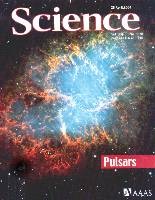
An April 2004 Science did a feature section on pulsars. In one of the articles, R.N. Manchester makes a statement concerning pulsars, but it pretty much sums up the situation in all of astronomy: "Pulsars . . . are believed to be rotating neutron stars formed in supernova explosions." (1) I have emphasized the word "believed" in this statement. This was the theme of the seminar on the limitation of science - the foundations of science are faith-basedd, especially concerning origins and astronomy. One has to believe in science.
Continuing with the special section on pulsars in Science, two other authors state why belief is necessary: "A neutron star . . . has an interior dominated by neutrons packed as much as 10 times more densely than a typical atomic nucleus. This form of matter is so exotic that laboratories cannot recreate it; to understand it, neutron star aficionados must depend on theory and astronomical observations." (2) So ideas about pulsars cannot be tested, which technically means they are not scientific; this is another place where belief comes in.
To guide their thinking about pulsars, astronomers are using existing theories and what they can detect. But remember all they can detect are basically different types of energy. There is a cartoon about astronomical theories. It shows two astronomers discussing their latest finding: "We've discovered a massive dust and gas cloud which is either the beginning of a new star or just a heck of a lost of dust and gas."
Let us examine the Big Bang and the Origin of the Universe by checking on the relevant facts. The most critical facts for our seminar are 1) that some observed light spectrums have more red (longer wavelenghts) in them than others, and 2) the detection of heavy elements, especially those from Iron to Uranium. Uranium is one of the heaviest elements so I will focus on it. However, looking at Uranium is going to involve us in the age of the earth, as well as that of the heavens.
The many assumptions made in calculating the age of the Earth by radiometric means add up to a questionable result. An important example is Uranium with an atomic weight of 238 (238U), which decays into lead, with at atomic weight of 206 (206Pb). Is this a decay series that can be used to determine the Earth's age? To start with, we must ask "Where did very heavy elements like Uranium come from, and how did they get into the Earth's crust?" The answer to this question relates directly to the formation and age of the Universe.
The explanation for the formation of heavy elements is highly speculative. First, there is no agreement on either what preexisted the hypothetical "Big Bang," or what triggered it. As discussed in the earlier seminar, this shortcoming especially applies to the genesis of the so-called "laws of nature" that all matter and energy supposedly follow. So our story of the origin of heavy elements is incomplete from the start - but let us continue anyway.
According to current speculation, shortly after the hypothetical "Big Bang,"
the Universe contained only the lightest elements: hydrogen, helium, maybe a little lithium, and
perhaps a few others, but none heavier than boron (although the details of this story do change
from time to time as the model is adjusted). No one has seen the formation of a star, but since
there are stars, scientists assume the lightweight elements
somehow accreted together to form the stars. This coming together is no mean feat if the
elements were also speeding apart from each other due to the supposed primal explosion, the Big
Bang!
Some stars blow up, which we call supernovae. These are thought to have been stars that ran out of fuel and then collapsed under their own weight. Theorists think this collapse generated the high pressures needed to forge the heavy elements. No one has observed heavy elements like Iron or Uranium being made in these collapsing stars, but astronomers believe it must have happened. Although supernovae scatter these heavy elements, and though they are rushing away from each other, they somehow cluster together and, in theory, form new stars. Again this is unobserved, and naturalistic presuppositions drive astronomers to assume this happened simply because there are stars with heavy elements in them.
We must pause here in our discussion, because the latest astronomical findings make the above scenario even more improbable. An earlier article (1998) from Science reported on the problems with this scenario, and a later article (2004) supports it. The earlier article reported that, at a symposium in Canberra, Australia, August 1998, astronomers reported detecting heavy elements in stars thirteen billion years old. (3) Since the calculated age of these stars is close to the presently accepted age of the Universe of 13.4 to 13.7 billion years, they are obviously very, very old stars. (4) The later article in Science has the age of the stars at 14 billion years of age. (5) (Even if the margin of error for these calculations allows for the stars to be younger than the Universe, the remaining time is too short for the stars to form.) For the whole story to hold together, there had to have been the Big Bang, then matter accretion, star formation, supernovae, and more matter accretion before these heavy- element-containing stars formed. Yet supernovae are rare - none have been observed in our galaxy in hundreds of years (SN1987A was nearby). (6) We are being presented with a highly improbable chain of events. Put another way, according to the first article, the oldest stars we can see are theoretically a long way from being the oldest stars. And, according to the second article, the stars are older than the universe!

Similarly, the most distant galaxies (and therefore presumably the oldest) also contain heavy elements. (7) Again, theoretically there had to have been even earlier stars that formed and then later blew up, but there is no proof of this. An article from a January Science this year also reports that galaxies are too old for the existing age of the Universe to be true. (8)
The improbabilities are starting to become so great that these so-called naturalistic events are taking on miraculous qualities for them to have happened as theoreticians say they did, when they did. It appears that the Universe would have to be many orders of magnitude older than presently thought for one to even begin to conceive that it happened by chance. It is no wonder that well-known astronomers like Robert Jastrow are writing books titled God and the Astronomers. An interview with Jastrow titled "A Scientist Caught Between Two Faiths" certainly captures the belief-based thinking needed when scientists consider origins. (9)
Another speculative concept, one based on questionable inferences, is the Big Bang itself. First let us summarize a little about the Big Bang.
1. Fact: Starting at the beginning of the 20th century with Vesto Slipher at the Lowell Observatory in Flagstaff, Arizona, astronomers have observed red spectra in star and galactic light that could be considered above normal, if one thinks that a laboratory spectrum is normal.
2. Considering the "above normal" red light in stars, some, such as Edwin Hubble, concluded that the stars were moving away from us. The greater the "redshift" the greater the velocity.
3. Because of these stellar velocities, Hubble and other theorists further concluded that the universe is expanding.
4. Because of the expanding universe, theorists further concluded that the universe had an explosive beginning, dubbed the Big Bang.
5. Fact: Engineers from Bell Laboratory accidently detected a background radiation when they were working on a microwave receiver. Further research showed that this radiation is uniform everywhere we look in the universe, with only very minor variation.
6. Theorists have interpreted that this background radiation is derived from the Big Bang, and so is supportive of the idea. (The radiation is thought to actually date from when the Universe first became transparent.)
If one carefully examins the proofs offered for the Big Bang, one finds they are not proofs at all, usually they evidences that could also apply to alternative cosmologies. I do not recommend the alternative cosmologies presented in the books, Bye Bye Big Bang by William Mitchell, and Dark Matter, Missing Planets & New Comets by Tom Van Flandren, but let me summarize some of the Big Bang problems the authors point out.
1. The conclusion that entire Universe was contained in an infinitesimal point is not testable.
2. From some unknown cause, the infinitesimal point somehow exploded, eventually creating the Universe that we see.
3. Matter, energy, space, and apparently time were thought to be formed by the explosion. Again, this is not testable.
4. The explosion was so uniform it emitted an almost perfectly uniform radiation everywhere.
5. However, the explosion was non-uniform enough to create a very irregular matter distribution in the Universe.
6. At this time, the superclusters astronomers observe are not predicted by the Big Bang model.
7. The explosion formed matter that, although expanding away from each other, somehow organized itself into the complex Universe we observe. Again, this is not testable.
8. The theoretical calculations involving the Big Bang explain the formation of hydrogen and deuterium, but not of heavier elements.
9. If the Universe is as old as thought, the rotating spiral galaxies would have unwound themselves by now. Thus, huge amounts of "dark matter" have been hypothesized to explain this anomaly.

The back cover of Bye Bye Big Bang says: "The combined impact of the flaws forever destroys the credibility of a Big Bang. In discussions of those flaws with others, Mitchell would frequently be asked, "If you don't believe in the Big Bang, what do you believe in?" (Again, this shows the fact that theories about origins are basically matters of belief.)
The back cover of Bye Bye Big Bang continues: "This book succeeds Mitchell's 1995 book, The Cult of the Big Bang, which was published with endorsements by allies in the struggle against Big Bang Theory. Those allies included plasma physicist and cosmologist Anthony L. Peratt of the Los Alamos National Laboratories, astronomer and cosmologist Halton C. Arp of the Planck Institute for Astrophysics, and Professor Jayant V. Narlikar, director of the Inter-University Centre for Astronomy and Astrophysics of India. Despite its anti-establishment content, that book has been amazingly successful."
Jayant Narlikar identifies the three major problems with the Big Bang model. First, the theory violates the law of conservation of matter and energy. Next, the temperature of the microwave background radiation cannot be deduced from any calculations of the early Universe. (Remember that the background radiation was accidently discovered - no one was looking for it. But Narlikar must be referring to the exact temperature since some calculations have been made.) Finally, while the Big Bang theory can explain the formation of helium and deuterium, it has problems with other nuclei such as lithium, berylium, and boron.
There are also other problems with the model. For one, with the inflation portion of the Big Bang, the age of the Universe is "uncomfortably small" compared with the ages of the galaxies and the globular clusters, as we just saw. Another problem with the model is that it puts limits on the amount of "ordinary" matter. Therefore astronomers speculate that there has to exist a lot of the so-called "dark" matter. (10) However, this may still not be enough. Also, Anthony Peratt, a physicist at Los Alamos National Laboratory, adds that even this "ad hoc dark matter" cannot account for the enormous superclusters of galaxies that astronomers observe. Further, these superclusters are not predicted by the Big Bang model. Finally, the smooth background microwave radiation (11) "does not presuppose an explosive beginning. (12) It is not surprising that John Maddox declared that the Big Bang is a "thoroughly unsatisfactory explanation of the origin of the Universe. (13)
Theorists have also called on "dark matter"
to hold together our galaxy and others like it. The
problem is that these galaxies are rotating so fast they would have already flown apart if the
Universe really is as old as is currently thought. These galaxies have not flown apart, so either the
Universe is a lot younger, or else something else, such as a lot of extra
"dark matter" is holding
them together. So far, independent
studies imly that there is no "dark matter" in our galaxy. (14) An article in the May Science
reports another negative result in the search for dark matter. Also, this latest research disproves a
suspect claim by the Italians to have found dark matter. (15) This is just one of many problems in
 arguing for an old Universe. But dark matter involves discovering a new particle called the weak
interacting massive particle (WIMP). If WIMP is not found, then the Universe has to be young.
arguing for an old Universe. But dark matter involves discovering a new particle called the weak
interacting massive particle (WIMP). If WIMP is not found, then the Universe has to be young.
Astronomers have observed spectral differences in the light frequencies toward the red end of the spectrum for objects beyond our solar system, and those observed in the laboratory. This is a fact, but what follows is not. Theorists think that an expanding universe is the best interpretation for these so-called "redshifts" (a somewhat theory-laden term). This explanation implies there was an explosive beginning to the Universe, dubbed the Big Bang. If any objects in the universe were found not to be flying outward from this primal explosion, it would call into question the idea of the Big Bang. Halton Arp thinks he has found such objects.
Arp graduated from Harvard College cum laude, and earned a Ph.D. from the California Institute of Technology, also cum laude. He has received numerous awards for his observational work on quasars and galaxies. Unfortunately for him, he began to realize that the redshifts astronomers had observed for quasars may not be due to velocity outward from the primal explosion. In several instances, a quasar and a galaxy appear to be connected, but they have different redshifts - so, according to theory, they could not be connected. These findings threatened the Big Bang theory. Mt. Palomar colleagues warned Arp not to pursue this line of investigation. (16) Rightly or wrongly, he persisted and suddenly found himself cut off from telescope time at Mt. Wilson, Mt. Palomar, and at Los Companos, Chile. This shut him out from any further research in his position.
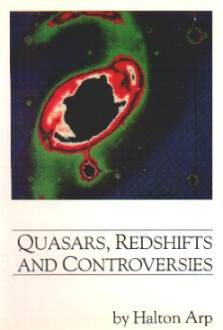
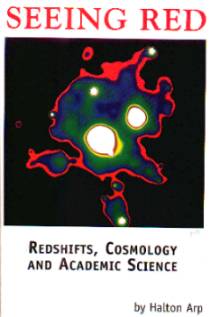
Arp ended up leaving the United States to join the staff of the Max Plank Institute for Physics and Astrophysics in Munich, Germany. He has written two books, Quasars, Redshifts, and Controversies (1987), and Seeing Red: Redshifts, Cosmology and Academic Science (1998). These show his observations and explain his conclusions. Look at the pictures on the covers of these books. They each show a quasar and a galaxy connected. But the two space objects have different redshifts. So, in theory, they should not be connected. This is the problem. The observations and the theory do not match.
The latter book also tells about how establishment scientists control the
interpretation of astronomical data to fit the uniformitarian scenario.
An example of controlling data interpretation occurred at the three-yearly meeting of the
International Astronomical Union in Holland in 1994. At the symposium on the Big Bang,
researchers had, at best, fifteen or twenty minutes for presenting new observations. As usual, an
authority had the better part of an hour to give a summary of the state of the art, even though
 everyone knew all about it. "Clearly," Arp wrote, "the main purpose of these `review of the
theory talks' was to fix firmly in every one's mind what the party line was so that all observations
could be interpreted properly." Martin Rees, Astronomer Royal of England, gave this review.
Later, at a panel meeting, Rees attacked Arp's latest research. Arp replied, giving even more
evidence of objects that contradicted conventional models. A Dutch journalist, Govert Schilling,
rose to ask Rees why, in view of Arp's findings, major facilities were not being used to further
observe these objects. Arp reports that Rees "turned toward me and erupted in a vitriolic
personal attack." It stunned him and probably the audience, too.
everyone knew all about it. "Clearly," Arp wrote, "the main purpose of these `review of the
theory talks' was to fix firmly in every one's mind what the party line was so that all observations
could be interpreted properly." Martin Rees, Astronomer Royal of England, gave this review.
Later, at a panel meeting, Rees attacked Arp's latest research. Arp replied, giving even more
evidence of objects that contradicted conventional models. A Dutch journalist, Govert Schilling,
rose to ask Rees why, in view of Arp's findings, major facilities were not being used to further
observe these objects. Arp reports that Rees "turned toward me and erupted in a vitriolic
personal attack." It stunned him and probably the audience, too.
Arp's story is not an isolated one. A group of scientists is challenging the Big Bang, but like Arp, the "main stream" scientists marginalized them. (17) The famous astronomer, the late Sir Fred Hoyle, has also criticized the Big Bang, saying that "a sickly pall now hangs over the Big Bang theory." (18)
Nevertheless, Geoffrey Burbridge and Adelaide Hewitt were able to publicize the redshift problem in a popular astronomy magazine. They report that "Quite a number of bright QSOs [Quasi-Stellar Objects] lie close to relatively bright, nearby galaxies (nearer than several hundred million light-years) that have much lower redshifts. This statistical evidence, and signs of optical or radio connections between galaxy and QSO, lead us to conclude that they are physically associated . . .. Contrary to what you are often told, the statistical evidence for association is well documented and has held up since the first proper analysis of QSOs in the 3C catalog was made in 1971 . . .. Thus for us the only conclusion that can be drawn is that at least some QSOs are relatively nearby, and that a large fraction of their redshift is due to something other than the expansion of the Universe." (19) If true, then this statement is a death-blow to the Big Bang theory.
There are a variety of alternative explanations for "redshifts." One is that there has been energy degradation as light travels from a galaxy to the Earth - this could be due to photon- photon or photon-neutrino interactions. Another possibility that the "shift" could be caused by a gravitational effect. A third explanation is that light particles have a rest mass slightly above zero, and are capable of speeds less than that predicted by the hypothesis of special relativity. (20) More research would be needed to show if these speculations are on the right track.
The Formation and Age of the Solar System
Similar to the problems of the Big Bang are those concerning the formation and age of our Solar System. An article appeared in a May 2004 Science that shows some of the depth and scope of these problems: "What kind of environment gave birth to the Sun and planets?. . . conventional wisdom is almost certainly incorrect. Recent studies of meteorites confirm the presence of live 60Fe in the early solar system. No known mechanism could have formed this short-lived (half-life = 1.5 million years) radionuclide locally with the young solar system. . . ." (The author also sates that" . . . The fields of astrophysics, meteorites, astrobiology, and planetary science meet in the early solar system . . .." (21)
We find the same theme in this article from two years ago: "Most experts agree that the solar
system's most ancient rocks from asteroids and comets should be sprinkled with microscopic
diamond dust, a remnant of ancient stars. The less altered the rock since the gas and dust of the
solar nebula came together, . . . But a group of researchers reported this week that at least some
 of the most primitive, unaltered rock in the solar system contains no diamond star dust at all. . . 'It
really was an unexpected result,' says microscopist Lindsay Keller of NASA's Johnson Space
Center in Houston, who was not in on the (non)discovery, 'Why nanodiamonds are not there is
uncertain' . . . Zurong Dai of Georgia Institute of Technology in Atlanta, Georgia and his
colleagues . . . reported in this week's issue of Nature. . . 'We should have found nanodiamonds in
every [sample] we looked at, but we didn't,' says cosmochemist John Bradley of Lawrence
Livermore National Laboratory in California, a co-author on the Dai paper. 'That's puzzling'. . .
The absence of nanodiamonds . . . has 'no easy explanation,' says Bradley . . .." (22)
of the most primitive, unaltered rock in the solar system contains no diamond star dust at all. . . 'It
really was an unexpected result,' says microscopist Lindsay Keller of NASA's Johnson Space
Center in Houston, who was not in on the (non)discovery, 'Why nanodiamonds are not there is
uncertain' . . . Zurong Dai of Georgia Institute of Technology in Atlanta, Georgia and his
colleagues . . . reported in this week's issue of Nature. . . 'We should have found nanodiamonds in
every [sample] we looked at, but we didn't,' says cosmochemist John Bradley of Lawrence
Livermore National Laboratory in California, a co-author on the Dai paper. 'That's puzzling'. . .
The absence of nanodiamonds . . . has 'no easy explanation,' says Bradley . . .." (22)
A study of craters, especially the impact basins on our moon, shows that they are not evenly distributed. An even distribution is what we would expect if the moon is old and events occur along the lines of the uniformitarian model. Instead, the timing of the cratering and lava flows on the moon better fit a younger age for the moon and a catastrophist model. (23) Similarly, a young age of the solar system explains the fact that the faint, diffuse E ring of Saturn is still with us. "Its micrometer-sized particles should have been swept up by Enceladus and other moons long ago." (24)
Astronomers have regularly observed comets break up, an example being Shoemaker-Levy, the comet that hit Jupiter several years ago. Also periodic comets have not returned, meaning they broke up somewhere else. The observational implications are that comets are short-lived phenomena. All this flies in the face of old ages for the solar system and the regions just outside of it. Either there is some "storage" place for comets that we cannot see and they somehow leave this place from time to time, or else comets are not as old as thought.
Danny Faulkner has a Ph.D. in astronomy from Indiana University, and teaches at the
University of South Carolina. In an article, he argues for a young age for the Solar System.
While it was once thought that the Oort cloud could account for all comets, computer
simulations have clearly shown that short-period comets cannot originate from the cloud. . .
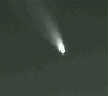 comets are very fragile, losing much of their material during each close pass to the Sun. . .
Because no source of creation for comets has been identified, comets are assumed to be
primordial. If this is true, then the age of the Solar System must be less than the estimated upper
age of comets. . . This has been recognized as a problem in astronomical circles for a long time. It
is concluded that the existence of short-period comets is still a valid argument for a recent
creation of the solar System. (25)
comets are very fragile, losing much of their material during each close pass to the Sun. . .
Because no source of creation for comets has been identified, comets are assumed to be
primordial. If this is true, then the age of the Solar System must be less than the estimated upper
age of comets. . . This has been recognized as a problem in astronomical circles for a long time. It
is concluded that the existence of short-period comets is still a valid argument for a recent
creation of the solar System. (25)
Going back now to our story of Uranium in the Earth's crust: No one has observed the elements scattered by supernovae accreting together to form planets, but since there are planets, naturalistic presuppositions drive scientists to assume this must have happened. Again, elements, including uranium, blasted outward by an explosion somehow accrete into large masses.
238U radioactively decays to Thorium, with an atomic weight of 234 (234Th). Physicists have calculated the rate of this decay and express that rate as "half-life," the amount of time it takes for half the radioactive parent to decay to its daughter product. The calculated half-life for 238U decaying to 234Th is about four and one-half billion years. Obviously, because of this large length of time, this half-life is also unobserved. Scientists assume that they can extend findings made today back four and one-half billion years but, as discussed earlier, there is no proof that the "natural laws" like radioactive decay rate stayed constant over that huge time span - it is assumed to have stayed constant.
However, we know the radioactive decay rate can vary. Scientists have discovered that the chemical form can affect decay rates. Chemical bonding can subtly rearrange the electrons in an atom and slightly change the decay rate. A very dramatic change occurs if all the electrons in a nucleus are stripped away. Scientists have demonstrated that stripping the electrons from rhenium-187 nuclei causes the half-life to change from forty-two billion years to thirty-three years! This could happen in a harsh environment like a star's interior. (26)
What follows is the 238U decay chain for alpha decay only. (The beta decay steps are not shown.)
238U decays to 234Th in approximately 4.5 billion years
234U decays to 230Th in 24 days
230Th decays to 226Ra in 80 thousand years
226Ra decays to 222Ra in 1,620 years
222Ra decays to 218Po in 38 seconds
218Po decays to 214Po in 3 minutes
214Po decays to 210Po in 160 microseconds
210Po decays to 206Pb in 138 days
206Pb is stable and the chain does not decay any more.
(U=Uranium, Th=Thorium, Ra=Radium, Po=Polonium, Pb=Lead)
The next assumption is a critical one and yet it is the weakest one. Scientists assume that all
the 206Pb in the Earth's crust got there from 238U. That is to say, neither 206Pb nor its parents in the
above decay chain (except 238U, of course), was made by any supernova. It is popular to
summarize the naturalistic explanation by saying "all is stardust." But it is not so - only 238U in
the above decay chain can be thought to be stardust. This is a critical assumption because,
without it, no meaningful calculation of the age of the Earth can be made. If some 206Pb came
from a supernova, scientists measuring it in the Earth would not know how much of it came from
stardust and how much of it resulted from radioactive decay. They would not be able to arrive at
a correct answer for the age of the Earth. Similar problems about assumed amounts and rates
 plague any radiometric dating procedure for the age of the Earth.
How good is the assumption that absolutely no 206Pb is stardust? The answer rests on how well existing scientific theories explain what we think goes on in stars. The best check for this is our own Sun, and the answer is not good news for these theories. There was a time, for over two decades, that experimental measurements of the neutrinos from our Sun did not match theoretical predictions. At first, some thought the problem might be in the experiment itself since neutrinos are hard to detect. Researchers were slow to accept experimental data even when neutrinos from a supernova were detected. This attitude eventually changed as American results were confirmed by Russian and Japanese experiments. (27) This meant that there were shortcomings with the theory (called the Standard Model).
The latest research indicates that neutrinos have mass, again something not predicted by the Standard Model. (28) Scientists are now working to expand the equations to fit the experimental results. Some thought neutrinos changed from one type to another as they travel through space. Others speculated that there might be even more particles than they thought existed. (29) Scientists think they have the answer now. However, when the model has to be altered too many times, one has to question its capability for prediction. Already the presently accepted theoretical model has to be artificially fudged to make it work for electrons under certain circumstances, a process called mass-renormalization.
Therefore, when a theorist claims that absolutely no 206Pb, 210Po, 218Po, 222Ra, 226Ra, 230Th, 234U, or 234Th comes from supernovae, but that 238U did, I am skeptical. If we cannot make accurate theoretical calculations about what is happening in our own Sun, how can we say that absolutely no 206Pb in the Earth came from any supernova? The same type of criticism holds true for any radiometric age-dating involving long times.
Danny Faulkner has pointed out a different problem concerning the sun. It is that the sun could not be as old as is now thought and still have life appear on earth. The sun should be 40% brighter now than it was 4.6 billion years ago when life is thought to have first appeared. This faint-sun paradox can be resolved by younger time frames. (30)
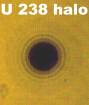
Robert Gentry has done careful research on rocks containing the radioactive decay chain above. He has published his work in refereed scientific journals, including Nature and Science. His technique is to look for evidence of alpha particle decay in mica. This is what they look like under the microscope. Each element in the radioactive decay chain has a different energy and so leaves its own signature, as shown here. He has found evidence that Polonium appeared in some Precambrian granites without any parent. (31) Since these Poloniums all have short half-lives, the implications are staggering. Gentry's experimental results imply that these rocks did not form from hot magmas that slowly cooled over long ages - rather they formed nearly instantaneously. Thus, the Poloniums did not come from stardust or Uranium decay, and therefore the rocks containing them and the Earth itself are not old and neither is the Solar System.

Gentry's research has been known to scientists since the 1960's and known to the public since the 1981 US trial McLean vs. Arkansas trial. Although his conclusions are unacceptable to many, there has been no scientific refutation of his work. I saw a narrow critique on the web site of a Canadian firefighter, J. Richard Wakefield, who is studying geology, but at that time had published nothing in a refereed scientific journal. (32) Someone else offered a similar criticism in a conference paper that was more of a defense of uniformitarian dating methods (33) but again, nothing published in refereed scientific journals.
G. Brent Dalrymple was a member of the U.S. Geological survey for over thirty years and is the evolutionary geologist who testified at McLean vs. Arkansas in 1981, that Gentry's work was a "tiny mystery." He had no answer to Gentry's research although he badly wanted to refute it. Under the letterhead of the National Center for Scientific Education, (34) he signed 1992 and 1995 letters to "the multi-thousand members of the prestigious American Geophysical Union" calling for a conventional answer to Gentry's findings. He posed the question "How would you answer a student who claims the presence of Polonium halos in granite demonstrates that granite had to have formed suddenly (i.e., was specially created). (35) Again, there has been no scientific counter to Gentry's and its startling implications.
Similarly, Dalrymple used the Journal of Geophysical Education to attack Thomas Barnes' conclusion that the decay of the Earth's magnetic field indicates that the Earth is young. (36) Dalrymple hypothesizes that the Earth's magnetic field is caused by a dynamo in the Earth's molten core. Barnes counters that there is no physical evidence of such motion and there is no power source to keep the supposed dynamo running for the hypothesized billions of years. (37)

As discussed earlier, the famous philosopher of science, Sir Karl Popper, asked: "When should a theory be ranked as scientific?" (38) His answer is "its falsifiability, or refutability, or testability." (39) Gentry proposed a test of theories in 1979 and repeated it at the McLean vs. Arkansas trial. He claims the polonium halos he has observed in granite are evidence of God's instantaneous creation. Gradualistic geology holds that these halos formed naturally, which Gentry says is impossible. To back this claim up, Gentry has challenged the scientific community to first synthesize a hand sized piece of granite and then produce a Polonium 218 halo in it. If this experiment can be done, he is willing to drop his claim. He has repeated this test of theories at the University of Tennessee in 1987, Stetson University in 1989, Clemson University in 1991, East Carolina University in 1993, Cornell University in 1996, and North Carolina State University in 1997.
So which should we accept for the age of the Earth - questionable conclusions from unfounded assumptions and an incomplete theoretical model, or a logical and falsifiable deduction from observation and experiment? Which is more scientific? (40)
The Formation and Age of the Heavens and the Earth
Much of this seminar has discussed why the heavens and the earth are not as old the conventional paradigm has it. However, there is a theory to explain a young age of the Earth, as well as a young age for the Universe and Solar System, when viewed from the Earth. Dr. Russell Humphreys presents it in this book, Starlight and Time. His theory:
1. Uses the equations of General Relativity.
2. Assumes that the Universe is bounded (not unbounded as in the Big Bang).
The result is that on the event horizon of a white hole (a black hole running in reverse) an event on the earth taking days could take millions or billions of years elsewhere.
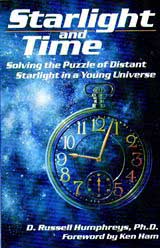
The implications of Humphreys' theory that the universe is expanding out of a white hole are astounding. So let me picture what I have just said. [Overheads] Big Bang cosmology assumes an unbounded and expanding universe and uses the equations of General Relativity. Humphreys also uses the equations of General Relativity and an expanding universe, but assumes that the Universe is bounded. The result is that the universe is expanding out of a white hole. First, let me say that some Humphreys' assumptions are supported implicitly in a paper by Smoller and Temple published in 2003 ("Shock-wave cosmology inside a black hole," Proc. Nat. Acad. Sci. USA).
One of Humphreys' implications is that events on the earth that take days could take millions or billions of years elsewhere. The resulting shortened time frame would explain all the problems I have listed about short-period comets, Saturn's rings still there, spiral galaxies not unwound, and so on. Also, God is the solution to the cause of all things and the source of 1)the information in DNA and 2)what we call natural laws.
I think that when God created, it is logical that He created all things. This would include the daughter products of 238U: 206Pb, 210Po, 218Po, 222Ra, 226Ra, 230Th, and 234U. This means that the current assumptions about radioactive dating are wrong, and so the results are wrong. However, this interpretation does explain Gentry's observation that the Polonium he saw in granite was created instantaneously. This also explains the mtDNA result I presented in the first seminar. If one uses real human mutation rates, based on the Tsar's and other families instead of an evolutionary assumption, then one gets an age of the human race of 6,000 years.
References
1. Manchester, R.N. "Observational Properties of Pulsars." Science 304:542 - , 23 April 2004.
2. Rowan, Linda and Coontz, Robert: "The Strange and Twisted World of Pulsars," Science 304:531, 23 April 2004.
3. Hellemans, Alexander: "Galaxy's Oldest Stars Shed Light on Big Bang," Science 281: , 4 September 1998.
4. 4. This date is according to Charles H. Lineweaver, "A Younger Age for the Universe," Science 284:1503 (1999).
5. Krieger, Kim: "New Measurement of Stellar Fusion Makes Old Stars Even Older," Science 304:1226, 28 May 2004.
6. 6.Roger Tayler,"The birth of elements," New Scientist, 16 December 1989, pp. 25-29. See page 28. On page 27, Tayler says "Star formation is not well understood."
7. 7.A. Hellemans, "Galaxy's Oldest Stars Shed Light on Big Bang," Science 281:1428-1429 (1998).
8. "Early Galaxies Baffle Observers, But Theorists Shrug," Science 303:460 - 461, 23 January 2004.
9. Durbin, Bill: "A Scientist Caught Between Two Faiths," Christianity Today, p14.
10. 10.Jayant Narlikar, "Challenge for the Big Bang," New Scientist 138:27-30 (1993).
11. 11.Exactly how smooth this radiation is will be more accurately determined by a balloon-borne detector. See R. Irion, "Balloon Flight Brings Cosmic Glow into Focus," Science 286:1266-1267 (1999). Nevertheless, first indications are that there are some fluctuations, but they are too small to cause the observed effects.
12. 12.Anthony L. Peratt, "Not with a Bang," The Sciences (January/February 1990) p. 27.
13. 13.John Maddox, "Down with the Big Bang," Nature 340:425 (1989).
14. 14.See A. Hellemans, "Galactic disk contains no dark matter," Science 278:1230 (1997) and M. Creze, et. al., Astronomy and Astrophysics 329:920-936 (1998).
15. "Once Again, Dark Matter Eludes A Supersensitive Trap," Science 304:950, 14 May 2004.
16. 16.M. Mitchell Waldrop, "Astronomer May Be Barred from Telescopes," Science 215:1214 (1982).
17. 17.The Natural Philosophy Alliance calls itself "the world's largest organized group of critics of modern physics and cosmology." It can be contacted at P.O. Box 14014, San Luis Obispo, California, 93406.
18. 18.Sir Fred Hoyle, "The Big Bang Under Attack," Science Digest 92:84 (1984).
19. 19.G. Burbridge and A. Hewitt, "A Catalog of Quasars Near and Far," Sky and Telescope (December, 1994) pp. 33 and 34.
20. 20.J.C. Pecker, A.P. Roberts, and J.P. Vigier, "Non-Velocity Redshifts and Photon-Photon Interactions," Nature 237:227-229 (1972).
21. Hester, J. Jeff; Desch, Steven J.; Healy, Kevin R., and Leshin, Laurie A.: "The Cradle of the Solar System," Science 304:1116-1117, 21 May 2004.
22. Kerr, Richard A: "Diamond Dust Dearth Raises Doubts," Science 297:177, 12 July 2002.
23. 23.Danny R. Faulkner "A biblically-based cratering theory," CEN Technical Journal 13:100-104 (1999).
24. Kerr, Richard A: "Saturn: The Unfinished Symphony," Science 304:1230-1232, 28 May 2004.
25. Faulkner, Danny: "Comets and the Age of the Solar System," Creation Ex Nihilo Technical Journal 11(3):264-273, 1997.
26. 26.R.A. Kerr, "Tweaking the Clock of Radioactive Decay," Science 286:882-883 (1999).
27. 27.See I. Peterson, "More evidence of a solar neutrino shortfall," Science News 140:406 (1991).
28. 28.J. Brainard, "Ghostlike particles carry a little weight," Science News 153:374 (1998).
29. 29.D. Kestenbaum, "Neutrinos Throw Their Weight Around," Science 281:1594-1595 (1998).
30. Faulkner, Danny: "The Young Faint Sun Paradox And The Age Of The Solar System," Impact No. 300, June 1998.
31. 31.R.V. Gentry, Creation's Tiny Mystery, (Knoxville, Tennessee: Earth Science Associates, 1986).
32. 32.Wakefield published an article in Creation/Evolution 22:13-33 (1987-88) that had been edited by G. Brent Dalrymple (see p. 32).
33. 33.Kurt P. Wise, "The Way Geologists Date!" Proceedings of the First International conference on Creationism, Vol. 1 (Pittsburgh, PA: Creation Science Fellowship, Inc., 1986) pp. 135-138. (However, Wise has coauthored chapters in a 1994 I.C.R. publication edited by Steve Austin, Grand Canyon: Monument to Catastrophe.)
34. 34.This pro-evolution group's website is http://www.NatCenSciEd.org
35. 35.Gentry reports this and replies to his critics in "Fingerprints of Creation" at http://www.halos. com/finger.htm. He does not mention that Dalrymple was president of the American Geophysical Union from 1990 to 1992.
36. 36.Thomas G. Barnes, "Earth's Magnetic Age," http://www.icr.org/pubs/impli-127.htm.
37. 37.Barnes covers the details in Origin and Destiny of the Earth's Magnetic Field, Technical Monograph No. 4, revised and expanded (Santee, CA: Institute for Creation Research, 1999).
38. 38.Karl R. Popper, Conjectures and refutations: The Growth of Scientific Knowledge (New York: Harper and Row, 1968) p. 33.
39. 39.Ibid, p. 37.
40. 40.Note that this critique is for absolute dates. Radiometric dating probably could be used carefully for relative dates since less assumptions are involved and speculation is reduced.