India
Myself and my good friend, the right honourable David "Linno" Linehan (click here to see his pics), we wre invited by an indian friend to his wedding in northern India (Lucknow, looks next to Nepal on a map, but it's a very big country, so we were actually at least 200 miles from Nepal)
Nothing could have prepared me for what I saw and lived.
These aren't my best pictures. India is a constant temptation to take snaps, but I didn't want to take any most of the time, as I felt it would have been disrespectful for the locals. Somehow. And I preferred to watch it with my own eyes, not through a selective lens. So I kinda forced myself to take some pics. Which may appear obvious in some cases
It wasn't the best time in the year to be there: Early June, just before Monsoon. The daytime temperature reached 45-47 degrees Celsius, and the nightime temperature was around 35-40 degrees. Luckily, many houses in India are equipped with Air Conditioning units (say AC units): a big wooden box with openings on 4 sides: 3 to suck air in thru wet straw-like material (thus cooling the air), kept wet by a pump system that pours the water on top of the straw. The 4th opening being oriented towards the inside of the building, fitted with a propeller with an electric engine that pulses the cool air into the room . And that's enough. It makes a bit of noise, but it works.
Note on Indian nights: not many mosquitoes, at least not in Northern India. Probably because of all the flies (lots of them, but with an insect repellent, it's OK). Indian beds: well, it's quite basic. Imagine a table and a table cloth on it, with a pillow. And it really does the trick: it's quite good for the back, and I slept long and well. Many Indians sleep on the concrete on top of their houses, which must be even better for the back...
In such temperatures, the typical indian workday is 6 AM to 10 AM: work, 10 AM - 5 PM: siesta (well at least that's how I took it), 5 PM - 9 PM work again, and then night falls and what happens then is evryone's guess...
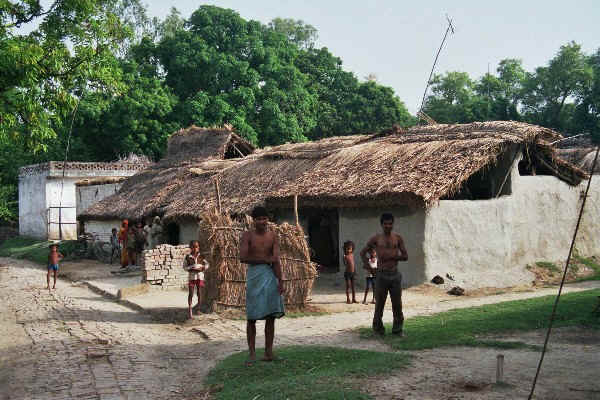
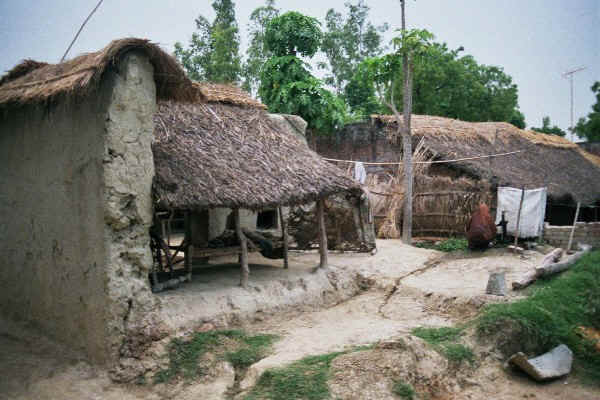
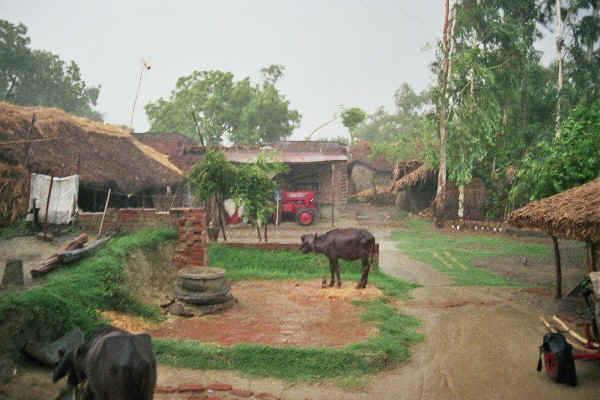
Here is Behra, 100 miles north of Lucknow, the village of our friend Sudansh Verma (the bridegroom), in a few snapshots: We were in one the only 2 concrete houses, the other houses were clay and straw houses:
Note the little brick wall in the lower left quarter of the picture: this country, or at least this part of India, seems to have a love story with bricks. Not a street in any town without heaps of bricks, not 5 miles in the countryside without the chimney of a brick factory.
A simple, pastoral, quiet life, with none of the gadgets of modern life. You'd think you were catapulted 2000 years ago in Europe, except for the climate. And a television aerial in the top left quarter of the picture.
Buffalos. People and beasts live in close proximity, and rather good complicity. And its not just the cows, but also the apes, and in rural India, buffalos:
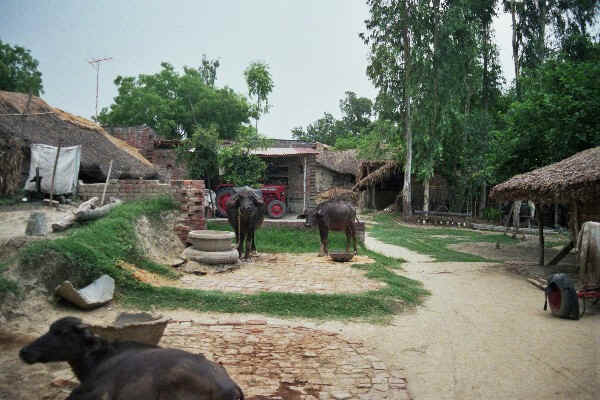
Buffalos
are useful in a variety of ways:
-They help pull ploughs in the fields,
-they provide milk: Tea (Chi for the locals) is served with unpasteurised buffalo milk. No question of taking anything from a cow! By the way, best not to bring any leather item in India, it may offend some.
-Heating: dried buffalo dung is collected and dried up during the summer to be used as fuel in the winter months.
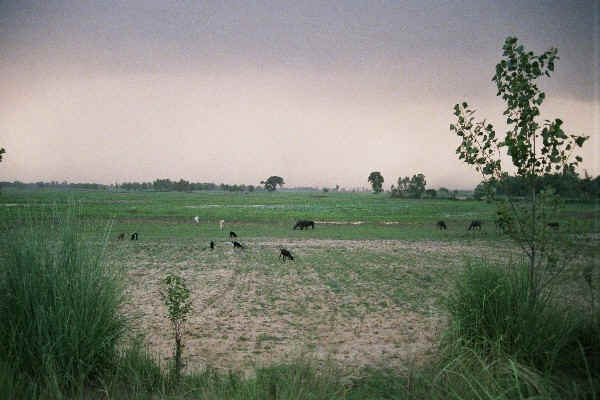
This is what the countryside looks like, very flat (this is the Ganges plain, just south of the Nepalese Himalaya), and very green. Although this was the dry season, it was still very green. The landsape is a patchwork of fields, mots of them Sugar cane fields. Some of them, smaller patches in a more intense green than most, are rice fields, where rice grows before being repicked into much bigger rice ponds, once Monsoon has come.
One evening, around 6PM we were invited on a short ride around the village, as the temperature had dropped below 40º C. In this picture it's a bit dark, not just because of the evening time, but mainly because as I took this picture, the horizon was blurred by what looked like a low lying cloud.
It was acutally a sand storm coming our way!
Everybody was very excited, as what they had been hoping for weeks on end had come:
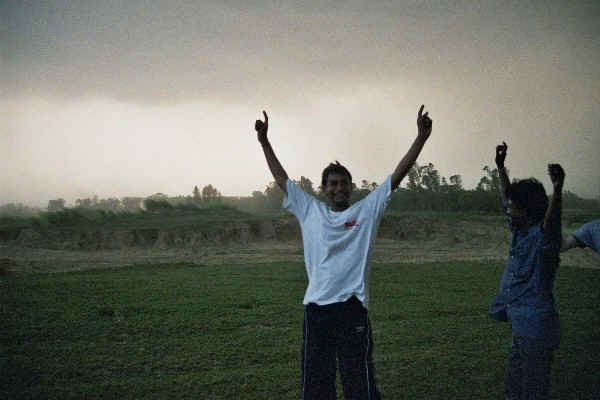
Monsooooon!
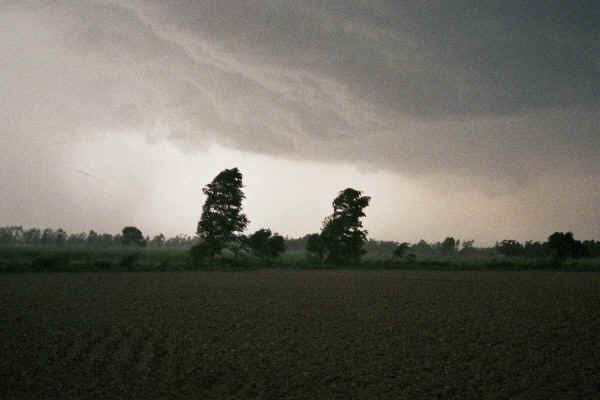
We were sandblasted and quickly retreated into our driver's car. This is just the wind before the rain. Some trees were broken in two by the gusts of wind.
Rain itself was on for the whole night. Within an hour, the temperature had dropped from 45º C to just 25ºC
In the morning, the village looked somewhat wetter:
This is Gola, the local town, 70.000 inhabitants:
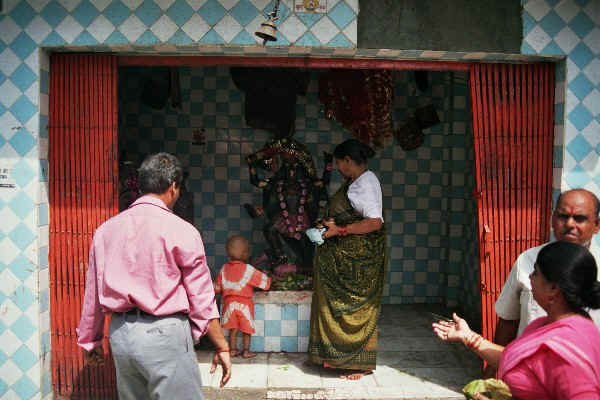
This is the temple compound where all gods have their shines:
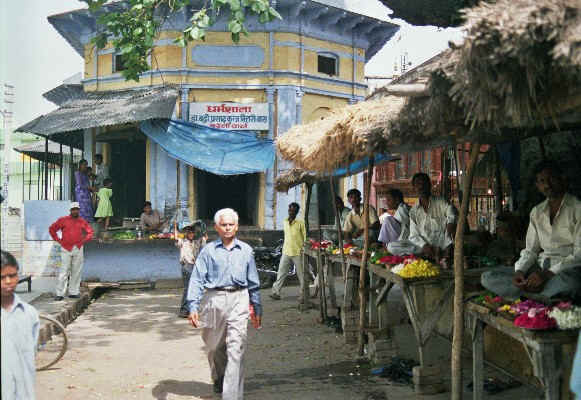
The Temple of "Lord Krishna". Bells are rung as a way to attract the god's beneficial attention unto oneself:
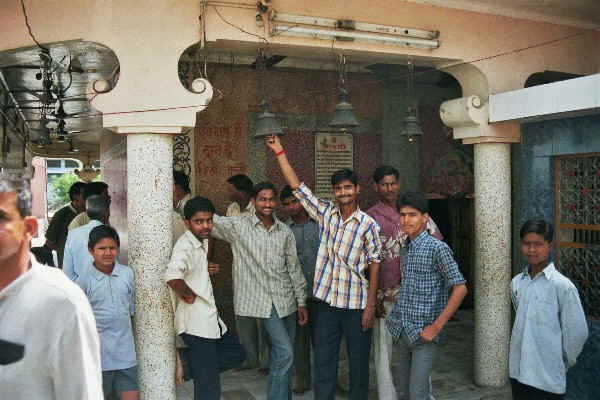
The temple of Hanuman, the Ape God:
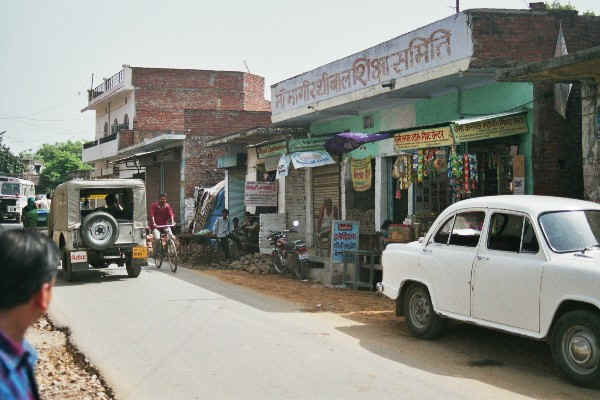
Every house in this part of India seems to be a shop-front. India has over 1 billion inhabitants, and probably just as many traders. My impression was of rather independent and entrepreneurial people, with a mixture of a stern attitude and a resolute optimism.
Bicycles: without them, no rickshaws, and not many people able to move around. A feature that seems to be common to most asian countries.
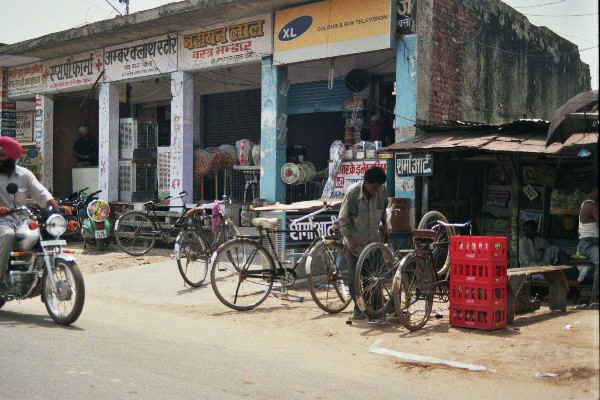
Most walls seem to be in need of repairs, and a new coat of paint. So many of them are smothered in ads, sometimes from top to bottom. Anyway, if they crumble, there is no shortage of bricks....
HARIDWAR
Our friend's wedding took place in an Ashram in Haridwar, one of the most religious places in India, at the source of the Ganges, as it springs in a torrent out of the foothills of Himalaya.
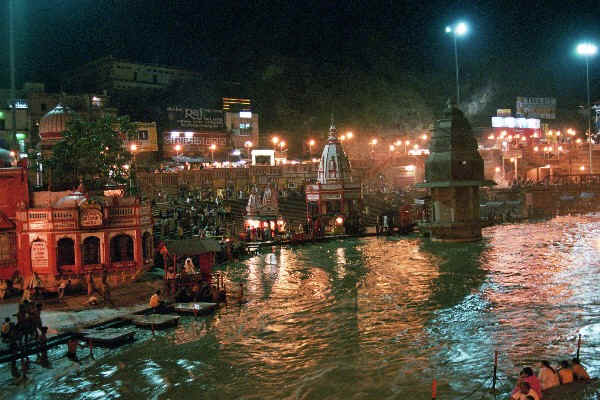
Thousands of people of all social origins bathe in this place, where the water is still very pure. At around 7 PM, thousands of people gather on the banks to light candles on a little leaf-made boat and put them in the water. I missed that by a few minutes. Sorry.
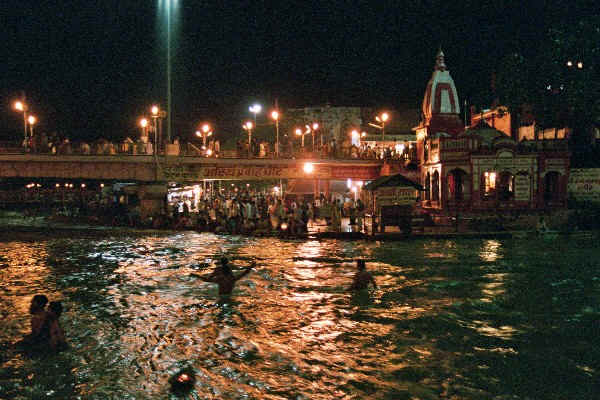
The current is quite strong, and it is advisable to go in holding a chain attached to the concrete bank, or you might get carried away.
That's all I could take from the wedding, as my Camera batteries went too weak from this moment, and my lightmeter was giving strange readings.