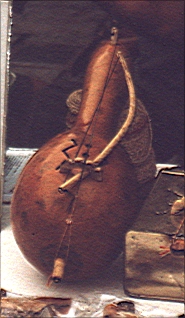
Este instrumento tambi�n llamado La�d monocorde, por poseer solo una cuerda de cola
De caballo o tambi�n de crin de p�cari , es de la etnia TOBA/KOM, tal vez es esta etnia la
Que posee la mayor variedad instrumental despu�s de la cultura quichua, en nuestro pa�s.
Su funci�n en la comunidad es para despertar la danza y evocar antiguas melod�as, su
Sonido es r�stico y se trabaja mas que nada con los arm�nicos , produci�ndose un efecto
Muy particular, se toca tambi�n en grupo,no posee una afinaci�n determinada, y es muy
Especial para las danzas de la comunidad, tambi�n suena a d�o con el tambor toba
Kopakataki del cual se desprenden una gran variedad de ritmos que a veces suelen ser
Muy irregulares.
ENGLISH
This instrument also called La�d monocorde, to also have single a cord of tail Of horse or of horsehair of p�cari, is of ethnic group TOBA/KOM, is this ethnic group the one That has the greater instrumental variety after the culture quichua, in our country. Its function in the community is for waking up the old dance and to evoke melod�as, its Sound is rustic and it works but that nothing with the overtones, taking place a Very particular effect, is also touched in group, it does not have a determined refining, and he is very Special for the dances of the community, also it sounds to pair with the drum Kopakataki tufa which come off a great variety of rates that sometimes usually are Very irregular

click sobre la foto para escuchar el sonido