|
|
Works Cited and Consulted
The Chronology of Alexandre Dumas' Life
The Biography of Alexandre Dumas
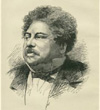
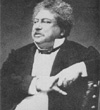
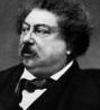
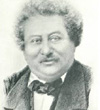
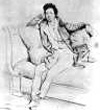
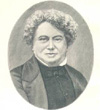
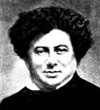
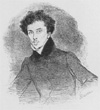
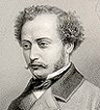
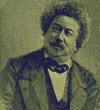
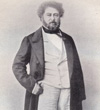
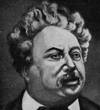
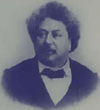
Alexandre Dumas (Dumas p�re), was born in Villers-Cotterets, 40 km northeast of Paris on July 24th 1802 to parents Thomas-Alexandre Dumas and Marie-Cosette Dumas. Dumas p�re's mother was originally Marie-Louise Labouret, a Haitian slave and daughter of a tavern owner. Thomas had changed his last name to his wife�s �Dumas� upon joining the French army with his father�s disapproval (so as not to disturb what his father called his �noble surname').
In 1806, after his father died, Dumas' family was very poor. Alexandre moved to Paris in 1823 where he found work at the Palais-Royal in the office of the powerful duc d'Orl�ans as a copy clerk because of his beautiful handwriting. In Paris, Dumas fathered Alexandre Dumas Jr. illegitimately with Marie Catherine Labay, a dressmaker, in 1824. Although he only recognized three illegitimate children, it is said that he fathered dozens more. He has been quoted as telling one of his illegitimate children that he needed numerous mistresses because, �If I had only one, she'd be dead inside eight days." In fact, even his father Thomas, was an illegitimate son.
He was mostly self-educated, and throughout his childhood he was an avid reader and developed a real talent for storytelling and having love affairs. When he became an author, he would soon realize his destiny as a famous French novelist and dramatist. His first successes were plays including the historical dramas Henri III et sa cour in 1829, Christine in 1830, Antony in 1831, and La Tour de Nesle in 1832, all involving the Middle Ages. During this time, he also became active in the Revolution of 1830.
After his first independent novels, he is said to have collaborated on the rest (largely with Auguste Maquet). He wrote some 250 books, plays, memoirs, and journals with the help of 73 assistants. Often his assistants would develop plot lines, correct his grammar, and even write entire chapters. Dumas would later tie the book together with characters and details of his own. These works were published under his name alone because everyone agreed his name would sell more books and make everyone richer. His works, although critiqued as lacking characterization in the writing world, have found their niche with the masses, being translated into 100 languages and acted out in 200 movies. The Count of Monte Cristo alone has been made into 23 movies.
Dumas invented a new literary genre: the historical novel. This is a novel that is loosely based on real events, but it consists of fictional plots and characters. The real prizes of his writings were The Three Musketeers written in 1844 and its sequels Twenty Years After in 1845, The Count of Monte Cristo in 1846, and The Vicomte de Bragelonne in 1850. Among his other works were The Journal of Madame Giovanni in 1844, Queen Margot in 1845, The Lady of Monsoreau in 1847, The Forty-Five in 1848, and The Black Tulip in 1850. Dumas would be working on so many books at the same time that he needed to color-code his work to keep the books straight. All of his writings made him rich, but he was never able to control his bad spending habits and extreme charitable donations. These spending habits also contributed to his separation with Ida Ferrier in 1846, just six years after they were married. This came after he had spent her entire dowry. He even declared bankruptcy in 1852. He was interested in Italian unification, and was part of Garibaldi�s expedition in 1860. True to his fictional characters, Alexandre was an expert horseman and swordsman and was even involved in several duels to defend his honor
By the time he died on December 5th 1870 from a stroke in his son's house, he had written more than 200 books ranging from historical fiction to theatrical melodrama to journalism, and even some poetry. He overcame the obstacles of his race and poverty to become the most well known writer of his time. He amassed several fortunes, only to lose them later. He was involved in three revolutions and fought several duels. His last words were reported to be, "I shall never know how it all comes out now," in regards to a yet unfinished book. A statue was erected in France in 1883 to commemorate him. On December 5th 2000, the remains of Alexandre Dumas were moved from a tomb in a small town in northern France to the Pantheon. There, he joined the official heroes of France including Rousseau, Voltaire, Victor Hugo, Emile Zoa, and Pierre and Marie Curie. Even great writers such as Flaubert, Stendhal, and Proust are excluded from the Pantheon. He was granted entrance to the Pantheon for popularizing French history and culture all over the world.
Back to top
The Chronology of Alexandre Dumas' Life
Works Cited and Consulted
|
|
|