| Chapter 6 |
 |
|||
|
Chapter
6: Muhammad in the Bible "Those
who follow the Messenger, the unlettered Prophet whom they find written
in the Torah and the Gospel with them. He enjoins upon them that which
is right and forbids for them that which is evil. He makes lawful for
them all things that are good and prohibits for them all that is foul
and he relieves them from their burden and the fetters that they used to
wear. Then those who believe in him, honor him, assist him, and follow
the light which is sent down with him: they are the successful"
The noble Qur'an, Al-A'araf(7):157. "And when there came to them a
messenger from Allah, Confirming what was with them, a party of the
people of the book threw away the book of Allah behind their backs as if
(it had been something) they did not know" The Qur'an, Al-Bakarah(2): 101 "And because of their breaking of
their covenant, We have cursed them and made hard their hearts. They
change the words from their places and they forget a portion
thereof" The noble Qur'an, Al-Maida(4): 13. Before starting this topic, let me first
clear up a common misconception. Many Christians require of all Muslims
to either accept all of the Bible or to reject all of the Bible.
Therefore, they sometimes find a Muslim's attitude towards the Bible
bewildering. For this reason, I will explain how a Muslim is commanded
to deal with the Bible. Muslims are told that Allah Almighty sent
down an "Injeel" upon Jesus (pbuh). The Qur'an then goes on to
describe how mankind later changed this "Injeel" and altered
it's original message to them. For this reason, Muhammad (pbuh) told all
Muslims to deal with the Bible with respect since it started out as the
true word of God. Muhammad (pbuh) told his followers that if they were
to reject the whole book, then they might be rejecting words that remain
the true word of God. He told them that the Qur'an had been sent down to
"bear witness over" that which was changed by mankind in the
Bible and to return it to the original teachings of God through it's own
guardianship. We read this in the Qur'an: "And unto you (O Muhammad) have We
revealed the Scripture (Qur'an) with the truth, confirming that which
was before it of the Scripture, and a watcher/corrector over it. So
judge between them by that which Allah has revealed, and follow not
their desires away from the truth which has come unto you.." The noble Qur'an, Al-Maidah(5):48. The actual word used in this verse was the
Arabic word "Muhaimin" which means
"Guardian/warden/overseer/watcher/protector." For this reason,
Muhammad (pbuh) commanded them to accept only that which is verified by
the Qur'an and to reject that which contradicts the Qur'an. Muslims have recorded that the "people
of the book" at the time of Muhammad (pbuh) had been expecting a
new prophet to be coming soon. There are many historical reports to this
effect. We are told that the Jews of Yathrib (Al-Madinah Al-Munawarah)
were constantly threatening it's Arab citizens with his impending
arrival and that they would follow him and slaughter them in a similar
manner as A'ad and Iram where slaughtered, and this was one of the major
reasons that the Arabs of Yathrib followed Muhammad (pbuh) so quickly.
To beat the Jews to him. There are also other similar stories, such as
the story of Salman Al-Farisi, the story of the monk Bahira, and the
story of Al-Najashi, the king of Ethiopia among many others. There are many predictions of the coming of
Jesus (pbuh) in the Old Testament. Many Christians have even told us
that the Bible has predicted much of what has occurred after the time of
Jesus (pbuh) including the Pope and Israel. Unlike the Jews, Muslims do
not contest the claimed prophesies of the coming of Jesus (pbuh) since
the Qur'an commands them to believe in him. We have also seen in the
verse which was presented at the very beginning of this chapter how the
Qur'an tells us that both the Torah of Moses as well as the Injeel
(Gospel) of Jesus both contain prophesies of Muhammad However, if we ask
the Christians whether they can find any mention of Muhammad (pbuh) in
the Bible, their immediate response is an emphatic "No!" But
if the Bible has predicted all of these other things then we must ask:
why does it have absolutely nothing at all to say about the man who
single-handedly convinced many billions of people over the ages to
believe in the miraculous birth of Jesus (pbuh), his message, the piety
and chastity of his mother Mary (pbuh), the miracles of Jesus (pbuh),
and the fact that he was one of the greatest messengers of God for all
time? There is not a single prophesy in the Old
Testament that mentions Jesus (pbuh) by name. Messiah, translated
"Christ" is not a name. It is a description, a title.
It means "the anointed one." Even "Jesus" is not
Jesus' true name. "Jesus" is a Latinized version of the Hebrew
name "Yeshua," which itself is the shortened form of "Yehoshua"
- God Saves. When the Christians claim that a verse professes the coming
of Jesus (pbuh) what they have done is to compare the description
found in that verse to Jesus (pbuh) and if it fits him then they say
that it speaks of him. Using the Christian's same system we claim that
there is indeed not one, but more than TEN verses in the Bible that
speak of the coming of Muhammad (pbuh) as God's last messenger, but that
previous commentators have misunderstood them (just as the Christians
tell us that the Jews have done with the Old Testament prophesies of
Jesus, pbuh). The reader will notice that in what is to follow the
verses are explained very simply, using the obvious meanings of the
words themselves without having to resort to forced abstract and
metaphysical meanings for these verses. These verses speak about major
events, locations, and milestones in Islamic history as well as the
characteristics of both Islam and Muhammad (pbuh). Now the prophesies: "Those unto whom We gave the
Scripture recognize him (Muhammad) as they recognize their sons. But
verily, a party of them conceal the truth while [well] they know
it" The
noble Qur'an, al-Baqarah(2):146 6.1:
Three distinct prophesies In the Bible we read of the test that the
Jews applied to Jesus (pbuh) in order to ascertain his truthfulness. The
Jews had a prophecy that required Elias to come before Jesus (pbuh): "Elias verily cometh first" Mark 9:12 (also John 3:28). They had not seen Elias
yet so they doubted the claim of Jesus (pbuh). Jesus, however, responded
to them that Elias had already come but that they did not recognize him.
In Matthew we read: "But I say unto you, That Elias is
come already, and they knew him not.........Then the disciples
understood that he spake unto them of John the Baptist."
Matthew 17:12-13 John, however refutes the claims of Jesus (pbuh).
This is one of the Christian's "dark sayings of Jesus" that
their scholars have tried to reconcile for centuries. We will leave this
matter for them to work out among themselves (This matter is resolved in
the Gospel of Barnabas. Please see chapter 7 for more). Now, in John we read "And this is the record of John,
when the Jews sent priests and Levites from Jerusalem to ask him, Who
art thou? And he confessed, and denied not; but confessed, I am not
the Christ. And they asked him, What then? Art thou Elias?
And he saith, I am not. Art thou that prophet? And he answered,
No." John 1:19-21 We notice that there are three distinct
prophecies here: 1) Elias, 2) Jesus, 3) That prophet. The Jews were not
waiting for two prophecies, but three. This can be further
clarified by reading John: "And they asked him, and said unto
him, Why baptizest thou then, if thou be:
a) not that Christ,
b) nor Elias, c) neither that prophet?"
John 1:25 If
"that prophet" were Jesus (pbuh) wouldn't the third question
in both verses be redundant? Further, we must remember that "That
prophet" can not apply to any prophet before the time of Jesus (pbuh)
because at the time of Jesus (pbuh) the Jews were still waiting for
all three. Notice how when we let the Bible speak for itself,
without forcing the holy spirit or other supernatural meanings on it in
the commentary, or forcing three questions to be only two, how clear
these verses become. For much more evidence in this regard, please read
chapter 7 regarding the Dead Sea Scroll prophesies of "two
messiahs" and how the Jews who wrote the scrolls and who were
waiting for the coming of Jesus (pbuh) clearly state in these scrolls
that they were waiting for not one, but TWO messiahs, the first
of which would be announced by an eschatological prophet. 6.2:
Foretells the story of the chapter of "Al-Alak" "And the vision of all is become
unto you as the words of a book that is sealed, which [men] deliver to
one that is learned, saying, Read this, [I pray thee]: and he saith, I
cannot; for it [is] sealed: And the book is delivered to him that is not
learned, saying, Read this, [I pray thee]: and he saith, I am not
learned. Wherefore the Lord said, Forasmuch as this people draw near
[me] with their mouth, and with their lips do honor me, but have removed
their heart far from me, and their fear toward me is taught by the
precept of men: Therefore, behold, I will proceed to do a marvelous work
among this people, [even] a marvelous work and a wonder: for the wisdom
of their wise [men] shall perish, and the understanding of their prudent
men shall be hid. Woe unto them that seek deep to hide their counsel
from the LORD, and their works are in the dark, and they say, Who seeth
us? and who knoweth us? Surely your turning of things upside down shall
be esteemed as the potter's clay: for shall the work say of him that
made it, He made me not? or shall the thing framed say of him that
framed it, He had no understanding? [Is] it not yet a very little while,
and Lebanon shall be turned into a fruitful field, and the fruitful
field shall be esteemed as a forest? And in that day shall the deaf hear
the words of the book, and the eyes of the blind shall see out of
obscurity, and out of darkness."
Isaiah 29:11-18 Prophet Muhammad (pbuh) was illiterate. His
entire life he never learned to read nor write. The exact circumstances
of this first revelation were as follows: It was the habit of Muhammad (pbuh)
to frequently remove himself from the midst of his fellow Arabs and
their heathenistic actions and spend many days secluded in the cave of
"Hiraa" in the mountains of Makkah where he would pray to God
according to the religion of Abraham (pbuh). After many years of this,
and having reached the age of forty (610AD), the angel Gabriel suddenly
appeared before him and ordered him to "Iqra!" (read,
recite, repeat, proclaim). Muhammad (pbuh), in his terror thought he was
being asked to read, so he stammered: "I am unlettered."
The angel Gabriel again ordered him to "Iqra!" Muhammad
(pbuh) again replied: "I am unlettered." The angel
Gabriel now took a firm hold of him and commanded him "Iqraa in
the name of Allah who created!". Now Muhammad (pbuh) began to
understand that he was not being asked to read, but to recite, to
repeat. He began to repeat after him, and Gabriel revealed to him the
first verses of the Qur'an, those at the beginning of the chapter of
Al-Alak(96): "Read(Iqraa): In the name of your
Lord who created, Created man from a clot. Read(Iqraa): And your Lord is
the Most Bounteous, Who teaches by the pen, Teaches man that which he
knew not." The noble Qur'an, Al-Alak(96):1-5 As mentioned above, the actual word angel
Gabriel used to address Muhammad (pbuh) was the Arabic word "Iqra."
It is derived from the Arabic root word "qara". However, if we
were to go back to the original Hebrew form of the verses of Isaiah
29:11, we would find that the actual word which is translated into
English as "Read this [I pray thee]" is the Hebrew word
qara', {kaw-raw'}. Is it not an amazing coincidence that the Hebrew text
used not only a word with the same meaning, but the exact same
word itself ? Verse 11 of Isaiah tells us that the final
book (the Qur'an) was revealed to previous prophets, however, they could
not read it. It was "sealed" for them because it was meant for
the last prophet, and until the last prophet's time came, the people
would not yet be able to "bear" this message (John 16:13). It
was also sealed for them because it was revealed in Arabic. "A Book whereof the verses are
explained in detail; a Qur'an in Arabic for people who have
knowledge" The noble Qur'an, Fussilat(41):3 "Had We made this as a Qur'an (in a
language) other than Arabic, they would have said: 'Why are not its
verses explained in detail? What! An Arab and non Arabic?' Say: 'It is a
Guide and a Healing for those who believe; and for those who disbelieve,
there is a heaviness (deafness) in their ears, and it is a blindness
upon them: They are as those who are called from a place far distant (so
they neither hear nor understand)'" The noble Qur'an, Fussilat(41):44 For more details on why the Arabic language
was selected as the language of the Qur'an, please read chapter 13. Indeed, the Qur'an was revealed to a man
who could neither read nor write so that it might be apparent to mankind
that he could not have received it from the writings of man, but only
from God Almighty. "Neither did you (O Muhammad) read
any book before it, nor did you write any book with your right [hand].
In that case, indeed, the followers of falsehood might have doubted Nay,
it is but clear signs in the breasts of those endowed with knowledge:
and none but the unjust reject Our signs." The noble Qur'an, Al-Ankaboot(29):48-49. As we see in the above verses of Isaiah, by
the time Prophet Muhammad (pbuh) received this book from God, mankind
will have been reduced to worshipping God in words alone, while their
hearts shall be far removed from true belief. They will have forsaken
the true belief in God in favor of "the precept of men"
(the laws of men). We have already seen the confirmation of this in
chapter one where we learned how "St. Paul" managed to totally
replace the message of Jesus (pbuh) with his own message, and how the
later followers of Paul believed that they were justified in using force
to get the first Christians to accept their gospels. We also saw how
they burned Gospels that were accepted as authentic in the first
centuries CE, and killed all Christians who did not "convert."
Finally, we also saw how St. Paul managed to reduce the message of Jesus
(pbuh) to mere "words" of "faith" with no concrete
actions or commandments required of them (i.e. Romans 3:28). Verse 14 now goes on to explain how when
mankind accepts this situation, then the wisdom of the wise men shall
perish and all that shall be left is mankind's corruption. Once again,
we have seen this in chapter one, where we learned the historical
details of how the followers of Jesus (pbuh) and the apostles were
murdered and their books destroyed. This is indeed the same situation described
by Muhammad (pbuh) in one of his sayings. In Sahih Al-Bukhari we read
that Abdullah ibn Amr ibn Al-'As said: "I heard Allah's Apostle (pbuh)
saying, 'Allah does not take away the knowledge, by taking it away from
(the hearts of) the people, but takes it away by the death of the
religious learned men till when none of them remain, people will take as
their leaders ignorant persons who when consulted will give their
verdict without knowledge. So they will go astray and will lead the
people astray.'" In verse 15, we are told that there will
remain among those corrupt individuals those who shall know the truth
but shall strive to hide it from becoming known. Once again, we have
seen this in chapters, one, and two. For more, see chapter 7. Once
again, when the Qur'an was revealed, it confirmed this situation, we
read: "Those unto whom We gave the
Scripture recognize (this prophet) as they recognize their sons. But lo!
a party of them conceal the truth which they themselves know." The noble Qur'an, Al-Baqara(2):14 "And whether you hide your word or
publish it, He certainly has (full) knowledge, of the secrets of (all)
hearts." The noble Qur'an, Al-Mulk(67):13 Verses 16 goes on to tell us how this
treachery, concealment of the truth, and "overturning" of
verses, laws, and obligations shall be exposed, and the wicked shall be
held accountable for their deeds. Yet again, in the Qur'an we read: "That Day shall We set a seal on
their mouths. But their hands will speak to us, and their feet bear
witness, to all that they used to do" The noble Qur'an, Ya-seen(36):65 "And (remember) the day that the
enemies of Allah shall be gathered to the Fire so that they will (all)
be collected there. Till, when they reach it, their hearing and their
eyes and their skins will testify against them as to what they used to
do. And they will say to their skins 'Why did you testify against us?'
They will say: 'Allah has caused us to speak, [for He is] the One who
caused all things [which He willed] to speak, and He created you the
first time, and unto Him you are returned". The noble Qur'an, Fussilat(41):19-21. "O People of the Scripture! Now has
Our messenger come unto you, revealing to you much of that which you
used to hide in the Scripture, and forgiving much. Now has come unto you
light from Allah and plain Scripture," The noble Qur'an, Al-Maidah(5):15 "They did not estimate Allah with
an estimation due to Him when they said: "Nothing did God send down
to man [by way of revelation]" Say: "Who then sent down the
Book which moses brought?- a light and guidance to man: But you make it
into [separate] sheets for show, while you conceal much [of its
contents]: and [by which] you were taught that which you knew not
yourselves nor [did] your fathers [know it]?." Say: 'Allah [sent it
down]': Then leave them to plunge in vain discourse and trifling."
The noble Qur'an, Al-An'am(6):91 Finally, we read in Isaiah 18 that when
this final message is revealed to this "unlettered" prophet,
those who have been lost in darkness and ignorance through the work of
the corrupt shall be brought out of their ignorance and their darkness
and shall be returned to the true message of God. "Wherewith God guides all those who
seek His good pleasure unto paths of peace. He brings them out of
darkness unto light by His decree and guides them unto a straight
path." The noble Qur'an, Al-Maidah(5):16 "And that those who have been given
knowledge may know that it is the truth from thy Lord, so that they may
believe therein and their hearts may submit humbly unto Him. Lo! Allah
verily is guiding those who believe unto a right path." The noble Qur'an, Al-Hajj (22):54 As we saw at the very beginning of this
chapter, this very prophesy was mentioned quite clearly in the Qur'an: "Those who follow the Messenger,
the unlettered Prophet whom they find written in the Torah and the
Gospel with them. He enjoins upon them that which is right and forbids
for them that which is evil. He makes lawful for them all things that
are good and prohibits for them all that is foul and he relieves them
from their burden and the fetters that they used to wear. Then those who
believe in him, honor him, assist him, and follow the light which is
sent down with him: they are the successful" The Qur'an, Al-A'araf(7):157. The complete story is narrated by Aisha (pbuh)
in Sahih Al-Bukhari: "The commencement of the Divine
Inspiration of Allah's Apostle was in the form of good dreams which came
true like bright daylight, and then the love of seclusion was bestowed
upon him. He used to go in seclusion in the cave of Hira where he used
to worship (Allah alone) continually for many days before wishing to see
his family. He used to take with him provisions for the stay and then
come back to (his wife) Khadeejah to eat his food again as before. One day suddenly the Truth descended
upon him while he was in the cave of Hira. The angel came to him and
asked him to read. The Prophet (pbuh) replied, "I do not know how
to read." The Prophet (pbuh) added, "The angel caught me
(forcefully) and pressed me so hard that I could not bear it any more.
He then released me and again asked me to read and I replied, "I do
not know how to read." Thereupon he caught me again and pressed me
a second time until I could not bear it any more. He then released me
and again asked me to read but again I replied, "I do not know how
to read (or what shall I read)?" Thereupon he caught me for the
third time and pressed me, and then released me and said, "Read in
the name of your Lord, who has created (all that exists), created man
from a clot. Read! And your Lord is the Most Generous.'"(96):1-3. Then Allah's Apostle (pbuh) returned
with the Inspiration and with his heart trembling. He went to Khadeejah
the daughter of Khuwaylid (his wife) and said, "Cover me!" She
covered him until his fear subsided. After that he told her everything
that had happened and said, "I fear that something may happen to
me." Khadeejah replied, "Never! By Allah, Allah will never
disgrace you. You keep good relations with your kith and kin, help the
poor and the destitute, serve your guests generously and assist the
deserving people afflicted with calamities."
Khadeejah then accompanied him to her
cousin Waraqah ibn Nawfal ibn Asad ibn AbdulUzza, who, during the
pre-Islamic period became a Christian and used to write in the Hebrew
alphabet. He would write from the Gospel in Hebrew as much as Allah
wished him to write. He was an old man and had lost his eyesight. Khadeejah said to Waraqah, "Listen
to the story of your nephew, O my cousin!" Waraqah asked, "O
my nephew! What have you seen?" Allah's Apostle described that
which he had seen. Waraqah said, "This is the one who keeps the
secrets (angel Gabriel) whom Allah had sent to Moses. I wish I were
young and could live until the time when your people will turn you
out." Allah's Apostle asked, "Will they drive me out?"
Waraqah replied in the affirmative and said, "Anyone (man) who came
with something similar to that which you have brought was greeted with
hostility; and if I remain alive until the day when you will be turned
out then I should support you strongly." But
after a few days Waraqah died (see section 6.4 and chapter 10 for the
confirmation of this prophesy of Muhammad, pbuh, being 'driven out') 6.3
A "Paraclete" like Jesus p1 In the Bible we can find the following four
passages wherein Jesus (pbuh) predicts a great event: John 14:16 "And I will pray the
Father, and he shall give you another Comforter, that he may abide with
you for ever" John 15:26 "But when the Comforter
is come, whom I will send unto you from the Father, [even] the Spirit of
truth, which proceedeth from the Father, he shall testify of me"
John 14:26 "But the Comforter,
[which is] the Holy Ghost, whom the Father will send in my name, he
shall teach you all things, and bring all things to your remembrance,
whatsoever I have said unto you." John 16:7-14 "Nevertheless I tell
you the truth; It is expedient for you that I go away: for if I go not
away, the Comforter will not come unto you; but if I depart, I will send
him unto you. And when he is come, he will reprove the world of sin, and
of righteousness, and of judgment: Of sin, because they believe not on
me; Of righteousness, because I go to my Father, and ye see me no more;
Of judgment, because the prince of this world is judged. I have yet many
things to say unto you, but ye cannot bear them now. Howbeit when he,
the Spirit of truth, is come, he will guide you into all truth: for he
shall not speak of himself; but whatsoever he shall hear, [that] shall
he speak: and he will shew you things to come. He shall glorify me: for
he shall receive of mine, and shall shew [it] unto you." In these four verses, the word
"comforter" is translated from the word "Paraclete"
("Ho Parakletos" in Greek). Parakletos in Greek is
interpreted as "an advocate", one who pleads the cause of
another, one who councils or advises another from deep concern for the
other's welfare (Beacon Bible commentary volume VII, p.168). In these
verses we are told that once Jesus (pbuh) departs, a Paraclete will
come. He will glorify Jesus (pbuh), and he will guide mankind into all
truth. This "Paraclete" is identified in John 14:26 as the
Holy Ghost. It must be pointed out that the original
Greek manuscripts speak of a "Holy pneuma." The word pneuma
{pnyoo'-mah} is the Greek root word for "spirit." There is no
separate word for "Ghost" in the Greek manuscripts, of which
there are claimed to be over 24,000 today. The translators of the King
James Version of the Bible translate this word as "Ghost" to
convey their own personal understanding of the text. However, a more
accurate translation is "Holy Spirit." More faithful
and recent translations of the Bible, such as the New Revised Standard
Version (NRSV), do indeed now translate it as "Holy Spirit."
This is significant, and will be expounded upon shortly. All Bibles in existence today are compiled
from "ancient manuscripts," the most ancient of which being
those of the fourth century C.E. Any scholar of the Bible will tell us
that no two ancient manuscripts are exactly identical. All Bibles in our
possession today are the result of extensive cutting and pasting from
these various manuscripts with no single one being the definitive
reference. What the translators of the Bible have done
when presented with such discrepancies is to do their best to choose the
correct version. In other words, since they can not know which
"ancient manuscript" is the correct one, they must do a little
detective work on the text in order to decide which "version"
of a given verse to accept. John 14:26 is just such an example of such
selection techniques. John 14:26 is the only verse of the
Bible which associates the Parakletos with the Holy Spirit. But
if we were to go back to the "ancient manuscripts" themselves,
we would find that they are not all in agreement that the "Parakletos"
is the Holy Spirit. For instance, in the famous the Codex Syriacus,
written around the fifth century C.E., and discovered in 1812 on Mount
Sinai by Mrs.Agnes S. Lewis (and Mrs. Bensley), the text of 14:26 reads;
"Paraclete, the Spirit"; and not "Paraclete,
the Holy Spirit.". Is this just knit picking?
"Spirit" or "Holy Spirit," what's the big deal?
Obviously they both refer to the same thing. Right? Wrong! There is a
big difference. A "spirit," according to the language of the
Bible simply means "a prophet" See for instance: "Beloved, believe not every spirit,
but try the spirits whether they are of God: because many false prophets
are gone out into the world," 1 John 4:1-3: (also see 1 John 4:6), or an inspired human,
for example read 1 Corinthians 2:10, 2 Thessalonians 2:2, ...etc. We have already exhibited in chapters one
and two many documented cases of deliberate modification of the Biblical
text by members of the Christian clergy themselves, as well as
deliberate large scale projects to "correct" the Bible, and
the writings of "the early fathers," (such as the deliberate
insertion of the verse of 1 John 5:7 which is now universally
discarded). It is, therefore, possible that either: 1) The word "Holy" could have
been dropped by a careless copyist., or 2) Someone could have inserted the word
"Holy" to convey his personal understanding of the text. Which was it?
In order to arrive at the answer we must follow the same path of
detective work the Biblical scholars themselves do. We must study the
characteristics of the "Paraclete" and compare them to both
the "Holy Spirit" and to a "Spirit." Muslims believe
that Muhammad (pbuh) was the one intended and not the Holy Ghost. In the
Christian's own "Gospel of Barnabas" Muhammad is mentioned by
name here. The Trinitarian church, however, has done it's utmost to
obliterate all existing copies of "The Gospel of Barnabas,"
and to hide it from the masses or to label it a forgery (see chapter 7).
For this reason, it becomes necessary to show that even the Gospels
adopted by Paul's church also originally spoke of Muhammad (pbuh). 1) Christian scholars see evidence of
tampering: In the famous "Anchor Bible" we
find the following quote: "The word parakletos is peculiar in
the NT to the Johnannine literature. In John ii Jesus is a parakletos
(not a title), serving as a heavenly intercessor with the Father ...
Christian tradition has identified this figure (Paraclete) as the Holy
Spirit, but scholars like Spitta, Delafosse, Windisch, Sasse, Bultmann,
and Betz have doubted whether this identification is true to the
original picture and have suggested that the Paraclete was once an
independent salvific figure, later confused with the Holy Spirit."
The Anchor Bible, Doubleday & Company,
Inc, Garden City, N.Y. 1970, Volume 29A, p. 1135 We are about
to see some of the evidence that goes to prove this position. 2) Does the Holy Spirit
"speak" or "inspire":
The Greek word translated as
"hear" in the Biblical verses ("whatsoever he shall
hear, that shall he speak") is the Greek word "akouo"
{ak-oo'-o} meaning to perceive sounds. It has, for instance, given us
the word "acoustics," the science of sounds. Similarly the
verb "to speak" is the Greek verb "laleo" {lal-eh'-o}
which has the general meaning "to emit sounds" and the
specific meaning "to speak." This verb occurs very frequently
in the Greek text of the Gospels. It designates a solemn declaration by
Jesus (pbuh) during his preachings (For example Matthew 9:18). Obviously
these verbs require hearing and speech organs in order to facilitate
them. There is a distinct difference between someone
"inspiring" something and him "speaking" something.
So the Paraclete will "hear" and "speak," not
"inspire." Muhammad (pbuh), as seen above, did indeed
fulfill this prophesy. Whatsoever he "HEARD" from Gabriel (The
Qur'an), the same did he physically "SPEAK" to his followers.
In the Qur'an we read: "(God swears) By the star when it
falls!: Your comrade (Muhammad) errs not, nor is he deceived; Nor does
he speak of (his own) desire. It is naught save a revelation that is
revealed (unto him)." The noble
Qur'an, Al-Najm(53):1-4 3) The Holy Ghost was already with them:
In the above verses we read "if I
go not away, the Comforter will not come unto you; but if I depart, I
will send him unto you." The comforter can not be the Holy
Ghost because the Holy Ghost (according to the Bible) was
"with" them already (and even quite active) long before the
coming of Jesus (pbuh) himself and then throughout his ministry. Read
for example. Genesis 1:2 "And the earth was
without form, and void; and darkness [was] upon the face of the deep.
And the Spirit of God moved upon the face of the waters." 1 Samuel 10:10 "And when they came
thither to the hill, behold, a company of prophets met him; and the
Spirit of God came upon him, and he prophesied among them." "And the Spirit of God came upon
Saul when he heard those tidings, and his anger was kindled
greatly." 1 Samuel 11:6 "Then he remembered the days of
old, moses, and his people, saying, Where is he that brought them up out
of the sea with the shepherd of his flock? where is he that put his holy
Spirit within him?" Isaiah 63:11 "For he (John the Baptist) shall be
great in the sight of the Lord, and shall drink neither wine nor strong
drink; and he shall be filled with the Holy Ghost, even from his
mother's womb." Luke 1:15 "And the angel answered and said
unto her, The Holy Ghost shall come upon thee."
Luke 1:35 "And it came to pass, that, when
Elisabeth heard the salutation of Mary, the babe leaped in her womb; and
Elisabeth was filled with the Holy Ghost"
Luke 1:41 "And his father Zacharias was
filled with the Holy Ghost, and prophesied, saying," Luke 1:67 "And, behold, there was a man in
Jerusalem, whose name was Simeon; and the same man was just and devout,
waiting for the consolation of Israel: and the Holy Ghost was upon
him." Luke 2:25 "And it was revealed unto him by
the Holy Ghost (Simeon), that he should not see death, before he had
seen the Lord's Christ." Luke 2:26 "And the Holy Ghost descended in a
bodily shape like a dove upon him (Jesus), and a voice came from heaven,
which said, Thou art my beloved Son; in thee I am well pleased."
Luke 3:22 "Then said Jesus to them again,
Peace be unto you: as my Father hath sent me, even so send I you. And
when he had said this, he breathed on them, and saith unto them, Receive
ye the Holy Ghost." John 20:21-22 Did they or
did they not already receive the Holy Ghost? Was Jesus (pbuh) not still
with them when they received the Holy Ghost? Was the Holy Ghost
not with Simeon, Mary, Elisabeth and Zacharias before the birth of Jesus
(pbuh)? Was the Holy Ghost not with Moses (pbuh) when he parted the
seas? There are many more similar verses to be found in the Bible. In
the above verses, we are told that if Jesus (pbuh) does not depart then
the "parakletos" will not come. Thus, the "Holy
Ghost" cannot be the one originally intended since it was already
with them. The contradiction is quite obvious. 4) Selective translation: Jesus (pbuh)
too is a Paraclete: The word "Paraclete" is applied
to Jesus (pbuh) himself in 1 John 2:1 "My little children, these things
write I unto you, that ye sin not. And if any man sin, we have an advocate(parakletos)
with the Father, Jesus Christ the righteous."
1 John 2:1 Notice how the translators have managed to
translate this exact same word one way (advocate) in
reference to Jesus (pbuh) and another (comforter) with regard to the
coming "parakletos." Why would they want to do such a thing?
The reason is that the translators did not want the Christians, after
reading "we have an advocate(parakletos)
with the Father, Jesus Christ the righteous" to then read "And I will pray the Father, and he
shall give you another advocate(parakletos)." Can we see why this would make them
nervous? Well, what was Jesus (pbuh)? He was a
prophet! Read: "...This is Jesus the prophet of
Nazareth of Galilee." Matthew 21:11 and "..Jesus of Nazareth, which was
a prophet mighty in deed and word before God and all the people"
Luke 24:19: ...etc.
(see more in section 1.2.3.12). Muhammad (pbuh)
was also a prophet of God. We have already demonstrate in chapter one
how the verses of the Bible themselves prove quite conclusively that
Jesus (pbuh) was neither a god nor part of God Almighty, but an elect
messenger of God. The concept of his divinity was concocted by Paul and
his ministry during the first three centuries after the departure of
Jesus (pbuh) and is explicitly refuted by the Bible itself and Jesus'
apostles (see section 1.2.5). 5) "Another" Paraclete:
Now go back to John 14:16 and notice the
words "another Paraclete." If the comforter is the Holy
Ghost then how many Holy Ghost's are there? The word "another"
is significant. We have already seen how this term is applied to Jesus (pbuh)
himself. In English, "another" may mean "One more of the same
kind" or "one more of a different kind." If the
latter were the one intended then the current Christian interpretation
might bear some merit. However, if "One more of the same kind"
was what was intended then this is positive proof that the coming
Paraclete would be just like Jesus (pbuh), a human being and a
prophet, not a ghost. The actual Greek word used was the word
"allon" which is the masculine accusative form of "allos"
{al'-los}: "Another of the SAME kind." The Greek word
for "another of a different kind" is "heteros" {het'-er-os}. Prof. Abdul-Ahad Dawud (formerly Rev. David
Benjamin Keldani, Bishop of Uramia)* says: "The adjective 'another' preceding
a foreign noun for the first time announced seems very strange and
totally superfluous. There is no doubt that the text has been tampered
with and distorted." Muhammad in the Bible, Prof. Abdul-`Ahad
Dawud, p. 211 "The Paraclete is a parallel figure
to Jesus himself; and this conclusion is confirmed in the fact that the
title is suitable for both. It is clear from 14:16 that the source
thought there were sendings of two Paracletes, Jesus and his successor,
the one following the other" The Gospel of
John a Commentary, Rudolf Bultmann, p. 567 6) "Parakletos" or "Periklytos"?:
Some scholars believe that what Jesus (pbuh)
said in his own Aramaic tongue in these verses represents more closely
the Greek word "Periklytos" which means the admirable or
glorified one. This word corresponds exactly to the Arabic word
"Muhammad" which also means the "admired one" or
"glorified one." In other words, "Periklytos" is
"Muhammad" in Greek. There are several similar documented
cases of similar word substitution in the Bible. It is also quite
possible that both words were contained in the original text but were
dropped by a copyist because of the ancient custom of writing words
closely packed, with no spaces in-between them. In such a case the
original reading would have been: "and He will give you another
comforter(Parakletos), the admirable one(Periklytos)" (See
examples of many similar cases in the Biblical text in "The
Emphatic Diaglott"). In his book "Muhammed in the
Bible", Professor `Abdul-Ahad Dawud, formerly Rev. David Benjamin
Keldani, Roman Catholic Bishop of Uramiah, submits a much more eloquent
and scholarly presentation in defense of these assertions, far beyond
the limited abilities of this humble author. For those who which to read
a truly scholarly study of this matter, you may obtain a copy of that
book. The following is a very brief quotation from that book: "The 'Paraclete' does not signify
either 'consoler' or 'advocate'; in truth, it is not a classical word at
all. The Greek orthography of the word is Paraklytos which in
ecclesiastical literature is made to mean 'one called to aid, advocate,
intercessor' (Dict. Grec.-Francais, by Alexandre). One need not profess
to be a Greek scholar to know that the Greek word for 'comforter or
consoler' is not 'Paraclytos' but 'Paracalon'. I have no Greek version
of the Septuagint with me, but I remember perfectly well that the Hebrew
word for 'comforter' (mnahem) in the Lamentations of Jeremiah (I. 2, 9,
16, 17, 21, etc.) is translated into Parakaloon, from the verb Parakaloo,
which means to call to, invite, exhort, console, pray, invoke. It should
be noticed that there is a long alpha vowel after the consonant kappa in
the 'Paracalon' which does not exist in the 'Paraclytos.' In the phrase
(He who consoles us in all our afflictions) 'paracalon' and not 'Paraclytos'
is used. (I exhort, or invite, thee to work). Many other examples can be
cited here. There is another Greek word for comforter or consoler, i.e.
"Parygorytys' from 'I console'.....The proper Greek term for
'advocate' is Sunegorus and for 'intercessor' or 'mediator' Meditea"
Muhammad in
the Bible, Prof. Abdul-`Ahad Dawud, pp. 208-209 7) "He" not "It":
Notice the use of "he"
when referring to the Paraclete and not "it." If
we read John 16:13, we will find no less than SEVEN occurrences of the
masculine pronoun "He" and "Himself." There is not
another verse in the 66 books of the Protestant Bible or the seventy
three books of the Catholic Bible which contains seven masculine
pronouns, or seven feminine pronouns, or even seven neuter genders. So
many masculine pronouns ill befits a ghost, holy or otherwise. The word
"Spirit" (Greek, pneu'ma), is of a neutral gender and is
always referred to by the pronoun "it." Mr. Ahmed Deedat says: "When this point of seven masculine
pronouns was mooted by Muslims in India in their debates with the
Christian missionaries, the Urdu (Indian) version of the Bible had the
pronouns presently changed to SHE, SHE, SHE! so that the Muslims could
not claim that this prophecy referred to Muhammad (pbuh) - a man! This
Christian deception I have seen in the Bible myself. This is a common
trickery by the missionaries, more specially in the vernacular. The very
latest ruse I have stumbled across in the Afrikaans Bible, on the very
verse under discussion; they have changed the word "Trooster"
(Comforter), to "Voorspraak" (Mediator), and interpolated the
phrase - "die Heilige Gees" - meaning THE HOLY GHOST, which
phrase no Bible scholar has ever dared to interpolate into any of the
multifarious English Versions. No, not even the Jehovah's witnesses.
This is how the Christians manufacture God's word."
"Muhammad, the natural successor to
Christ," Ahmed Deedat, p. 51 8) He will guide you into all truth:
In the above verses Jesus (pbuh) is quoted
as saying "I have yet many things to say unto you, but ye cannot
bear them now. Howbeit when he, the Spirit of truth, is come, he will
guide you into all truth." What does Jesus (pbuh) mean by "ye
cannot bear them now"? If we were to read the Bible, we would
find many verses throughout the Bible wherein Jesus (pbuh) bemoans the
lack of understanding he was constantly greeted with from his disciples
throughout his ministry: "And he(Jesus) saith unto them(the
disciples).....O ye of little faith."
Matthew 8:26 "...and (Jesus) said unto him(Peter),
O thou of little faith." Matthew 14:31 "he (Jesus) said unto them(the
disciples), O ye of little faith."
Matthew 16:8 "And he(Jesus) said unto them(the
disciples), Where is your faith?"
Luke 8:25 Notice that these are not common Jews who
he is saying these words to, but his own elect disciples. The Bible
vividly illustrates how he is constantly going out of his way to
simplify matters for them and to speak to them as one speaks to little
children. However, even at that, they still misunderstand. He is finally
driven to frustration and made to say: "And Jesus said, Are ye even yet
without understanding?" Matthew 15:16 and "And Jesus answering said, O
faithless and perverse generation, how long shall I be with you, and
suffer you?" Luke 9:41 We are even told that his own people did
not accept him: "He came unto his own, and his own
received him not." John 1:11 Jesus (pbuh) had "all truth,"
but he could not give it to them because they were not fit to receive
it. Therefore, he told them that another would come after him who shall
guide them into "all truth" which they could not
receive from him. He tells us that the one who will come will "teach
you all things." This one who will guide them into "all
truth" is described as "The spirit of truth."
We have already seen how the word "spirit" in the Bible is
synonymous with the word "Prophet." Muhammad (pbuh), even
before he became the prophet of Islam was known among his people as
"Al-sadik Al-amin," which means "The truthful, the
trustworthy." Thus, it becomes apparent that Muhammad was indeed "the
spirit of truth." Since the departure of Jesus (pbuh) and to
this day, the "Holy Ghost" has not taught mankind a single
new truth not revealed by Jesus (pbuh) himself. It is important to notice the words "ALL
truth" and "MANY things." "Many" and
"All" means more than one. What new and innovative teachings
has the Holy Ghost given mankind which were not taught by Jesus (pbuh)?
The Qur'an says: "O
mankind! The messenger (Muhammad) hath come unto you with the truth from
your Lord. Therefore believe; (it is) better for you. But if ye
disbelieve, still, lo! unto Allah belongeth whatsoever is in the heavens
and the earth. Allah is the All-Knower, the All-Wise." 9) He shall glorify me:
The Paraclete "shall glorify
me" and will "testify of me." Muhammad (pbuh)
did indeed testify of Jesus (pbuh) and did indeed glorify him and raise
him and his mother to their well deserved stations of honor and piety
and even made it an article of faith for every Muslim to bear witness to
this. Just one of the many examples of this is: "And the angles said 'O Mary, Allah
gives you glad tidings of a Word from Him, his name is Messiah, Jesus
son of Mary, High honored in this world and the next, of those near
stationed to Allah." The noble Qur'an, A'al-Umran(3):40. Nobody seems to recognize this fact as
being at all extraordinary. People generally look upon the Jews as true
worshippers of God and followers of a legitimate faith, even if they do
consider them misguided by not following Jesus (pbuh) but killing him.
Their book is even incorporated into the Bible as the faultless word of
God. On the other hand, Muslims are looked down upon as followers of a
false prophet and as savage blood thirsty terrorists or barbarians.
However, if we were to look at the Jewish opinion of Jesus (pbuh) we
would find that an early reference in the Babylonian "Talmud"
says that "Jeshu ha-Nocri" was a false prophet who was hanged
on the eve of the Passover for sorcery and false teaching. They further
claim that he was a bastard son of a Roman adulterer among many other
allegations. Mr. Josh McDowell is a Biblical scholar who
has researched the topic of the Jewish Talmud's view of Jesus. The
Talmud, of course, is the ultimate authoritative body of Jewish
tradition, comprising the Mishnah and Gemara. In Mr. McDowell's book,
"Evidence that demands a verdict," he quotes extensively from
the Jewish Talmud with regard to the official Jewish view of Jesus (pbuh).
The following is a small sampling from this book: "Tol'doth Yeshu. Jesus is referred
to as 'Ben Pandera'." Note: 'Ben Pandera' means 'son of Pandera'.
He was a Roman soldier the Jews allege to have raped Mary to produce the
illegitimate son Jesus (God forbid).
Yeb. IV 3;49a: "Rabbi Shimeon Ben
Azzai said (regarding Jesus): 'I found a genealogical roll in Jerusalem
wherein was recorded, such-an-one is a bastard of an adulteress."
Joseph Klausner adds:
"Current editions of the Mishnah,
add: 'To support the words of Rabbi Yehoshua' (who in the same Mishnah
says: What is a bastard? Everyone who's parents are liable to death by
the Beth Din), that Jesus is here referred to seems to be beyond
doubt." The Jews had adopted in their ancient
references a system of referring to Jesus with code names when heaping
upon his person allegations of evil and blasphemy. One good reference on
this topic is "The Jewish Encyclopaedia," in twelve volumes.
The following information is obtained from that book. Under the heading of "Jesus in Jewish
legend" (Vol. VII, page 170-173), we are told that Jesus is
referred to in Jewish references by such code names as "that
man," "that anonymous one," "Yeshu,"
"bastard," "son of Pandera," "son of Stada,"
"Balaam," (destroyer of the people) etc. Most allegations
which are associated with Jesus (peace be upon him and his mother),
concern themselves either with belittling the person of Jesus, ascribing
to him illegitimate birth, ascribing to his mother Mary (pbuh) acts of
whoredom, attributing to Jesus acts of black magic through the vain use
of the given name of God, and attributing to him a shameful death as
well as severe and denigrating punishment in the afterlife. These references to Jesus in Jewish records
and law claim that Jesus was born to a well known adulteress named
"Mary," who conceived him through adultery with a Roman
soldier who was named either "Pandera" or "Stada."
Jesus is then claimed to have traveled to Egypt and entered into the
service of magicians, he lusted after a woman and was excommunicated, he
set up a brick as his god and led all of Israel into apostasy. He is
claimed to have cut his magic formulas into his skin, by having taken a
parchment containing the "declared name of God" and cut it
into his skin in order to steal it from the Temple. All of his miracles
were then performed through this stolen parchment which was later
forcibly retrieved from him. It was Judas Iscarlot who volunteered to
retrieve it from Jesus. An arial battle ensued between Judas and Jesus.
Judas found that he could in no way touch Jesus so he
"defiled" him. Judas emerged victorious and Jesus fled. Forty
days before the condemnation of Jesus, a herald called upon anyone who
could say anything in Jesus' favor. Not a single person came. The
scholars of Israel then bound him to a pillar, however, his disciples
attacked them and freed him. He disguised himself and rode an ass into
Jerusalem, however, Judas saw through his disguise and exposed him. We
are told that Jesus was then taken to be hung on the tree as the law
required, however, he had conjured all of the trees with his black magic
and none of them would receive him. Finally they hung him up on a large
cabbage stalk which received him. After Jesus' body was placed in the
tomb it disappeared and his disciples tried to claim that he had risen,
however, it was later discovered that "Judas the gardener" had
taken Jesus' body and used it as a dam to hold back the water in his
garden. Jesus' body was then retrieved and flung before the Queen. In
this manner the lies of the apostles were silenced and there was great
rejoicing throughout the land. This same encyclopaedia aleges that the
Qur'an "alludes to" the insult delivered to the body of Jesus
in the streets of Jerusalem. A claim that is not only preposterous and
unfounded, however, the authors are hereby publicly challenged to
produce the text of the Qur'an that "alludes to" such evil
claims against Jesus, peace be upon him and his mother Mary. 6.4:
The emigration (The Hijra) "God (his guidance) came from Teman,
and the Holy One from mount Paran. Selah. His glory covered the heavens,
and the earth was full of his praise."
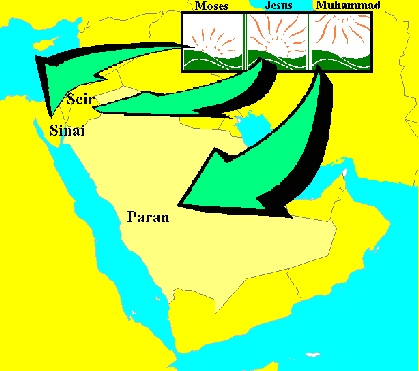
Habakkuk 3:3 The wilderness of Paran is where
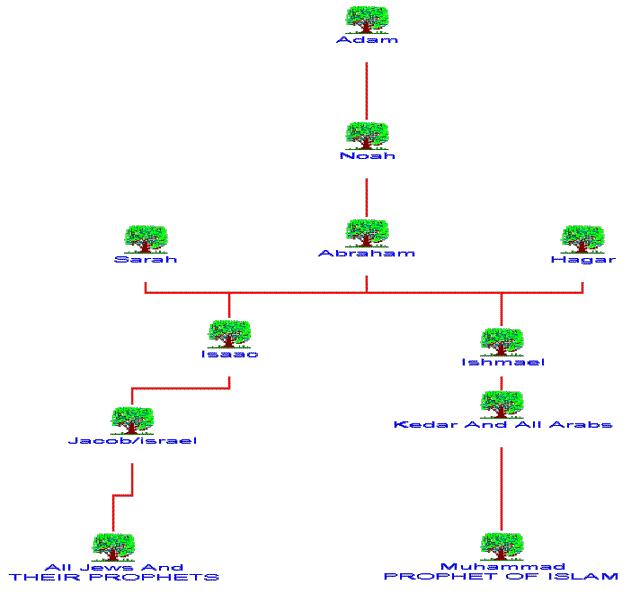
Abraham's wife Hagar and his eldest son Ishmael, the father of the
Arabs, settled (Genesis 21:21) in the Arabian desert. Specifically,
Makkah (Please see Map 1, page 440). Makkah is, of course, the capital
of Islam in Arabia and the birthplace of Muhammad (pbuh). Indeed, it was
Hagar and Ishmael themselves who transformed a barren patch of desert
into what is now the capital of Islam, "Makkah." Mount Paran
is the chain of mountains in that same region which the Arabs call the
"Sarawat mountains." According to J. Hasting's Dictionary of the
Bible, Teman is an Oasis just North of Madinah. Muhammad (pbuh) did
indeed come from Paran. About 622 AD, he and his followers were forced
to migrate from Makkah (Paran) to Madinah (Teman) where he spent the
rest of his prophetic life teaching it's people the guidance of God (the
Qur'an). These two cities, Makkah and Madinah, are such critical
importance to a Muslims faith that every single chapter of the Qur'an is
classified as either "Makkia" (revealed in Makkah) or "Madaniyyah"
(revealed in Madinah). When someone describes someone as having
"come from" a certain town, this is usually interpreted as
meaning that that person was born in that town. In other words, that
town is this man's "home town." However, when one reads the
words "God came from…," the meaning is quite different. It
is quite obvious that the verse is not implying that a given location is
God's "home town." Jews, Christians, and Muslims all affirm
that God Almighty is Omnipresent* and Eternal. So, if this is
the case, then we can not say that God Himself "came" or
"went" to a given place since that would imply that there are
times and places where God's knowledge and supervision is NOT present,
and thus, it is possible to hide from God since I could go to a place
where God has not "come" and is not present in His knowledge. So if God is Omnipresent (present in
knowledge everywhere at the same time), then we begin to realize that it
is not God "Himself" that is "coming" from a given
place, rather it is God's guidance and mankind's recognition of God that
is being established in a given location. In other words, in a place
where the true worship of God and the true knowledge of His message were
absent, God blesses them with knowledge of Himself and His message. In
this way, they become "acquainted" with God, and
"meet" or "learn of" Him. In this fashion, although
God Almighty was ever present in His knowledge, with them and all of His
creation, they are only now beginning to comprehend His presence. Once we understand that the people of Mount
Paran and Teman are described as becoming aware of the message of God
and His guidance, and we realize that Paran and Teman are to Islam what
Jerusalem is to Judaism or Christianity, then we begin to see the
emergence of a prophesy of the coming of the final message of God. This
is because Muhammad (pbuh) first received the prophethood of Islam in
the cave of "Hira'a" located in the highest part of the
mountains of Paran (see section 6.2). Jesus (pbuh) never in his life
traveled to Paran nor Teman. Muhammad, however, was born in Paran, he
became the prophet of Islam there, and it was the capital of the Islamic
religion in that day and this. No man from Paran, throughout history,
has had his praise sung in so many nations as has Muhammad (pbuh). The
name "Muhammad" itself literally means in Arabic "The
praised one." Through the teachings of Muhammad, God is now being
praised by over one billion Muslims around the world. However, if we were to look more closely at
this verse we would find even greater detail of this coming message. The
word which has been translated here as "Holy One" is the
Hebrew word "qadowsh" {kaw-doshe'} which has the multiple
meaning of "sacred, holy, Holy One, saint, set apart." In this
specific verse the translators judgment drove them to translate it as
"Holy One" (notice the capitals), thus, they understood this
verse to simply mean "God came from Teman and God came from
mount Paran." However, if this was the intended reading then
why did God choose to use the word "God" in one place and
"Holy One" in the other? There must be a reason for this
specific wording. Actually, there is. If we were to read Exodus 19:6 we would
find that the same translators of the Bible have translated this same
Hebrew word as "holy nation." In Exodus 29:31 it is translated
as "holy place," and in Zec. 14:5 they translated it as
"saints." Thus, we see that according to the witness of these
same translators of the Bible, this verse of Habakkuk 3:3 could (or more
correctly, should) be translated as "and the saint from mount
Paran," or "and the holy one from mount Paran"
(no capitals). This is important, why? If we were to accept everything these
Biblical translators are teaching us and to accept that the word "qadowsh"
can be translated as "Holy One," or as "holy one,"
or as "saint," or as "holy," etc. based upon the
meaning most appropriate for the chosen verse, then we realize that
although it would be completely appropriate to interpret the coming of
Islam from the mountains of Makkah as "the Holy One" coming
from "mount Paran," still, it would be more precise to say
that "the holy one" (or "the saint") came from
"mount Paran." This is because Muhammad (pbuh) was born on
Paran (Makkah) and first received the message of Islam in the mountains
of Makkah. So why does the first part of this verse
say "God came from Teman" and not "The Holy One came from
Teman"? Well, the reason for this is that Islam was indeed first
revealed to Muhammad (pbuh) in Makkah, however, he and his followers
remained persecuted and in constant fear of death from the pagans of
Arabia while they resided in Makkah (see chapter 10). This continued for
a period of thirteen years. During this period, the Muslims were beaten,
starved, tortured, and killed. This situation was hardly conducive of
the Muslims openly preaching the message of God to all of mankind. For
this reason, the knowledge of the persecution that one must endure upon
acceptance of Islam prevented many from openly accepting it or preaching
it to others. However,
this all changed in the beginning of the fourteenth year. That is when
God Almighty commanded Muhammad (pbuh) to emigrate with his companions
to Teman (Madinah). Although the pagans escalated their persecution of
the Muslims into all-out warfare at this point, still, within the
boundaries of the city of Madinah they had begun to enjoy a measure of
freedom and autonomy. This freedom manifested itself in their ability to
not only preach the message of God within the city itself, but they also
began to send delegations to the surrounding cities inviting them to
Islam. In other words, the message of Islam did not truly begin it's
"global" phase until it reached "Teman" or Madinah.
This is why the verse says "God came from Teman, and the holy
one from mount Paran" In fact, just as the Christian calendar
starts with the presumed date of the birth of Jesus (pbuh), so does the
Islamic "Hijra" calendar start with the year in which the
Muslims emigrated to Madinah. 6.5:
Isaiah's vision Isaiah saw a vision of two riders. "And he saw a chariot [with] a
couple of horsemen, a chariot of asses, [and] a chariot of camels
.." Isaiah 21:7 Who was the rider upon the ass? Every
Sunday school student will tell us that this was a prophecy of Jesus (pbuh),
as stated in John: "And Jesus, when he had found a
young ass, sat thereon; as it is written," John 12:14 but who is the promised prophet who would
ride the camel? If it is not Muhammad (pbuh) then this prophecy has yet
to be fulfilled. Let us read on... "And, behold, here cometh a chariot
of men, [with] a couple of horsemen. And he answered and said, Babylon
is fallen, is fallen; and all the graven images of her gods he hath
broken unto the ground." Isaiah 21:9 Babylon did indeed fall before Islam and
the Islamic nation under the guidance of Muhammad (pbuh) did indeed
succeed in eradicating the worship of idols from Babylon replacing it
with the worship of God alone. In fact, the Muslims were the only
believers in the God of Isaiah to ever succeed in fulfilling this
prophesy (see chapter 10). Continuing ... "The burden upon Arabia ..."
Isaiah 21:13 What does the word "burden" mean?
Let us ask the Scofield Study Bible: "…which also means an oracle is a
word sometimes used in the prophetical writings to indicate a divine
message of judgment" Scofield Study Bible New King James
Version, note 1, p. 792 So the Muslims of Arabia (and subsequently
Muslims everywhere) would be assigned the burden of God's message. "The inhabitants of the land of
Tema brought water to him that was thirsty, they prevented with their
bread him that fled. For they fled from the swords, from the drawn
sword, and from the bent bow, and from the grievousness of war"
Isaiah 21:14-15 Tema,
according to John McKenzie's dictionary of the Bible is "a place name and tribal name of
Arabia; a son of Ishmael.... The name survives in Teima, an oasis of the
part of the Arabian desert called the Nefud in N Central Arabia."
This word, Tema, is the name of the ninth
son of Ishmael (the father of the Arabs), in Genesis 25:13-15 we read: "And these are the names of the
sons of Ishmael, by their names, according to their generations: the
firstborn of Ishmael, Nebajoth; and Kedar, and Adbeel, and Mibsam, And
Mishma, and Dumah, and Massa, Hadar, and Tema, Jetur, Naphish,
and Kedemah" Strong's concordance tells us that this
name was also applied to the land settled by Tema the son of Ishmael. It
goes on to explain how this word is "probably of foreign
derivation". Indeed, this word, Teima,
"For thus hath the LORD said unto
me, Within a year, according to the years of an hireling, and all the
glory of Kedar shall fail. And the residue of the number of archers, the
mighty men of the children of Kedar, shall be diminished: for the LORD
God of Israel hath spoken [it]."
Isaiah 21:16-17 Kedar* is the second son of
Ishmael, the father of the Arabs: "And these are the names of the
sons of Ishmael, by their names, according to their generations: the
firstborn of Ishmael, Nebajoth; and Kedar, and Adbeel, and Mibsam."
Genesis 25:13 Kedar is also synonymous with all of Arabia
in general, as in Ezekiel: "Arabia, and all the princes of
Kedar." Ezekiel 27:21 The Arabs of Makkah, the capital of the
paganistic tribes of Arabia of the day, were indeed defeated by the
Muslims in the second year after their forced immigration from Makkah to
Madinah (The Hijra). This victory signaled the turning point for Islam
and a transition from a position of weakness to one of power and victory
(for more, please read chapter 10). It should be pointed out here that, as
mentioned at the beginning of this chapter, the children of Israel, from
the tribe of Levi, were distinctly aware of this prophesy. Indeed this
is the very reason why they had begun to immigrate from the lush and
fertile pastures of their holy land of Israel to the barren parched
deserts of Arabia, specifically to Madinah and the surrounding areas of
Khaibar, Tema, and others. Because they knew that this is where the
final prophet would appear. As mentioned above, these children of the
Jews were constantly threatening the Arab inhabitants of Madinah (the
tribes of Al-Aws and Al-Kazraj) with his impending arrival and how they
would follow him and, through his leadership, they would utterly destroy
these Arabs. They had hoped that this prophet would be from their tribe
and that their presence in this location might facilitate this hope. When their awaited prophet finally did
come, they rejected him. They wanted a Jewish prophet from their own
tribe and not an Arab from the sons of Ishmael. Thus, they allowed their
pride to come between them and the truth which they recognized. However,
their efforts were not totally in vain. So continuous were their efforts
in threatening the inhabitants of Madinah with the final prophet's
imminent arrival that when Muhammad (pbuh) finally did come, the
inhabitants of Madinah immediately recognized him and hastened to follow
him before the Jews. These inhabitants of Madinah would later become
among those very first followers of Muhammad (pbuh) who would one year
later go on to fulfill the prophesy of Isaiah by defeating the
"mighty men of Kedar" in the very first battle of the Islamic
nation, the battle of Badr. As the prophesy requires, one year after
prophet Muhammad (pbuh) and his followers escaped from the torture and
persecution of the people of Kedar and emigrated to Madinah, the men of
Makkah decided to once and for all put an end to Muhammad (pbuh) and his
followers. They assembled an army consisting of 750 footmen and 200
horsemen, all of their very best fighters, and all very well armed. The
leaders of this army consisted of the majority of the leaders of Kedar
(see chapter ten). They were confident of victory and bragged that after
this massacre they would be feared throughout all of Arabia. The Muslims heard of this amassing of
troops and prepared as best they could. They collected 313 footmen with
two horses and seventy camels. The Muslims fought long and hard with the
men of Kedar and were finally granted victory. This battle ended in the
death of these leaders of Kedar and a resounding victory for the
Muslims. In this battle, only fourteen Muslims and
seventy pagans from Kedar were killed. Twenty four of those who died
from Kedar were their leaders. In addition, seventy others from Kedar
were taken as prisoners and later ransomed back to their people (for
more see chapter ten). This was the great turning point for the
Islamic nation. This battle could be said to have been the beginning of
the end for the reign of idolatry and paganism within the land of
Arabia. This Muslim nation would then go on to expand to many other
nations until it spread from Spain to China, fulfilling many more
prophesies in the Bible, including Daniel 2:44, Genesis 15:18-21, and
many others. An unfortunate misconception which has
managed to creep into many Western beliefs is that Islam was only spread
through force and the sword. Today, however, this notion is beginning to
be recognized for the absurdity that it was. A Christian missionary, Sir
Thomas W. Arnold says: "...of any organized attempt to
force the acceptance of Islam on the non-Muslim population, or of any
systematic persecution intended to stamp out the Christian religion, we
hear nothing. Had the caliphs chosen to adopt either course of action,
they might have swept away Christianity as easily as Ferdinand and
Isabella drove Islam out of Spain, or Louis XIV made Protestantism penal
in France, or the Jews were kept out of England for 350 years. The
Eastern Churches in Asia were entirely cut off from communion with the
rest of Christendom throughout which no one would have been found to
lift a finger on their behalf, as heretical communions. So that the very
survival of these Churches to the present day is a strong proof of the
generally tolerant attitude of Mohammedan [sic] governments towards
them" The Preaching of Islam, A History of the
Propagation of the Muslim Faith, Sir Thomas W. Arnold, Westminster
A. Constable & Co., London, 1896, p. 80. "Against unbelievers he (Muhammad)
enjoined his followers to undertake a holy warefare, but only when
attacked. The earlier Moslem[sic] leaders did not try to impose their
faith upon other nations" The History of Christianity in the Light of
Modern Knowledge, A Collective Work, Harcourt Brace and co., p. 520 Muslims did indeed wage many wars, just as
many Jews and Christians did both before and after this. Muslims waged
their wars in self-defense or in order to abolish idolatry, tyranny,
slavery, and oppression. Muslims were commanded to not attack those who
did not attack them, to not cut down a fruit tree, to not kill the
animals, to not take the people's property, to not harm women or
children or old people so long as they did not fight with them, and to
not burn crops. When they were victorious, the Muslims were
commanded not to destroy the churches nor the synagogues, nor to force
the people to convert to Islam. The people were allowed to continue to
practice their religion without persecution or being forced to convert
(Compare for example with Numbers 31, and Deuteronomy 20. Please also
compare with the great Spanish inquisitions). "There is no compulsion in
religion. The right path is henceforth distinct from misguidance" The noble Qur'an, Al-Bakarah(2):256. If Islam was indeed spread by the sword and
not by it's spiritual appeal, then how do we explain, for example, the
fact that Islam is the religion of the majority of the people of the
country of Indonesia even though no Muslim army ever set foot on their
land and they can by no stretch of the imagination be labeled as Arabs?
The only contact these people ever had with Islam was through Muslim
traders who passed through their lands. If the truth were to be known, in almost
every single battle the Muslims ever participated in, they were almost
always vastly outnumbered. For example, when the Muslims finally
overthrew the pagan Byzantine superpower in the battle of Al-Yarmook of
the year 636 C.E., the Muslim army consisted of 40,000 fighters verses
200,000 solders in the Byzantine army. So although many historians may
like to attribute the fall of this superpower to any number of factors
such as claiming that they were taxed and weary from previous battles
with the Romans, (while not claiming that the Muslims were taxed and
weary from their previous battles), and although they refuse to believe
that this victory could have come from the Almighty, still, one needs to
wonder if this victory were not through divine intervention then how do
we explain the fact that an ill-equipped army of Bedouin sheep herders
who were outnumbered more than four to one could so resoundingly defeat
one of the two "superpowers" of their age? "The extinction of race
consciousness as between Muslims is one of the outstanding achievements
of Islam and in the contemporary world. There is, as it happens, a
crying need for the propagation of this Islamic virtue."
The Genuine Islam, Vol. 1, George Bernard
Shaw, No. 81936. "I have always held the religion of
Muhammad in high estimation because of its wonderful vitality. It is the
only religion which appears to me to possess that assimilating capacity
to the changing phase of existence which can make itself appeal to every
age. I have studied him-the wonderful man and in my opinion far from
being an anti-Christ, he must be called the Savior of Humanity. I
believe that if a man like him were to assume the dictatorship of the
modern world, he would succeed in solving its problems in a way that
would bring it the much needed peace and happiness: I have prophesied
about the faith of Muhammad that it would be acceptable to the Europe of
tomorrow as it is beginning to be acceptable to the Europe of
today." Hamilton Gibb, Whither Islam, London, 1932,
p. 379. 6.6:
Truthfulness of Muhammad (pbuh) "And if thou say in thine heart,
How shall we know the word which the LORD hath not spoken? When a
prophet speaketh in the name of the LORD, if the thing follow not, nor
come to pass, that [is] the thing which the LORD hath not spoken, [but]
the prophet hath spoken it presumptuously: thou shalt not be afraid of
him." Deuteronomy 18:21-22 So if the statements made in the Qur'an
were not true then this would prove that it is not the word of God.
However, there is not a single claim made in the Qur'an that has been
scientifically and objectively refuted as false. Quite the contrary,
there is not one, but tens of scientific and historical statements to be
found in the Qur'an which have just begun to be scrutinized by modern
scientists and historians and which, according to many non-Muslim world
renowned, pioneering scientists of the United States, Germany, Canada,
Japan, Taiwan, India and many other nations, could not have been known
by an illiterate man of the desert fourteen hundred years ago (see
chapter 13). They themselves have only discovered these facts through
the use of microscopes, telescopes, satellites, and various other
scientific equipment that was not available to Muhammad (pbuh). These
statements range over the fields of Embryology, Oceanography, Geology,
Astronomy, Anatomy, Physics, and many others. Some of them have only
been discovered during the last twenty years. These facts could not even
have been copied from the Bible because many of them are either
completely missing from the Bible or totally oppose similar verses in
the Bible. If Muhammad (pbuh) had plagiarized the Bible, then did he
also selectively correct incorrect scientific statements in it? It is
also interesting to note that Christian scholars readily acknowledge
that the Bible was not translated into Arabic until at least the eighth
century AD, long after the death of Muhammad (pbuh) in 632C.E. You may
get a side-by-side comparison of the Biblical vs. the Quranic versions
of many scientific facts by referring to Dr. Maurice Bucaille's books:
"The Bible, the Qur'an, and Science." I also highly recommend the following
books: "Qur'an and modern science Correlation Studies," by
Keith L. Moore, Abdul-Majeed A. Zindani, Mustafa A. Ahmed, and "The
developing Human," By Dr. Keith Moore. These books speak about
embryology in the Qur'an, and other topics. 6.7:
Moses foretells of Muhammad's coming "I (God) will raise them up a
Prophet from among their brethren, like unto thee (moses), and will put
my words in his mouth; and he shall speak unto them all that I shall
command him." Deuteronomy 18:18 There are many verses in the Old Testament
that predict the coming of Jesus (pbuh). This one, however, is not one
of them. This can be clearly seen from the following four points: a) Like unto moses
Muslims believe in all of the previous
prophets. They make no distinction between them, nor do they place one
above the others in piety. However, they are all human, and as humans
they differ from one another in their characteristics. Let us compare
these characteristics: 1) Both Christians and Muslims agree that
both Moses and Muhammad (pbut) had fathers and mothers. They both also
believe that Jesus (pbuh) had only a mother and no father. Therefore,
Muhammad is like Moses, but Jesus is unlike Moses. 2) Both Moses and Muhammad (pbut) married
and begat children. Jesus (pbuh) never married nor had any offspring.
Therefore, Muhammad is like Moses, but Jesus is unlike Moses. 3) Moses (pbuh) was accepted by the Jews
and to this day, as a nation, they accept him as their prophet.
Muhammad (pbuh) was accepted by his people, and as a nation, over
one billion Muslims around the world accept him as the prophet of Allah.
Jesus (pbuh), however, was rejected by his people (the Jews) as stated
in the Christian's own Bible: "He (Jesus) came unto his own, but
his own received him not" (John 1:11) Therefore, Muhammad is
like Moses, but Jesus is unlike Moses. 4) Both Moses and Muhammad (pbut) were
kings on Earth in the sense that they had the ultimate power of
government, the power to inflict capital punishment. When the
Jews brought before Moses (pbuh) the Israelite who had been caught
collecting firewood on the Sabbath, Moses had him stoned to death
(Numbers 15:36). Muhammad (pbuh) had similar authority. When a woman
came before him confessing (with no witnesses) to having committed
adultery, he gave her a chance to consider the severity of her claim and
the punishment she would receive. When she insisted, he ordered her
stoned to death and ordered his companions to respect her for her
sincere repentance. Jesus (pbuh), however, explicitly refuted the
claim that he had a kingdom on earth. When he was dragged before the
Roman Governor Pontious Pilate with a charge of sedition he said: (John
18:36) "Jesus answered, My kingdom is not of this world:
if my kingdom were of this world, then would my servants fight, that I
should not be delivered to the Jews: but now is my kingdom not from
hence." Jesus (pbuh) would not resort to lying to save his
skin. Thus, he had no earthly kingdom. Further, in John 8:1-7 we read
the story of the woman who was taken in adultery by the Jews and brought
before Jesus (pbuh). They were hoping to trap him by either having him
contradict the laws of Moses (pbuh) by not stoning her, or by placing
him in a bad position with the Roman empire by taking the law into his
own hands and ordering her stoned. Jesus cleverly extracted himself from
this predicament by commanding them: "He that is without sin
among you, let him first cast a stone at her." So the woman
was set free. Therefore, Muhammad is like Moses, but Jesus is unlike
Moses. 5) Both Moses and Muhammad (pbut) came with
a new and comprehensive set of laws for their people. The law brought by
prophet Moses was named the Judaic Law, and the law brought by prophet
Muhammad was named the Shari'ah. Jesus (pbuh) however, as witnessed by
Matthew, claimed to have not introduced any new laws, but to have come
to renew the law of Moses (pbuh) and to have neither added nor
subtracted from it. In Matthew 5:17-18 we read: "Think not that
I am come to destroy the law, or the prophets: I am not come to destroy,
but to fulfill. For verily I say unto you, Till heaven and earth pass, one
jot or one tittle shall in no wise pass from the law, till all be fulfilled."
Therefore, Muhammad is like Moses, but Jesus is unlike Moses. 6) Moses lead his people in a secret mass
exodus from their hometown to Median in an attempt to flee the
persecution of their enemies. Muhammad (pbut) too emigrated with his
followers from their home town to Madinah in secret in order to flee the
torture of their enemies. Jesus, however, never led his followers in a
any sort of mass exodus from their hometowns . Therefore, Muhammad is
like Moses, but Jesus is unlike Moses. 7) Moses was victorious over his enemies
both morally as well as physically. Pharaoh was defeated by Moses and
all of his army were drowned in the sea. Muhammad (pbuh) too met his
enemies in battle and defeated them all. This too was a moral as well as
a physical victory. Jesus (pbuh) on the other hand is claimed in the
Bible to have been crucified by his enemies. Thus, his victory was only
a moral one. Therefore, Muhammad is like Moses, but Jesus is unlike
Moses. 8) Both Moses and Muhammad (pbut) died
natural deaths. Jesus (pbuh), is claimed by the Christians to have died
violently on the cross. Therefore, Muhammad is like Moses, but Jesus is
unlike Moses. 9) Both Moses and Muhammad (pbut) lie
buried in the ground. Jesus (pbuh), however, is claimed by the
Christians to abide in heaven. Therefore, Muhammad is like Moses, but
Jesus is unlike Moses. 10) Most Christians claim that Jesus (pbuh)
is God. No Christian or Muslim, however, claims that Moses or Muhammad
(pbut) was God. Therefore, Muhammad is like Moses, but Jesus is unlike
Moses. 11) Both Moses and Muhammad (pbuh) began
their prophetic missions at the age of forty. The Bible tells us that
Jesus (pbuh) began at thirty. Therefore, Muhammad is like Moses, but
Jesus is unlike Moses. 12) Christians claim that Jesus (pbuh) was
resurrected after his death. Neither Muslims nor Christians claim that
Moses or Muhammad was resurrected. Therefore, Muhammad is like Moses,
but Jesus is unlike Moses. There are many additional points that could
be mentioned but we will suffice with these for now. b) Cannot be a Jew
Well, is Muhammad (pbuh) the only prophet
who is "Like unto Moses"? For example, what about Jesus
(pbuh)? Well, we should then notice that Jesus (pbuh) was a Jew, "Then saith the woman of Samaria
unto him, How is it that thou (Jesus), being a Jew, askest drink
of me, which am a woman of Samaria?" John 4:9 and the Bible specifically denies that this
awaited prophet will be a Jew. We are told that in Deuteronomy: "And there arose NOT a
prophet since in Israel LIKE unto Moses." Deuteronomy 34:10 This awaited prophet, however, must be "LIKE
unto thee (Moses)." So he will come from OUTSIDE
of Israel. c) Is from the BRETHREN of the Jews
If this prophet can not be a Jew, then what
is left? In this verse, God speaks to Moses (pbuh) about the Jews as a
racial entity. The awaited prophet is claimed to not be "from the
Jews" or "from among themselves" but rather "from
among their (the Jew's) brethren." Who are the brethren of the
Jewish nation? The Jews are the sons Jacob, the son of Isaac, the son of
Abraham. Isaac's older brother was Ishmael, the father of the Arabs.
Thus, the brethren of the Jewish nation is the nation of the Arabs. This
statement is further reinforced by the following definition of
"Brethren" in the Hebrew Dictionary of the Bible: "personification of a group of
tribes who were regarded as near kinsmen of the Israelites."
Muhammad in the Bible, Jamal Badawi, p. 16 Please compare this expression with that of
the Qur'an: "Indeed Allah has conferred a great
favor upon the believers (Muslims) when He sent among them a messenger from
among themselves, reciting unto them His verses, purifying them and
teaching them the Book and wisdom; although before that they were in
manifest error." The noble Qur'an, Aal-Umran(3):164 There has come unto you (O Muslims) a
messenger from among yourselves (Muhammad, pbuh). It grieves him that
you should receive any injury or difficulty, full of concern for you,
for the believers [he is] full of pity, kind and merciful.
The noble
Qur'an, Al-Tawba(9):128 d) Put my words in his mouth
If we were to read the Qur'an we would find
that it contains many verses stating "I am your Lord, so worship
Me" (Al-Anbia: 92, Al-Muminoon: 52), "Verily, I am
Allah" (Taha: 14, Al-Namil: 9, Al-Qasas: 30), "I am thy
Lord" (Taha: 19). These verses are not preceded by "I
heard God say.....," or "And God said....," or similar
statements which would be the words of a man transmitting the words of
God, rather, their form is that of the first person who speaks of
himself. Neither Muhammad (pbuh) nor any Muslim ever claimed that
Muhammad (pbuh) was God, therefore, Muhammad (pbuh) was speaking with
his mouth the words of God. Similarly, we can find in the Qur'an more
than four hundred verses of the form "Say (O Muhammad) :
........" In other words God Almighty is putting His words into
Muhammad's (pbuh) mouth and commanding him to speak them. We also find in the Qur'an verses which
command Muhammad (pbuh) to perform a certain action, such as the opening
verses of Al-Muzzamil(73), or which even go so far as to reproach
Muhammad (pbuh), such as the chapter of Al-Tahreem(66) or the chapter of
Abasa(80). Christians claim that the Bible has many
"authors," and that while the "inspiration" is from
God, still, the words are those of mortal men. Dr. W Graham Scroggie of the Moody Bible
institute, Chicago, says on page 17 of his book "It is human, yet
divine": "...Yes, the Bible is human,
although some out of zeal which is not according to knowledge, have
denied this. Those books have passed through the minds of men, are
written in the language of men, were penned by the hands of men and bear
in their style the characteristics of men...." Kenneth Cragg, the Anglican Bishop of
Jerusalem, says on page 277 of his book, "The call of the
minaret": ".....Not so the New
testament....... There is condensation and editing; there is choice
reproduction and witness. The Gospels have come through the mind of the
church behind the authors. They represent experience and
history....." (Both quotes have been obtained from the
books of Ahmed Deedat) The Qur'an, however, is the book of God in
both word and meaning. An example of this is a teacher who sends two
students to teach what they have learned from him. The first is told to
"teach them what I taught you." While the second is given a
textbook written by this teacher and told to read verbatim from this
book and say nothing of his own accord. The first will convey the
thoughts of the teacher. The second will convey both his thoughts and
his words. Sir William Muir says: "There is probably in the world no
other book which has remained twelve centuries (at the time of this
quote) with so pure a text" Life of Muhammad from original sources, Sir
William Muir, Edinburough, J. Grant, p. xxii-xxiii This matter becomes clearer when studying
for example the personal greetings and salutations of Paul and his
friends at the ends of Titus (3:15), 2 Timothy (4:19), 1 Thessalonians
(5:26) ..... etc. These words are not the word of God but the personal
greetings of Paul and his friends. There are many such examples to be
found in the Bible. The Qur'an contains no such verses from Muhammad
(pbuh). The words of Muhammad (pbuh) are collected in a completely
separate reference from the Qur'an called "The Sunnah" (or the
"Hadeeth"). We notice from all this that even the Church
itself does not claim that the Bible is the actual word of God, but His
"inspiration" (his teachings) through the words of men. The
Qur'an, however, is the actual word of God. "And (remember) when Abraham and
Ishmael were raising the foundations of the House (the Ka'aba in
Makkah), [praying]: Our Lord! Accept from us [this service]. Verily!
You, [only You,] are the Hearer, the Knower. Our Lord! And make us
submissive unto You and of our offspring a nation submissive unto You,
and show us our ways of worship, and relent toward us. Verily! You,
[only You,] are the Relenting, the Merciful. Our Lord! And send among
them a messenger from among them who shall recite unto them Your verses,
and shall instruct them in the Book and in wisdom and shall purify them.
Verily! You, [only You,] are the Mighty, the Wise. And who desires other
than the path of Abraham except he who befools himself? Truly, We chose
him in this world, and Verily! In the Hereafter he shall be among the
righteous. When his Lord said unto him: Surrender! (literally: 'Be a
Muslim!') he said: I have surrendered (Literally: 'I have become a
Muslim') to the Lord of creation." The noble
Qur'an, Al-Baqarah(2):127-131 e) Grave Warnings for all who do not
follow him: So what shall we say to those who say:
"Jesus has redeemed us. We have no need to follow any future
prophets."? After the above verse of Deuteronomy, God himself
threatens severe retribution against all those who do not follow this
awaited prophet. In Deuteronomy we read: "And it shall come to pass, [that]
whosoever will not hearken unto my words which he shall speak in my
name, I will require [it] of him." (in some translations: "I
will be the Revenger") Deuteronomy
18:19 Well, do Muslims read the word of God (The
Qur'an) in His name? The answer is: Yes. Muhammad (pbuh) never in his
lifetime claimed that the Qur'an was his words, but the words of God it
is only the West which claims that it is his words. Further, when a
Muslim reads a verse or chapter of the Qur'an, you will find that they
have been taught to always start their recitation with the words: "In
the name of God, Most Gracious, Most Merciful." The Qur'an
contains 114 Chapters. If we were to follow them on down we would find
that the first chapter, second chapter, third chapter, and so on all
begin with the words "In the name of God, Most Gracious, Most
Merciful." (there is one exception). So not only Muhammad
(pbuh), but all Muslims in general recite the words of God in His name.
Indeed, the Qur'an does even confirm this same warning of Deuteronomy: "And whosoever seeks other than
Islam as their religion it will not be accepted from him, and he shall
be in the hereafter among those who have lost" The
noble Qur'an, A'al Umran(3):85 6.8:
Legitimacy of Hagar and Ishmael p1 Many Christians and Jews mistakenly believe
that Abraham's descendants through Ishmael (Muhammad and his ancestors,
as seen in Fig. 3) were excluded from God's covenant with Abraham (pbuh)
because Ishmael's mother, Hagar, was not a legitimate wife of Abraham,
thus, her son Ishmael (the father of the Arabs) was not a legitimate son
of Abraham. Therefore, they conclude that Ishmael(pbuh) and his
descendants were not included in God's covenant with the sons of Abraham
(pbuh) and that this covenant was exclusive to Abraham's second son,
Isaac, the father of the Jews. In what follows we will disprove each of
these claims, in addition to showing evidence of human tampering with
the text of the Biblical verses. The story of Ishmael according to the Bible
is as follows: Abraham married Sarah (pbut). Sarah was a barren woman
and bore him no children (Genesis 16:1). God then made a great promise
to Abraham even before any children were born to him. "And I will make of thee a great
nation, and I will bless thee, and make thy name great; and thou shalt
be a blessing: And I will bless them that bless thee, and curse him that
curseth thee: and in thee shall all families of the earth be
blessed." Genesis 12:2-3 Not long after, Sarah gave Abraham her
handmaid, Hagar, to be his wife according to the legal Jewish custom of
polygamous marriages (customary in the Bible among Israelites and many
of their prophets). "And Sarai Abram's wife took Hagar
her maid the Egyptian, after Abram had dwelt ten years in the land of
Canaan, and gave her to her husband Abram to be his wife.."
Genesis 16:3
Fig.
3 Arabs and Jews. Semitic "brethren." In Genesis 16 we are told that after Hagar
(pbuh) became pregnant with Ishmael, Sarah (pbuh) felt that Hagar
despised her, so she dealt with her harshly until she was forced to
escape from this harsh treatment "And when Sarai dealt harshly with
her, she fled from her face" Genesis 16:6. The angel of God then appeared before Hagar
and told her to return to Sarah and submit herself to her will and that "the
Lord has heard thy affliction" and would reward her with a son
called "Ishmael" (God hears) and would multiply her seed
exceedingly. Hagar willingly bowed to the command of her Lord and
returned and submitted herself to Sarah. In A Dictionary of Biblical
tradition in English literature, we read: "The
Jewish Haggadah identifies Ishmael as one of the six men who were given
a name by God before their birth (Ginzberg, LJ 1.239)." 6.9:
A rod out of the stem of Jesse "And there shall come forth a rod
out of the stem of Jesse, and a Branch shall grow out of his roots: And
the spirit of the LORD shall rest upon him, the spirit of wisdom and
understanding, the spirit of counsel and might, the spirit of knowledge
and of the fear of the LORD;" Isaiah 11:1-2 Once again, we have here a verse which has
been popularly interpreted to apply to Jesus, and once again it must be
stated that although all Muslims believe in Jesus and in the prophesies
of him in the OT, still, this specific prophesy does not apply to him,
why? To understand this prophesy we need to
study the verses carefully. These verses tell us that the rod (branch)
which shall grow out of the stem (trunk) of "Jesse" shall be
filled by God with wisdom, understanding, council, might, knowledge, and
the fear of God. In other words, he shall be a statesman, a prophet and
a judge. The obvious question that springs to mind is: Who was
"Jesse"? In the Encyclopedia Biblica we read that Jesse is a
contraction of Ishmael, or: "Jesse, for Ishmael… The changes
which proper names undergo in the mouths of small children account for a
large number of these particular abbreviations - who could guess, to
take modern examples, that Bob and Dick arose out of Robert and Richard?
… such forms as in ai were particularly common in later times … and
many more in the Talmud, which also exhibits various other kinds of
abbreviation" Encyclopaedia Biblica, Rev. T. K. Cheyne
D.Litt D.D., J. Sutherland Black M.A. LL.D., Vol. 3, under
"Names," p. 3292, item 52 Now, the reason why these biblical scholars
have said this may not be readily apparent to us simply by reading the
English rendition of these two words, however, when these Christian
scholars went back and looked at the original Hebrew words, that is when
they realized it's true meaning. Although a complete understanding of
why this is true would require a knowledge of the Hebrew language,
still, it is possible at least phonetically to see this even in the
English language. Let us have a look. In Hebrew, the word Ishmael is written as
Yishma`e'l. It is pronounced {yish-maw-ale'}. Similarly, in Hebrew, the word Jesse is
written as Yishay. It is pronounced {yee-shah'-ee}, or in Aramaic it is
'Iyshay and pronounced {ee-shah'-ee}. Thus, we begin to see, even in our phonetic
Hebrew rendition, how these Christian Biblical scholars came to
recognize that just as "Dick" is a contraction of
"Richard," and "Bob" is a contraction of
"Robert," similarly, by studying the Hebrew words themselves,
they found that {yee-shah'-ee} is indeed a contraction of
{yish-maw-ale'}. Isn't it amazing that we have been told
this not by Muslims, but by Christian scholars? Which Muslim
"Moor" stood over these Christian scholars with a drawn sword
and forced them to come to this realization? Out of the thousands
upon thousands of Hebrew names in the Bible, what drove these Christians
to recognize that Jesse is derived from Ishmael and not, for example,
from Judah, or Isaac, or Shem, or any of these other thousands upon
thousands of Hebrew names? The odds against it are astronomical if what
the Qur'an said was false. Yet here we have it in black and white. Isn't
it amazing how with every passing day the most learned among Christians
scholars are drawing closer and closer to Islam? It is further interesting to note the
following words of the authors of this same "Encyclopaedia
Biblica": They say: "In many cases the contraction is such
as to render the discovery of the original form impossible."
… hmm. The only "branch" from the stem
of Ishmael who was a statesman, a prophet and a judge was prophet
Muhammad (pbuh). The reason many people interpret this verse to apply to
Jesus (pbuh) is because he is claimed to be of the lineage of king
David, and Jesse was the name of the father of king David. However, why
would this prophesy tie the coming prophet to the father of David
who was for all practical purposes a completely unknown figure in the
Bible? It would be much more logical to follow the much more popular
trend found elsewhere in the Bible of associating Jesus with king David himself
who was both a king and a prophet and a much more popular figure in the
Bible and much better known to anyone who reads it. In other words, what
is so direly special about king David's father that this prophesy had to
completely bypass the legendary prophet king David himself in order to
apply itself to his unknown father? The answer is that it was not meant
to apply to the father of king David but to a descendant of Ishmael the
son of prophet Abraham. It is further important to remember that
insisting on tying prophet Jesus (peace be upon him) to a human lineage
descendant from king David shall ultimately result in a complete
nullification of the religion known today as "Christianity."
This is because if Jesus is the descendant of king David then he has a human
father and his father is not God. Some attempts have been made to insist that
Jesus was the physical Son of God and at the same time apply spiritual
contradictory human lineages to him such as Matthew 1 and Luke 3 so that
he can be the physical son of both David and God. This,
even though the Bible is quite explicit that the lineage must be a
"physical" and not a "spiritual" lineage. We find
this stipulation spelled out quite clearly in the Bible in:
Therefore, the only way that Jesus (pbuh)
could be the physical Son of God and also be the physical
son of king David "according to the flesh" is if his lineage
from kind David passes through his (human) mother Mary (pbuh). However,
if we were to read the two contradictory lineages found in Matthew 1 and
Luke 3 we would find that both attempt to make his lineage pass through
a human father. In one it is "Joseph the son of Jacob"
and in the other is "Joseph the son of Heli." Such practices
can only hurt the message of Jesus (pbuh) rather than helping it. 6.10:
Reference to moses, Jesus, and Muhammad (pbut) in that order "And this [is] the blessing,
wherewith moses the man of God blessed the children of Israel before his
death. And he said, The LORD came from Sinai, and rose up from Seir unto
them; he shined forth from mount Paran, and he came with ten thousands
of saints: from his right hand [went] a fiery law for them." Deuteronomy 33:1
Fig.
8 The succession of the prophets of God, like the rising sun. This is a chronological succession of
prophets which is narrated through reference to location (see Fig. 8).
This prophesy is reported at the end of Deuteronomy in association with
the story of the death of prophet Moses (pbuh). It was a blessing and
glad tidings bestowed by prophet Moses upon his followers just prior to
his death. It was designed to give his followers hope upon the occasion
of the passing of their prophet that God is not abandoning them, rather,
the best is yet to come, and He shall continue to bless mankind with His
guidance and His light. Sinai
is a reference to Moses (pbuh). It is an obvious reference to mount
Sinai where Moses (pbuh) received his revelation (Exodus 19:20). Seir
is a reference to Jesus (pbuh). It is usually associated with the chain
of mountains West and South of the Dead Sea extending through Jerusalem,
and Bethlehem, the birthplace of Jesus (pbuh). It was later extended to
include the mountains on the East side as well (Dictionary of the Bible,
John L. McKenzie, S.J., p. 783). However, Seir is also identified
with the Northern border of the tribal territory of Judah and usually
with Saris near Kesla (Chesalon), barely nine miles West of these two
cities (The Eerdmans Bible Dictionary, by Allen C. Myers, pp. 921-922,
and The Interpreter's Dictionary of the Bible, V4, p. 262) Prophet Moses
(pbuh) never in his lifetime entered Palestine, and thus, this could not
be a reference to him. As we have already seen in section 6.4, Paran
is a reference to the city of Makkah in the Arabian Peninsula. The
wilderness of Paran is where Abraham's wife Hagar and his eldest son
Ishmael settled (Genesis 21:21) in the Arabian desert, specifically,
Makkah. Makkah is, of course, the capital of Islam in Arabia and the
birthplace of Mohammed (pbuh). Mount Paran is the chain of mountains in
that same region which the Arabs call the "Sarawat mountains".
Muhammad (pbuh) received his first revelation in the cave of
"Hira'a" located in these mountains (see Fig. 9). Jesus never
in his life traveled to Paran. Mohammed, however, was born there. He
became the prophet of Islam there. And it was the capital of the Islamic
religion in that day and this. No prophet of the Bible ever came from
the Arabian city of Paran (Makkah). Prophet Muhammad (pbuh) is the only
prophet of God who has ever fulfilled this prophesy. We also read in verse 33:2 that a fiery law
shall issue forth from the right hand of the prophet from Paran.
Muhammad (pbuh) did indeed come with a new law called the Shari'ah. The
reference to "right" hand is a reference to strength, justice,
and guidance. In Islam, all clean and desirable actions are performed
with the "right" hand (eating, shaking hands, etc.), while all
other actions are done with the left hand (washing one's private parts,
picking up garbage, etc.). In the Qur'an, the good are described on the
Day of Judgment as receiving their book of deeds in their
"right" hands, while the wicked receive theirs in their
"left" hand. This can be seen for example in
Al-Haqah(69):13-37. This general attitude is also conveyed in the Bible.
We read: "Biblical phrases referring to the
right hand reflect a widespread human cultural attitude, namely the
recognition that for most people the right hand is both stronger and
more adept than the left, and is the hand with which many tasks are
instinctively undertaken ... Eccl. 10:2 links 'a wise man's heart' with
his right hand, and 'a fool's heart' with his left. When the Son of Man
separates the sheep from the goats at the Last Judgment, it is to the
damned 'on the left hand' that he says, 'Depart from me, ye cursed, into
everlasting fire' (Matt. 25:41) ...The right hand is often mentioned as
a symbol of strength, both for human beings and anthropomophically for
God (e.g. Job 40:14; Isa. 48:13)" A Dictionary of Biblical Tradition In
English Literature, David Lyle Jeffrey, p. 442. This fiery law that shall issue from the
right hand of the prophet from Paran will be a new law for the
children of Israel and not the same one they had been practicing in the
time of Moses (pbuh) and later. This is held out by simple logic; if I
already own something, then I can not say that my neighbor shall bring
"for me" this same "something" which I already own.
In such a case, he would have "brought" nothing and it would
have been more logical to say he would "confirm" the
preexistent law. No prophet of the Bible ever in his lifetime either
came from Paran or preached the replacement of the law of Moses (pbuh).
Even Jesus (pbuh) came to confirm and reinforce the law of Moses
(Matthew 5:17-19), as explained in detail in chapter one. Muhammad
(pbuh) is the only prophet of God who fulfilled both of these
requirements. However, if we look closely, we will find
that the prophesy contains one more requirement. It tells us that this
prophet from Paran who will bring a fiery new law shall come with 10,000
saints. Once again, two years before the death of prophet Muhammad
(pbuh), in the year 630 AD, he lead 10,000 of his followers to their
final and decisive victory against the pagans of Makkah (see chapter
10). This was one of the most bloodless victories of all history. The
Muslims took control of Makkah, the capital of paganistic Arabia,
virtually without a single casualty. Upon entering Makkah victorious,
Muhammad did not take it's inhabitants as prisoners. Even though these
people had been torturing himself and his companions, and killing many
of them over many years, still, Muhammad commanded that they not be
tortured, nor should retribution be sought against them. Rather, he
pardoned them all and set them free. Most of them entered into Islam. Once again, we find that prophet Moses
(pbuh) was appointed seventy very close and devout followers (Exodus
24:1-9, Numbers 11:16-25). Jesus (pbuh) was appointed eleven very close
and devout followers (if we were to exclude Judas), as seen in Matthew
10:1-5, Mark 3:14-19, etc. Prophet Muhammad, once again, was the only
one to fulfill this requirement. Mr. Kais Al-Kalbi asks the question: "When this verse Deut 33:2 was
translated from Hebrew to English, the phrase '10,000 saints10,000
saints' was kept the same. But when this verse was translated from
Hebrew to Arabic, the phrase '10,000 saints' was intentionally changed
to 'holy valley', why?" Prophet Muhammad the last messenger in the
Bible, third edition, Kais Al-Kalbi, pp. 231-232. The wording also bears out this
chronological succession of prophets. Came: daybreak and the
arrival of the sun in the morning. Rose up: like the light of
dawn. Shined forth: Mid-day sun which lights up the Earth from
East to West. Islam has indeed come to shine all over the earth as the
mid-day sun. It is estimated to have 1.2 billion adherents throughout
the globe, and according to Western sources, it is said to be the
fastest growing religion in the world today. "This day have I (God) perfected
your religion for you, completed My favor upon you, and have chosen for
you Islam as your religion." The
noble Qur'an, Al-Maidah(5):3 6.11:
God did not kill Muhammad (pbuh) for speaking in His name In Deuteronomy 18:20 we read "But the prophet, which shall
presume to speak a word in my name, which I have not commanded him to
speak, or that shall speak in the name of other gods, even that prophet
shall die." Muhammad (pbuh) spoke not just a single
word, but dictated a whole book in God's name. For twenty three years he
spoke exclusively in the name of God Almighty. He was given one hundred
and fourteen chapters, all of which were, and are to this day, recited
day after day in God's name. Chapters in the Qur'an begin with the words
"In the name of God, the Gracious, the Merciful." Yet
he did not die, but lived to fulfill his message completely. He
himself even narrated in the name of God a similar verse in the Qur'an: "And if he (Muhammad) had invented
false sayings in Our (God's) name, We would have taken him by the right,
then We would have severed from him his aorta, and there is none among
you who could have held Us off from him"
The noble Qur'an, al-Haaqah(69):46 (Remember
that the plural form of this verse is the Arabic plural of respect, not
the Christian plural of "Trinity," as seen in chapter 14). If
the claims of some are true: That Muhammad (pbuh) was an impostor, then
did God go to sleep for twenty three years? Of course not! He knew full
well what Muhammad (pbuh) was claiming. If he was not telling the truth,
why did God not kill him? Why did he allow him to perpetrate a
lie that would span fourteen centuries, and eventually come to cover the
globe? 6.12:
Glorifies Jesus(pbuh) "Beloved, believe not every spirit
(prophet), but try the spirits whether they are of God: because many
false prophets are gone out into the world. Hereby know ye the Spirit of
God: Every spirit that confesseth that Jesus Christ is come in the flesh
is of God: And every spirit that confesseth not that Jesus Christ is
come in the flesh is not of God: and this is that [spirit] of
antichrist, whereof ye have heard that it should come; and even now
already is it in the world." 1 John 4:1-3 This one is very easy to understand: Every
prophet who does not confess that Jesus (pbuh) came in the flesh was not
sent by God. He is a false prophet. But any prophet that confesses that
Jesus (pbuh) came in the flesh was sent by God. What does the
Qur'an and Muhammad (pbuh) say about Jesus (pbuh)? They say that a
Muslim is not a Muslim if he does not believe in Jesus (pbuh), in
his miraculous birth, in his giving life to the dead by God's
permission, in his healing of the lepers and the blind by God's
permission, in his piety and chastity, in his truthfulness, and in the
fact that he was the Messiah (the Christ). The Qur'an contains many
verses to this effect. For example, in A'al-Umran(3):40 we read: "And the angles said 'O Mary, Allah
gives you glad tidings of a Word from Him, his name is Messiah, Jesus
son of Mary, High honored in this world and the next, of those near
stationed to Allah." So now we must ask: Has Muhammad (pbuh)
fulfilled this criteria or not? This is all the more remarkable when it
is contrasted with the popular opinion of the time such as the claims of
the Jews regarding Jesus (pbuh) and his mother Mary (pbuh) as seen in
part nine of section 6.3. As a matter of fact, Jesus is referred to by
name in the Qur'an fully sixteen times, as compared to only four places
in the whole Qur'an where Muhammad (pbuh) is mentioned by name. No other religion in the whole world
outside Christianity makes it an article of faith for its
adherents to believe in, love and honor Jesus except Islam. Reading the
Qur'an bears testimony to that (see for example (19):16-36,
A'al-Umran(3):33-68, Al-Nissa(5): 72-77). Here we have the testimony
of Jesus himself in the Bible that Muhammad was a prophet of God. If
Jesus' words carry any weight at all with us then we must concede that
Muhammad was a prophet of God and therefore spoke in the name of God. Further, Jesus gives a second criteria to
judge the truthfulness of a prophet. He says: "Beware of false prophets, which
come to you in sheep's clothing, but inwardly they are ravening wolves.
Ye shall know them by their fruits. Do men gather grapes of thorns, or
figs of thistles? Even so every good tree bringeth forth good fruit; but
a corrupt tree bringeth forth evil fruit. A good tree cannot bring forth
evil fruit, neither [can] a corrupt tree bring forth good fruit. Every
tree that bringeth not forth good fruit is hewn down, and cast into the
fire. Wherefore by their fruits ye shall know them." Matthew 7:15-20 So, according to the testimony of Jesus, if
we wish to know whether prophet Muhammad (pbuh) was a true prophet or
not we need to see what sort of "fruit" his message produced.
A moderately detailed description of these fruits can be found in
chapters 9 and 10, however, let us listen to the words of the Hindu
Professor K. S. Ramakrishna Rao. He says: "Historical records show that all
contemporaries of Muhammad, both friend and foes, acknowledged the
sterling qualities, the spotless honesty, the noble virtues, the
absolute sincerity, and the absolute trustworthiness of the apostle of
Islam in all walks of life and in every sphere of human activity. Even
the Jews and those who did not believe in his message accepted him as
arbitrator in their personal disputes on account of his scrupulous
impartiality" Muhammad the Prophet of Islam, K. S.
Ramakrishna Rao, p. 13 (Please
read chapter nine for more on the fruit of the message of Muhammad,
pbuh) 6.13:
The rejected stone From the promise in Genesis 21:13-18, Jesus
(pbuh) spoke of the kingdom of God being taken away from the Jews and
given to the rejected stone of "Hear another parable: There was a
certain householder, which planted a vineyard, and hedged it round
about, and digged a winepress in it, and built a tower, and let it out
to husbandmen, and went into a far country: And when the time of the
fruit drew near, he sent his servants to the husbandmen, that they might
receive the fruits of it. And the husbandmen took his servants, and beat
one, and killed another, and stoned another. Again, he sent other
servants more than the first: and they did unto them likewise. But last
of all he sent unto them his son, saying, They will reverence my son.
But when the husbandmen saw the son, they said among themselves, This is
the heir; come, let us kill him, and let us seize on his inheritance.
And they caught him, and cast [him] out of the vineyard, and slew [him].
When the lord therefore of the vineyard cometh, what will he do unto
those husbandmen? They say unto him, He will miserably destroy those
wicked men, and will let out [his] vineyard unto other husbandmen, which
shall render him the fruits in their seasons. Jesus saith unto them, Did
ye never read in the scriptures, The stone which the builders rejected,
the same is become the head of the corner: this is the Lord's doing, and
it is marvelous in our eyes? Therefore say I unto you, The kingdom of
God shall be taken from you, and given to a nation bringing forth the
fruits thereof. And whosoever shall fall on this stone shall be broken:
but on whomsoever it shall fall, it will grind him to powder. And when
the chief priests and Pharisees had heard his parables, they perceived
that he spake of them. But when they sought to lay hands on him, they
feared the multitude, because they took him for a prophet."
Matthew 21:33-46 Indeed, prophethood was transferred from
the nation of the Jews to the Jews' rejected stone, the nation of the
Arabs (Ishmael's nation, the nation of Muhammad pbuh). Some have
misunderstood this verse to refer to Jesus (pbuh) as the rejected stone.
This can be seen to be a misinterpretation by simply reading the above
verse carefully. Jesus (pbuh), in this parable is obviously drawing a
parallel between the actions of the Jews and their killing and stoning
of previous prophets, or "servants" in this verse. "Wherefore ye be witnesses unto
yourselves, that ye are the children of them which killed the prophets.
Fill ye up then the measure of your fathers"
Matthew 23:31-32 In other words, Jesus (pbuh) is speaking to
the Jews as a racial entity. The men standing before him did not kill,
beat, and stone the previous prophets, rather their forefathers did. But
as a nation, they are all responsible. They are following in their
forefathers footsteps. What is Jesus (pbuh) telling the Jews? He is
telling them that they, as a nation, have abused their position, and
therefore, God Almighty will take His kingdom from the Jews and give it
to a different "NATION." How will we know which nation God's
prophethood will be transferred to? The verse states that it will be
given to the nation of the "rejected stone." Jesus (pbuh) was
indeed rejected by the Jews, but he is not the one intended. Why?
Because Jesus was a Jew. His disciples were also Jews. Jesus (pbuh)
himself even said quite clearly: "But he answered and said, I am not
sent but unto the lost sheep of the house of Israel" Matthew 15:24 We also read "Then saith the woman of Samaria
unto him, How is it that thou (Jesus), being a Jew, askest drink
of me, which am a woman of Samaria?" John 4:9 He even told his own twelve apostles: "Go not into the way of the
Gentiles (non-Jews), and into any city of the Samaritans enter ye not:
But go rather to the lost sheep of the house of Israel. And as ye go,
preach, saying, The kingdom of heaven is at hand" Matthew 10:5-7 To further emphasize this Jesus (pbuh) is
quoted as saying: "But he (Jesus) answered and said,
It is not meet to take the children's (Jews) bread, and to cast [it] to
dogs (Gentiles)." Matthew 15:26 Is the kingdom of God going to be taken
from the Jews and given to the Jews? It is important to notice that the verses
wherein Jesus (pbuh) is alleged to have commanded his followers to
preach to the whole world (such as Mark 16:15) are either now considered
later "insertions" because they are nowhere to be found in the
most ancient manuscripts available today (those of the fourth century)
such as the Sinaitic Manuscript, the Vatican #1209, and the Armenian
version, or refer only to preaching to "all nations" (such as
Luke 24:47) which, in order to not conflict with the above verses must
be understood to refer to the twelve nations of Israel. This is exactly
what the Qur'an says. An example of a reference to the tribes of Isaac
as "nations" can be seen in Genesis 17:16. There are other
examples, such as the referral to the twelve tribes of Ishmael as twelve
"nations" in Genesis 25:16, the referral to the tribes of Ham
in Genesis 10:20, the tribes of Shem in Genesis 10:31, the tribes of
Noah in Genesis 10:32, and the tribes of Abraham in Genesis 17:5
......etc. Well, what do Christian scholars have to
say about the word "all" in "all nations"?
If we go back to one of their foremost references, Strong's concordance,
and look up this word and it's meaning we will find that the original
Greek word is "pas" {pas}. The following description is given
for this word: ".....'The whole world has gone
after him' Did the whole world go after Christ? 'Then went all Judea,
and were baptized of him in the Jordan'. Was all Judea or all Jerusalem
baptized in the Jordan? 'ye are of God little children', 'and the whole
world lieth in the wicked one', Does the whole world there mean
everybody? The words 'world' and 'all' are used in some seven or eight
senses in the Scripture, and it is very rarely the 'all' means all
persons, taken individually...."
Strong's Concordance, C.H. Spurgeon from a
sermon on Particular Redemption. Mr. Tom Harpur, says: "Most of Jesus' ministry took place
in the Northern district of Israel, the Galilee, and it is clear he
thought of his mission as directed to the Jews, not to the world at
large" For Christ's Sake, Tom Harpur, p. 35. In the tenth year1 of Muhammad's
(pbuh) prophethood, Allah Almighty sent Gabriel with a beast called
Al-Buraq in order to take prophet Muhammad (pbuh) from the
"Inviolable Mosque" in Makkah to the "Furthest
Mosque" in Palestine (currently known as Israel). He was then taken
up into the heavens where he saw many of the signs of the Almighty and
then he returned to Makkah. All of this happened in one night which was
later named the night of "Israa and Miraj" (Travel by night
and ascension)*. After this deed was accomplished, Allah
revealed to Muhammad (pbuh) the first verses of the chapter of
Al-Israa(17). Scholars of the Qur'an from long ago noticed that while
the first verse speaks about this occurrence explicitly, the following
verses suddenly begin to speak about the children of Israel, the
scripture that was sent to them by Allah, and how they shall bring
corruption into the earth. These scholars concluded that the verses were
revealed in order to confirm the transfer of Allah's covenant from the
children of Israel to the Islamic nation and to reveal the reason for
this decree. Please read in this regard the parting
words of prophet Moses in the Old Testament when he spoke to the
children of Israel on his deathbed: "And it came to pass, when moses
had made an end of writing the words of this law in a book, until they
were finished, That Moses commanded the Levites(Jews), which bare the
ark of the covenant of the LORD, saying, Take this book of the law, and
put it in the side of the ark of the covenant of the LORD your God, that
it may be there for a witness against thee. For I know thy rebellion,
and thy stiff neck: behold, while I am yet alive with you this day, ye
have been rebellious against the LORD; and how much more after my death?
Gather unto me all the elders of your tribes, and your officers, that I
may speak these words in their ears, and call heaven and earth to record
against them. For I know that after my death ye will utterly corrupt
[yourselves], and turn aside from the way which I have commanded you;
and evil will befall you in the latter days; because ye will do evil in
the sight of the LORD, to provoke him to anger through the work of your
hands." Deuteronomy
31:25-29 On pages 24-25 of "The five
Gospels," written over six years by 24 Christian scholars from a
number of Western universities, we read "Christian conviction eventually
overwhelms Jesus: He is made to confess what Christians had come to
believe...The charge to announce the good news to the whole world (Mark
13:10 and Matthew 28:18-20) was developed by Paul, Mark and others in
the early days of the new movement."
This book has already demonstrated in
chapter one how "Saint Paul" was the one primarily responsible
for the corruption of the message of Jesus (pbuh). Logic too verifies the Christian
recognition that "the great commission" of the above verses
was a later insertion of the church and not the words of Jesus (pbuh).
This claim can be demonstrated to be supported by logic by observing
that had Jesus (pbuh) indeed commissioned his apostles to preach to the
whole world, as claimed in the above verses, then obviously they
would not differ on this matter later on. However, the Bible
tells us that long after this alleged commission, "St. Paul"
decided to preach to the Gentiles (non-Jews). We are told in Galatians
2:13-15 that this resulted in a fierce debate and a great difference of
opinion between the apostles and Paul (the apostles Peter the Rock,
James the son of thunder, and Barnabas on one side, and Paul on the
other). This would not have been the case if Jesus (pbuh) had explicitly
commanded his apostles to preach to the gentiles and this verse was not
a later insertion. We also notice that Paul only refers to his
own philosophy and opinion in his charge of "hypocrisy"
against the apostles, never does he quote the alleged command of Jesus
(pbuh) wherein he is claimed to have publicly commanded the twelve
disciples to preach to the Gentiles. If this verse was not a later
insertion, then St. Paul could have very simply defended his point of
view by simply quoting Jesus (pbuh). There would be no need for him to
say anything more. Thus, these verses are recognized by Christian
theologians as later insertions of the Church and not the words of Jesus
(pbuh). Since this topic would take up too much time and space to get
into here I will suffice with this sampling for now (see section 1.2.2.1
for more on this topic). However, there is another problem which
prevents Jesus (pbuh) from being the one intended. If Jesus (pbuh) was
indeed the one intended by this verse then we must apply the rest of it
to him also. We read.... "Jesus saith unto them, Did ye
never read in the scriptures, The stone which the builders rejected, the
same is become the head of the corner: this is the Lord's doing, and it
is marvelous in our eyes?.. And whosoever shall fall on this stone shall
be broken: but on whomsoever it shall fall, it will grind him to
powder" Matthew 21:42 This rejected stone of the Jews, the nation
of Ishmael, would indeed come to be victorious against all comers. The
Islamic nation, through the guidance of Allah, and which fought in His
name, grew till it stretched from China to Spain and was victorious
against all pagan superpowers (including the Persians and the Romans) of
it's time. It then went on to raise science to new heights. There was
not a single nation that was able to stand in the way of the Muslims who
fought in the name of God and died in His cause. Both the Jews and the
Christians were either subjugated by the Roman pagans or took them as
allies. Jesus (pbuh), could not be this "rejected stone"
because he did not fall on the Jews or the Romans and "grind them
to powder," nor did they fall on him and become "broken."
Quite the contrary, the Bible alleges that Jesus (pbuh) was arrested,
beaten, spat on, whipped, kicked, mocked, cut, laughed at, crucified,
and then sent to hell for three days. In the mean time, the Romans and
Jews went back to business as usual. There is a distinct difference between
saying that Jesus (pbuh) died for someone's sin and between saying he
fell on nations and ground them to powder, and nations fell on him and
were broken. This is the profile of a military leader and not a meek
sacrificial lamb of God who tells his followers: "Ye have heard that it hath been
said, An eye for an eye, and a tooth for a tooth: But I say unto you,
That ye resist not evil: but whosoever shall smite thee on thy right
cheek, turn to him the other also. And if any man will sue thee at the
law, and take away thy coat, let him have [thy] cloak also. And
whosoever shall compel thee to go a mile, go with him twain" Matthew 5:38-41 and also "Then saith he (Jesus)
unto them, Render therefore unto Caesar the things which are Caesar's;
and unto God the things that are God's." Matthew 22:21 Whilem on the other hand, the Qur'an taught
Muhammad (pbuh) and his followers: "And fight against them until
persecution is no more and religion is for God alone. But if they desist
then let there be no hostility except against wrongdoers" Al-Bakarah(2):194. Many Christians will object "No, Jesus
(pbuh) was the one intended." They will explain that the verse is
not meant to be taken literally but in an abstract sense. Jesus
was prophesying himself. Thus, Jesus did indeed fall on the sinners and
grind them to powder and they did fall on him and become broken.
In other words, matters of FAITH and not WAR are intended. This is a
valid theory, so let us test it: Those who make these claims will themselves
readily acknowledge that the "son of the householder" is Jesus
(pbuh) but then they go on to tell you that "the rejected
stone" is also Jesus (pbuh). So:
For example, if a Jew did not believe in
Moses (pbuh), would it be more accurate to say: "He REJECTED
Moses" or to say "He FELL upon Moses"? If Pharaoh sent an
army to kill Moses (pbuh) and the Jews, would it be more accurate to say
"Pharaoh FELL upon Moses" or "Pharaoh REJECTED
Moses"? These verbs were carefully chosen for a reason. Indeed, if
we were to go back to the Bible itself, we would find that the term
"fall on" is in fact used to convey the general meaning of
"fight", or "to wage war". For example, in Judges we
read: "And they said unto him, We are
come down to bind thee, that we may deliver thee into the hand of the
Philistines. And Samson said unto them, Swear unto me, that ye will not fall
upon me yourselves." Judges 15:12 And "And the men were afraid,
because they were brought into Joseph's house; and they said, Because of
the money that was returned in our sacks at the first time are we
brought in; that he may seek occasion against us, and fall upon us,
and take us for bondmen, and our asses." Genesis 43:18 And "And they said, The God of the
Hebrews hath met with us: let us go, we pray thee, three days'
journey into the desert, and sacrifice unto the LORD our God; lest he fall
upon us with pestilence, or with the sword." Exodus 5:3 And "Then Zebah and Zalmunna said,
Rise thou, and fall upon us: for as the man is, so is his strength. And
Gideon arose, and slew Zebah and Zalmunna, and took away the ornaments
that were on their camels' necks." Judges 8:21 There
are countless other examples, however, these should suffice. Thus, we
see that the prophesy is for one who will wage war against those who
killed and persecuted the prophets of God. This war against the
"killers of the prophets" by this messenger of God would
result in "miserably destroying" these transgressors. This
prophesy was fulfilled by Muhammad (pbuh) who began by signing pacts and
treaties with the Jews. However, after they reneged on their pacts and
broke their promises, he fought against them, utterly destroyed them,
and finally expelled them from Arabia for all time (see chapter 10). 6.14:
Other Prophesies There are many other points which could be
brought up in this comparison, however. Such prophesies include Daniel 2
which history has shown us to have been fulfilled only by the Islamic
nation. For those readers who would like to read more on these matters,
I recommend the books:
I shall leave it up to the interested
reader to study Islam, Muhammad, and the Qur'an, and arrive at their own
conclusion with regard to Muhammad (pbuh) having fulfilled all of the
requirements of the coming "Second
Messiah"/"Paraclete"/Prophet. It is not at all uncommon in the West for
people to be known by two names. For examples, a man called William
would be called "Bill" by his friends, Robert would be called
"Bob"...etc. In a similar manner, Muhammad (pbuh) was known by
two names: "Muhammad" and "Ahmed." I mention this to
clarify the following verse: "And when Jesus son of Mary said: O
Children of Israel! verily! I am the messenger of Allah unto you,
confirming that which was (revealed) before me in the Torah, and
bringing good tidings of a messenger who cometh after me, whose name is
Ahmed(the praised one). But when he came to them with clear proofs, they
said: This is clearly magic" The noble Qur'an, Al-Saf(61):6 It is one thing for someone to make a
clever play on words and twist their meaning to suite his fancied desire
so that they would refer to Muhammad (pbuh). It would be much harder to
do so with more than ten. These verses lend themselves so easily
to Muhammad (pbuh) without having to resort to abstraction and applying
them to the Holy Ghost or other supernatural meanings, or to combining
three prophesies into only two. "Then We sent our messengers in
succession. Whenever there came to a nation their messenger they called
him a liar; so We caused them to follow one another (in destruction) and
We made them tales (told to others). So away with a people who will not
believe!" The noble Qur'an, Al-Muminoon(23):44. "Alas for (My) servants! There
comes not a messenger unto them but they ridicule him."
|
||||
 is an Arabic word which
means "Barren desert". It remains the name of a city in the
Arabian peninsula just north of "Al-Madinah Al-Munawarah," or
"Madinah" for short (Please see Map 1, page 440). Muhammad (pbuh)
and his companions were given sanction to migrate. They departed Makkah
during the night and left all of their possessions behind. Upon reaching
Madinah they were greeted by it's citizens with open arms and Muhammad (pbuh)
assigned each one of the Muhajireen (citizens of Makkah) to one of the
Ansar (citizens of Madinah) to house and feed them until they could
strike out on their own. This became the first year of the Arab "Hijra"
(Emigration) calendar used in Islamic countries to this day.
is an Arabic word which
means "Barren desert". It remains the name of a city in the
Arabian peninsula just north of "Al-Madinah Al-Munawarah," or
"Madinah" for short (Please see Map 1, page 440). Muhammad (pbuh)
and his companions were given sanction to migrate. They departed Makkah
during the night and left all of their possessions behind. Upon reaching
Madinah they were greeted by it's citizens with open arms and Muhammad (pbuh)
assigned each one of the Muhajireen (citizens of Makkah) to one of the
Ansar (citizens of Madinah) to house and feed them until they could
strike out on their own. This became the first year of the Arab "Hijra"
(Emigration) calendar used in Islamic countries to this day.