| Chapter 5 |
 |
||||||||||||||||||||||
|
Chapter
5 Various miscellanea (Before
continuing, please make sure you have read section 2.3) "The
Jews and Christians say: We are the sons of Allah and His loved ones.
Say: Why then does He punish you for your sins? Nay, you are but mortals
of His creating. He forgives whom He will, and punishes whom He will.
Allah's is the dominion of the heavens and the earth and all that is
between them, and unto Him is the journeying."
The
noble Qur'an, Al-Nissa (5):18 5.1 A Biblical picture of God A Muslim believes that God is unlike
anything we can imagine. No one can look at him and live. He never
tires. He is All-Knowing, All-Seeing, All-Powerful, Perfect. All he
needs do is decree a matter and it will be. Yet the language of the
current Bible never fails to picture even God himself in undignified
terms: God goes for a stroll: Genesis 3:8 "And they heard the
voice of the LORD God walking in the garden in the cool of the day: and
Adam and his wife hid themselves from the presence of the LORD God
amongst the trees of the garden." God can not find Adam (not all-knowing):
Genesis 3:9-10 "And the LORD God
called unto Adam, and said unto him, Where are you? And he said, I heard
your voice in the garden, and I was afraid, because I was naked; and I
hid myself."(from God?) God does not know if Adam ate from the
tree or not (not all-knowing): Genesis 3:11 "And he (God) said,
Who told thee that thou wast naked? Hast thou eaten of the tree, whereof
I commanded thee that thou shouldest not eat?" Before looking for hidden meanings for the
above verses, we should consider the following: 1) Read section 2.3. 2) If you were to give your child total,
unconstrained freedom to do whatever he wants in your house, you only
ask him "don’t play with my stereo." If he then goes ahead
anyway and proceeds to dismantle it into fifty different pieces. If you
know for a fact that he did it and you know exactly where he
has hidden himself (maybe you had a hidden camera somewhere), would you
walk all over the house calling out "Where are you my son?,"
"come out, come out wherever you are"?, or would you storm up
to the place where he was hiding, pull him out by his ears, and punish
him severely? 3) If you did not know where he was
hiding, but knew what he had done without a doubt, would you,
once you had found him, ask him: "why are you hiding? Did you break
my stereo?" It is important to first attempt to think logically
before looking for abstract meanings. Note: For the Islamic version of this
incident please read chapter 15. God becomes tired and needs to be
refreshed: Exodus 31:17 "It is a sign between
me and the children of Israel for ever: for in six days the LORD made
heaven and earth, and on the seventh day he rested, and was
refreshed." Notice that the verse does not claim that
God Almighty "abstained from work," but rather that He "rested."
This implies that it is possible for God Almighty to experience fatigue
and that He is not All-Mighty and All-Powerful since He sometimes needs
to be "refreshed." God is not cognizant and/or is not
eternally aware (not all knowing, all seeing, attentive and aware): Psalms 44:23 "Awake, why sleepest
thou, O Lord? arise, cast us not off for ever." When God finally becomes cognizant
attentive and aware, He acts like a drunkard: Psalms 78:65 "Then the LORD awaked
as one out of sleep, and like a mighty man that shouteth by reason of
wine." The above verses are responded to by the
Almighty in the noble Qur’an as follows: "And verily We (God) did create the
heavens and the earth in six days and no fatigue touched Us." The
noble Qur’an, Qaf(50):38 "Allah! there is no god but He, the
Living, the Sustainer and Protector. Neither slumber nor sleep overtake
Him. His are all things in the heavens and the earth. Who can intercede
in His presence except as He permits? He knows what is before and behind
them. Nor do they encompass aught of His knowledge except as He wills.
His throne does extend over the heavens and the earth and He feels no
fatigue in preserving them. For He is the Most High, the Supreme." The
noble Qur’an, Al-Baqarah(2):255 Jacob wrestles with God. God can not win
against Jacob. Jacob sees God face to face: "And Jacob was left alone; and
there wrestled a man with him until the breaking of the day. And when he
saw that he prevailed not against him, he touched the hollow of his
thigh; and the hollow of Jacob's thigh was out of joint, as he wrestled
with him. And he said, Let me go, for the day breaketh. And he said, I
will not let thee go, except thou bless me. And he said unto him, What
is thy name? And he said, Jacob. And he said, Thy name shall be called
no more Jacob, but Israel: for as a prince hast thou power with God and
with men, and hast prevailed. And Jacob asked him, and said, Tell me, I
pray thee, thy name. And he said, Wherefore is it that thou dost ask
after my name? And he blessed him there. And Jacob called the name of
the place Peniel: for I have seen God face to face, and my life is
preserved." Genesis
32:24-30 Many people claim the Jacob wrestled with
an angel. Does this sound like he wrestled with an angel? Did Jacob (pbuh)
say "I have seen the angel of God"? Did he say "I have
seen the light of God" or some other statement that might have had
an abstract meaning? No! He said "I have seen God"
and just so that there would be no doubt in anyone's mind he added the
words "face to face." If Jacob (pbuh) had wrestled with
an angel, then why would he need to say "my life is
preserved"? Do people who see angels die? (Numbers 22:31, 2
Samuel 24:17, 1 Chronicles 21:16, ...etc.). If Jacob had seen the face
of an angel then why would he name the place "the face of
God"(peni-el), and not "the face of the angel"(peni-malak)?
Indeed, this is how the great St. Augustine and many others understood
this verse. This brings up another question. How do we reconcile this
with point 25 in the table of section 2.2 (regarding seeing God)? We are beaten over the head four times with
the fact that a human (Jacob, peace be upon him) managed to out-wrestle God
Almighty, but the translators realizing the fallacy of this
concoction continually try to reinterpret this verse and make excuses
for it. Notice how we are beaten over the head not once, but four
times with the fact that this was GOD who was beaten by Jacob: 1) "I have seen GOD." 2) "FACE to FACE." 3) "And my life is preserved." 4) They called the place "Peniel"
("FACE OF GOD"). Are we now to believe that God wrestled
with Jacob all night, He resorted to hitting Jacob (pbuh) below
the belt, and in the end was still bested by Jacob ("I
will not let thee go, except thou bless me")? When someone has
you in a headlock and tells you: "do as I tell you," is he
victorious or not? God forbid! High exalted is He!
Illustrious! Mighty! Magnificent! All-Powerful! Neither Moses nor Jacob
would ever make such a claim. Nor would the other prophets of God. The
great and noble prophets would never dare to claim that God had been
reduced to a punching bag to further their own egos. Notice how we are
encouraged to believe that it is not sufficient to humbly prostrate
oneself before God, bowing down and beseeching Him for His favors in
earnest prayer and in all submission. Rather it is necessary to slap Him
silly and beat Him into the ground then force Him to bless
the victor. Is this not preposterous? Does this not reek of tampering
fingers? May God Almighty forgive me for even repeating these words. God regrets his actions, God can not see
the future, God can not change the past: Genesis 6:6 "And it repented the
LORD that he had made man on the earth, and it grieved him at his
heart." It is not possible to regret doing
something unless the result of this action was something bad that had not
been foreseen and can not be changed. In Webster's New Dictionary
(1990), the word "repent" is defined as follows: to regret,
sorrow for, to wish to have been otherwise what one has done or left
undone. Thus, God is claimed to be: 1) Unable to see the future: If I
know for a certainty that performing "action" will
result in "result," then when "result" comes about I
will not regret it unless I was forced in the first place to
perform "action." There is a difference between
"disliking" something and "regretting" something. 2) Unable to change the past if he
wanted to: As per the above Webster's definition, to repent is to
"wish to have been otherwise what one has done or left
undone." But if God is capable of doing all things, as a Muslim
believes, then he does not need to "wish." He simply decrees
it and it is. Also notice that God is not merely claimed
to have regretted this action, but to have "grieved at His
heart." Webster's defines grief as: Deep sorrow
caused by loss, distress. So according to this passage, God felt the
deepest sorrow from the bottom of his heart. If one of us felt this kind
of torment and was given the means to change matters, would we hesitate?
God is not this helpless! For the Islamic perspective on God
Almighty, read the following: God Almighty: Al-Ikhlas(112):1-4,
Kaaf(50):38, Al-Aaraf(7):143, Al-Shurah(24):11-12, Al-Anaam(6):3,
Saba(34):27, Al-Zumar(39):1-7, Al-Hashir(59):21-24, Al-Hadeed(57):1-6 5.2
My grandfather did it (or: Is King David going to Hell?):
"A bastard shall not enter into the
congregation of the LORD; even to his tenth generation shall he not
enter into the congregation of the LORD." Deuteronomy
23:2 If we look at the genealogy of David the
king (pbuh) we find: "The book of the generation of
Jesus Christ, the son of David, the son of Abraham. Abraham begat Isaac;
and Isaac begat Jacob; and Jacob begat Judas and his brethren; And Judas
begat Phares and Zara of Thamar; and (1)Phares begat (2)Esrom;
and Esrom begat (3)Aram; And Aram begat (4)Aminadab; and Aminadab begat
(5)Naasson; and Naasson begat (6)Salmon; And Salmon begat (7)Booz of
Rachab; and Booz begat (8)Obed of Ruth; and Obed begat (9)Jesse; And
Jesse begat (10)David the king" Matthew
1:1-6 Who is Phares, the son of Judas? Let us ask
the Bible: "And it came to pass about three
months after, that it was told Judah, saying, Tamar thy daughter in law
hath played the harlot; and also, behold, she is with child by
whoredom. And Judah said, Bring her forth, and let her be burnt.
When she was brought forth, she sent to her father in law, saying, By
the man, whose these are, am I with child: and she said, Discern, I pray
thee, whose are these, the signet, and bracelets, and staff. And Judah
acknowledged them, and said, She hath been more righteous than I;
because that I gave her not to Shelah my son. And he knew her again no
more. And it came to pass in the time of her travail, that, behold,
twins were in her womb. And it came to pass, as he drew back his hand,
that, behold, his brother came out: and she said, How hast thou broken
forth? this breach be upon thee: therefore his name was called Pharez."
Genesis
38:24-28 (Note: For some reason, the Old and New
Testaments tend to spell names differently) King David's ninth father, Phares the son
of Judas (Pharez the son of Judah), according to the Old Testament, was
a bastard. Does this mean that king David (pbuh), a great and pious
messenger and the ancestor of Jesus (pbuh) (according to Matthew 1:1)
shall not enter the congregation of the Lord? Try to remember this when
you are told that Jesus (pbuh) inherited the kingdom of David (what then
did he inherit?). This is not a Muslim’s view of David (pbuh) nor
Jesus (pbuh). Does this not reek of tampering hands? Please read section
2.3. 5.3
Poison yourself or be damned As mentioned
previously, the religion of Jesus (pbuh), as preached by him in the
Bible in both word and actions, was a simple continuation, affirmation,
and return to, the original message of prophet Moses (pbuh). The later
concepts of "original sin," "atonement," etc. were
not introduced into the teachings of Jesus by Jesus himself but by Paul
and his followers. Paul and his followers succeeded in
"spiritualizing" the message of Jesus and removing all
obligation from it. Thus, the message of Jesus which was based upon
faith and works was transformed into a message of faith without works
and doctrines of sensationalism. To illustrate this point let us take
the example of the following pop quiz: 1) Are you a Christian? Yes or no? 2) Do you truly believe? Yes or no? 3) Have you been baptized? Yes or no? 4) Mark 16:16-18 "He that believeth
and is baptized shall be saved; but he that believeth not
shall be damned. And these signs shall follow them that believe;
(a) In my name shall they cast out devils; (b) they shall speak with new
tongues; (c)They shall take up serpents; and (d) if they drink any
deadly thing, it shall not hurt them; (e) they shall lay hands on
the sick, and they shall recover." 5) Once again. Have you (a)been baptized
and (b)do you believe? a) If NOT then you WILL NOT BE
SAVED BUT DAMNED. b) If a Christian has been baptized and
believes then they should exhibit the "signs" mentioned above,
such as being able to drink any deadly poison (such as battery acid,
etc.) and not be harmed. How about the other signs? Can all believing
and baptized Christians lay their hand on any randomly selected
terminally ill cancer patient or paraplegic and have him rise completely
cured? Does this not require that the Christian world be completely free
of all illness, doctors, and hospitals? According to this verse, should
not all believing, baptized, Christians be able to do this if they truly
believe are to be saved? If a Christian does not exhibit these signs,
then does this not prove that they do not believe, and thus will not be
saved but damned? 6)
Go back to (1). 5.4
Who's will is stronger? In Deuteronomy we read that Moses was not
to disturb the children of Ammon nor attempt to take their land: "That the LORD spake unto me,
saying, Thou art to pass over through Ar, the coast of Moab, this day:
And when thou comest nigh over against the children of Ammon, distress
them not, nor meddle with them: for I will not give thee of the land of
the children of Ammon any possession; because I have given it unto the
children of Lot for a possession."
Deuteronomy 2:17-19 "Only unto the land of the children
of Ammon thou camest not, nor unto any place of the river Jabbok, nor
unto the cities in the mountains, nor unto whatsoever the LORD our God
forbad us." Deuteronomy 2:37 Yet Joshua tells of how Moses gave the land
of Ammon to Gad as an inheritance: "And moses gave inheritance unto
the tribe of Gad, even unto the children of Gad according to their
families. And their coast was Jazer, and all the cities of Gilead, and
half the land of the children of Ammon, unto Aroer that is before Rabbah;"
Joshua 13:24-25 God
himself vowed to not give Moses (pbuh) even the smallest portion
of the land of Ammon, yet Moses is now claimed to have taken it anyway
(against God's will?) and given half of it to GC.E. Was this a slip of a
scribe's pen? Is it a difference in "spelling"? Centuries of
tampering with the word of God has left it's mark. 5.5
Who bears the sin? "The soul that sinneth, it shall
die. The son shall not bear the iniquity of the father, neither shall
the father bear the iniquity of the son: the righteousness of the
righteous shall be upon him, and the wickedness of the wicked shall be
upon him." Ezekiel 18:20 Remembering this, let us read:...... Noah curses Canaan: "And the sons of Noah, that went
forth of the ark, were Shem, and Ham, and Japheth: and Ham is the father
of Canaan. These are the three sons of Noah: and of them was the whole
earth overspread. And Noah began to be an husbandman, and he planted a
vineyard: And he drank of the wine, and was drunken; and he was
uncovered within his tent. And Ham, the father of Canaan, saw the
nakedness of his father, and told his two brethren without. And Shem and
Japheth took a garment, and laid it upon both their shoulders, and went
backward, and covered the nakedness of their father; and their faces
were backward, and they saw not their father's nakedness. And Noah awoke
from his wine, and knew what his younger son had done unto him. And he
said, Cursed be Canaan; a servant of servants shall he be unto his
brethren." Genesis 9:18-25 If for a moment we are to believe that this
was originally inspired by God and not a later insertion of mankind, and
we are to believe that Noah (pbuh) would drink till he became
falling-down drunk and naked. And we are to somehow assign the blame for
this to Ham. Then, why curse Canaan (the son of Ham) why not curse Ham
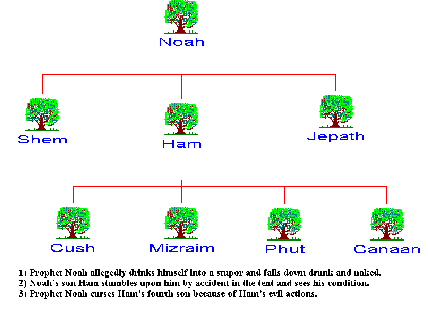
directly? Also, why curse only one of the four sons
of Ham and not all of them (see Fig. 2)? "And the sons of Ham; Cush, and
Mizraim, and Phut, and Canaan."
Genesis 10:6 Further, Ham did not uncover his father. He
only happened upon his father by chance. He could not have known that he
would find his father naked in the tent. His brothers Shem and Japheth
were told by Ham of their father's condition. So they knew without
having to actually see. If their roles were reversed, and Shem or
Japheth were to have been in Ham's shoes, what would they have done
differently? Is this justice? If I burn my own house down, and you call
the fire department, shall I then randomly select one of your sons and
curse him? Why? What could possibly justify such an action?
Fig.
2 The cursing of Canaan One thing that people in Western countries
today find hard to comprehend is that in the past, and even today in
many Eastern countries, tribalism was a very strong force. A scandal in
one tribe or an indiscretion of their ancestors would be powerful
ammunition in the hands of their rivals. To have such scandals stated
publicly by God himself would only strengthen the validity of that claim
(please read section 2.3). If I were a Jewish descendant of Shem or
Japhath and my neighbor were a son of Canaan, then I could beat him over
the head day and night with the fact that he was a servant of my
servants. God Himself said so. "Verily, those who purchase a small
gain at the cost of Allah's covenant and their oaths, they shall have no
portion in the Hereafter. Neither will Allah speak to them, nor (will
He) look upon them on the Day of Resurrection, nor will He purify them,
and they shall have a painful torment." The noble Qur'an, A'al-Umran(3):77 For a Muslim, many of the claims to be
found in the Bible with regard to the prophets of God, and even God
himself, are monstrous and preposterous. One is hard pressed to find a
single prophet or messenger who was not a drunkard, an idolater, an
adulterer, guilty of incest, a liar, and so forth. The Bible practically
overflows with such stories from almost every Tom, Dick, and Harry. The
messengers of God are even made to be guilty of multiple cases of
adultery and worse. Abraham (pbuh) is alleged to be a liar and worse
(Genesis 12:13). Noah (pbuh) a drunkard (Genesis 9:21). Lot (pbuh) a
drunkard and guilty of incest (Genesis 19:30-38). Solomon (pbuh) a
worshipper of idols in his old age (1 Kings 4-9), King David (pbuh)
commits adultery with Uriah's wife and then murdered her husband (2
Samuel 11:3-4,15-18), David's son Ammon is guilty of incest and the rape
of his half sister (2 Samuel 13:14). Aaron (pbuh) fashions an idol (the
golden calf) for the Jews to worship (Exodus 32:1-4), to name but a very
few of the many allegations to be found in the current Bible. We have
already seen in section 2.3 how such fabrications found their way into
the book of God (also see section 6.8) so we will not get into it here. Muslims believe that God protects his
messengers from erring in matters of faith. They can only err in matters
of livelihood. For instance, a prophet can make a mistake in selecting
which season to plant crops but he can not make a mistake in doctrine
and worship. Why? Let us take the example of the most benign of these
allegations, that of lying. When a prophet is sent by God to a group of
people, he can expect the deck to be stacked severely against him. They
will justly assume him to be a liar until proven, beyond a shadow of a
doubt, to be otherwise. They will call him a liar even if they have no
proof. A prophet's message rests solely on his truthfulness. If he were
ever to lie, even to save his life, then this would prove that he is
capable of lying and that he has established for himself guidelines
under which it is permissible to lie. This would undermine his whole
message as no one could then be sure he had not convinced himself that
the end justifies the means, and that in order to get them to become
decent people he might be willing to fabricate lies against God himself. How much worse to drink oneself into a
stupor. Alcohol is the door to all evils. Once a person loses control of
his faculties he will be capable of anything. Just look at the
allegations presented against Lot* (pbuh). He who is willing
to drink in such a fashion must realize that he will be accountable for
his subsequent actions. It is not an acceptable excuse to say "I
was drunk, I didn't know what I was doing." If your neighbor drinks
himself into a stupor and then runs down your mother with his car, will
you say "It's not your fault. You were drunk"? Think about the
other allegations for a while and you will understand what we mean.
Muslims believe that the prophets of God are above such actions. A Muslim believes that when God selects a
messenger, He chooses the best of the best. He chooses men who will be
an inspiration and a good example for their followers. Why the
insistence in the Bible that God has such poor judgment? If my prophets,
which God sent to guide and teach me, are sinful people, can I not say
"What is good enough for my prophet is good enough for me"? The claim that God wanted to prove the
fallibility of humans is quite flimsy. When we elect a congressman, do
we look for a man of weak character who we know will use his position to
steal and then say: "we did this to prove that thieves are people
too," or do we look for the man with the most impeccable character?
If this man then steals, do we say "he is only human, don't worry,
we might have done the same," or do we say "Kick the son of a
gun out of office and throw him in jail!"? When a government sends
an ambassador to another country to represent them, do they select a man
who they know will bring their country disgrace and dishonor? Since God
knows what is in our hearts (Deuteronomy 8:2), does this not make him
the supreme judge of character? God's prophets are human, and thus,
imperfect. However, they are not this low. Even in this age of indulgence, we can find
individuals of sterling character who rise above allowing themselves to
become falling-down drunk. There are monks who spend their whole life
without a mate much less committing adultery. Incest is such a filthy
word that even the most brazen criminal would be disgusted at such a
thought. Are our highest examples of humankind less than these men? Let us now look at another allegation
against Jesus (pbuh). In John 2:1-10 we read about Jesus' (pbuh) alleged
treatment of his mother. In these verses, Jesus (pbuh) is alleged to
have said to his mother John 2:4 "Jesus saith unto her, Woman, what
have I to do with thee? mine hour is not yet come." "Woman, what have I to do with
thee?" Is this how a good Christian talks to his mother? The same
mother who carried him in her womb for nine months and endured the pains
of labor and birth for him. The same mother who endured the lies,
accusations, and injuries of many with regard to her chastity because of
him? The same mother who suckled him and raised him? Is this how the
meek lamb of God is alleged to have responded to his mother's question?
Can he find no better manner to address her than that which he used to
address the adulteress in John 8:10: ".....Woman, where are
those thine accusers?"? In the Qur'an we read the story of the
miraculous birth of Jesus (pbuh) wherein we find a defense of Jesus (pbuh)
against such claims: "Then she (Mary pbuh) brought him
(Jesus pbuh) to her own folk carrying him. They said: 'O Mary, you have
truly come with a most wicked innovation. O sister of Aaron, your father
was not a wicked man nor was your mother a harlot'. Then she pointed to
him. They said: 'How can we speak to one who is in the cradle, a young
child?'. He spoke: 'Lo! I am the servant of God, He has given me the
Scripture and appointed me a prophet. And has made me blessed
wheresoever I may be, and has enjoined upon me prayer and charity so
long as I live. And (has made me) dutiful toward my mother and not
overbearing or miserable. So peace upon me the day I was born, and the
day I die, and the day I shall be raised alive(the hereafter)"
The noble
Qur'an, Maryam(19):27-33. For the Islamic perspective on the
prophets, read the following: Jesus: Maryam(19). Moses: Al-Aaraf(7):103-171, Yunus(10:75-93,
Al-Bakarah(2):47-101, Al-Nisa (4):162, Al-Maidah(5):20-26. Noah: Aal-Umran(3):33, Nooh(71):1-28,
Al-Qamar(59):9-16, Yunus(10):71-75, Hood(11):36-49 Solomon: Al-Anbia(21):80-82,
Al-Namil(27):15-44, Sad(38):30-40 Abraham: Al-Anaam(6):83-90,
Al-Bakarah(2):124, Al-Bakarah(2):130-132, Al-Bakarah(2):135,
Al-Bakarah(2):140, Al-Bakarah(2):258, Al-Bakarah(2):260,
Aal-Umran(3):33, , Aal-Umran(3):67, Hood(11):75 David: Al-Anbia(21):79-80,
Al-Namil(27):15-16, Al-Bakarah(2):251, Saba(34):10-11, Saad(38):17-26,
Hood(11):69-76 Lot: Al-Aaaraf(7):80-84, Hood(11):77-83,
Al-Hijir(15):59-75, Al-Sharaa(26):160-175, Al-Namil(27):54-58,
Al-Ankaboot(29):28-30 Aaron: Al-Aaraf(7):150, Al-Kassas(28):34,
Al-Anbia(21):48, Taha(20):80-101, Maryam(19):53, Al-Aaraf(7):142-154 For the Islamic viewpoint on God's elect in
the face of adversity read the chapter of Yusuf(12) where we find the
story of Joseph and of his chastity and fear of God. Also, see
Al-Anaam(6):84-90. 5.6
Like Jesus prayed When a Muslim prays or thanks God he does
so in the same fashion that was taught to Abraham, Moses, Jesus, and all
of the previous prophets of Allah. You will find that when a Muslim
prays he places his forehead on the ground in total submission to God
Almighty. Let us see how the prophets (including Jesus, pbuh) prayed: Genesis 17:3 "And Abram fell on his
face: and God talked with him, saying," Genesis 17:17 "Then Abraham fell
upon his face, and laughed, and said in his heart, Shall a child be born
unto him that is an hundred years old? and shall Sarah, that is ninety
years old, bear?" Exodus 34:8 "And Moses made haste,
and bowed his head toward the earth, and worshipped." Numbers 16:20-22 "And the LORD
spake unto Moses and unto Aaron, saying, Separate yourselves from among
this congregation, that I may consume them in a moment. And they fell
upon their faces, and said, O God, the God of the spirits of all flesh,
shall one man sin, and wilt thou be wroth with all the
congregation?" Joshua 5:14 "And he said, Nay; but
as captain of the host of the LORD am I now come. And Joshua fell on his
face to the earth, and did worship, and said unto him, What saith my
Lord unto his servant?" Ezekiel 9:8 "And it came to pass,
while they were slaying them, and I was left, that I fell upon my face,
and cried, and said, Ah Lord GOD! wilt thou destroy all the residue of
Israel in thy pouring out of thy fury upon Jerusalem?" 2 Chronicles 20:18 "And Jehoshaphat
bowed his head with his face to the ground: and all Judah and the
inhabitants of Jerusalem fell before the LORD, worshipping the
LORD." Ezekiel 11:13 "And it came to pass,
when I prophesied, that Pelatiah the son of Benaiah died. Then fell I
down upon my face, and cried with a loud voice, and said, Ah Lord GOD!
wilt thou make a full end of the remnant of Israel?" Matthew 17:6 "And when the
disciples heard it, they fell on their face, and were sore afraid."
Matthew 26:39 "And he (Jesus) went
a little farther, and fell on his face, and prayed, saying, O my Father,
if it be possible, let this cup pass from me: nevertheless not as I
will, but as thou wilt." 5.7
Like Jesus' greeting From ancient times, the prophets of God
including Moses, Joseph, David, Jesus, the angles of God and many others
have made it their custom to greet the believers with the words
"Peace be with you." This can be seen in such verses as: Genesis 43:23 "And he said, Peace
be to you, fear not: your God, and the God of your father, hath given
you treasure in your sacks: I had your money. And he brought Simeon out
unto them." Judges 6:23 "And the LORD said unto
him, Peace be unto thee; fear not: thou shalt not die." 1 Samuel 25:6 "And thus shall ye
say to him that liveth in prosperity, Peace be both to thee, and peace
be to thine house, and peace be unto all that thou hast." Numbers 6:26 "The LORD lift up his
countenance upon thee, and give thee peace." 1 Samuel 1:17 "Then Eli answered
and said, Go in peace" Luke 24:36 "And as they thus spake,
Jesus himself stood in the midst of them, and saith unto them, Peace be
unto you." John 20:19 ".....came Jesus and
stood in the midst, and saith unto them, Peace be unto you." John 20:26 "........then came
Jesus, the doors being shut, and stood in the midst, and said, Peace be
unto you." And especially: Luke 10:5 "And into whatsoever
house ye enter, first say, Peace be to this house." Can
anyone guess what Muhammad (pbuh) taught his followers to say when
greeting each other or departing from each other? You guessed it! "Assalam
alaikum" or "Peace be unto you." Have you ever met a
Christian who greets others with the words of Jesus (pbuh): "Peace
be unto you" or departs with those words? 5.8
Thirty seven verses word for word?
5.9
Melchizedek, A god greater than Jesus? In the Bible we can read about another god.
His name is Melchizedek (or Melchisedec). He is first mentioned in
Genesis "And Melchizedek king of Salem
brought forth bread and wine: and he was the priest of the most high
God. And he blessed him, and said, Blessed be Abram of the most high
God, possessor of heaven and earth: And blessed be the most high God,
which hath delivered thine enemies into thy hand. And he gave him tithes
of all." Genesis 14:18-20 This in itself may not be all that
significant until we read Hebrews "For this Melchisedec, king of
Salem, priest of the most high God, who met Abraham returning from the
slaughter of the kings, and blessed him; To whom also Abraham gave a
tenth part of all; first being by interpretation King of righteousness,
and after that also King of Salem, which is, King of peace; Without
father, without mother, without descent, having neither beginning of
days, nor end of life; but made like unto the Son of God; abideth
a priest continually. Now consider how great this man was, unto whom
even the patriarch Abraham gave the tenth of the spoils."
Hebrews 7:1-4 Is this God's brother? Is this God's
cousin? Is this a completely different God? For these are certainly
divine attributes. According to the Bible in our hands today, Jesus (pbuh)
had a beginning (he was "begotten"), and an end "he
gave up the ghost" (Luke 23:46). This mighty being, however, is
alleged to have had neither. It is stated plainly here in the Bible,
that he was "made like unto the son of God." Why do they
not worship him then? The church now will allege that Jesus peace be
upon him was "begotten" by God. Tell us what you mean when you
say "begotten." What did God Almighty do to "beget"
Jesus (pbuh)? Further, if Jesus (pbuh) was "begotten," but
Melchisedec who was "made like unto the Son of God,"
was not, then does this not make Jesus (pbuh) a "son of God"
but Melchisedec an independent god with neither offspring nor parents?
Is a god with no parents not greater than one who needs parents? Where
is Melchisedec now? From these verses we get the following
picture:
Does this not sound preposterous? Notice
how when Jesus (pbuh), a man, is preached as being a god most people
have no trouble with that. They are willing to see proof of his godhead
even where it can not be found (see chapter one). This is because this
is a well established doctrine in Paul's church. However, when the same
Bible tells them in no uncertain terms that another man, Melchisedec, is
a god, then they are willing to "interpret" the verses fifty
different ways and attach to them all manner of abstract interpretations
to disprove this claim since Melchisedec "cannot possibly" be
a god. Why? Because the church has not told us to worship Melchizedec?.
If the Bible remains the word of God then why should we place the words
of men (the church) above the words of God? Some people will object that: "Melchizedec
was an imaginary character and not real." Once again, a valid
possibility, so let us study this claim. Let us go back and read the
above verses. Was prophet Abraham (pbuh) an imaginary character? Of
course not! Well then, did Abraham "meet" a figment of his
imagination upon returning from the "slaughter of the kings"?
Was Abraham blessed by a figment of his imagination? Did he give a tenth
of his spoils to a figment of his imagination? I have searched far and wide in my quest
for a logical answer to this dilemma. Many interpretations have been
presented, however, these interpretations always attempt to either
completely side-step the above issues, or when they do actually attempt
to deal directly with them they say "of course it can not possibly
be that the words are meant to be taken literally," with no valid
explanation whatsoever. It is simply left up to the reader to have
"faith" and only take the literal meanings of such words when
they are applied to Jesus (pbuh), but when they are applied to others
then they "can not possibly" be understood to be taken
literally. Why? It is easy to make excuses. It is much
harder to keep an open mind. Many people have a tendency to quote only
part of the command of the Bible. They read "Jesus said unto
him, Thou shalt love the Lord thy God with all thy heart, and with all
thy soul" and stop!. Well what about the rest of the verse?
What about "…and with all thy mind." I don't know
about you, but my salvation is too precious a commodity to allow someone
to dictate to me blind faith in doctrines they have inserted in the book
of God, resulting in countless discrepancies. A truly unchanged religion
of God must be able to convince me fifty ways from Sunday that it is
faultless and unchanged by the hands of men. It should not need it's
propagators, and "correctors" to demand blind faith and my
having to continually make excuses for it even though they themselves
bear witness to the continuous and unrelenting attempts of the church to
"correct" and "clarify" the Bible over so many
centuries. 5.10
The ultimate test of Jesus Many verses of the Bible make reference to
the "three day and three night" prophesy (Matthew
20:19...etc.). Christian scholars themselves make mention of several
cases throughout the Bible where people have put words in Jesus' mouth
(see chapter two). They also recognize many passages of the Bible as
being of a questionable nature. However, let us simplify this matter a
little in order to make it easier to recognize the tampering
fingerprints of the unscrupulous. Let us start with the assumption that
no human being ever added or removed a single word from the Bible and
move on from there. Please try to stay with me on this and you will see
how only a very small amount of logic will prove that Jesus (pbuh) never
said these words: You would be hard pressed to find a single
Christian today who has not heard of the "three days and three
nights" prophesy. Where do they get it from? They get it from
"the Gospel of Matthew." What does it say? If we read Matthew
12 we will see how the Jews were giving Jesus (pbuh) no end of trouble.
They were constantly doubting him and refusing to accept him. They had
seen countless signs of his prophethood but insisted on disbelieving.
Finally they ask him for a sign of his prophethood. How does Jesus (pbuh)
allegedly respond to this request? Does he draw their attention to his
healing of the lepers and the blind? No. Does he draw their attention to
his casting out of devils? No. Does he point out his raising of the
dead? No. Does he mention any of his other countless miracles? No. Well,
what does he say? He says: "But he answered and said unto
them, An evil and adulterous generation seeketh after a sign; and there
shall no sign be given to it, but the sign of the prophet Jonas: For as
Jonas was three days and three nights in the whale's belly; so shall the
Son of man be three days and three nights in the heart of the
earth" Matthew 12:39-40 In effect, Jesus (pbuh) was claimed to have
put all of his eggs in one basket. He was telling them that "NO"
sign shall be given to them "BUT" the sign of
Jonas. This ONE sign shall ALONE decide who is truthful,
him or those who doubted him. This shall be the "be all end
all" acid test of his truthfulness. Now, what is "Good Friday"?
"Good Friday" is the day Christians tell us Jesus (pbuh) was
crucified. In Merriam Webster's Collegiate Dictionary (tenth edition),
it is defined as "the Friday before Easter observed in churches
as the anniversary of the crucifixion of Christ." This is also
confirmed by the Bible: "And now when the even was come,
because it was the preparation, that is, the day before the
Sabbath" Mark 15:42 So the Bible tells us that Jesus (pbuh)
died on Friday, just before nightfall. According to the Bible, the Jews had been
carting Jesus (pbuh) back and forth on "Good Friday" between
Pontius Pilate and Harod trying to get a conviction and official
sanction to crucify him. After all of this carting back and forth, they
finally get him to the cross and hang him up on it. However, no sooner
have they gotten him up on the cross than they are in a hurry to get him
back down again. Why is that? It is because they believed that if he
remained on the cross all night then he would defile their land. "And if a man have committed a sin
worthy of death, and he be to be put to death, and thou hang him on a
tree: His body shall not remain all night upon the tree, but thou shalt
in any wise bury him that day; (for he that is hanged is accursed of
God;) that thy land be not defiled, which the LORD thy God giveth thee
for an inheritance." Deuteronomy 21:22-23 So the Jews begged Pilate to break Jesus'
legs so that he would die quickly from suffocation: "The Jews therefore, because it was
the preparation, that the bodies should not remain upon the cross on the
Sabbath day, (for that Sabbath day was an high day,) besought Pilate
that their legs might be broken, and that they might be taken
away.." John 19:31 About the
sixth hour (twelve noon), Jesus is claimed to be in front of Pilate
(John 19:14). According to the Bible (e.g. John 19:30), Jesus died
around the ninth hour (three PM). During these three hours Jesus was
dressed in purple with a crown of thorns and made fun of, spat on,
abused and beaten, and then made to carry the cross to the location of
his execution (John 19:17), the cross was planted in the ground, he was
hung up on it, his title was written in Hebrew, Greek and Latin on the
cross, lots were cast and his clothes distributed, he spoke to one of
the two thieves and to an apostle, many people passed before him and
rebuked him, he was given something to drink, and he died, all of which
took place in these three hours, and his legs were never broken.
After that there was thunder, an eclipse, and an earthquake, the veil of
the temple was rent in twain, and the dead came out of their graves.
Jesus (pbuh) was then let down and placed in the shroud and the tomb.
Early Sunday morning (the first day of the week according to the Jews),
while it was still dark, Mary Magdalene visits the tomb alone (Mark
16:9, John 20:1) and finds the stone moved and Jesus (pbuh) missing. Let
us count:
As you can see, it is impossible to add up
the days and nights so that they equal "three days and three
nights." Assuming that Jesus (pbuh) waited until just before the
arrival of Mary to leave the tomb, the Bible tells us that Jesus (pbuh)
was in the ground for ONE day and TWO nights. Has the prophesy been
fulfilled? Has the ONE "be all end all" sign to the Jews been
established? Further, it is important to remember that
Jonah was swallowed alive by a whale and remained in its
belly alive for three days. His miracle was not that the
whale swallowed him, nor that it swallowed him whole, nor yet that he
remained in it's belly for three days (If I eat a piece of food and it
remains in my stomach for three days, is this a "miracle"?).
The miracle of Jonah was that HE DID NOT DIE. For Jesus to
have properly fulfilled the prophecy, he would need to enter the tomb
alive and come out alive just as Jonah entered the whale's belly ALIVE
and came out of it's belly ALIVE. Why should Jesus give this of all
signs if he was to die and be resurrected? Where is the
"miraculous" similarity with the miracle of Jonah? A Christian gentleman from Canada once
asked us: "Why do Muslims doubt that the scriptures always
taught the death and resurrection of Jesus." Can we now see why
Muslims recognize such claims to be later insertions and not the words
of Allah's elect messenger Jesus (pbuh) nor his most honorable apostles?
Have we made anything up? Have we not been quoting directly from the
same Bible every Christian has at home? For more, please read Mr. Ahmed
Deedat's book "Crucifixion or Cruci-fiction." Indeed, Christian scholars are beginning to
recognize that the text of Matthew 12:38-40 was in fact embroidered by
the church in order to be able to claim that Jesus (pbuh) himself had
prophesied the crucifixion. The original form of this verse can be seen
in Mark 8:11-12, where we read: "And the Pharisees came forth, and
began to question with him, seeking of him a sign from heaven, tempting
him. And he sighed deeply in his spirit, and saith, Why doth this
generation seek after a sign? verily I say unto you, There shall no sign
be given unto this generation." ... and that is all. There is
no mention of "three days and three nights" nor "the sign
of Jonah" nor anything else. These were all added on later (please
read section 2.1 for more on this topic). As a side note regarding the renting of the
veil of the temple and resurrection of the dead, Mr. Tom Harpur says "The story of the saints' being
resurrected from the tombs to the east of the city, just below the Mount
of Olives, and going into Jerusalem is also the result of an attempt to
give mythical form to the belief that Jesus was the "first fruits
of them that slept," Surely an event of such stupendous dimensions,
had it actually occurred, would have not only found its way into other
Gospels (than Matthew) and letters in the New Testament, but would also
have been recorded in some other Jewish or Roman historical source. Yet
the record is silent." For Christ's Sake, Tom Harpur, p. 102 It is also interesting to note that while
those who were not apostles (such as Luke) give detailed descriptions of
all of these most stupendous and earth-shaking events, in spite of that,
the "Gospel of John," which was supposedly written by the
apostle John the son of Zebedee, found it completely unnecessary to
mention any "renting of the veil of the temple", or any
"rising of the dead", or any earthquakes, or any eclipses of
the sun, or any of these other most stupendous events. Did the apostle
John feel all of these events to be inconsequential and undeserving of
mention, or has the church been "embroidering" the events of
the crucifixion? Did the apostle John "not notice" the earth
shaking beneath his feet, or the sun being blotted out above his head?
Did he "not notice" the dead coming out of their graves? It is
interesting to further note that such "mourning of all of
creation" for the death of an important figure was not restricted
to Jesus (pbuh). Only seventy years earlier, Julius Caesar's death was
documented to have been accompanied by similar stupendous acts of
nature, as well as many members of the clergy after that. (Go back and
read chapter three for more on this topic). When prophet Muhammad's infant son Ibraheem
died, his death happened to coincide with an eclipse of the sun. All of
the Muslims came running to him exclaiming "It is a miracle, the
sun itself is mourning the death of your only son." Upon hearing
this, prophet Muhammad became very angry with them and said 'The sun and the moon do not eclipse
because of the death of any among mankind. They are but two signs among
the signs of Allah. When you see them stand up and pray.'
Narrated by AbuMas'ud in Sahih Al-Bukhari The priest and scholar Anselm Turmeda*,
who later became a Muslim says: "This description of the tragedy
you have already read has been completely derived from an old book. This
record was written by a Jewish historian when Titus conquered and
destroyed Jerusalem. Now we see the same phrases in the book of Matthew.
In other words, somebody has inserted these words into the Book of
Matthew." (for more on Anselm, please read section
6.3 of this book) 5.11
Who was "Immanuel"? "Therefore the Lord himself shall
give you a sign; Behold, a virgin shall conceive, and bear a son, and
shall call his name Immanuel (God is with us)."
Isaiah 7:14 Muslims are commanded in the Qur'an to
believe in Jesus (pbuh) as a true and faithful prophet of God. For this
reason, Muslims have no trouble believing that prophets of the Old
Testament prophesied the coming of Jesus (pbuh). However, as we have
already seen in chapter two, over the ages mankind continued to feel the
need to embroider and improve upon the word of God. This was not
restricted to merely inserting, deleting, or changing words as seen in
previous chapters, rather, they even went so far as to try to
"prove" their innovations through the citation of other
ancient passages. There are many examples of this. One such example
shall be studied here. When members of the clergy read to their
flock the verse of Isaiah 7:14, they then go on to explain to them: "Do
you see? Prophet Isaiah prophesied the coming of the God Himself.
Immanuel means 'God is with us,' so this is not only a prophesy of the
coming of God but also a prophesy of the 'incarnation' of God Almighty
in the form of Jesus". It is true, Immanuel does mean "God is
with us." However, this is a prime example of how the evangelists
manage to constantly base their arguments on catch words or phrases and
then quickly gloss over the details. The phrase "a virgin"
which we find in our English Bibles does not appear in the original
Hebrew text. The word used is 'almah {al-maw'} meaning "a young
woman of marriageable age". The Hebrew word for "virgin"
is bthuwlah {beth-oo-law'}. When the Hebrew text is translated into
Greek in the NT, it uses the word parthenos {per-then'-os}, which has a
dual meaning; a young girl or a virgin. The translators have mistakenly
chosen the latter. More recent and accurate versions of the Bible such
as the Revised Standard Version present this verse as follows: "Therefore, the Lord Himself will
give you a sign. Look, the young woman is with child and shall bear a
son, and shall name him Immanuel"
Isaiah 7:14 (RSV) Biblical scholars have suggested that this
prophesy was concerning the second son or possibly the third son of
Isaiah by a Jewish maiden. It does not relate to Jesus or his virgin
birth. If Jesus (pbuh) was indeed intended by this
prophesy, then why was he named "Jesus" and not
"Immanuel" as the prophesy requires? Notice that the prophesy
states that "his NAME shall be Immanuel." It
does not say that "HE shall be Immanuel." There
is a big difference between saying "His name shall be 'God is
with us'" and between saying "He shall be God with
us." "Immanuel" is not the only name
in the OT that contains the word "El" (God). There are
hundreds of Hebrew names that consist of "El" and another
noun. For example, "Ishmael" which means "God
hears." Did God's sense of hearing come down to earth and live
among us in the form of a man? Was God's sense of hearing
"incarnated" in the form of a man?. There is also
"Israel" (prince of God), and "Elijah" (my God is
Jehovah), and so forth. As we can see, it was a very common occurrence
for Israelites to have such names. Neither prophet Isaiah, nor King Ahaz,
nor any Jew ever thought that the prophesy was for God himself to come
down and live among them. In Genesis 28:19 we read "And he
called the name of that place Bethel (house of God)". Since the
place was named "house of God," does this mean that God lived
inside this house? In Genesis 32:30, we are told that Jacob (pbuh)
called a piece of land "Peni-el" (Face of God). The
actual text states: "And Jacob called the name of the
place Peniel," is this the same as saying: "And Jacob
said this place is Peniel"? Was the patch of land the actual
face of God? Was the face of God "incarnated" in this piece of
land? Gabriel, the name of the angle of God, has
been interpreted in Biblical references as having the general meaning of
"Strength of God." So, does this mean that the angle Gabriel
is the "incarnation" of the "strength of God"? "The name Immanuel could mean 'God
be with us' in the sense 'God help us!'" Interpreter's dictionary of the Bible, V2,
p. 686. Jesus
(pbuh) was given his name by the angel Gabriel even before his birth
(Matthew 1:21). Never was he named "Immanuel." King Ahaz was
in danger. His enemies were closing in. This is when a promise was made
to show him a sign, a pregnant woman, not a virgin Mary (pbuh)
who would not show up until many centuries after he had turned to dust.
Can we see how the Trinitarian doctrine of incarnation was forced upon
the message of Jesus (pbuh) through "bending" of the
prophesies and general glossing over of the "trivial details"?
For more on how the "incarnation" was forced upon the message
of Jesus centuries after his departure, please read section 1.2.5. 5.12
Eli, Eli Lama Sabachthani Both Muslims as well as Christians affirm
that God Almighty is a just and merciful God. Muslims believe that the
sign of God's mercy is that He multiplies the good deeds of mankind from
ten to seven hundred times, or even more. He also counts an evil deed as
a single evil deed or forgives it. The Church, on the other hand, claims
that the sign of God's mercy is that He sacrificed His only begotten son
to save mankind. Let us study this claim: If God Almighty decided to sacrifice His
only son for the redemption of mankind, then we have one of two cases: 1) Jesus (pbuh) did not know of this plan
and the fate God had decreed for him. 2) Jesus (pbuh) knew of this plan and the
fate God had decreed for him. In the first case, if Jesus (pbuh) did not
know of God's plan, then this insinuates that God either tricked Jesus (pbuh)
into this fate, or God forced Jesus (pbuh) into this fate. In other
words, Jesus' mercy and sacrifice require God Himself to be savage,
blood-thirsty, and ruthless. This, of course, is preposterous. In the second case, if Jesus (pbuh) did
know of this plan, then we are faced with three problems: a) If Jesus' (pbuh) sole mission to mankind
was to die on the cross, free them from the original sin, free them from
the law of Moses (pbuh), and provide salvation for them, then why did he
never in his lifetime mention it to his followers? Why did he not spend
night and day drumming these new concepts into their minds? Why did he
himself observe the commandments of Moses (pbuh) so completely and so
faithfully even up till his alleged death? In Matthew 19:16-21 when
Jesus (pbuh) was asked for the path to heaven, why did he emphasize the
keeping of the commandments of Moses but never mention the crucifixion
nor the redemption or having "faith" in them? Why, when he was
pressed for more, did he still not mention either a crucifixion
nor a redemption but only claim that anyone who kept the commandments of
Moses (pbuh) and sold his belongings would be "perfect"? Why
did he not say "have faith in my crucifixion and forsake the
commandments and you shall be 'perfect'"? b) If Jesus' (pbuh) sole mission to mankind
was to die on the cross, free them from the original sin, free them from
the law of Moses (pbuh), and provide salvation for them, then why, when
he was in the garden of Gethsemane did he plead with God Almighty and
implore Him "Eli, Eli Lama sabachthani", meaning
"my God, my God, why have you forsaken me?" (Matthew 27:46)?
Why are the words of Matthew 27:46 the only words of all
of the New Testament reported in their original Aramaic form? Could it
be that Jesus' alleged helpless cry left such a vivid impression of a
man seemingly bereft of hope that anyone who heard them would remember
the exact words? Why did he allegedly beseech God to "let this cup
pass" (Matthew 26:39, Mark 14:36, Luke 22:42)? Did he get cold
feet? Was he trying to back out of a fate he had previously accepted?
Was the redemption of mankind not so important any more? c) If Jesus' (pbuh) sole mission to mankind
was to die on the cross, free all of Mankind from the original sin, free
them from the law of Moses (pbuh), and provide salvation for them, then
why when he spoke to the Canaanite woman in Matthew 15:22-8 did he
refuse to heal her daughter on the grounds that he was sent to the Jews
alone "I am not sent but unto the lost sheep of the house of
Israel,"? According to Jesus' words in these verses, his
mission was for the Jews alone, therefore it was not fitting for him to
even heal a non-Jewess woman since in his own words "It
is not meet to take the children's bread and to cast it to dogs."
Was Jesus to die on the cross for the Jews alone? If Jesus
(pbuh) did not see fit to even heal non-Jews then how could we
claim that he knew and accepted from the beginning of time that he was
going to endure torture, humiliation, and finally a very gruesome death
in order to provide eternal salvation for all of mankind?
Did God and Jesus (pbuh) not know when he was first sent what his
ultimate mission would be? Did his mission change later on? Did they not
decide that it was necessary for Jesus (pbuh) to die for the
"original sin" until the end of Jesus' mission? Once again, we find both alternatives
preposterous. As has been previously proven in chapter one from both the
Old Testament as well as the Qur'an, mankind does not inherit sin, nor
does God hold them responsible for the same. God only judges mankind
according to their own individual actions and forgives much of their
transgressions. Jesus (pbuh) was human messenger of God sent to the Jews
alone in order to return them to the message of Moses and discard
the innovations that had crept into their book over the ages. The
"universal messenger" (Muhammad, pbuh) would not come until
six hundred years later. He would teach mankind that God Almighty was
capable of all things and that mankind's salvation lies within their own
hands if they worship Him as He commanded and seek His boundless mercy. 5.13
Hiding the miracles When Mary Magdalene and Mary the Mother of
Jesus saw Jesus (pbut) after the alleged crucifixion and resurrection,
he was wearing gardener's clothing (John 20:15). What was the
significance of Jesus wearing gardener's clothing (as opposed to normal
clothing)? Was it meant to be a disguise? If so, for what purpose? Why were the women who visited the tomb
terrified (Mark 16:8)? If Jesus (pbuh) had indeed foretold of his death
and resurrection then should they not be overjoyed to see the alleged
confirmation of this prophesy? What did they have to be terrified of if
Jesus' prophesy to them was being fulfilled before their very eyes?
Should they not be ecstatic? Should they not be overjoyed? Did Jesus not
publicly challenge the Jews that he would die and be resurrected after
three days? (section 5.10 of this book). Should the two women not have
been expecting his resurrection? Should they not have been awaiting it
with the utmost anticipation? If Jesus could conquer death and rise from
the dead, why did he fear seeing the Jews after the crucifixion?
Particularly as death had no more power over him? "Knowing that Christ being raised
from the dead dieth no more; death hath no more dominion over him."
Romans 6:9 Why disguise himself, hide from the Jews
and Romans, and appear only to the disciples? Surely, this was the great
manifestation of his power and the fulfillment of the purpose of his
creation according to the Church. What was the purpose in keeping it all
a secret now? Are we not told in the Bible that Jesus (pbuh) told the
Jews that they shall receive no sign except the "three days and
three nights" sign? (Matthew 12:38-40) Are we not told that this
would be his greatest sign to them? If all of this was true, and he had
overcome death, and the Jews could no longer kill him, why did he not go
marching with all of the disciples into the middle of town and shout at
the top of his lungs to the Jews: "Here is the verification of my
greatest challenge to you, come and see for yourselves"? Why issue
the challenge if he is not willing to show up and prove his truthfulness
to those he has challenged? Why show himself only to those who didn't
need to be convinced? Why not show himself to those who disbelieved so
that they might recognize their error and be saved eternally? The Church fathers have struggled with this
conundrum for centuries in an effort to make sense of it. Their
explanations however have all been based on mere conjecture or strange
and illogical interpretations. For example, the third century Church
father Origen (185-254AD) comments "Christ avoided the judge who
condemned him, and his enemies, that they might not be smitten with
blindness." Life of Jesus, David Strauss, p. 738 Others have suggested that Jesus did not
show himself to those he had challenged because that would have
compelled them to believe!? or because they would not have believed even
had they seen him so there was no use trying? (i.e. What about all of
the "neutral" onlookers who would have believed had he
publicly shown himself to the Jews as he had promised?). All of these
attempts have been doomed to failure since they have all avoided
addressing the actual cause of this problem. Specifically, that
someone's fingers have been tampering with the text. ...Something to
think about. On the other hand if, Jesus (pbuh) was a
human being who was not crucified but had been protected by God from the
hands of the Jews, and if his ministry were about to come to an end, and
if he needed to see his disciples one last time and deliver one last
parting sermon to them, and the Jews were eager to kill him at the first
sign of his presence, then it would be completely logical for him to
disguise himself and stay out of the public eye. What reason can there
be for him to so severely stifle and hide his greatest miracle and
challenge to the Jews and the most powerful confirmation of his mission
and his prophesies if he had truly said these things and they were not
later additions of unscrupulous tampering fingers? 5.14
Was "Christ" a "Christian"? If we were to ask a random Christian off
the street: "What was the religion of Jesus?" They would
unhesitantly respond: "Christianity." If we were then to ask:
"Did Jesus himself ever use this word? Did he ever call his
religion 'Christianity' or call his followers 'Christians'?" If
this Christian knows his Bible, he will say, "No." "So," we would continue,
"once again, what was his religion?" If this Christian knows
his Bible he will now respond "Judaism." "That's
right!," we would affirm, "Jesus was a Jew! He followed
the religion of Moses!" (read chapter one). "According
to the Bible, Jesus lived and died never having violated a single aspect
of the true Mosaic religion. He fasted when they fasted. He prayed as
they prayed. He observed the Sabbath as the Jews did. He never in his
life tasted pork. He was circumcised like all faithful Jews, and he
ordered his followers to keep the commandments of the God 'till heaven
and earth pass' (Matthew 5:17-18)." So Jesus (pbuh) was a Jew! He
followed the religion of Moses (pbuh). The word "Christianity"
was not invented till long after the departure of Jesus (pbuh). We have
already demonstrated in chapter one how everything from the Catholic
Encyclopedia, to countless Christian scholars, to Western encyclopedias,
in addition to many other Christian sources all confirm that the true
founder of "Christianity" was the Jew named "Saul of
Tarsus." More popularly known as "Saint Paul." According
to the Bible, it was only after Jesus' (pbuh) death that the religion he
observed so faithfully was nullified. This was done upon the authority
of "Saint Paul" who had never met him in the flesh, and who
claimed that he was receiving divine "visions" from Jesus'
ghost ordering him to nullify that which Jesus (pbuh) observed
throughout his life and commanded his followers to observe "till
heaven and earth pass." Now, we will ask: "If Jesus was a Jew,
then where did 'Judaism' come from?" Once again, the respondent
will most likely jump up and say: "From Moses!" "So Moses
introduced Judaism?" we would ask. "Of course!" he would
reply. We would then ask: "Was prophet Abraham a Jew?" Again,
this man would more than likely respond "Of course!" We would
now ask "was prophet Adam, the first human, a 'Jew'? "Were all
of the prophets of God Jews?" He would not be sure. We would respond: "Well then, did
Moses ever call his religion 'Judaism'?" Once again, if this person
knows their Bible then they will respond: "No." So, we would
continue: "Where does the word 'Jew' come from then?" If he
does not know, then we would explain that it comes from
"Judah." Judah was the son of Jacob (Israel), who was the son
of Isaac, who was the son of Abraham (pbuh). So, if neither Abraham nor Moses (pbut)
introduced "Judaism," and it was named after prophet Abraham's
(pbuh) great grandson, then it is only logical to ask: what was prophet
Abraham's religion? What was prophet Adam's religion? In general, what
was it that all of the prophets from Adam through Jesus (pbut) preached?
The Qur'an has the answer, but it needs a little explanation. Since we have now found the origins of
"Christianity" and "Judaism," it is only fair to do
the same with "Islam." "Islam" is an Arabic word
which means "Submission to the will of God(alone)." The word
"Muslim" is derived from this word. "Muslim" means
"one who has submitted to the will of God(alone)." "O People of the Scripture! Why do
you argue about Abraham, when the Torah and the Gospel were not revealed
till after him? Have you then no sense? Verily! you are those who argue
about that which you have some knowledge: Why then do you argue
concerning that which you have no knowledge? Allah knows and you know
not. Abraham was not a Jew, nor yet a Christian; but he was an upright
'Muslim' (he surrendered to Allah), and he did not worship other than
Allah. Verily! those of mankind who have the best claim to Abraham are
those who followed him, and this Prophet(Muhammad) and those who
believe; and Allah is the Ally of the believers"
The noble Qur'an, A'al-Umran(3):65-68. "Say: 'Truly, my Lord has guided me
to straight path, an upright enduring religion, the religion of Abraham,
the true belief (i.e. the True Islamic Monotheism-- to believe in One
God and to worship none but Allah, alone) and he was never amongst those
who worshipped others with Allah." The noble Qur'an, Al-Ana'am(6):161-163 "And strive hard in the cause of
Allah as you ought to strive. He has chosen you, and has not imposed
upon you in religion any hardship; the faith of your father Abraham [is
this]. It is he who has named you Muslims of old time, and in this (Qur'an),
that the messenger may be a witness over you, and that ye may be
witnesses over mankind. So perfect [your] prayer, pay the poor-due, and
cling fast to Allah. He is your Patron. What an Excellent Patron and
what an Excellent Supporter!" The noble Qur'an, Al-Hajj(22):78 "Say (O Muslims): We believe in
Allah and that which is revealed unto Us and that which was revealed
unto Abraham, and Ishmael, and Isaac, and Jacob and the sons of Jacob,
and that which Moses and Jesus received, and that which the Prophets
received from their Lord. We make no distinction between any of them,
and unto Him we have surrendered (literally: "we are
Muslims")." The noble Qur'an, al-Bakarah(2):136 5.15
Will Judas judge Israel? "When his disciples heard it, they
were exceedingly amazed, saying, Who then can be saved? But Jesus beheld
them, and said unto them, With men this is impossible; but with God all
things are possible. Then answered Peter and said unto him, Behold, we
have forsaken all, and followed thee; what shall we have therefore? And
Jesus said unto them, Verily I say unto you, That ye which have followed
me, in the regeneration when the Son of man shall sit in the throne of
his glory, ye also shall sit upon twelve thrones, judging
the twelve tribes of Israel. And every one that hath forsaken houses, or
brethren, or sisters, or father, or mother, or wife, or children, or
lands, for my name's sake, shall receive an hundredfold, and shall
inherit everlasting life. But many that are first shall be last; and the
last shall be first." Matthew 19:25-30 This one is very simple. Jesus (pbuh) is
alleged here to be speaking to all twelve of his apostles
and telling all twelve of them that they shall sit on twelve
thrones judging the tribes of Israel on the Day of Resurrection. So, the
logical question becomes: who are these twelve who he is addressing? Let
us ask the same "Gospel of Luke" and see what it says: "And when it was day, he called
unto him his disciples: and of them he chose twelve, whom also he named
apostles; Simon, (whom he also named Peter,) and Andrew his brother,
James and John, Philip and Bartholomew, Matthew and Thomas, James the
son of Alphaeus, and Simon called Zelotes, And Judas the brother of
James, and Judas Iscariot, which also was the traitor."
Luke 6:13-16 So, according to the gospel of Luke, Jesus
(pbuh) allegedly promised the traitor Judas that he has a throne
reserved for him in heaven. Not only that, but he shall sit on this
throne judging the twelve tribes of Israel on that day. It is obvious
that Judas is included because Jesus says "YOU shall
..." In other words he is addressing the twelve men who are standing
before him. He also explicitly mentions the word "twelve
thrones." The twelfth can not be "St. Paul", the
self-appointed replacement for Judas, since Jesus (pbuh) never met Paul.
So Paul was not present in this meeting where Jesus addressed all of his
apostles and told them that "THEY" shall judge Israel from
twelve thrones. Once
again, the tampering fingers have left their mark. 5.16
Does God need a "blood atonement"? "And again he entered into
Capernaum after some days; and it was noised that he was in the house.
And straightway many were gathered together, insomuch that there was no
room to receive them, no, not so much as about the door: and he preached
the word unto them. And they come unto him, bringing one sick of the
palsy, which was borne of four. And when they could not come nigh unto
him for the press, they uncovered the roof where he was: and when they
had broken it up, they let down the bed wherein the sick of the palsy
lay. When Jesus saw their faith, he said unto the sick of the palsy,
Son, thy sins be forgiven thee. But there was certain of the scribes
sitting there, and reasoning in their hearts, Why doth this man thus
speak blasphemies? who can forgive sins but God only? And immediately
when Jesus perceived in his spirit that they so reasoned within
themselves, he said unto them, Why reason ye these things in your
hearts? Which is easier, to say to the sick of the palsy, Thy sins be
forgiven thee; or to say, Arise, and take up thy bed, and walk? But
that ye may know that the Son of man hath power on earth to forgive
sins, (he saith to the sick of the palsy,) I say unto thee, Arise, and
take up thy bed, and go thy way into thine house. And immediately he
arose, took up the bed, and went forth before them all; insomuch that
they were all amazed, and glorified God, saying, We never saw it on this
fashion." Mark 2:1-12 As seen in chapter one, when Paul came with
his new and innovative ideas on how to improve upon the message of Jesus
(pbuh), he began by dropping specific commandments. This continued until
he decided that his alleged "visions" were sufficient
authority to completely discard all of the commandments which both
prophet Moses as well as prophet Jesus (pbut) both observed very
strictly throughout their lives. The fact that both of these prophets
are well known to have spent their lives commanding their followers to
uphold these laws and commandments is casually brushed aside by
"St. Paul." His "visions," we are told, are higher
in authority than the commands of Jesus (pbuh) during his lifetime. Once Paul was finished nullifying the law
of God through Moses and Jesus and simplifying the religion for them he
began to get many converts. This is because his
"Christianity" only required "faith" and no actual
work (Romans 3:28). But faith without work was too flimsy a concept to
build one's whole way of life around. Paul needed a stupendous and
monumental event to have faith IN order for his claims to
be accepted by anyone. Thus the original sin and the atonement were
born. Paul claimed that God Almighty had created
mankind inherently sinful and as inheritors of "the sin of
Adam." He claimed that this hereditary burden was so great that the
creator of all of the heavens and earth, and yes, the creator of the
concepts of sin and forgiveness themselves, could not forgive this sin.
This, in Paul's estimation, was beyond God's capabilities. Paul preached
that the only way the creator of the heavens and the earth and
everything in-between could forgive this sin was to have his sinless
"only begotten son" beaten, spat on, stripped, whipped, cut,
humiliated, and finally killed in the most gruesome and drawn-out way
known to man at the time; by hanging on the cross, and thus becoming a
curse upon mankind. "Christ hath redeemed us from the
curse of the law, being made a curse for us: for it is written, Cursed
[is] every one that hangeth on a tree"
Galatians 3:13: Only then would God be able to forgive this
sin. However, if we were to read the words of
Jesus (pbuh) in Mark 2:9 we would find that Jesus (pbuh) informs us that
for him to tell a man that his sins are forgiven is much easier than to
cure a paralytic and cause him to walk, and since Jesus (pbuh) had the
power to cure paralytics, therefore, he demonstrates to us that
forgiving sins is much easier for him. However, we already know that God Almighty
the "Father" of all believers "And call no [man] your father upon
the earth: for one is your Father, which is in heaven" Matthew 23:9 We further know that God Almighty is
greater in power than all humans, inluding Jesus: "..my Father is greater than
I", John 14:28 Finally, we know that Jesus (pbuh) gets his
power from God: "I can of mine own self do
nothing...," John 5:30 "Ye men of Israel, hear these
words; Jesus of Nazareth, a man approved of God among you by miracles
and wonders and signs, which God did by him in the midst of you, as ye
yourselves also know:" Acts 2:22 So it stands to reason that what is easy
for Jesus (pbuh) is trivial and inconsequential for God Almighty
Himself. Thus, if Jesus (pbuh) can forgive sins with the utmost ease
simply by uttering the words "your sins are forgiven you,"
then it is well within the ability of God Almighty Himself to do the
same simply by willing it, even without uttering a word. Indeed, we can
even read in the Bible: "Who [is] a God like unto thee,
that pardoneth iniquity, and passeth by the transgression of the remnant
of his heritage? he retaineth not his anger for ever, because he
delighteth [in] mercy." Micah 7:18 "Nevertheless, He (God), [being]
full of compassion, forgave [their] iniquity, and destroyed [them] not:
yea, many a time turned He His anger away, and did not stir up all his
wrath. For He remembered that they [were but] flesh; a wind that passeth
away, and cometh not again." Psalm 78:38-39 "I, [even] I, [am] he that blotteth
out thy transgressions for mine own sake, and will not remember thy
sins." Isaiah 43:25 Well, how then does God Almighty forgive
our sins? Is He able to simply say "you are forgiven" to those
who turn to Him in repentance or must He first sacrifice a sinless
individual before He can do this? To get the answer let us read the
Bible: "It may be that the house of Judah
will hear all the evil which I purpose to do unto them; that they may
return every man from his evil way; that I may forgive their iniquity
and their sin." Jeremiah 36:3 "Let the wicked forsake his way,
and the unrighteous man his thoughts: and let him return unto the LORD,
and he will have mercy upon him; and to our God, for he will abundantly
pardon." Isaiah 55:7 "I acknowledged my sin unto thee,
and mine iniquity have I not hid. I said, I will confess my
transgressions unto the LORD; and thou forgavest the iniquity of my sin.
Selah." Psalm 32:5 "By mercy and truth iniquity is
purged..." Proverbs 16:6 "If my people, which are called by
my name, shall humble themselves, and pray, and seek my face, and turn
from their wicked ways; then will I hear from heaven, and will forgive
their sin, and will heal their land." 2 Chronicles 7:14 "But if the wicked will turn from
all his sins that he hath committed, and keep all my statutes, and do
that which is lawful and right, he shall surely live, he shall not die.
All his transgressions that he hath committed, they shall not be
mentioned unto him: in his righteousness that he hath done he shall
live. Have I any pleasure at all that the wicked should die? saith the
Lord GOD: [and] not that he should return from his ways, and live? But
when the righteous turneth away from his righteousness, and committeth
iniquity, [and] doeth according to all the abominations that the wicked
[man] doeth, shall he live? All his righteousness that he hath done
shall not be mentioned: in his trespass that he hath trespassed, and in
his sin that he hath sinned, in them shall he die. Yet ye say, The way
of the Lord is not equal. Hear now, O house of Israel; Is not my way
equal? are not your ways unequal? When a righteous [man] turneth away
from his righteousness, and committeth iniquity, and dieth in them; for
his iniquity that he hath done shall he die. Again, when the wicked
[man] turneth away from his wickedness that he hath committed, and doeth
that which is lawful and right, he shall save his soul alive. Because he
considereth, and turneth away from all his transgressions that he hath
committed, he shall surely live, he shall not die. Yet saith the house
of Israel, The way of the Lord is not equal. O house of Israel, are not
my ways equal? are not your ways unequal? Therefore I will judge you, O
house of Israel, every one according to his ways, saith the Lord GOD.
Repent, and turn [yourselves] from all your transgressions; so iniquity
shall not be your ruin." Ezekiel 18:21-30 "To do righteousness and justice
[is] more acceptable to the LORD than sacrifice." Proverbs 21:3 "For I (God) desired mercy, and not
sacrifice; and the knowledge of God more than burnt offerings." Hosea 6:6 "Wherewith shall I come before the
LORD, [and] bow myself before the high God? shall I come before him with
burnt offerings, with calves of a year old? Will the LORD be pleased
with thousands of rams, [or] with ten thousands of rivers of oil? shall
I give my firstborn [for] my transgression, the fruit of my body [for]
the sin of my soul? He hath shewed thee, O man, what [is] good; and what
doth the LORD require of thee, but to do justly, and to love mercy, and
to walk humbly with thy God?" Micah 6:6-8 "To what purpose [is] the multitude
of your sacrifices unto me? saith the LORD: I am full of the burnt
offerings of rams, and the fat of fed beasts; and I delight not in the
blood of bullocks, or of lambs, or of he goats. When ye come to appear
before me, who hath required this at your hand, to tread my courts?
Bring no more vain oblations; incense is an abomination unto me; the new
moons and sabbaths, the calling of assemblies, I cannot away with; [it
is] iniquity, even the solemn meeting. Your new moons and your appointed
feasts my soul hateth: they are a trouble unto me; I am weary to bear
[them]. And when ye spread forth your hands, I will hide mine eyes from
you: yea, when ye make many prayers, I will not hear: your hands are
full of blood. Wash you, make you clean; put away the evil of your
doings from before mine eyes; cease to do evil; Learn to do well; seek
judgment, relieve the oppressed, judge the fatherless, plead for the
widow. Come now, and let us reason together, saith the LORD: though your
sins be as scarlet, they shall be as white as snow; though they be red
like crimson, they shall be as wool."
Isaiah 1:11-18 This is indeed the teachings of Islam. In
the Qur'an, we are told that mankind were created to inhabit the earth.
When Adam and Eve were first created, they were allowed to abide in the
garden. However, soon after they ate from the tree and God sent them
down to earth. Once Adam realized his error he was remorseful and
repentant, however, he was the first man. He did not know how to repent
or how to seek forgiveness. So, God Almighty provided him with a
revelation teaching him how to ask for God's forgiveness. Adam did so
and God accepted Adam's repentance. God did not mandate gruesome and
torturous blood sacrifices of the sinless or anything else. He simply
forgave Adam's sin. We can read this story in the Qur'an: "And We said: O Adam! Dwell you and
your wife in the Paradise, and eat from it freely with pleasure and
delight wherever you will, but do not approach this tree or you both
will be of the wrongdoers. But Satan made them slip therefrom (the
Paradise), such that he expelled them from that in which they were. And
we said: Decend, all, with enmity between yourselves. On earth will be a
dwelling place for you and an enjoyment until a time. Then Adam received
from his Lord words (of revelation), and He pardoned him. Verily! He is
the Forgiving, the Merciful. We said: Decend, all of you, from hence;
but whenever there comes to you a guidance from Me, then whosoever
follows My guidance, there shall no fear come upon them neither shall
they grieve. But they who disbelieve and deny our revelations, such are
the dwellers of the Fire. They shall abide therein forever" The noble Qur'an, Al-Baqarah(2):35-39 "Say: O My slaves who have been
prodigal to their own hurt (through excessive sin)! Despair not of the
mercy of Allah. Verily Allah forgives all sins. Truly, He is the
Oft-Forgiving, the Most-Merciful." The noble Qur'an, Al-Zumar(39):53 Anas ibn Malik narrated in Mishkat
Al-Masabih the following: "Allah's Messenger (pbuh) stated that
Allah said, "O Son of Adam, as long as you supplicate to Me and
have hope in me I will pardon you in spite of what you have done, and I
do not care. O Son of Adam, if your sins were so numerous as to reach
the lofty regions of the sky, then you asked My forgiveness, I would
forgive you, and I do not care. O Son of Adam, if you were to meet Me
with enough sins to fill the earth, then met Me, not associating
anything with Me (in worship), I shall greet you with it's equivalent in
forgiveness.'" Narrated by Al-Tirmidhi. And Ahmad and
Al-Darimi transmitted it from AbuTharr. For more on this topic please read section
1.2.3.20.
|
|||||||||||||||||||||||