| Chapter 3 |
 |
|||
|
Chapter
3: Ancient paganism and the dangers of compromise p1 In
this chapter, we shall demonstrate that most of the practices of today's
"Christianity" as well as most of it's beliefs were only
introduced into the religion as a regrettable outcome of an excessive
undue willingness to compromise with the surrounding pagans in order to
attain their support and conversion. This was the same paganism Jesus (pbuh)
fought so valiantly during his lifetime to destroy. This will be proven,
by the will of God, through the writings of Christians themselves. We
shall demonstrate how all of these practices and beliefs were well
established among many other pagan cults centuries before the arrival of
Paul and his "visions." The expanse of land between the river Nile
and the river Euphrates was home to the Jews for centuries before the
coming of Jesus (pbuh). During this period, this land fell under the
rule of many empires, including the Babylonians, the Persians, and the
Romans, all of whom had extensive contact with many other cultures and
beliefs. We shall see in what follows that the religion of Jesus (pbuh)
was revised and modified after his departure through the influence of
all of these cultures and beliefs and how it now bears characteristics
of many of these religions, including Buddhism, Roman and Greek worship,
Hinduism, Persian and Egyptian beliefs, in addition to Judaism and many
others. The following information has been obtained
from the books "Bible myths and their parallels in other
religions" by T. W. Doane and "Islam and
Christianity in the modern world," by Dr. Muhammad Ansari. The general impression among Christians
today is that the difference between today's "Christianity"
and Paganism is so great that any similarity between them is scarcely
recognizable. This, however, is far from the truth. The more
knowledgeable a Christian becomes with today's "Christianity,"
the more they realize that it is the end result of a continuous effort
to appease the pagan Romans in order to gain their support. This has
regrettably resulted in the foisting upon Jesus (pbuh) and his apostles
the pre-existent beliefs of ancient paganism. The established beliefs of
these pagans were "inserted" into the word of God and it's
religious practices through the agency of many centuries of divine
"inspiration" to the Church. The knowledgeable Christian
scholars are the most well-acquainted with this fact. The great luminary of the Church, Saint
Augustine (354-430 C.E.), is quoted to have said "The same thing
which is now called CHRISTIAN RELIGION existed among the ancients. They
have begun to call Christian the true religion which existed
before." "Our love for what is old, our
reverence for what our fathers used, makes us keep still in the church,
and on the very altar cloths, symbols which would excite the smile of an
Oriental, and lead him to wonder why we send missionaries to his land,
while cherishing his faith in ours"
James Bonwick Let us start with the very symbol of
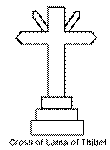
Christianity itself, the "cross ." The Cross:
It is well known that the first symbol of
Christianity was that of a fish . On sacramental cups, seals, and lamps
the Holy Spirit was symbolized by a dove and Christ by a fish (perhaps
because at the time, fish was one of the elements of the sacred meal) or
by a shepherd carrying a sheep on his shoulders
The ancient Egyptians also adopted the
cross as a religious symbol of their pagan gods. Countless Egyptian
drawings depict themselves holding crosses in their hands. Among them,
the Egyptian savior Horus is depicted holding a cross in his hand. He is
also depicted as an infant sitting on his mother's knee with a cross on
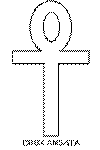
the seat they occupy. The most common of the crosses used by these pagan
Egyptians, the CRUX ANSATA, was later adopted by the Christians.
The Egyptian savior,
Osiris , the Egyptian god of the dead and the underworld, is sometimes
represented holding out this cross to mortals signifying that this
person has discarded mortality for the life to come. Another cross has been unearthed in
Ireland. It belongs to the cult of the Persian god of the sun "Mithra-Mithra-->"
and bears a crucified effigy. The Greeks and Romans too adopted the
cross as their religious symbol many centuries before Christianity did
the same. An ancient inscription in Tessaly is accompanied by a Calvary
cross. More crosses can be found to adorn the tomb of king Midas in
Phrygia. The above references may be referred to for many more examples.
|
||||