|
Chapter
13: The miracle and challenge of the Qur'an
"W
e shall show them Our signs on the horizons and within
themselves until it will become clear to them that it is the
Truth. Does it not suffice that your Lord is Witness over
all things?"
The noble Qur'an,
Fussilat(41):53.
Muslims are taught that
throughout the ages, Allah Almighty has sent a prophet to
every nation as a warner and a bearer of glad tidings.
"Verily! We have sent
you (O Muhammad) with the Truth, a bearer of glad tidings
and a warner; and there is not a nation but a warner has
passed among them,"
The noble Qur'an, Fatir(35):24.
Each prophet was wisely
selected by Allah in order to be the best person for the
job. He was then provided by Allah with miracles as proof of
his truthfulness and his message. These miracles were wisely
selected by Allah in order to be in the same field as that
which these people excelled in so that they could fully
comprehend the magnitude of these miracles.
For instance, the people during
the time of Moses excelled at magical trickery. Their rulers
used to surround themselves with the most powerful of these
wizards as a sign of power. This is why Allah made the
miracles of Moses (pbuh) similar to their magical trickery
(changing a stick into a snake, parting of the sea... etc.)
but of a much greater magnitude than anything they could
ever hope to accomplish. For they were not tricks, but
actual physical miracles.
The people at the time of the
prophet Jesus (pbuh) excelled in matters of medicine. For
this reason, his miracles were of a medical nature (raising
of the dead, healing of the blind...etc.), but of a degree
that they could never hope to imitate. Similarly, one of the
major miracles of Islam was a new and unheard-of type of
literature similar to the Bedouin's poetry but far beyond
anything they could ever hope to match. Although they did
indeed try. This new literature was called "The Qur'an."
The Arabic language, as can be
attested to by any of it's scholars, is a very rich and
powerful language. The Bedouin people of the Arabian desert
were, in general, illiterate people of very little
scientific knowledge. The thing that set them apart,
however, was their mastery of poetry . Spending their days
as they did in the desert watching their sheep graze got
quite boring. They alleviated their boredom by continually
composing and refining poetry. They would spend entire years
composing and refining their poetry in anticipation of a
yearly face-down of the poetic compositions of their peers
from all over the country. The fact that they were
illiterate forced them to also train themselves in the
memorization of works of literature to such an extent that
they were able to memorize complete works from a single
recitation. Even in matters of leadership, one of the major
criteria for selecting the leaders of the various Bedouin
tribes was the individual's prowess in literary composition
and memorization.
The Arabian Bedouins took great
pains to make their poetry as compact and picturesque as
humanly possible, constantly expanding the language along
the way. A single word could convey complete pictures. The
Qur'an, however, has put even these great efforts to shame.
You will notice that when a Muslim translates a verse of the
Qur'an he usually does not say "the Qur'an says so and
so" but rather "An approximation of the meaning of
what the Qur'an says is so and so." You really need to
know the language to comprehend this.
In the English language, we
find that the words: "mustang," "colt,"
"mare," "pony," "stallion,"
"bronco"... etc. all refer to the same thing; a
horse. Each one of these words conveys a slightly different
mental picture. The mental picture we get when we hear the
word "colt" is slightly different than the picture
we get if we hear the word "mare." In a similar
manner, the Arabic language progressed in such a fashion as
to make it possible to convey such mental pictures in as
concise and picturesque a format as possible. It is not at
all uncommon to find over three hundred words that refer to
the same thing in the Arabic language. Each one of these
words gives a slightly different picture than the others.
Many centuries of this constant
refinement eventually lead to a very complex and rich
vocabulary, and the primary miracle of Muhammad (pbuh), the
Qur'an, was in exactly this field
In the noble Qur'an we find a
challenge from Allah to compose a literary work on a par
with this Qur'an it is indeed the work of mankind. They
could not. The Qur'an continued to reduce it's challenge
until the challenge finally became: "compose only a
single verse comparable to this Qur'an and you will have
won." They still could not. This in addition to the
fairness, justice, and logic of the Qur'an eventually won
them over and slowly more and more people became Muslims.
"Well then, if the
Koran were his own [Muhammad's] composition other men could
rival it. Let them produce ten verses like it. If they could
not (and it is obvious that they could not), then let them
accept the Koran as an outstanding evidential miracle"
Mohammedanism, H. A. R. Gibb,
Oxford University Press, p. 42
"From the literary
point of view, the Koran is regarded as a specimen of purest
Arabic, written in half poetry, half prose. It has been said
that in some cases grammarians have adopted their rules to
agree with certain expressions used in it, and though
several attempts have been made to produce a work equal to
it as far as elegant writing is concerned, none yet has
succeeded"
Glimpses
of the Noble Qur'an, Muhammad Azizullah, Crescent
Publications, pp. 104-105
"In making the present
attempt to improve on the performance of my predecessors,
and to produce something which might be accepted as echoing
however faintly the sublime rhetoric of the Arabic Koran, I
have been at pains to study the intricate and richly varied
rhythms which - apart from the message itself - constitute
the Koran's undeniable claim to rank amongst the greatest
literary masterpieces of mankind... This very characteristic
feature - 'that inimitable symphony,' as the believing
Pickthall described his Holy Book, 'the very sounds of which
move men to tears and ecstasy' - has been almost totally
ignored by previous translators; it is therefore not
surprising that what they have wrought sounds dull and flat
indeed in comparison with the splendidly decorated
original."
The Koran Interpreted, Arthur
J. Arberry, Oxford University Press, 1964, p. x.
"The Koran admittedly
occupies an important position among the great religious
books of the world. Though the youngest of the epoch-making
works belonging to this class of literature, it yields to
hardly any in the wonderful effect which it has produced on
large masses of men. It has created an all but new phase of
human thought and a fresh type of character. It first
transformed a number of heterogeneous desert tribes of the
Arabian peninsula into a nation of heroes, and then
proceeded to create the vast politico-religious
organizations of the Muhammadan world which are one of the
great forces with which Europe and the East have to reckon
today."
G. Margoliouth, Introduction to
J.M. Rodwell's, The Koran, New York: Everyman's Library,
1977, p. vii.
"A work, then, which
calls forth so powerful and seemingly incompatible emotions
even in the distant reader - distant as to time, and still
more so as a mental development - a work which not only
conquers the repugnance which he may begin its perusal, but
changes this adverse feeling into astonishment and
admiration, such a work must be a wonderful production of
the human mind indeed and a problem of the highest interest
to every thoughtful observer of the destinies of mankind …
Here, therefore, its merits as a literary production should
perhaps not be measured by some preconceived maxims of
subjective and aesthetic taste, but by the effects which it
produced in Muhammad's contemporaries and fellow countrymen.
If it spoke so powerfully and convincingly to the hearts of
his hearers as to weld hitherto centrifugal and antagonistic
elements into one compact and well-organized body, animated
by ideas far beyond those which had until now ruled the
Arabian mind, then its eloquence was perfect, simply because
it created a civilized nation out of savage tribes, and shot
a fresh woof into the old warp of history."
Dr. Steingass, quoted in T.P.
Hughes' Dictionary Of Islam, p. 526-528.
Many claims have been made
against Muhammad in that day and this. Among them are the
claims that he was a lunatic, a liar, or deceived by the
devil. If Muhammad was a lunatic or a liar then we have to
wonder how all of his prophesies came true?. Further, if he
was a deceived by Satan then we are faced with another
problem. For we know that all Muslims are taught that when
reading the Qur'an they must first begin with the words "I
seek refuge in Allah from Satan the stoned*
one." and then follow this up with the words "In
the name of Allah, Most Compassionate, Most Merciful"
So we have to wonder if Satan would "inspire" a
man to teach mankind to seek refuge in God from Satan?
Indeed this is the exact same accusation which was made
against Jesus (pbuh). Let us read how Jesus responded to
this claim:
"But some of them (the
Jews) said, He (Jesus) casteth out devils through Beelzebub
(Satan) the chief of the devils. And others, tempting [him],
sought of him a sign from heaven. But he, knowing their
thoughts, said unto them, Every kingdom divided against
itself is brought to desolation; and a house [divided]
against a house falleth. If Satan also be divided against
himself, how shall his kingdom stand? because ye say that I
cast out devils through Beelzebub."
Luke 11:15-18
It has been the case throughout
the ages that with all previous prophets, their miracle was
separate from their book. Although we may claim that we have
the "Torah" of Moses, still, it is not possible
now to bring Moses ' (pbuh) staff and see it perform
miracles as it did in his time. Similarly it is not possible
today to see Jesus (pbuh) raise the dead as he did so many
centuries ago. However, since the message of Islam was the
final message of God to mankind, therefore, the book of
Islam itself was made the main miracle of Islam and it has
continued to renew it's challenge to mankind throughout the
ages.
What does this mean? Nowadays,
the number of people who can appreciate the literary content
of the Qur'an has dwindled and this challenge no longer has
the same impact it did fourteen hundred years ago. However,
as we have seen in the verse quoted at the beginning of this
chapter, Allah Almighty has promised to continually renew
the challenge of the Qur'an throughout the ages. So how will
it be renewed?
Recently, a new field of study
has opened up to scholars. People nowadays are fascinated
with science. This is the age of technology and scientific
discovery. For this reason, mankind has begun to study the
religious scriptures of mankind from a scientific point of
view in order to challenge the scientific claims made in
these scriptures. Many works have been published on this
topic. In this chapter I will give a brief taste of these
matters and then leave it up to the interested reader to
learn more from any one of the many books which have been
published in this regard (see list at back of this book).
As mentioned previously,
Muhammad (pbuh) lived among tribes of people who were for
the most part illiterate. He himself was also illiterate.
These people used to live extremely simple lives. Some were
traders and businessmen, others were farmers, and yet others
were nomadic sheepherders who traveled from place to place
depending on where they could find grass for their sheep to
graze. When Muhammad (pbuh) brought them the Qur'an, the
believers found in the Qur'an the command to go out, seek
knowledge, and confirm the presence of their Creator by
studying His creation. Muslims began to fulfill this command
of the Qur'an and this resulted in one of the greatest
explosions of scientific advancement mankind has ever seen.
All of this was going on during a period that the West calls
"The Dark Ages ," wherein the scientists of the
West were being persecuted and killed as sorcerers and
wizards. During this period, Muslims scholars introduced
into the world such things as:
* Mathematical evolution of
spherical mirrors
* Rectilinear motion of light
and use of lenses
* Refraction angle variations
* Magnifying effects of the
plano convex lens
* Introduced the concept of the
elliptical shape of cosmological bodies
* Study of the center of
gravity as applied to balance
* Measurement of specific
weights of bodies
* Rule of algebraic equations
* Solutions to quadratic and
cubic equations
* Work on square roots,
squares, theory of numbers, solution of the fractional
numbers
* Solutions of equations of
cubic order
* Wrote on conic geometry
elaborating the solution of algebraic equations
* Determined the Trinomial
Equation
* Avicenna's "Canon of
Medicine." He is know as the Prince of Physicians to
the West
* Wrote the first description
of several drugs and diseases as meningitis.
* Treatment of physiological
shocks
* Expertise in psychosomatic
medicine and psychology
* Al-Biruni mentions fifty six
manuscripts on pharmacology
* Credited for identifying
small pox and its treatment
* Use of alcohol as an
antiseptic
* Use of mercury as a purgative
for the first time
* First to describe the
circulation of blood.
* "Holy Abbas" was,
after Rhazes, the most outstanding Physician. His works were
authoritative till the works of ibn Sina appeared
* Writings on Cosmology,
Astrology, Science of numbers and letters
* Proved that the earth is
smaller than the sun but larger than the moon.
* Final authorities on
Chemistry for many Centuries
* Classified metals into three
classifications
* Laid the basis of the Acid
Base theory
* Distillation, calcination,
crystallization, the discovery of many acids
* Cultivation of Gold - is a
continuation of Jabir's work
* Theory of Oscillatory motion
of equinoxes
* Addition of ninth sphere to
the eight Ptolematic astronomy
* Discovered the increase of
the suns apogee
* Gravitational force
* Responsible for the discovery
motion of the solar apsides
* wrote ' On the Science of
Stars '
* Determination of latitudes
and longitudes
* Determination of geodetic
measurements
* Described the motion of the
planets
* Solved the problems of
spherical trigonometry
* First to study the isometric
oscillatory motion of a pendulum
* Invented the instrument '
Sahifah "
* Responsible for the proof of
the motion of the apogee of the sun with respect to the
fixed stars.
* authorities on the theory of
the system of homocentric spheres
* Prepared a calendar that was
more accurate than the Gregorian one in use today.
...............and much, much
more.
All of this began with a single
illiterate Arab from the desert fourteen hundred years ago.
The book that was brought into the world by such a man cries
out to be studied from a scientific aspect. We will now give
you a glimpse of the results:
"So
ask the People of Knowledge if you do not know"
The
Qur'an, Al-Anbia(21):7
Example Number 1:
Embryology:
Dr. Keith L. Moore is a
Professor of Anatomy and Cell Biology, University of
Toronto, Toronto, Canada. He is a world renowned scientist
and a distinguished researcher in the fields of anatomy and
embryology, he has published more than 150 research
articles, chapters and books in this field. He is the author
of several medical textbooks, such as the widely used and
acclaimed "The Developing Human: Clinically oriented
Embryology " (now in it's fifth edition, and translated
into eight different languages), "Before We Are
Born" and "Clinically Oriented Anatomy." He
has also recently co-authored "Qur'an and Modern
Science, Correlation Studies." Dr. Moore is the
recipient of numerous awards and honors, including, in 1984,
the J.C.B. Grant Award, which is the highest honor granted
by the Canadian Association of Anatomists. He has served in
many academic and administrative positions, including the
President of the Canadian Association of Anatomists,
1968-1970. Let us see what Dr. Moore's opinion is on the
scientific statements regarding embryology to be found in
the Qur'an:
Dr. Moore was contacted by a
Muslim scholar by the name of Abdul-Majeed Azzindani. He was
asked to participate in a three-year study of around
twenty-five verses of the Qur'an and the Sunnah (sayings of
Muhammad, pbuh) which speak about embryology, and to
determine the their correspondence to modern scientific
discoveries. Dr. Moore's conclusion regarding this matter
was:
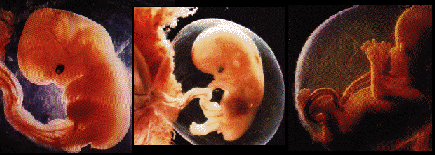
Fig.
12 The human fetus in various stages of
development,
at six, eight and 14 weeks
"For the past three
years, I have worked with the Embryology Committee of King
Abdulaziz University in Jeddah, Saudi Arabia, helping them
to interpret the many statements in the Qur'an and the
Sunnah referring to human reproduction and prenatal
development. At first I was astonished by the accuracy of
the statements that were recorded in the seventh century AD,
before the science of embryology was established. Although I
was aware of the glorious history of Muslim scientists in
the 10th century AD, and of some of their contributions to
Medicine, I new nothing about the religious facts and
beliefs contained in the Qur'an and Sunnah. It is important
for Islamic and other students to understand the meaning of
these Qur'anic statements about human development, based on
current scientific knowledge. The interpretations of the
"verses" in the Qur'an and the Sunnah, translated
by Shaikh Azzindani, are to the best of my knowledge
accurate."
From the forward of "The
Developing Human: Clinically oriented Embryology,"
third edition, by Dr. Keith L. Moore .
The Qur'an and the Sunnah of
the prophet Muhammad (pbuh) provide a very detailed
description of the microscopic development of the human
embryo from a mere sperm drop up to the stage of a
completely formed human being. It is well known that
microscopes were not developed until the sixteenth century
AD, and even at that were very crude in design. Zacharias
Janssen is credited with having invented the compound
microscope in about 1590. With it, remarkable scientific
discoveries were made in the 17th and 18th centuries. The
Dutch naturalist Anthony van Leeuwenhoek produced lenses
powerful enough to prove that many tiny creatures are not
spontaneously generated but come from eggs.
Before this period, theories on
human reproduction ran rampant. Some scientist believed that
the menstrual blood itself developed into the fetus. Later
on, a new theory was developed wherein the sperm drop was
popularly believed to contain a completely developed
miniature human (homunculus) which later grew to the size of
a baby. The science of embryology as we know it today did
not discover many of the detailed aspects of human
development which are taken for granted today until only
about twenty years ago, or 1973 to be precise.
Now we must ask the question:
where did Muhammad (pbuh) get such detailed knowledge of the
microscopic development of the human embryo in the 6th
century AD without a microscope, technical training, a
laboratory of any kind, or even the ability to write his own
name? The only logical conclusion is that it came from
exactly where he claimed it did. From the one who created
mankind, God Almighty!
Prof. Moore has since given
numerous lectures on the topic of embryology in the Qur'an.
He is quoted in one of these lectures as saying:
"It is clear to me that
these statements must have come to Muhammad from God, or
Allah, because most of this knowledge was not discovered
until many centuries later. This proves to me that Muhammad
must have been a messenger of God, or Allah."
Prof. Moore was so impressed
with the Qur'anic classification of the stages of
development of the human embryo, that he suggested the
adoption of the Qur'anic system in place of the system
currently in use by scientists today. Prof. Moore said:
"Because the staging of
the human embryo is complex owing to the continuous process
of change during development. It is therefore suggested that
a new system of classification could be developed using the
terms mentioned in the Qur'an and the Sunnah. The proposed
system is simple, comprehensive, and conforms with present
embryological knowledge."
When Dr. Moore first presented
his findings in Toronto it caused quite a stir throughout
Canada. It was on the front pages of some of the newspapers
across Canada. One newspaper reporter asked Professor Moore,
"Don't you think That
maybe the Arabs might have known about these things - the
description of the embryo, its appearance and how it changes
and grows? Maybe there were not scientists, but maybe they
did some crude dissections on their own - carved up people
and examined these things."
Professor Morre immediately
pointed out to him, however, that he had missed a very
important point. All of the slides of the embryo that Dr.
Moore had based his study upon had come from pictures taken
through a microscope. He said,
"It does not matter if
someone had tried to discover embryology fourteen centuries
ago, they could not have seen it!."
Dr. Moore taunted, "Maybe fourteen centuries ago
someone secretly had a microscope and did this research,
making no mistakes anywhere. Then he somehow taught Muhammad
and convinced him to put this information in his book. Then
he destroyed his equipment and kept it a secret forever?. Do
you believe that? You really should not unless you bring
some proof because it is such a ridiculous theory."
When
he was asked "How do you explain this information in
the Qur'an?" Dr. Moore's reply was, "It
could only have been divinely revealed."
Example Number 2: The
Universe:
Another example of such
scientifically accurate statements in the Qur'an can be
found in the following analysis:
"And the firmament(sky)
We constructed with power and skill and verily We are
expanding it"
The noble Qur'an,
Al-Thariyaat(51):47.
(Remember: "we" is
the Arabic plural of respect , not the Christian plural of
"Trinity, " as seen in chapter 14).
"Do not the
disbelievers see that the heavens and the earth were fused
then We ripped them asunder, and We created from water every
living thing, do they not believe?"
The noble Qur'an,
Al-Anbia(21):30.
"Then He
settled/equilibrated unto the firmament(sky) when it was
smoke and said unto it and to the earth: come willingly or
unwillingly. They said: we come willingly"
The noble Qur'an,
Fussilat(41):11.
Allah Almighty has in these
three concise verses answered questions that it has taken
some of the greatest physicists and astronomers of history
centuries to answer. It was only in this century that they
finally found the truth.
Mankind has studied the heavens
and the earth for countless centuries. The Greeks were some
of the first people to attempt to describe various
cosmological phenomena. They gave us many of the very first
theories regarding the universe and it's composition. The
major contribution came with the writings of Plato . Plato
claimed that the universe was created by what he called
"The Demiurge." According to Plato, the universe
was the result of reasoning and planning, it was constructed
by the Demiurge upon precise mathematical and geometrical
principles. Later on, Aristotle, Plato's student, adopted
his teacher's basic concept. Aristotelian cosmology was
based on the concept of an enclosed cosmos comprising a
series of concentric, spheres revolving around a stationary
Earth. Motion was provided by the "prime mover"
and, once initiated, would remain circular, uniform and
eternal.
Both Plato and Aristotle taught
that the universe was eternal, with neither beginning nor
end. The universe as a whole was considered steady and
unmoving, and this was the basis for the later formation of
the "steady state theory." In 1915, Albert
Einstein had published the famous general theory of
relativity. Soon afterward he proposed a static model of the
universe, but he would later declare that it was "one
of the greatest mistakes of my career." Why?,
Because in 1925, Edwin Hubble (after whom the Hubble Space
telescope is named) provided the observational evidence for
the expansion of the universe, or as Stephen Hawking put it "The
universe is not static, as had previously been thought, it
was expanding."
Although mankind did not
discover these facts till this 20th Century, still, we find
that Allah Almighty had provided the answers for mankind
1400 years ago in the Qur'an through the agency of His
illiterate Prophet Muhammad (pbuh). During Muhammad's (pbuh)
time, the Greeks were claiming that the cosmos was static
and not expanding. So how did he know that the universe was
expanding 1300 years before the foremost scientist of the
West proved this to be a scientific fact?
However, this is not the only
claim that the Qur'an makes with regard to the universe .
Let us study the next two verses:
At the present time, the Big
Bang theory of the origin of the universe is the
cosmological model most widely accepted by astronomers. It
holds that about 20,000,000,000 years ago the universe began
with the explosive expansion of a single, extremely
condensed state of matter ("the heavens and the
earth were fused then we ripped them asunder"). As
mentioned above, a further development of this model, known
as "inflationary theory," describes the
original condensed matter as arising from virtually empty
space. It was only after the development of radio telescopes
in 1937 AD that the necessary observational precision was
achieved in order for astronomers to arrive at the above
conclusion. Out of the observations of such scientists has
arisen the so called "Hubble Constant" (Ho) which
is quantity currently used to gauge the rate at which
the universe is expanding. In other words, the issue is no
longer whether the universe is expanding or not, rather, it
is only a question of how fast it is expanding.
The second and third verses
presented appear to claim that the heavens and the earth
were once a single mass then were "ripped
asunder," The exact root words used in the Qur'an are
the words "ra-ta-qa" and "fa-ta-qa," or "the
heavens and the earth were 'ra-ta-qa' then we 'fa-ta-qa'
them"
"Ra-ta-qa"
is an Arabic word which has the general meaning of "to
fuse, to sew, to mend, to patch up, to repair." ("Lisan
Al-Arab," by Ibn Mandoor, Vol. 10, Dar Al-Fikr, p. 114,
and also "A Dictionary of Modern Written Arabic,"
Hans Wehr, Librairie du Liban, p. 325)
Similarly, "fa-ta-qa"
has the general meaning of "To rip, to undo sewing, to
unstitch, to tear apart, to rend, to rip open." ("Lisan
Al-Arab," by Ibn Mandoor, Vol. 10, Dar Al-Fikr, p. 296,
and also "A Dictionary of Modern Written Arabic,"
Hans Wehr, Librairie du Liban, p. 695)
The verse then goes on to say
that Allah Almighty created the heavens and the earth from a
celestial "smoke." Astronomers today have pictures
of galaxies being formed by exactly this process, i.e. the
condensation of spiraling celestial "mists." Isn't
it an incredible coincidence that an illiterate man from the
desert, without the aid of observatories or satellite
imaging was making these claims over 1400 years ago?. Was he
just guessing?
Further,
the cosmic phenomenon depicted in the following two figures
is commonly referred to by astronomists as a cosmic
"mist." However, if we were to read the second
verse of the Qur'an presented above we will find that the
Qur'an more accurately refers to it as a "smoke."
This is because "mist" implies a cool and tranquil
spray of water. However, "smoke" implies a hot gas
containing airborne particles. This is indeed another
example of the literary miracle of the Qur'an in that it
manages to convey to us in a very concise language a very
accurate and detailed description of the topic at hand.
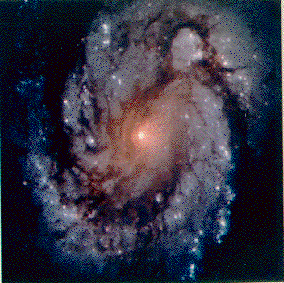
Fig.
13 The Spiral Galaxy M100 courtesy of the Hubble Space
Telescope
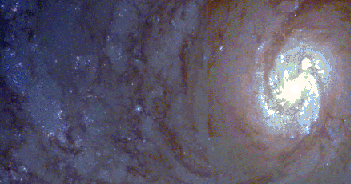
Fig.
14 M100 again. The distance to the swirling grand design
spiral M100 is causing quite a stir among astronomers. Many
believe that the Hubble Space Telescope's recent distance
measurement to this galaxy accurately calibrates the
"Hubble's constant." A scientific debate involving
the actual value of Hubble's constant titled "The Scale
of the Universe" is scheduled to occur in April 1996 in
Washington, DC.
"And
those who have been given knowledge know that that which has
been revealed to you from your Lord is the Truth"
The
noble Qur'an, Saba(34):6
"Do
they not consider the Qur'an (with care) or are there locks
upon their hearts?"
The
noble Qur'an, Muhammad(47):24
Example Number 3: Water and
Life:
In the Qur'an we read:
"Do not the
disbelievers see that the heavens and the earth were joined
together then we split them asunder, and we created from
water every living thing, do they not believe?"
The noble Qur'an,
Al-Anbia(21):30.
"And Allah has created
every trodding creature from water......"
The noble Qur'an,
Al-Noor(24):45.
"It is He who created
from water a human...."
The noble Qur'an,
Al-Furqan(25):54.
Water is the most common
substance on Earth, covering more than 70% of the planet's
surface. All living things consist mostly of water; for
example, the human body is about two-thirds water (when you
cremate a human what happens to him? Why?). Scientist tell
us that all forms of life known to humanity today require
three basic conditions: Temperature, the existence of water,
and the existence of an atmosphere.
All metabolisms require water
to survive, so animals that exist in arid regions have body
mechanisms that protect against water loss and make maximum
use of water (camels for example). Dehydration in humans
results from lack of food, drink, and from sweating, in
addition to other factors. This loss eventually affects the
proper functioning of the heart, central nervous system, and
organs containing smooth muscle. Finally, intercellular
water is lost, which upsets vital chemical processes in the
cells. If water is not restored to the body, death will
usually occur within a few days.
The
blood of all living creatures is composed of 55 percent
plasma, which in turn is composed of more than 90 percent
water. Jan Baptista van Helmont, the first experimental
physiologist, around 1640 AD concluded that water is the
only soil component required for plant growth. We could go
on and on. Again we find ourselves asking the question: How
did Muhammad (pbuh) know that all living creatures are
created from water centuries before mankind discovered this
fact through scientific experimentation? Did he randomly
select an element from the countless billions of possible
choices? Why did he not claim that mankind was created from
air, or from wood, or from light? Why water?
Example Number 4: Deep sea
currents:
In the Qur'an we read:
"Or as darkness on a
vast, abysmal sea. There covers it a wave, above which is a
wave, above which is a cloud. Layer upon layer of
darkness."
The noble Qur'an,
Al-Noor(24):40.
Mankind began to build
submersibles in the seventeenth century. The first crude
craft known to have ventured underwater was built by
Cornelis Drebbel, court engineer to James I of England, and
was demonstrated on the Thames river in 1620. From then
onwards, development of submarines continued until the
twentieth century, or 1954 to be exact, when the first
nuclear submarine became a reality. With mankind's study of
the sea came the realization that the waters lying
underneath the surface waves were not the place of tranquil
calmness they were previously envisioned to be. Rather,
there were underwater currents called deep sea currents
which could at times become such violent storms as to
rearrange sediments in the ocean bottom. How did Muhammad
(pbuh) know about these underwater currents centuries before
mankind invented the tools necessary for underwater
exploration?
"Say: It was sent down
by He who knows the secrets in the heavens and the
earth."
The noble Qur'an,
Al-Furqaan(25):6.
It is worth mentioning here in
connection with the above verse that some scientists have
interpreted the "layer upon layer of darkness"
to be the gradual separation of the light spectrum within
the ocean, one color at a time until complete darkness is
finally achieved. In other words, at one depth, the yellow
bandwidth is suppressed and "yellow darkness" is
achieved. At another depth, the red bandwidth is suppressed
and "red darkness" is achieved, and so forth.
There are many other scientific
statements made in the Qur'an which were only discovered to
be scientifically accurate many centuries after Muhammad's
death. Many of them have only been discovered in this
century. They range over many fields of science including
Anatomy, Chemistry, Astronomy, Geology, Hydrology, and many
other disciplines which are only beginning to be addressed
by scientists today.
For example, the Qur'an makes
reference to the fact that a human's pain receptors are
located in the skin (Al-Nissa(4):56). That the frontal lobes
of the brain are responsible for lying and sin
(Al-Alak(96):16). That mountains have below them roots that
extend deep into the earth's surface (Al-Naba(78):7). That
mountains pin the earth's crust and prevent it from moving
(Al-Nahil(16):15). That there exists a physical barrier
between bodies of fresh and salt water (Al-Rahman (55):20).
There is also information regarding the formation of milk in
cows (Al-Nahi(16):66). And on and on. So where was Muhammad
(pbuh) getting all of these scientific facts if not from the
Creator of mankind and the universe ? Allah Almighty askes:
"Is
this sorcery or is it that you do not see?"
The
noble Qur'an, Al-Tur (52):15.
Prof. Keith Moore is not the
only scholar who has been presented with such verses of the
Qur'an. Many other scholars from all over the world have
been presented with similar statements from the Qur'an in
their field of expertise. Only a few of these people are:
1) Dr. E. Marshall Johnson,
Professor and Chairman of the Department of Anatomy and
Developmental Biology, and the Director of the Daniel Baugh
Institute, Thomas Jefferson University, Philadelphia, USA.
Author of over 200 publications. Former President of the
Teratology Society among other accomplishments. After
studying the verses of the Qur'an he came to the following
conclusion:
"The Qur'an describes
not only the development of external form but emphasizes
also the internal stages - the stages inside the embryo of
its creation and development, emphasizing major events
recognized by contemporary science... If I was to transpose
myself into that era, knowing what I do today and describing
things, I could not describe the things that were
described... I see no evidence to refute the concept that
this individual Muhammad had to be developing this
information from some place... so I see nothing in conflict
with the concept that divine intervention was
involved..."
2) Dr. Joe Leigh Simpson.
Professor and Chairman of the Department of Obstetrics and
Gynecology at Baylor Collage of Medicine, Houston, Texas. He
is the President of the American Fertility Society, and has
served in many other professional, national, and
international organizations. He has received numerous awards
including Association of Professors of Obstetrics and
Gynecology Public Recognition Award in 1992. He has
published more than 400 chapters and articles in journals
and books. He says:
"... these Hadeeths
(sayings of Muhammad) could not have been obtained on the
basis of the scientific knowledge that was available at the
time of the writer'... It follows that not only is there no
conflict between genetics and religion (Islam) but in fact
religion (Islam) may guide science by adding revelation to
some of the traditional scientific approaches... There exist
statements in the Qur'an shown centuries later to be valid
which support knowledge in the Qur'an having been derived
from God."
3) Dr. T.V.N. Persaud.
Professor and Head of the Department of Anatomy, Professor
of Pediatrics and Child Health, and Associate Professor of
Obstetrics, Gynecology and Reproductive Sciences, University
of Manitoba, Winnipeg, Manitoba, Canada. He is the author
and editor of 25 books, has contributed 31 chapters to
publications, and has published over 180 scientific papers.
In 1991 he received the most distinguished award presented
in the field of anatomy in Canada, the J.C.B. Grant Award
from the Canadian Association of Anatomists. He says:
"Muhammad was a very
ordinary man, he couldn't read, didn't know how to write, in
fact he was an illiterate... were talking about 1400 years
ago, you have some illiterate person making profound
statements that are amazingly accurate, of a scientific
nature... I personally can't see how this could be mere
chance, there are too many accuracies and like Dr. Moore, I
have no difficulty in my mind reconciling that this is a
divine inspiration or revelation which lead him to these
statements."
4) After a study which lasted
ten years, the famous French physician Maurice Bucaille
addressed the French Academy of Medicine in 1976 and
expressed the complete agreement of the Qur'an and
established findings of modern science. He presented his
study on the existence in the Qur'an of certain statements
concerning physiology and reproduction. His reason for doing
that was that
"our knowledge of these
disciplines is such, that it is impossible to explain how a
text produced at the time of the Qur'an could have contained
ideas that have only been discovered in modern times."
5) Dr. Tejatet Tejasen, Head of
the Department of Anatomy, Faculty of Medicine, University
of Chiang Mai, Thailand. After his study on the Qur'an
passages dealing with embryology:
"From my studies and
what I have learnt at this conference I believe that
everything that has been recorded in the Qur'an 1400 years
ago must be true. That can be proved the scientific
way."
Others include:
6) Dr. Gerald C. Goeringer.
Professor and Coordinator of Medical Embryology in the
Department of Cell Biology in the Georgetown University
school of Medicine. Washington, D.C. He has published
numerous articles dealing mainly with the study of
teratogenesis.
7) Dr. Alfred Kroner, Professor
of Geology, Germany.
8) Dr. Yoshiodi Kozan, Director
of the observatory of Tokyo, Japan.
9) Dr. William Hay, Professor
of Oceanography, University of Colorado, Boulder, Colorado.
10) Dr. Pete Palmer, Professor
of Geology, University of Colorado, Boulder, Colorado.
11) Dr. Sayawida, Professor of
Marine Geology, Japan.
12) Dr. Armstrong, Professor of
Astronomy, University of Kansas, Lawrence, Kansas.
13) Dr. Draga Persaud Rauw,
Professor of Marine Geology, King Abdulaziz University,
Jeddah, Saudi Arabia
14)
Dr. Schroeder, Professor of Oceanography, Germany.
The response of these scholars
when presented with verses of the Qur'an in their field of
specialization, varied. One thing however was always
constant. They all confirmed the accuracy of the scientific
statements made in the Qur'an, and they all could not
explain how Muhammad (pbuh) could have known with such
accuracy the scientific claims to be found in the Qur'an so
many centuries before mankind discovered them to be
scientific truths.
Allah Almighty tells us in the
Qur'an:
"Allah
did not create (all) that except in truth. He details the
signs for people of knowledge."
The
noble Qur'an, Yunus(10):5
"And
those who were given knowledge see that which was sent down
upon you by your Lord is the truth and guides to the path of
the 'Exalted' (in Might) the 'worthy of all praise'."
The
noble Qur'an, Saba(34):6.
"Had We sent down this
Qur'an upon a mountain, you would surely have seen it
humbling itself and rending asunder for fear of Allah. Such
are the parables We put forth for mankind that they may
reflect."
The noble Qur'an,
Al-Hashr(59):21
"Verily! this Qur'an
guides to that which is most upright, and gives glad tidings
to the believers who work deeds of righteousness that theirs
will be a great reward"
The noble Qur'an, Al-Isra(17):9
"And We have indeed
simplified [the comprehension of] this Qur'an for
remembrance, so is there any that will remember [and be
admonished]?"
The
noble Qur'an, Al-Qamar(54):17
To obtain a more in-depth
analysis of these matters including video tapes containing
interviews with many of these pioneering Western scholars,
contact one of the following (ask for the video tape titled "It
is the Truth"):
1) Islamic Academy for
Scientific Research.
8150 West 111 Street
Palos Hills, IL 60465
U.S.A.
Phone: (708) 974-9151
2) Islamic Society of North
America (ISNA)
P.O. Box 38
Plainfield, Indiana, 46168
U.S.A.
Phone: (317) 839-8157
3) Academy for the Miracles of
Science in the Qur'an and the Sunnah
P.O. Box 5736
Makkah Al-Mukarramah
Saudi Arabia
Phone: (2) 545-1519
Also look for the books:
- "The Bible, the
Qur'an and Science," by Dr. Maurice Bucaille
- "The Qur'an and
Modern Science," by Dr. Maurice Bucaille
- "An Introduction
to Understanding the Qur'an," by Syed Abdul A'ala
Maudoodi
- "The Sources of
the Qur'an: A Critical Review of the Authorship
Theories," by Hamza Mustafa Njozi
- "Muhammad's
Prophethood: An Analytical View," by Dr. Jamal
Badawi
|