| THE COURTS
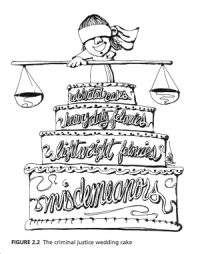
Despite very low clearance rates, there are several million arrests each year in the US which are sent to the courts for judicial processing. Most of these arrests involve petty offenses by poor people. The legal definitions of crimes are not much help in understanding what happens to criminal cases in the courts because formal law doesn't take into account the common sense differences between legally-similar cases and differing local perspectives on crime and offenders. The Wedding Cake Model of Crime The Wedding Cake Model is a "common sense" model that describes how the system actually works based on a research-driven understanding of the "courtroom work group" (people who work together in a courthouse on a day-to-day basis - prosecutors, defense attorneys, judges, probation officers, etc.) and "courthouse culture" - ways of "doing justice" developed by the work group - �doing justice� means trying to be fair and reasonable in disposing of a huge number of cases regardless of what the �letter of the law� might call for. At the top of the wedding cake are �celebrated� (highly publicized) cases, a tiny proportion of cases that attract a lot of publicity (OJ Simpson, Michael Jackson, Scott Peterson, Phil Specter, Paris Hilton, Court TV cases, etc.). Since they are highly visible and the public is watching, these cases usually highlight the way the legal system is �supposed to work� - fundamental issues are contested, and drama and suspense are often involved. But these cases also lead to misunderstandings of the legal system - for example, private attorneys and trials are very rare in the legal system because few people can afford lawyers and the system can�t afford very many trials. Trials in these cases are sometimes called �show trials� because of the elaborate and complex rituals involved. At the bottom of the wedding cake are misdemeanors, which constitute the vast majority of arrests (DUI, public drunkenness, fighting and domestic disputes,, vagrancy/homelessness, etc.). The legal system is typically very informal and traditionally fairly lenient with these cases - the process itself is usually the punishment - lost days of work, fines, court costs, a few days in jail, etc. The second and third layers, serious felonies and less serious felonies, are what we are mostly interested in here. Felonies are potentially the most serious kinds of crimes (robberies, burglaries, murders, assaults, etc.) and typically involve serious jail time (usually up to a year) and/or prison sentences (more than a year) upon conviction. In courthouse culture, three factors generally separate these two felony levels: 1. The circumstances of the crime - damage, injury or threats, use of a weapon, etc. 2. The prior record of the offender � no prior record often leads to lenient treatment, a prior record is usually taken as an indication of future offending. 3. Relationship between offender and victim (e.g., stranger vs. non-stranger) � stranger crimes are usually regarded as more serious than acquaintance crimes. Courtroom work group/Courthouse culture & "doing justice" The system is generally harsh toward second layer offenders � in courthouse culture these are the "real criminals" or �bad guys� � they deserve punishment and society deserves to be protected from them. The system is generally lenient toward third layer offenders - discretion is often used to moderate punishment (probation, suspended sentences, etc.) � in courthouse culture these offenders are regarded more as �losers� than as criminals, and thus don�t deserve as much punishment and don�t pose much of a threat to society. Some implications of the Wedding Cake Model: Public misunderstanding of crime � because of media distortions (TV shows, etc.) the public tends to stereotype �criminals� as vicious and cunning psychopaths, while in reality most felony arrests are for petty offenses by not-very-bright �losers� � the public misunderstands the differences between the second and (much larger) third layers. "Get tough on crime" policies are promoted for votes by opportunistic politicians who misrepresent the lenient treatment for third layer offenders as being �soft on crime� by �liberal� courts. These �get tough� policies tend to be resisted by the courts and when they are imposed they lead to unjust, ineffective, and expensive punishment of third layer offenders. The third layer is the source of most discrimination in the system � these are the cases where discretion is most likely to be exercised by white middle class lawyers dealing with young, poor, disproportionately minority offenders, and �institutional discrimination� is one result of this. Misunderstanding of plea bargaining � plea bargaining is used to sort out the serious and less serious offenders for appropriate punishment (from the point of view of the courtroom work group). Politicians and the public see plea bargaining as part of the �liberal soft on crime� approach in the courts. Clearance rates tend to be lower for second layer than for third layer offenses (�losers� are not very good at crime either so they are more likely to get caught) � so there is an almost endless pool of poor people available for arrest and punishment. What criminologists study! �Losers� are much easier to study than are real �criminals� so most criminology research has focused on young poor petty offenders. Even homicides fit this model (publicized, high culpability, medium culpability, low culpability) and the model can thus help understand death sentencing, etc. The Legal Process and the �Dual System� Courts get who the police arrest and send - mostly male, young, poor, minority, petty offenders, with a few serious offenders mixed in. The process involves a "dual system": an adversary system (lawyers, trials, etc.) for the affluent, a bureaucratic system (public defenders and plea bargaining) for the poor. The key dividing line is the ability to pay for bail and a private lawyer (offenders usually can afford both or neither). Plea Bargaining is mainly assembly line �justice� for the poor, and focuses almost entirely on pressuring guilty pleas. Technically, the defendant pleads guilty to a lesser offense in exchange for a lesser sentence than the original charge and loss at trial � the defendant exchanges legal rights for lesser penalty. The main function of Public Defenders (PDs) is to convince defendants to plead guilty because there is little/no chance of acquittal at trial. How do prosecutors (ADA) and PDs decide what exchange is proper/fair/just/etc.? In order to make a "fair exchange" objects being exchanged must have an agreed value. "Normal Crimes" - thru experience over time working together, ADAs and PDs form ideas about typical ways most crimes are committed, types of persons committing crimes, typical victims of the crimes, typical circumstances in which the crimes occur, etc. These types in these places are "normal crimes" and are settled very quickly. Often the ADA and PD can tell from police reports what the outcome of a case will be. Key features of Normal Crimes (allow routine trade-offs and seen as �doing justice"): 1. Typifications are of types of crimes/offenders, not specific cases. 2. Legal definitions and technicalities of the offense are mostly irrelevant. 3. Typifications are community-specific (they differ somewhat in different jurisdictions and over time). 4. Normal crimes are those routinely encountered over and over in the jurisdiction (burglary, theft, etc.). 5. A key feature is ecological - where the crime happens is important (commercial, residential, poor neighborhoods, etc.). 6. Knowledge of normal crimes is a measure of competence in the courthouse culture. How do workers in the system deal with this? Most are middle class professionals who have been taught all their lives that the poor are the major source of criminals + the people they process look, act, and are different from themselves (mainly because of social class and race/ethnic differences) + the police have sent these particular people to the courts and it is not the fault of the courts that they mainly deal with poor people. So all of their experiences in the system support and reinforce what they already believe, and after all they are just doing their jobs. Finally, despite the fact that they recognize that the system doesn't work according to the ideals (mostly learned in law school) that it is supposedly based on (the "rule of law" and "due process"), they also can clearly see the practical reason for this - the overloaded and overburdened CJS. Summary: The main task of the criminal courts is to process (with some degree of "justice") the poor-young-male-petty �criminals� who get caught and can�t afford to �buy� their way back out of the system. Since the system is already "tough" on serious crime (second layer), when politicians (usually with public/media support) impose "get tough" policies on the system, the result is filling up prisons with more and more petty offenders ("dipping into the third layer" of the wedding cake) - which leads to disaster, the imprisonment binge, which is expensive, unjust, racist, and ineffective. Copyright � 2009 Ernie Thomson. All rights reserved. email: [email protected] |
 |